Now we have reached 2017, and that From Balloons to Drones has been up and running for around six months, it thought it would be worth posting our top five posts of 2016 based on views.
In second place is my research note on ‘Air Power and the Challenge of Professional Military Education’ that was based on my thoughts on an excellent conference at the Royal Military College of Canada in November. An important subject that I hope to return to in 2017.
In third is Brian Laslie’s commentary, ‘TheF-35 is here!’, which deals with some of the issues surrounding this program and the important role that training will play in developing the aircraft’s use.
In fourth, and timed in conjunction with the types eventually retirement for the United States Air Force, Mike Hankins provided a timely discussion of the development of the McDonnell F-4 Phantom II in his piece ‘Remembering the F-4 Phantom – Part 1: A Product of Its Time.’ The second part of this article can be found here.
Finally, but no means last, Alex Fitzgerald-Black’s research note ‘Operation HUSKY’s Air Battle by the Numbers’ provided a useful discussion of the importance of the air battles fought during the invasion of Sicily in 1943.
These are just a selection of the highlights of our half year in existence. We are keen to expand our list of contributors and if you are interested in writing about air power issues – both historical and contemporary – then you can find out how here. If you have any questions then please leave a comments here or emails us at airpowerstudies@gmail.com.
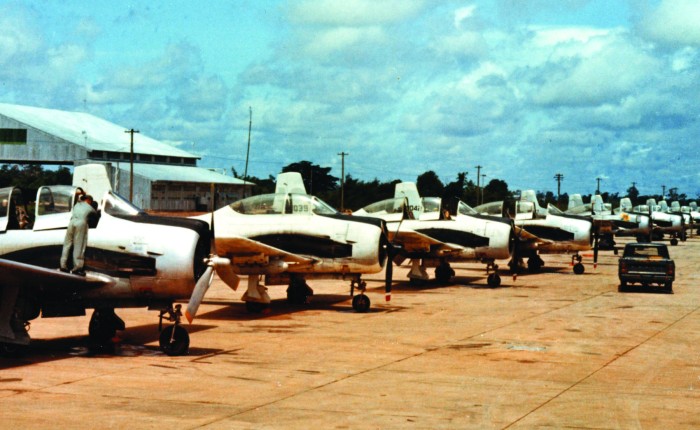
Header Image: A row of T-28s in Laos. (Source: USAF)
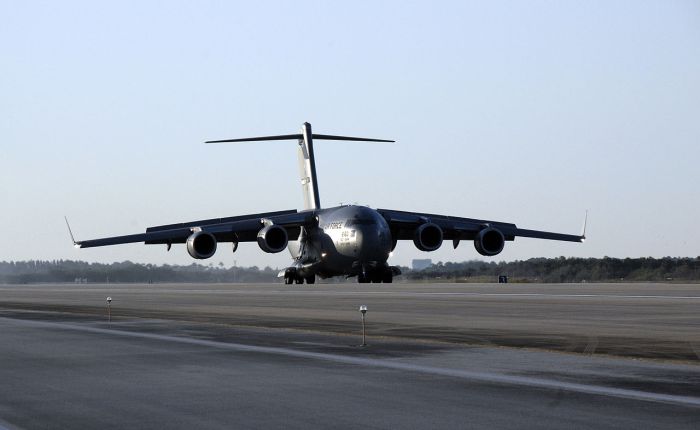
In airlift terms, the C-17A Globemaster III has arguably made the biggest single impact to Western Air Forces in the 21st Century thus far – and will likely hold this claim for the next decade. While it was conceived for the United States Air Force in the 1980s and introduced to service in the 1990s, its acquisition by nations including Canada, Australia, and the United Kingdom has given Western Air Forces its first real appreciation of modern strategic airlift. For the USAF, which arguably wrote the book on strategic military airlift, has also benefited significantly from the C-17A’s tactical airlift talents. Elsewhere, the aircraft has been capitalised upon by NATO, India, the UAE, Qatar, and Kuwait.
A big jet that can fly from little airfields (Source: RAAF)
With the production line closing in 2015, it is unlikely that we will ever see new Globemaster airframes constructed beyond the 279 that were delivered by McDonnell Douglas/Boeing (and indeed, a small number have been relegated to a museum or lost in an accident). This is not to say that we will not see new C-17 variants, especially if the Globemaster lives to see service past 2040, half a century after its first flight. Getting the airframe to that point (and beyond) however, will require careful attention and development.
Certainly, the C-17A has been no stranger to being developed over its 25-year history thus far. With a production spanning 15 years, older C-17As have been upgraded to match their newer kin with radios, weather radar, and combat lighting. A centre wing fuel tank was fitted to C-17As constructed after 2001 to extend the aircraft’s range, and in recent years, aircraft have been equipped with Large Aircraft Infrared Countermeasures and improved communications systems. Early Block Upgrades to the C-17A addressed design flaws in the original production aircraft – more recent ones have addressed issues of obsolescent aircraft systems and ensured fleet commonality.
How else might we see the C-17A mature in the next 30 years?
Minimalist Change
Numerous aircraft go through their service career with modest increases in capability to allow them to continue in their intended role. Indeed, it is arguable that the C-17A has maintained this track to date with the changes it has undergone thus far. The purpose of such upgrades are not so much to advance the aircraft beyond the original design intent, but more to ensure it remains compatible with current/immediate operating practices and airborne environments. Compatibility with any new Identification Friend or Foe (IFF) or battlespace networking systems, or global air traffic control management systems, are examples of this.
An office from a simpler time. (Source: USAF)
The aircraft’s cockpit ergonomics are still reminiscent of its early 1990s design, so it is not unreasonable to expect a countermeasures Mid-Life Update program that would improve the quality of cockpit displays, communications management, and other avionics. Newer airlifters such as the C-130J and A400M are equipped with larger HUD units and displays that can incorporate digimaps or other navigational data. A precedent for upgrading the C-17A exists, whereby old air mobility platforms (including the C-130H, KC-135 and C-5) have replaced their ‘steam gauge’ instruments and analogue controls with LCD screens and digital displays. Replacing these systems means eliminating obsolescence and ensuring the cockpit ergonomics have greater commonality with the wider air mobility and training fleet, and potentially improving the ease with which software updates can be applied to the aircraft.
Slightly More Ambitious Options….
The upgrades mentioned above were in large part to ensure the C-17A maintained pace with its operating environment. More ambitious upgrades, however, would provide new ways of performing its current mission. Evidence exists within existing air mobility platforms like the KC-135, which has been upgraded with navigation systems that now allow the aircraft to operate without a Navigator.
How could this apply to the C-17A? It is hard to judge this, as it is largely contingent on the technology that will be available to us in the next 15 years. It is easy to imagine a technology that has been applied to the A400M and C-130J being rolled out on the C-17A. It is harder to imagine the impact that newer and emerging technology – such as helmet-mounted displays, external sensors, and personal devices – will have. New tactical airlifters benefit from infrared cameras that allow landings to be comfortably made of poor visibility conditions. Whether such technology has an application on the C-17A remains to be seen.
Technology is finding its way on board, regardless. (Source: RAAF)
Likewise, the C-17A was revolutionary for its time by its use of a dedicated loadmaster station inside the cargo hold, a feature which has been capitalised by other airlifters. A future C-17A upgrade might extend on this further, allowing the loadmaster to control environmental conditions and cargo locks in the cargo hold with a personal electronic device, or direct automated aircraft loading equipment.
The High-End Option
High-end changes are easy to debate, being linked to systems on the aircraft that will become wholly inefficient or unsustainable during the aircraft’s life-of-type. These changes would be sufficient to mean the end of the C-17A as we know it today, delivering us a noticeably different aircraft – a C-17B or C-17C, for example.
Again, existing examples allow us to make educated guesses about the future, not only about the systems that are applied and upgraded but the causes for doing so. The C-5M Super Galaxy is the product of a program upgrade older C-5As and Bs with new engines, new avionics, improved cargo ergonomics, and most importantly, greater aircraft reliability. It essentially brings an aircraft design whose systems have their roots in the late 1960s and gives a 21st-century solution. The net result is a Galaxy with a shorter take-off distance and better climb rate, as well as extended range. While the C-17A is reliable now, we can expect to question its relative performance in the future, especially if the expectation is for the aircraft to beyond a 30-year lifespan. Upgrading the C-17A could prove less expensive than embarking upon an all-new airlift replacement, too.
Achieving this could take some paths. Replacing the engines on the aircraft, especially in light of advances in civilian airliner power plants, would be the most obvious choice. It could yield a Globemaster that is more fuel-efficient or carries heavier payloads, and the C-17A’s existing power plant – the Pratt & Whitney F117 – is a militarised version of the turbofan that powers Boeing 757s. One issue here, however, is that C-17A engines are required to perform across a different spectrum than a stock civilian airliner. This means a simple transplant of a civilian power plant will not likely address the C-17A’s performance needs.
Another potential upgrade could be to the C-17A’s winglets, which were revolutionary for their time in 1991. This feature improves the wing’s performance, reducing drag and improving fuel efficiency in a cruise. Today, the C-17A’s winglets appear clunky in comparison to modern airliners which possess ‘blended winglets’ that enhance fuel burn. Ensuring the Globemaster can cruise efficiently, extending its range and lowering its operating costs, are likely to be a significant consideration for how the aircraft is upgraded into the future.
Other considerations for a potentially major upgrade to the Globemaster might include those options put forward by Boeing during the late 2000s to improve the aircraft’s tactical performance. Considerations for the ‘C-17B’ including a new higher thrust powerplant, double-slotted flaps, additional centre-line landing gear, and precision landing systems. Arguably, the additional weight of some of these systems would come at a cost to the aircraft’s range and cruise efficiency. On the other hand, a sub-fleet of C-17s optimised for tactical performance to deliver payloads that can not be accommodated in a C-130 (and are unable to be transported over long ranges by future heavy vertical lift)
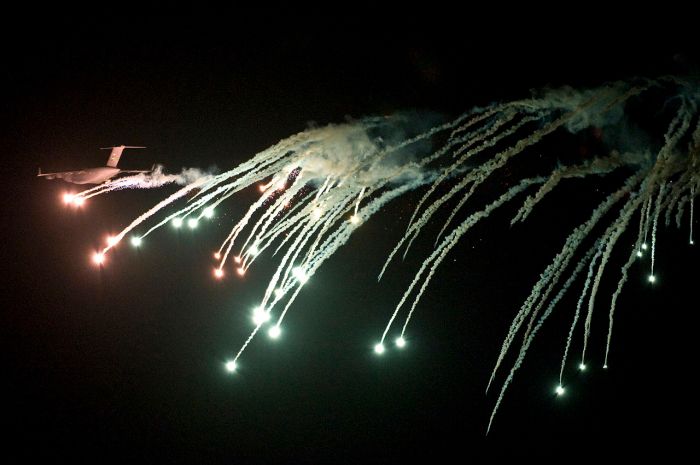
A C-17 performs evasive counter measures by launching flares during a Mobility Air Forces Exercise over the Nevada Test and Training Range on 16 November 2011, (Source: Wikimedia)
Examining options for the Globemaster’s future may see it called to perform roles that are well outside the traditional airlift roles that the aircraft performs today. Few would argue that the C-17A’s talents are best applied to providing dedicated strategic and tactical airlift. The external surfaces of a C-17A, however, provide significant ‘real estate’ for discrete sensors and antennas, and the aircraft’s interior likewise has space that would allow it to fulfil support functions for C4I and ISR – especially if the terminals for such roles are significantly smaller and modularised, contrasting with the fixed workstations that fill C-135 and Boeing 707 variants operated by the USAF. Today, other platforms (such as those based on commercial airliners) might conceivably fulfil this role more efficiently and effectively than a Globemaster. However, future requirements – especially those that call for an aircraft to deliver personnel and vehicles, then remain near provide immediate support – might dictate that the C-17 is the aircraft for the job.
The last consideration for the Globemaster receiving a ‘high-end’ upgrade is that it might pick up new roles not even in service today. The aircraft has been mooted as a potential ‘Drone Mothership’ in a battlespace, deploying them to perform a range of ISR, attack, and strike missions. Alternatively, the C-17A’s cargo bay has considerable space for batteries and other systems that would employ high-energy weapons.
Where the Globemaster ultimately fulfils any of these roles is anyone’s guess – while the technology is being developed, it is by no means about to be applied to the C-17A. Once said technology is mature, there are no guarantees that the C-17A will be the best jet for the job.
The Likely Options
At a minimum, progressive upgrades will need to be applied in the future to ensure the C-17A can continue to be operated. The crew stations are likely to be developed over time, as are the aircraft’s avionics, communications and networking systems. Foreign operators should bear these developments in mind – on the one hand, the upgrading of their aircraft is likely to have a greater impact on the number of aircraft they have available. On the other hand, such programs are an avenue for them to suggest development roadmaps that can be shouldered by Boeing and USAF. Exploring these avenues, however, would have to be a modest process. However, it is unlikely that an entirely new C-17 variant will be developed if only one smaller operator is guaranteed to require it.
With that in mind, the Globemaster’s future development is likely to be informed by three things – keeping the airframe viable, the USAF’s appetite to embark on upgrade programs, and Boeing’s willingness to provide options. Lockheed Martin’s C-5M program provides an excellent example of where the C-17A can go with such updates, replacing aircraft structures and systems that have become tired and unreliable while also meeting demands of the customer to capitalise on generational changes in engine, avionics, and ergonomic technology. Indeed, the C-5M in some respects feels like it carries some of the best features of a C-17A (except the HUD and fighter control stick).
Everyone has an embarrassing childhood photo. (Source: USAF)
Strategic airlift development, however, emphasises the importance of cruise efficiency and performance, which is often largely dependent on reductions in the aircraft’s weight and improvements in a power plant. Such upgrades are easy to forecast in the C-17A’s future. The more ‘creative’ upgrades for the Globemaster will be in how it is required to perform tactical roles in future – or approach brand new problems.
Eamon Hamilton graduated from the University of Western Sydney with a Bachelor of Communications (Journalism). He works as a Public Affairs Officer for the Royal Australian Air Force. He lives in Sydney. He runs the Rubber-Band Powered Blog and can be found on Twitter @eamonhamilton.
Header Image: A C-17 arrives with GEOS-O on board at the Shuttle Landing Facility. (Source: Wikimedia)
Since its launch in June 2016, From Balloons to Droneshas published a variety of articles, commentaries, research notes, and book reviews dealing with issues related to air power history, theory and practice. However, to continue to develop and regularly publish material we need new contributors keen to publish on the subject of air power. As such, we need you!
From Balloons to Drones welcomes and encourages potential submissions from postgraduates, academics, and practitioners involved in researching the subject of air power. We seek to publish articles, commentaries, research notes, and book reviews that encourage a healthy discussion about air power from historical themes through to commentary on contemporary operations and challenges.
Air power is treated in its broadest sense and includes cyber and space power, and we are happy to discuss the suitability of any proposal for the site. We also encourage contribution from people working in the fields of strategic studies, law, politics, ethics, international relations, archaeology, and museology.
Submissions can take the following form:
Articles – From Balloons to Drones seeks to publish informative articles on air power that range from historical pieces to the analysis of contemporary challenges. These well-researched articles should attempt to bridge a gap between the specialist and non-specialist reader. They should be around c. 1,000 to 1,500 words, though From Balloons to Drones will accept larger pieces though we reserve the right to publish them in parts. References can be via footnotes and hyperlinks.
Commentaries – From Balloons to Drones seeks to publish opinion pieces on recent on a recent piece of news, either on a contemporary or historical subject. These are to be responses to such piece and should be no longer than c. 1,000 words.
Research Notes – From Balloons to Drones seeks to publish research notes related to contributor’s currents research projects. These take the form of more informal pieces and can be a discussion of a source or a note on a recent research theme. Unlike other pieces published by From Balloons to Drones, they can be written in the first person, though they can include references. These should be c. 500 to 1,000 words.
Book Reviews – From Balloons to Drones publishes occasional book reviews that aim to be an accessible collection of appraisals of recent publications on the subject of air power. If publishers are interested in having a publication reviewed then, please contact us via the email address below.
Submissions should be submitted in Word format. Also, please include a 50-100 word biography with your submission. However, if you are not sure if your piece fits our requirements, then please email us with the POTENTIAL SUBMISSION in the subject line. References can be used, and, given the readership of this site, please be careful to explain any jargon used.
Header Image: A B-1B Lancer drops back after air refueling training, 30 September 2005. This B-1B, from the 28th Bomb Wing, deployed to Andersen Air Force Base, Guam, as part of the Pacific Command’s continuous bomber presence in the Asia-Pacific region. (Source: Wikimedia)
I have just come back from a conference at the Royal Military College of Canada on the theme of the ‘Education of an Air Force’ that was well worth the visit. I am sure most readers will agree that the subject of education is of vital importance and this is something that has been increasingly realised in recent years as modern air forces seek to grapple with the challenges that confront them in the operational sphere.
Ideas such as conceptual innovation have become catchphrases for efforts such as the Royal Air Force’s (RAF) Thinking to Win programme, the Royal Australian Air Force’s (RAAF) Plan JERICHO and the Royal Canadian Air Force’s (RCAF) AIRpower in Formation process. Underpinning these, to a greater or lesser degree, is the importance of air power education. Indeed, as Lieutenant-General Michael Hood, Commander of RCAF, recently noted in the introduction to an article in the Royal Canadian Air Force Journal on air power education and professional air power mastery:
There is also a requirement to continually review the training and education we give to all ranks to ensure that it is configured to deliver what we need within the contemporary environment.[1]
Nevertheless, phrases like the one above can often be a case of rhetoric versus reality, though having heard General Hood speak at the opening of the conference; I do believe he means what he says about the importance of education. The conference was historically focussed, but by observing the past, as historians, we can identify areas that can be points of friction and that need to be considered when attempting to introduce reform in the education process. What follows are just a few key areas I pondered during the conference.
Training or Education?
Perhaps the first thing that came to mind was what were we considering? The conference included the word education in the title but was this the case? Indeed, one key question that needs to be asked is whether those we study understand the distinction we make today between training and education. For me, at the most simplistic of levels, training is about skills development while education is about knowledge, understanding and critical thinking. Is this what was expected by those responsible for creating the institutions that delivered programmes related to professional development such as staff colleges. I suspect the answer is yes but the vernacular used in different eras leads to confusion. For example, Air Chief Marshal Sir Robert Brooke-Popham, first Commandant of the RAF Staff College, was clear that one issue he needed to deal with was anti-intellectualism and this is a matter of education though the term was infrequently used in the 1920s. By the 1960s, the RAF had begun, as it created a ‘progressive’ system of staff education, to differentiate between the two subjects. Nevertheless, we must be clear about what we are talking about if reform is to be achieved.
Culture
Military organisations are conservative in character. This is not to suggest that they are not innovative but rather to reflect that they are predominantly reactive rather than revolutionary. Thus, change, unless triggered by defeat, public opinion or budgetary cuts, can be difficult and challenging. This is ultimately a cultural issue and one that needs to be considered when introducing change. Leaders need to bring people along with them on the journey they seek to engender rather than just demanding that it happens. This applies to education as well. If education is to be improved, the organisation’s employees need to understand the need for this process. They need to be shown its value, and this has to be enunciated in a clear and meaningful manner. Indeed, in the modern era where most air forces have been in continuous operations for at least the past decade and a half, it needs to be illustrated why education is of value for those with operational experience. This comes back to the first point above, for example, we train an officer to fly rather than educate them.
The Role of Senior Leadership
From left, General Dwight Eisenhower, US Army Chief of Staff; Major General Muir Fairchild, Air University commander; and Major General David Schlatter, the Air University deputy commanding general (education), review an Air University organizational chart during Eisenhower’s visit to Maxwell on 9 April 1947. (Source: Wikimedia)
This brings me to the next important issue; the role of senior leaders. These are the people who lead change. Indeed, at the conference, when I made a comment about the culture of military organisations, Harold Winton, Professor Emeritus at the United States Air Force’s (USAF) School of Advanced Air and Space Studies (SAASS), quite rightly made the impassioned argument that when a leader who believes in education comes along, perhaps once every 15 to 20 years, then we should take advantage of that person. I completely agree, a champion who can provide top cover is essential, and it appears that RCAF have that in Hood while in the 1970s, the RAF had Marshal of the RAF Lord Cameron, who supported the creation of the position of Director of Defence Studies. Furthermore, support from senior leaders can help shape the culture and values of the organisation by providing an example to subordinates.
Non-Standard Education
What I mean here is the use of non-staff college education for officers, mainly higher research degrees such as MPhils and PhDs. In modern militaries, it is usual that officers going through the staff college system receive some form of credits towards a postgraduate degree, typically an MA. For example, British officers can work towards an MA in Defence Studies that builds on the Advanced Command and Staff Course at the Joint Services Command and Staff College. However, this is a relatively standard route and one that has been developed within the Staff College environment. What appears to be less typical, though needs to more readily embraced, is the encouragement of nurtured personal to undertake further research in the form of MPhils and PhDs. USAF do a good job of this through SAASS, and the RAF has a good fellowship scheme that not only encourages Masters work but also supports PhDs through the Portal Fellowship. This need to be promoted as higher research encourages critical thinking and air forces need such people to help develop their conceptual understanding of air power in the defence sphere. Nevertheless, air forces also need to encourage and reward personnel for taking ownership of their education irrelevant of whether the service sponsors it or not. Personnel need to be shown that in developing their critical thinking skills these are as valued as their operational ones. Also, where applicable, personnel should be encouraged to write in various forums from websites, such as this one, The Central Blue, War on the Rocks and The Strategy Bridge, to professional journals. However, this requires encouragement and critical mass and it is interesting to reflect that the RAF, RCAF and USAF all have journals but the RAAF does not, though the latter’s Air Power Development Centre does produce useful material. Overall, by encouraging ‘non-standard education’, air forces have the opportunity to develop knowledge and encourage informed discussion about air power in the public and policy sphere rather than what often currently occurs.
Officers or NCOs? Alternatively, Both?
An interesting point that came up in one discussion phase of the conference was the question of NCOs. All of the papers dealt with officer education with most focussed on the staff college scenario. However, what of NCOs and their education? We often hear phrases such as ‘whole force’ used to describe the personnel of an air force. As such, should we not be educating the NCO corps? Another challenge is that the current NCO corps is becoming better educated; it not unusual to find airmen and women entering service with degrees. If we are to develop the ‘whole force’ then similar opportunities afforded to the officer corps should be made available to NCOs especially as they are promoted and take on senior leadership roles. This is probably a conference of its own but a subject area that deserves consideration both in a contemporary as well as historical sense.
What I have written here is by no means the panacea for professional military education, and indeed much of this is axiomatic of any analysis of the field. Indeed, most of these challenges are just as applicable to each of the services; however, I would suggest that these difficulties need to be overcome and also understood in the context of air forces seeking to improve education provision. Nevertheless, the conference provided plenty of food for thought on the subject of the education of air forces as modern services strive to deal with operational and personnel challenges that they currently confront and will continue to do so into the 21st century. Another key positive of this conference was the involvement of the RCAF both regarding the opportunity to visit the Canadian Aerospace Warfare Centre but also to hear how they are dealing with current challenges.
Dr Ross Mahoney is an independent historian and defence specialist based in Australia. Between 2013 and 2017, he was the resident Historian at the Royal Air Force Museum, and he is a graduate of the University of Birmingham (MPhil and PhD) and the University of Wolverhampton (PGCE and BA). His research interests include the history of war in the twentieth and twenty-first centuries, air power and the history of air warfare, and the social and cultural history of armed forces. To date, he has published several chapters and articles, edited two books, and delivered papers on three continents. He is a member of the Royal Historical Society and is an Assistant Director of the Second World War Research Group. He is a member of the Royal Historical Society and an Assistant Director of the Second World War Research Group. He blogs at Thoughts on Military History, and can be found on Twitter at @airpowerhistory.
[1] Lieutenant-General Michael Hood, ‘Introduction’ to Brad Gladman, Richard Goette, Richard Mayne, Shayne Elder, Kelvin Truss, Pux Barnes, and Bill March, ‘Professional Airpower Mastery and the Royal Canadian Air Force: Rethinking Airpower Education and Professional Development,’ Royal Canadian Air Force Journal, 5(1) (2016), p. 9.
In a recent piece for The Central Blue, the blog of the Sir Richard Williams Foundation in Australia, Robbin Laird has suggested that rather than describing the F-35 Lightning II as a 5th Generation aircraft, we must think of it as ‘a first generation information and decision making superiority “flying combat system”.’[1] (Emphasis in original)
Arguably, this is an important shift in how we think about the capabilities of this new platform and the implications this has regarding how we think about air power. However, this labelling of platforms and capabilities raises several interesting observations and what follows are some personal opinions on the issue of ‘labels.’
First, and while we should always be careful of generating faulty parallels, as a historian, I am quite certain I have heard similar phrases before namely Giulio Douhet’s ‘battleplane’ concept. In short, in the second edition of his seminal work Command of the Air, written in 1926, Douhet argued that the roles of combat and bombing should be combined with a single type of aircraft, the ‘battleplane.’ This was a move away from his thinking outlined in the 1921 edition of Command of the Air, but as Thomas Hippler has noted, at a conceptual level, the ‘battleplane’ was important because it allowed Douhet to reconcile the ideas of war in the air and war from the air.[2] For Douhet, both were synonymous and one, though whether this proposed platform would have solved that challenge remains debatable. This was clearly a lesson derived from Douhet’s views of the First World War. Nevertheless, the problem with the ‘battleplane’ idea is that it was a solution to one set of circumstances and would not have applied to all situations where the use of air power might have been called upon. Could we end up in the same situation if we think of the F-35 in a similar vein?
Second, a broader issue with Laird’s description is that of buzzwords or phrases. Buzzwords tend to be created to support someone’s vision of the future, and they are unhelpful if not grounded in some form of intellectual rigour. Indeed, buzzwords and phrases are certainly not something limited to air forces but pervade the military more broadly. For example, in the last few days, it has been reported that the US Navy’s Chief of Naval Operations has decided to shelve the use of Anti-Access/Area-Denial as a ‘stand-alone acronym’ primarily because it ‘can mean all things to all people or anything to anyone.’[3] This is an important point, and the same can be said of effects-based operations, which was fashionable in the late 1990s and early 2000s.[4] Both of these strategies are ideas that have history, and we should be careful about trying to re-invent the wheel. As I recently heard from one colleague, if you want a new idea, read an old book. As such, is the description being applied to the F-35 helpful when thinking about the application of air power? It is indeed being linked to the idea of 5th generation strategy, but we must continually ask the question within the question and seek to understand what is underpinning such statements. For example, is the platform important or the ideas about their use? Also, should we be careful about linking platforms to strategy?
Nevertheless, while I would advocate the need to critique statements, such as Laird’s, there is certainly always a case to build new language and ideas to explain future challenges. This is particularly important for air power because, since the end of the Cold War, it has become, arguably, the West’s preferred way of war.[5] Nevertheless, as Tony Mason reflected, ‘while our technology is lifting us into the 21st century, our formative concepts remain rooted in a bygone age.[6] This comment remains as relevant today as it did in 1998. While today’s core air power roles can be identified in the activities of the First World War, it is perhaps an axiom that as with any field of human endeavour, the language and ideas about the use of military aviation should and must evolve as time goes by and situations change.
This, however, raises my third point of how we improve and encourage the conceptual thinking that underpins many of the statements made by commentators and practitioners. It is ok to have opinions and advocate them; however, they must be derived from the intellectual study of the field. Indeed, while advocacy can create friction, that friction, in turn, can generate innovation, which is important if organisations are to adapt to changing strategic, operational and organisational shifts. However, it should also be recognised and understood that such friction needs to be managed so that it does not become divisive as it arguably did at the strategic level between the RAF and Royal Navy in the inter-service debates of the 1920s. This is clearly an issue of education, and how that process is utilised and retained by air forces. This is difficult for western air forces primarily because they have been involved in sustained operations for at least the past decade. This has not given air forces significant time to think and reflect on their craft as their focus has been elsewhere. Nevertheless, air forces have, where possible promoted thinking. For example, the modern RAF runs a fellowship to encourage study and expand the Service’s ‘intellectual capacity.’[7] However, this intellectualising of air power needs to filter back into the development of thinking, policy and doctrine and refresh the lexicon while providing the necessary foundations to attempts to redraw conceptual boundaries.
Just to conclude, this is clearly a thought piece and does not propose any solutions to the challenges of today; however, we should be very careful about the labels we apply to platforms, capabilities and concepts. Terminology, as the discussion section of Laird’s piece, illustrated, matters and has a tendency to carry cultural baggage. In developing effective thinking about the application of air power as part of the solution to strategic challenges, air forces need to think about their place in the pantheon of options open to policy makers. I would argue that in an age of austerity and uncertainty, this requires air forces an investment in the organisation’s human element to generate the capacity to think effectively about the conceptual component.
Dr Ross Mahoney is an independent historian and defence specialist based in Australia. Between 2013 and 2017, he was the resident Historian at the Royal Air Force Museum, and he is a graduate of the University of Birmingham (MPhil and PhD) and the University of Wolverhampton (PGCE and BA). His research interests include the history of war in the twentieth and twenty-first centuries, air power and the history of air warfare, and the social and cultural history of armed forces. To date, he has published several chapters and articles, edited two books, and delivered papers on three continents. He is a member of the Royal Historical Society and is an Assistant Director of the Second World War Research Group. He is a member of the Royal Historical Society and an Assistant Director of the Second World War Research Group. He blogs at Thoughts on Military History, and can be found on Twitter at @airpowerhistory.
Header Image: An F-35 Lightning II Joint Strike Fighter test aircraft banks over the flight line at Eglin Air Force Base, 23 April 2009. (Source: Wikimedia)
[2] Thomas Hippler, Bombing the People: Giulio Douhet and the Foundation of Air-Power Strategy, 1884-1939 (Cambridge: Cambridge University Press, 2013), p. 147. There is a question over the correct date for Douhet’s second edition. Hippler consistently refers to it being produced in 1926 while the most recent imprint of Dino Ferrari’s 1942 translation describes it as the 1927 edition, see: Hippler, Bombing the People, p. 144; Thomas Hippler, ‘Democracy and War in the Strategic Thought of Guilio Douhet’ in Hew Strachan and Sibylle Scheipers (eds.), The Changing Character of War (Oxford: Oxford University Press, 2011), p. 181, fn. 13; Guilio Douhet, Command of the Air, translated by Dino Ferrari (Washington DC: Air Force History and Museums Program, 1998), p. x. It is clear, however, from the original Italian that while published in 1927, the second edition was written in 1926.
[4] For a useful discussion of effects-based warfare that takes account of historical and contemporary views as well as a multi-domain approach, see: Christopher Finn (ed.) Effects Based Warfare (London: The Stationary Office, 2002).
[5] For useful views on future air power thinking, see: John Andreas Olsen (ed.), Airpower Reborn: The Strategic Concepts of John Warden and John Boyd (Annapolis, MD: Naval Institute Press, 2015).
[6] Air Vice-Marshal Professor Tony Mason, ‘The Future of Air Power,’ RAF Air Power Review, 1(1) (1998), p. 42.
Previously, we looked at how McDonnell lost a significant contract with the US Navy after their upgraded F3H Demon failed a fly off competition against their competitor, Chance-Vought’s entry which became the F-8U Crusader.
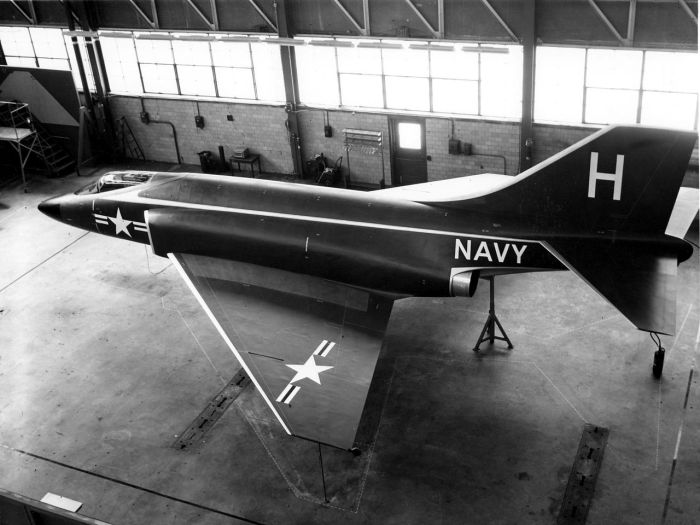
An early mockup of a modified F3H which is beginning to show some familiar visual characteristics of the F-4. (Source: US Navy National Museum of Naval Aviation)
McDonnell engineer Herman Barkley took the Demon’s rejection as a personal challenge and immediately began designing an unsolicited new aircraft initially without military funding.[1] Original sketches for the new craft consisted of yet another version of the Demon, similar to the design that had already failed against Vought’s F-8U. The US Navy had a vested interest in allowing McDonnell to experiment with the design. It could keep McDonnell afloat, enabling it to remain a valuable supplier, and perhaps reap some return on the initial investment they had both placed in the failed F3H. Upon review of these sketches, The US Navy did support the project, but gave no stated mission requirements for the plane, encouraging McDonnell to experiment on the drawing board. According to J. S. McDonnell himself:
All we had to work with in the beginning [of F-4 Phantom II Development] was a gleam in the customer’s eye […] What followed was two years […] of orchestrated confusion.
The US Navy, because of their doctrinal assumptions, wanted to focus on high-speed interceptors but was purposefully vague about communicating this, hoping McDonnell would reach in new and unexpected directions. This lack of specificity and a desire to maximise profits by designing a versatile plane that functioned in many contexts led McDonnell to develop a multi-role aircraft not optimised for the air-to-air mission.[2]
The confusion continued until Spring of 1955 when Commander Francis X. Timmes (newly in charge of the project) emphasised the high-speed interceptor role and stressed adaptability. Those concepts required that the plane to have two seats, two engines, and an armament of only missiles. The plane thus featured eleven hardpoints for carrying bombs or missiles, the most ever designed on an airframe at that time. The homogenous armament and dual-pilot setup both theoretically enhanced adaptability, since dogfighting was (allegedly) unnecessary, the lack of guns made the plane lighter (thus faster), and pilot duties could be split between two people. In July 1955, the US Navy rewarded McDonnell’s efforts with a contract for the production of seven prototypes.
The Phantom’s unique look was the result of over 5,300 hours of wind tunnel tests, which revealed a significant problem in supersonic flight. The plane was susceptible to ‘roll coupling,’ which is a technical way of saying the plane became uncontrollable – a condition from which pilots were trained to eject immediately. The angled wingtips and tail decreased the chances of this occurring. To add to stability concerns without sacrificing speed, the Phantom was given the ‘Stab Aug’ system that could sense unstable flight paths and automatically correct for them quicker than a pilot could manually. Computer controlled intake ramps to control air flow into the engines also increased the plane’s top speed. Another computerised system, ‘Boundary Layer Control,’ sent excess air from the engines over the wings to generate more lift and increase speed and acceleration. [3]
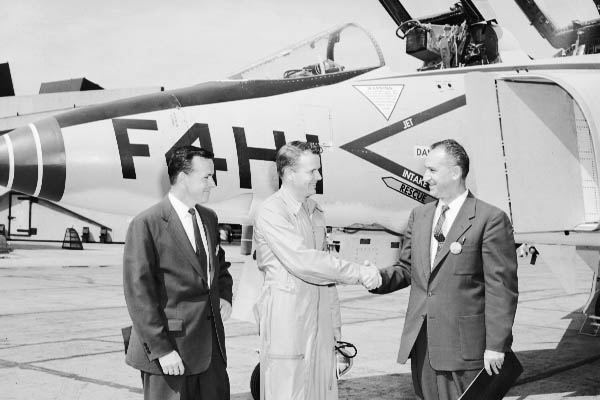
Herman Barkley (left) with test pilot Robert Little(center) and fellow engineer David Lewis (right) in front of a prototype of the F-4. (Source: Wikimedia)
Though the bond between the US Navy and its developers was strong, the military was loathed to place all its eggs in one basket. Timmes solicited other designs to fit the same roles as the Phantom in August 1955. The company that stepped up to the plate was none other than McDonnell’s old nemesis: Chance-Vought. Vought had developed an upgraded version of their successful F-8U Crusader, the very plane that had beaten McDonnell’s F3H Demon. Both new designs were set to compete in an unofficial fly off beginning on 15 September 1958. The tests emphasised the assumptions of the time, focusing on maximum speed and climbing rates. The assessments did not include manoeuvrability, gunnery, or other metrics pertinent to air-to-air combat.
In every tested category, the F8U-3 Crusader proved superior. It even had better fuel mileage. Its only drawbacks were a lower payload and time-consuming maintenance requirements. Despite this, George Spandenberg, then the director of Bureau of Aeronautics’ Evaluation Division, thought that single-seat, single-engine planes were inherently unreliable and argued that a two-seat plane would boost morale. Thus he boldly asserted, ‘The single-seat fighter era is dead.’ Advocates of the F-4 often claim the Phantom ‘won’ the contest (since it did win the US Navy contract after all), although a close look at the fly off reveals the upgraded Crusader had clear performance advantages in every category.[4]
Despite the Phantom’s lacklustre performance at the fly off, it was still an impressive aircraft in many respects. Between December 1959 and April 1962, the F-4 set over a dozen world records, the most coveted (and revealing of the plane’s doctrinal design focus) of which was that of absolute top speed: 1,606.3 miles per hour.[5] The F-4 also possessed many problems that came back to haunt the military over the jungles of Vietnam, and that appear almost negligent in retrospect. Aside from the stability issue (which caused ‘departure’ or ‘the adverse yaw effect,’ terms for when the plane loses control during maneuvers), the almost non-existent rear-visibility was a problem, as were the giant plumes of black smoke produced by the engines that gave away the location and heading of every Phantom. The plane was also quite vulnerable to ground fire because its hydraulic lines were delicate and devoid of redundancy. Indeed, ground fire downed more F-4s in Vietnam than any other single threat. Across US Air Force (USAF), the US Navy and the US Marine Corps combined, from January 1962 to January 1973, 930 planes were lost to small arms ground fire, or, 45% of losses by known causes. AAA claimed 632; SAMs shot down 191; MiGs destroyed 79, and friendly fire claimed 25.
The USAF observed these record-setting demonstrations and grew interested in the plane’s usefulness as a strategic bomber and interceptor.[6] After a series of tests, USAF eventually ordered more than triple the number of Phantoms as the Navy. McDonnell finally created four new models of the Phantom to USAF specifications, the first and most significant of which was the F-4C.[7]
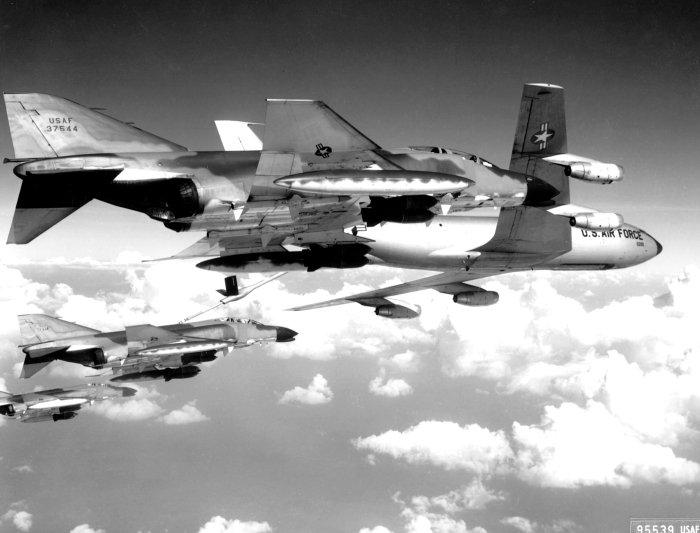
A flight of US Air Force McDonnell F-4C Phantom II fighters refuel from a Boeing KC-135A Stratotanker aircraft before making a strike against targets in North Vietnam. The Phantoms are loaded with six 750 pound general purpose bombs, four AIM-7 Sparrow air to air missles, and 370 gallon external fuel tanks on the outboard pylons. (Source: Wikimedia)
Although the Phantom would undoubtedly have performed extremely well in its designed role of intercepting enemy bombers, it ironically never had to. Instead of saving the world from nuclear Armageddon in the hypothetical World War III, the F-4 instead flew in a limited war over the jungles of a tiny third world country that many Americans had trouble locating on a map. The enemies it faced were not large lumbering bombers threatening nuclear annihilation, but missiles, ground fire, and manoeuvrable MiG fighters much more adept at air combat. Statistically, the deadliest enemy for the Phantom, one of the most powerful and expensive planes in US history to that point, was an individual on the ground with a machine gun. Similar to the doctrine that spawned it, the F-4 was the right plane for the wrong war.
The F-4 Phantom II was a fighter plane possessing few characteristics of traditional fighters. It was large, cumbersome, and built around the concept of long range attacks, sacrificing the agility and armament necessary of true air superiority craft. Originally conceived as an interceptor and soon burdened by ‘mission creep’ that insisted it handle multiple roles, the plane was the poster child for pre-Vietnam USAF doctrine, namely, the quasi-religious devotion to strategic bombing that minimised all other roles of air power.
Mike Hankins is a doctoral candidate at Kansas State University, where he teaches World History, the History of Airpower, and the History of Comic Books, and he is currently working on his dissertation, ‘Sources of Innovation: The Cultural and Technological Origins of Fourth Generation Fighter Aircraft, 1964-1991.’ He completed his master’s thesis at the University of North Texas in 2013, titled ‘The Phantom Menace: The F-4 in Air-to-Air Combat in the Vietnam War. He has a web page and can be found on Twitter at @hankinstien.
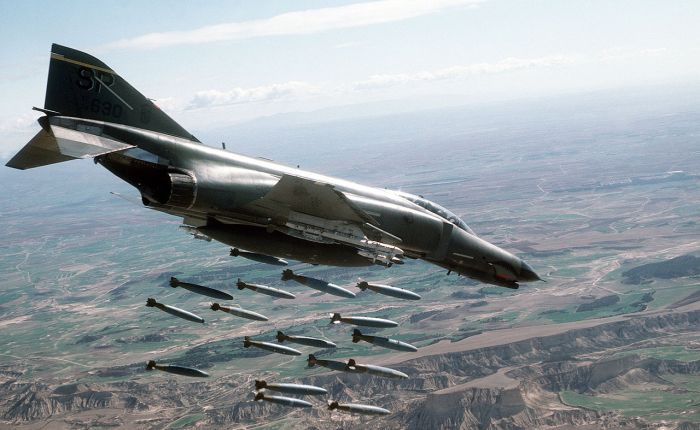
Header Image: A USAF McDonnell Douglas F-4E Phantom II from the 81st Tactical Fighter Squadron, 52nd Tactical Wing, releasing 18 Mark 82 227 kg bombs over the Bardenas Reales Gunnery Range, Spain, 25 March 1986. (Source: Wikimedia)
[1] Enzo Angelucci and Peter Bowers, The American Fighter (New York: Orion, 1987), p. 451, 310. Larry Davis, F-4 Phantom II in Action (Carrollton, TX: Squadron/Signal Publications, 1984), p 4.
[2] Glenn E. Bugos, Engineering the F-4 Phantom II: Parts Into Systems (Annapolis: Naval Institute Press, 1996)p. 23, 9, pp. 13-14.
[4] Peter E. Davies, USN F-4 Phantom II vs VPAF MiG 17/19: Vietnam 1965-73 (Oxford: Osprey Publishing, 2011), p. 16; Lou Drendel, F-4 Phantom II in Action (Warren, MI: Squadron/Signal Publications, 1972), p. 6; Bugos, Engineering the F-4, pp. 95-9.
[5] Mick Spick, All-Weather Warriors: The Search for the Ultimate Fighter Aircraft (London: Arms and Armour Press, 1994), p. 131; Enzo Angelucci with Peter Bowers, The American Fighter: The Definitive Guide to American Fighter Aircraft from 1917 to the Present (London: G.T. Foulis, 1987), pp. 310-1.
[7] Anthony M. Thornborough, USAF Phantoms: Tactics, Training, and Weapons (New York: Arms & Armour Press, 1988), pp. 11-12; Bugos, Engineering the F-4, p. 115.
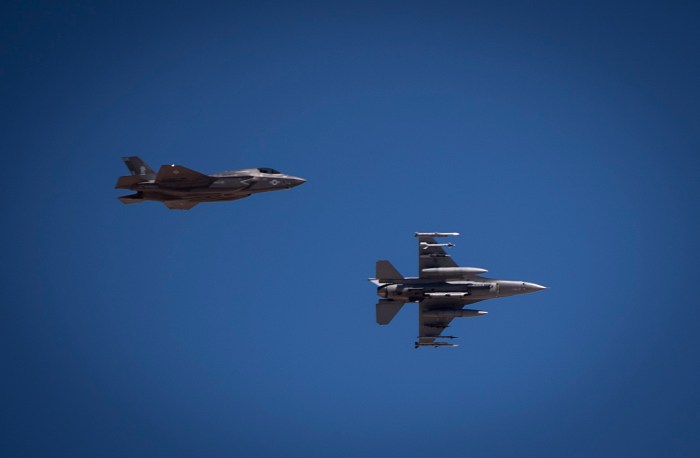
Ten years after its first flight and nine years after Detective John McClane brought one down in Live Free or Die Hard, it seems the Lockheed Martin F-35 Lightning II is finally here. Well, at least the U.S. Air Force and Marine Corps versions. Love it or hate it, it is here to stay. I do not want to get off into the discussion of what the F-35 can or cannot do, and we all know it is being asked to do a lot. Per Lockheed Martin’s website the F-35 is supposed to provide: ‘electronic attack, Air-to-Surface, Air-to-Air, Intelligence, Surveillance, and Reconnaissance (ISR), Stealth, Interoperability, and Full Mission Systems Coverage’ (whatever that last one is). That is many missions to cram into one airframe. We are all familiar with the Close Air Support (CAS) debates on the F-35 versus the A-10, and we have all followed the slow, arduous, and downright sloth-like advancement of the F-35 until this point. I have been known to walk both sides of the argument with the F-35.
A F-35B, assigned to the Marine Fighter Attack Squadron 121 out of Marine Corps Air Station Yuma, Arizona, flies level as a F-16 Fighting Falcon from the 177th Fighter Squadron from the New Jersey Air National Guard, banks hard during approach July 15, 2016 at Nellis Air Force Base, Nevada (Source: US Air Force)
I get it, it is behind schedule, and it is over budget, but so are all of my home improvement projects. I am not sold that it can effectively do everything it is billed to do, but I am also willing to give it a fighting chance in the coming years. For those that have followed the military aircraft industry for a few decades, you will know that every airframe has had its initial struggles: the F-22, F-16, F-15, each and every one of them were plagued by issues. The F-35 is no different with perhaps the one exception that we can all take to Twitter to complain about it. I would rather focus on something entirely different.
All, the F-35 is conducting missions. No, it is not dropping bombs on IS (yet), nor is it providing CAS sorties in Afghanistan. No, it is not even deployed overseas in-theater, but that will come with time as well. However, it is creeping ever closer. Last week, USMC F-35s of VMFA-121 participated in the USAF’s Red Flag exercise. This is a big deal. If you have followed me for more than a hot minute, you know that Red Flag is near and dear to my heart. I have written extensively about, most notably here.
Participating at Red Flag is a major step forward for the entire F-35 program. You can think of Red Flag in some different ways. First, it helps to ‘season’ inexperienced pilots. USAF created Red Flag in 1975 to give its fighter pilots exposure to their first ten ‘combat’ missions. The entire purpose of the exercise was to simulate combat in a realistic training environment. Reports after Vietnam, most notably the Red Baron Reports, indicated that a pilot’s chance for survival increased exponentially after the first ten missions. Second, it exposes units and aircrew to other units and aircrews. Across the spectrum of aerial operations units have to integrate and work together to accomplish the mission. An F-22 pilot of the 1st Fighter Wing at Langley Air Force Base, VA., does not have the opportunity to fly against US Navy, USMC, and other USAF fighters on a daily basis; Red Flag provides that opportunity. The participation of VMFA-121 is as important for the F-35 and its flyers as it is for every other participant in the exercise. This is the first chance for many of these aircrews to see what the F-35 is capable of during mission parameters. This particular Red Flag exercise will see the F-35 integrate with F-22s, F-16s, F-18s and other support aircraft. Finally, Red Flag has traditionally been an exercise used to integrate new aircraft and capabilities with existing missions and platforms. This was true of the F-15 in the 1970s and the F-22 in the 2000s, and it remains true for the F-35 in 2016.
Weapons schools will continue to push the bounds of what the F-35 can do, and we can continue to argue over that, but exercising the F-35 at Red Flag allows other members of the armed forces to see what the F-35 does do.
Dr Brian Laslie is an Air Force Historian and currently the Deputy Command Historian at North American Aerospace Defense Command (NORAD) and United States Northern Command (USNORTHCOM). A 2001 graduate of The Citadel and a historian of air power studies, he received his Masters’ from Auburn University Montgomery in 2006 and his PhD from Kansas State University in 2013. His first book The Air Force Way of War (2015) was selected for the Chief of Staff of the Air Force’s 2016 professional reading list. He lives in Colorado Springs. He can be found on Twitter at @BrianLaslie.
Header Image: F-35Bs, assigned to the 3rd Marine Aircraft Wing, Marine Corps Air Station Yuma, Az., sit on the flight line during Red Flag 16-3 at Nellis Air Force Base, Nev on July 12, 2016. (Source: US Air Force Photo)
From balloons to drones, exploring the development of air power from the earliest days of flight to now and the future.
Over the past two decades, airpower has become the “Western way of war” […] because it offers the prospect of military victory without large-scale destruction and loss of life. Airpower, however, cannot be decisive or even effective under all circumstances […] The utility of airpower is highly situational (emphasis added).
Air power remains the preferred weapon of choice for many governments. However, the application and development of air power, and the associated forces that are responsible for its use, are controversial and misunderstood. Indeed, as Olsen noted above, the use of air power is situational and contextual. The efficient use of military force, which lies at the heart of air power thinking, is dependent on understanding the ends, ways, and means of strategy and the relationship between objectives and capabilities.
This can only be achieved by understanding the development of air power and the forces that use this form of military capability as well as its relationship with broader areas, such as politics and society. To provide this, From Balloons to Drones is an online platform that seeks to provide analysis and debate about air power history, theory, and contemporary operations in its broadest sense including space and cyber power.
From Balloons to Drones seeks to publish articles, commentaries, research notes, and book reviews that encourage debate about air power.
We welcome and encourage potential submissions from postgraduates, academics, and practitioners involved in researching the subject of air power.
Submissions can take the following form:
Articles – Balloons to Drones seeks to publish informative articles on air power that range from historical pieces to the analysis of contemporary challenges. These well-researched articles should attempt to bridge a gap between the specialist and non-specialist reader. They should be around c. 1,000 to 1,500 words, though Balloons to Drones will accept larger pieces though we reserve the right to publish them in parts. References can be via footnotes and hyperlinks.
Commentaries – Balloons to Drones seeks to publish opinion pieces on recent on a recent piece of news, either on a contemporary or historical subject. These are to be responses to such piece and should be no longer than c. 1,000 words.
Research Notes – Balloons to Drones seeks to publish research notes related to contributors currents research projects. These take the form of more informal pieces and can be a discussion of a source or a note on a recent research theme. Unlike other pieces published by Balloons to Drones, they can be written in the first person, though they can include references. These should be c. 500 to 1,000 words.
Book Reviews – Balloons to Drones publishes occasional book reviews that aim to be an accessible collection of appraisals of recent publications on the subject of air power. If publishers are interested in having a publication reviewed then, please contact via the email address below.
Submissions should be submitted in Word format. Also, please include a 50-100 word biography with your submission. However, if you are not sure if your piece fits our requirements, then please email us with the POTENTIAL SUBMISSION in the subject line. References can be used, and, given the readership of this site, please be careful to explain any jargon used.
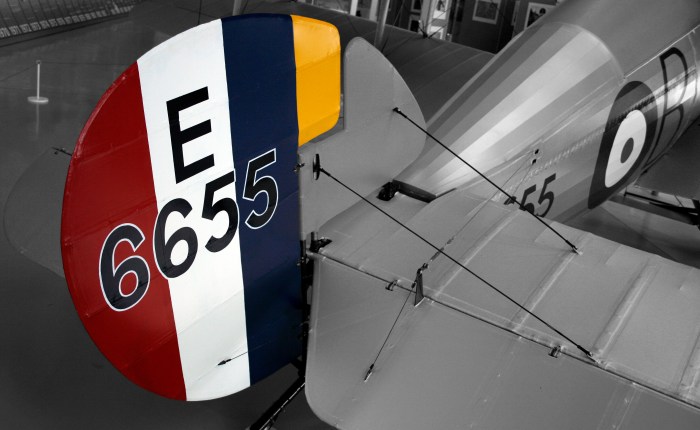
Header Image: Sopwith Snipe at the RAF Museum London (Source: Author’s Collection)
[1] John Andreas Olsen, ‘Introduction – Airpower and Strategy’ in John Andreas Olsen (ed.), Airpower Reborn: The Strategic Concepts of John Warden and John Boyd (Annapolis, MD: Naval Institute Press, 2015), p. 2.







 From Balloons to Drones


