By Major Jared Larpenteur
At 9:05 am on 12 July 2006, Hezbollah initiated Operation TRUE PROMISE at the Lebanese-Israeli border. They kidnapped two Israel Defense Force (IDF) reserve soldiers and sparked the Second Lebanon War.[1] Israel restricted large ground operations and instead turned to the Israeli Air Force (IAF) to win the war for them. Over the next 34 days, the IAF carried out tens of thousands of sorties but failed to achieve the decisive result sought by Israel.
No stranger to conflict, Israel has fought for survival since the establishment of the country in 1948. From 1948 to modern day the IDF has undergone multiple transitions to keep its military in line with the modern battlefield. Some of these transitions came at the cost of extensive amounts of blood and treasure. Despite a relatively successful air campaign in the 2006 Second Lebanon War, Israel’s societal perspective led to paying a high cost to discover essential lessons regarding the importance of joint warfare on the modern battlefield.
Since 1982, the IAF had dominated the skies of the Middle East. However, by the 2006 Lebanon War, they had become accustomed to an uncontested environment and employment in the counter-insurgency environment. Leading up to the Second Lebanon War, two intifadas, the first from 1987-1993 and the second in 2000, drew the Israeli military away from high-intensity conflict.[2] The first intifada occurred in 1987 and made the IDF shift focus from manoeuvre warfare to riot control to handle massive civilian uprisings. The second intifada in 2000 saw more violent clashes including suicide bombings in Israeli territory resulting in over 135 Israelis killed.[3] The two intifadas prompted the IDF to transition to a more counter-insurgency approach to warfare but also degraded public opinion as the Israeli populace became war-weary. At the same time, Israel observed the United States use of a heavy air power approach during Kosovo in 1999 and the initial Iraq invasion in 2003 to help limit casualties.
Israel had developed an aversion to casualties but still faced instability within the region. According to Frans Osinga, Israeli military leaders came to see air power as ‘a low-cost way to defeat adversaries such as Hamas and Hezbollah.’[4] Adversaries like Hezbollah watched, adapted, and understood the power of the IAF. Hezbollah understood Israel’s transition and according to their leader believed ‘the Israeli Achilles heel was the society itself.’[5] By 2006, Hezbollah planned for a future war with Israel under the assumption that Israel would rely on air power and limited ground forces to reduce the risk of casualties.
When Prime Minister Ehud Olmert, Chief of Staff General Dan Halutz (an IAF general), and Defense Minister Amir Peretz met shortly after the July 2006 abductions to discuss options their perspectives became apparent when they decided not to send a large ground force into Lebanon, but instead, rely on airstrikes and limited ground raids.[6] The resulting conversation led to Israel’s three political objectives: first, the release of the abducted soldiers to Israel unconditionally; second, stop the firing of missiles and rockets into Israel territory; lastly, enforce United Nations Resolution 1559, which pressured Lebanon to control Hezbollah, disarm militias, and secure its southern border.[7]
On 12 July, mere hours after the war began, the IAF launched Operation SPECIFIC WEIGHT. This air campaign targeted Hezbollah’s rocket sites, runways at the Beirut Rafic Hariri International Airport, interdicted the Beirut-Damascus highway and attacked the al-Manar Television Station (a Hezbollah-operated media source).[8] General Halutz assumed that it would only take two or three days to achieve the objectives because of the effect of precision-guided munitions on specific targets. These specific targets carried the planning assumption that air strikes would damage Hezbollah, pressure the Lebanese government, resulting in the release of the captured soldiers, and strengthen Israel’s military deterrence.
Two days later, Israeli intelligence assessed the strikes as successful. This led the IDF General Staff to target the town of Dahiye, a southern Beirut suburb that housed Hezbollah’s headquarters. The General Staff believe that Dahiye would deliver a symbolic blow to Hezbollah represented the beginning of a change of focus. With the soldiers still unreturned, the strikes on Dahiye appeared to expand the war aims to cause damage and pain to Hezbollah.[9]
By the end of the war, the IAF had carried out 19,000 sorties, averaging 200 sorties a day. The IAF attacked around 7,000 targets to include Hezbollah command posts, bridges, traffic intersections, and rocket launchers. The IAF used 19,000 bombs and 2,000 missiles of which 35 per cent of the ammunition were precision-guided munitions. The IAF racked up more flight hours in the Second Lebanon War than during the Yom Kippur War.[10] Despite the air effort, Israel began to realise that the air campaign alone would not achieve their political objectives as Hezbollah continued to launch an average of 90-150 rockets into Israeli territory every day.[11]
On 12 July, shortly after the air campaign began and keeping with the limited ground force approach Israel deployed several special operation units to recover the two kidnapped soldiers instead of large manoeuvre force. However, the special operations units did not anticipate the resistance from Hezbollah, while the IAF remained primarily focused on its strategic objectives. The IAF never prioritised integration and support for the ground offensive. Major General Benjamin Gantz, commander of the IDF army headquarters, stated:
By exploiting the air war, we could have gotten in simultaneously in full force and taken over the entire area, cleansing it from within. But that would have required […] decisive ground-maneuver warfare, not the stage-by-stage operations that were ultimately executed.[12]
However, the IDF entered southern Lebanon under the assumption that the destruction of targets by the IAF placed significant effects on Hezbollah.
To circumvent the use of air power and draw the IDF into attritional warfare Hezbollah developed large bunker and trench systems in southern Lebanon that could protect its arsenal of 122mm Katyusha rockets from air strikes. Additionally, Hezbollah integrated bunker systems inside of villages, towns, and surrounding terrain to draw the IDF closer rendering air support useless. As stated by an IDF lieutenant in southern Lebanon, ‘[Hezbollah] have so many places to hide from the air strikes, so we have to send in the infantry. It can be dangerous.’[13] For example, the IDF found a bunker complex in southern Lebanon 40 meters underground covering an area of two kilometres, with firing positions, operation rooms, medical facilities, and air conditioning.[14]
As the reports of Hezbollah’s resistance flooded in, it became clear that Israel needed a more significant force to secure the established political objectives. In response, the IDF launched its first large-scale ground force on 17 July to seize Maroun al-Ras and was surprised by Hezbollah’s preparation and fighting skills. Despite the effort, Maroun al-Ras remained unsecured as Hezbollah successfully outmanoeuvred the IDF with integrated mortar, rocket, and anti-tank weapons.[15] The realisation that intelligence did not match the reality on the ground hit hard as the first of the IDF ground elements manoeuvred into southern Lebanon. With the limited ground approach, the IDF faced massive resistance from Hezbollah. One IDF officer stated, ‘We expected a tent and three Kalashnikovs, that was the intelligence we were given. Instead, we found a hydraulic steel door leading to a well-equipped network of tunnels.’[16]
With the reports of limited success, Olmert and Halutz decided to deploy the Israeli reserves on 21 July. Despite the call for the reserves, Halutz’s ground plan remained the same without a consolidated effort between the IAF and IDF to achieve military objectives that linked to national objectives. By 5 August, three weeks after the start of the war, the IDF had roughly 10,000 soldiers in Lebanon four miles from the border. By 8 August, Israel realised it had been pulled into what they wished to avoid, a large-scale ground operation with dozens of casualties.[17]
Despite the scale of air power involved, Operation SPECIFIC WEIGHT did not have the intended effect. It only impacted around seven per cent of Hezbollah’s military resources.[18] Hezbollah still maintained the ability to manoeuvre and fire rockets, the two captured IDF soldiers were never returned to Israel, and the Lebanese government had no more control over Hezbollah than they did at the start of the war on 12 July. What changed the war and resulted in some semblance of partial Israeli success was not the massive air campaign but the eventual ground offensive.
For the US Military, Operation SPECIFIC WEIGHT provides several stark and valuable lessons. First, air power alone cannot achieve decisive results. Air and ground forces must act together whether in counter-insurgency, large scale combat operations or as in 2006 when facing a hybrid threat. On the modern battlefield, the integration of air and ground elements become imperative for success to achieve military and political objectives.
Second, as air and ground power integrate the release authority for munitions should be delegated down to lower echelons. In the Second Lebanon War, the IDF General Staff held the release authority which created lag times in fires and medical evacuation procedures. These lag times directly led to friendly fire incidents and enhanced pressure from the enemy. For example, near the town of Bint J’beil, an IAF attack helicopter inadvertently fired on IDF ground forces during a firefight barely avoiding fratricide.[19] Additionally, Israel learned that integration of the air and ground domain requires extensive training. That training should entail calling for fire, air-ground coordination, and target acquisition.
Lastly, the use of air power in the targeting process should focus more on desired effects to achieve decisive results rather than the destruction of specific targets. In the targeting cycle, the IAF uses a quantitative approach that focuses on the destruction of specific targets, with the assumption that effects placed on the target will bring decisive results.[20] The US Air Force uses a qualitative effects-based concept which focuses on the desired effects rather than a specific target.[21] During the Second Lebanon War, the air campaign attacked specific targets such as bridges over the Latini River, known Hezbollah positions, TV stations, and Lebanese airfields, with the assumption that destroying these targets would have the intended effect of achieving decisive outcomes. However, once the ground forces arrived in southern Lebanon, it became apparent that destroying these targets did not have the desired effect.
Israel paid the price in blood and treasure to learn the hard lessons of integrating air power on a modern battlefield. The Second Lebanon War resulted in the death of 66 IDF soldier, $55 million in loss of infrastructure, and $443 million in loss of economic activity.[22] The Second Lebanon War shows the importance of understanding the effective use of air power and the need to integrate air power across all operating domains. Israel learned the cost of getting air power integration wrong in 2006. In 2019 the US must avoid such costly schooling.
Major Jared Larpenteur is an Infantry Officer in the United States Army and currently a student at the School for Advanced Military Studies (SAMS) at Fort Leavenworth, KS. He is a 2003 graduate of Louisiana State University with a BA in History and commissioned through the ROTC program. He has deployed to both Iraq and Afghanistan and has experience in mechanized and light airborne infantry units. He received his masters from Kansas State University in Adult Learning and Leadership. He can be found on twitter at @jlarpe1 or email at jlarpe1@gmail.com. Views are his own and not representative of DoD or the US Army.
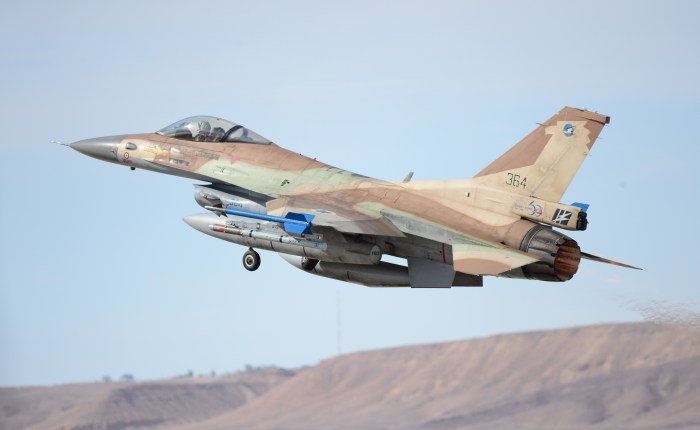
Header Image: An Israeli Air Force General Dynamics F-16C Barak of No. 110 Squadron departs on a mission during the ‘Blue Flag’ exercise on Ovda Air Force Base, Israel, on 27 November 2013. (Source: Wikimedia)
[1] Amos Harel and Avi Issacharoff, 34 Days: Israel, Hezbollah, and the War in Lebanon (New York: Palgrave Macmillan, 2008), pp. 12–3.
[2] Intifada translates as ‘shaking off’ meaning grassroots resistance across the Middle East, see: Bethan McKernan, ‘Intifada: What Is It and What Would a Thrid Palestinian Uprising Mean for Israel and the Middle East?,’ The Independent, 7 December 2017.
[3] Giora Eiland, ‘The IDF in the Second Intifada,’ Strategic Assessment, 13:3 (2010), p. 31.
[4] Frans Osinga, ‘Air Strike’ in John Andreas Olsen (ed.) Routledge Handbook of Air Power (New York: Routledge, 2018), p. 102.
[5] Cited in Scott C. Farquhar, Back to Basics: A Study of the Second Lebanon War and Operation Cast Lead (Fort Leavenworth, KS: Combat Studies Institute Press, 2009), p. 7.
[6] David E. Johnson, Hard Fighting: Israel in Lebanon and Gaza (Santa Monica, CA: RAND Corporation, 2011), p. 56.
[7] The United Nations Security Council, ‘United Nations Resolution 1559.’
[8] Harel and Issacharoff, 34 Days, p. 86.
[9] Ibid., p. 100.
[10] Johnson, Hard Fighting, p. 62.
[11] Ibid., p. 65.
[12] William M. Arkin, Divining Victory: Airpower in the 2006 Israel-Hezbollah War (Maxwell Air Force Base, AL: Air University Press, 2007), p. 133.
[13] Benjamin S. Lambeth, Air Operations in Israel’s War Against Hezbollah: Learning from Lebanon and Getting It Right in Gaza (Santa Monica, CA: RAND Corporation, 2011), p. 51.
[14] Arkin, Divining Victory, p. 21.
[15] Johnson, Hard Fighting, p. 68.
[16] Uzi Mahnaimi, ‘Humbling of the Supertroops Shatters Israeli Army Morale,’ The Times, 27 August 2006.
[17] Farquhar, Back to Basics, pp. 15-7.
[18] Ibid., p. 14.
[19] Lambeth, Air Operations in Israel’s War Against Hezbollah, p. 51.
[20] Johnson, Hard Fighting, p. 33.
[21] US Air Force, Air Force Doctrine Document No. 1, Air Force Basic Doctrine (Washington DC: Department of the Air Force, 2003), p. 18.
[22] Raphael S. Cohen et al., Lessons from Israel’s Wars in Gaza, Brief: Summary of From Cast Lead to Protective Edge (Santa Monica, CA: RAND Corporation, 2017), p. 8.






 From Balloons to Drones