#FilmReview – Masters of the Air, Episode Nine

#FilmReview – Masters of the Air, Episode Nine

By Dr Luke Truxal

Editorial note: On 26 January 2024, Apple TV+ launched the much-anticipated series Masters of the Air. This series follows the actions of the US 100th Bomb Group during the Combined Bomber Offensive in the Second World War. As the series is being aired, our Book Reviews Editor, Dr Luke Truxal, the author of Uniting against the Reich (2023), will critically review each episode.  

In the final episode of Masters of the Air, we see the episode successfully bringing the plots of the US 100th Bomb Group to a satisfying conclusion. It did well as an episode designed to finish the series and bring it to a successful landing. During the episode, we see the major characters resolve their past and begin to face their futures. Major Harry Crosby struggles with the nature of the air war and toils with how he has changed during the war. This is something that he struggled with after the war, like most veterans. Lieutenant Colonel Robert Rosenthal saw the Holocaust first-hand as he toured a concentration camp after he was shot down and rescued by troops from the Soviet Union’s Red Army. After the war, Rosenthal participated in the prosecution of Nazi officials at Nuremberg for their roles in the Holocaust. Finally, we see Majors Gale Clevan and John Egan face the horrors of the march from Stalag Luft III to their new camp at Mooseberg. During the march, Egan finally embraces the leadership role he had tried to avoid throughout the series.

The episode begins with Rosenthal and the 100th Bomb Group attacking Berlin in February 1945. During the raid, Rosenthal is shot down for the second time in the war. As his plane falls out of formation, he makes his way towards the Soviet lines east of Berlin. By buying this time, he gave his crew the best opportunity to be rescued by the Soviets. After Rosenthal bails out and lands behind the Soviet lines, the viewers get their first glimpse of the nature of the fighting on the Eastern Front. German soldiers are shot as they are surrendering. This might be the only time we see the Eastern Front in a series produced by Tom Hanks and Stephen Spielberg, and they execute it well. The fighting on the Eastern Front was one without mercy, and the writers did not shy away from showing Soviet war crimes. After Rosenthal is rescued, he spends time behind the Soviet lines. At one point, he tours a concentration camp that the Red Army had liberated. He is clearly shaken by what he has seen. Later, before he is put on an aeroplane to begin his long circuitous route back to Thorpe Abbotts, he meets with a Jewish family. He starts to ask questions about what happened during the German occupation. As he begins to learn about the nature of the genocide conducted by the Germans, he is clearly shaken and changed by this experience. By the time he returns to Crosby at Thorpe Abbotts, he has no remorse for the German people suffering under the bombs after what he has seen.

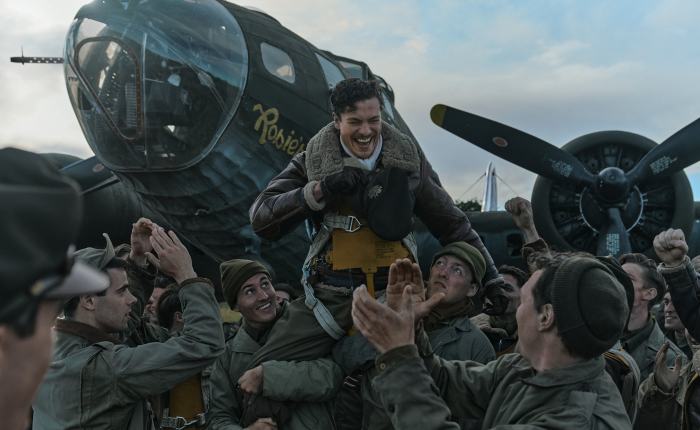
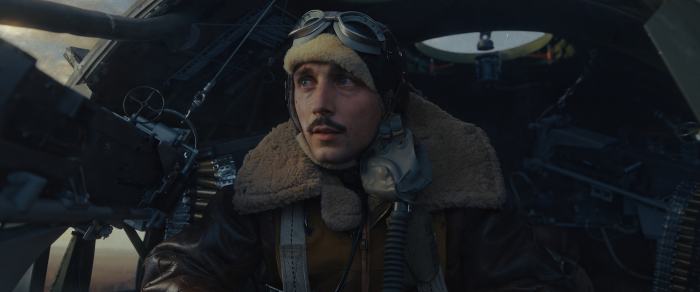
Masters_Of_The_Air_Photo_010902
Nate Mann in Masters of the Air. (Source: Apple TV+)

Crosby himself is dealing with many changes in his life. During the latter months at Thorpe Abbotts, we can see that he is becoming more challenging to live with as the only original group member to remain with the 100th Bomb Group throughout the war. At one point, he physically assaults another officer for failing to have the equipment room ready for the combat crews as they are trying to get their parachutes for the upcoming raid. This is something that Crosby notes in his book, A Wing and a Prayer, on several occasions, which is partially why he was sent on leave to the United States. When Rosenthal returns, Crosby updates him on his life and the fact that he will become a father. Crosby doubts whether he will be a good father after everything he has gone through. He also hints at his doubts about the morality of some of the bombings that they are doing. Rosenthal lets Crosby know he will be a good father and tries to get him to put aside his doubts about the air war. This is another good discussion because it shows the divisions airmen felt over their attacks against Germany. It also shows how the war has changed Crosby and Rosenthal. Rosenthal gains confidence that they are doing the right thing in the air war after his experiences on the ground, but Crosby has doubts due to the destruction of German cities and significant losses of life.

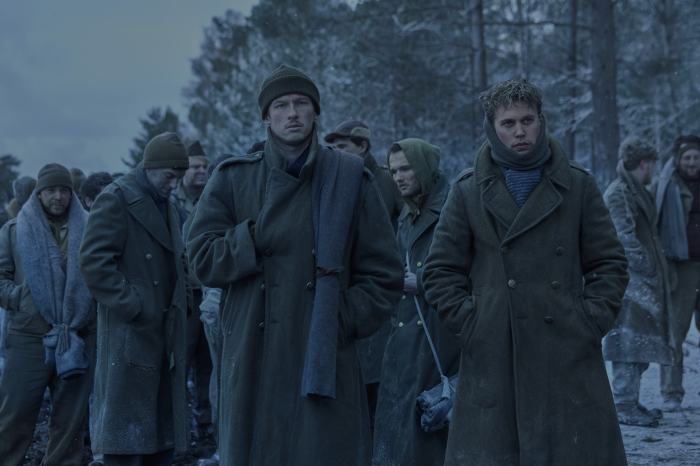
Clevan and Egan are given short notice that they have only minutes to pack as they are about to leave Stalag Luft III with the Soviets driving towards the camp. This is the beginning of their march to a new camp, Stalag VII-A, located in Moosburg, Germany. On the march, we see the Americans witness the downfall of Nazi Germany within Germany itself. We still see the prisoners attacked and strafed by United States Army Air Force P-51 Mustangs, which misidentified them as a troop column. In another instance, we see the fanatical support for Hitler’s Germany in one of the guards participating in the march. At the same time, we see an armoured column of German soldiers pass the prisoners. Those in the armoured column clearly look beaten. In addition to the veterans who have seen too much combat in a war that they have clearly lost by this point, we also see the images of young boys and older men in the armoured formation. As the column gets closer to Moosburg, Clevan sees an opportunity for a number of other prisoners to attempt to escape. Realising that he will not make it, Egan obstructs the German guards pursuing Clevan and his comrades. This is where Egan really shines. Instead of trying to make a bolt for it, he helps his friend and comrades escape. Thus ensuring he would remain a prisoner for the remainder of the war. The story for Egan ends when he is liberated from Moosburg with the other prisoners by the US 14th Armored Division.

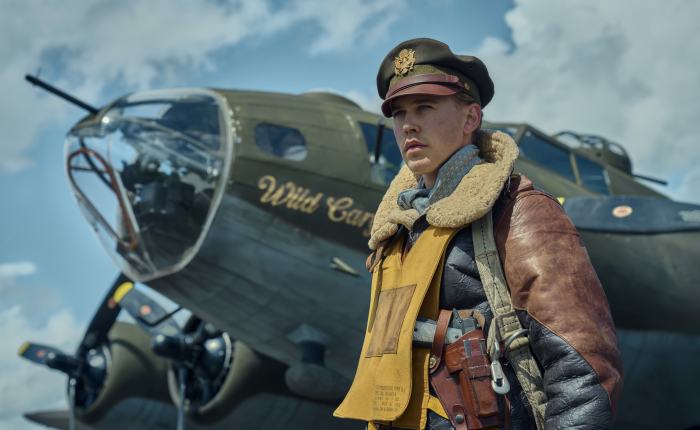
Masters_Of_The_Air_Photo_010904
Callum Turner and Austin Butler in Masters of the Air (Source: Apple TV+)

The episode ends with the ground personnel packing up Thorpe Abbotts and the 100th Bomb Group taking off to return home to the United States. While the aircrews fly back on their planes, the ground echelon returns to the United States via troop transport across the Atlantic. The series ends on a sombre note. During their final pre-flight check, Egan asks Clevan what he is thinking. Clevan responds by stating that he is thinking about the airmen they left behind. Due to the high attrition rate in the air war, many viewers struggled to connect with many of the new crews as the original members of the 100th Bomb Group were shot down. For men like Egan and Clevan, the losses of their comrades like Biddick and Bubbles, stuck with them long after the war. This brief moment tries to remind viewers of the high losses that the 100th Bomb Group and US Eighth Air Force suffered throughout the war.

Like previous episodes, this one has a couple of missed opportunities. First, seeing more of the US 332nd Fighter Group in this episode and the rest of the series would have been nice. Viewers never really saw the group conduct bomber escort missions, which it became known for throughout the air war. Additionally, there was an opportunity to cover Operation Thunderclap and the firebombing of Dresden from 13 to 15 February 1945. This would have provided better context for the viewers as Crosby and Rosenthal discuss the merits of the air war itself. Finally, I will state that the British spy plot that was dropped during the episode was the smart call to save airtime from tying off the other plot lines developed throughout the series. This decision did make me wonder why that story was even being told in the first place.

Overall, Masters of the Air has now become the best depiction of the American experience in the air war over Europe on screen. While this series has a lot of flaws, which I have noted throughout these reviews, it covers more ground than other depictions of the air war well. Also, it captures the nature of the fighting in ways that previous depictions could not be due to the technological limitations of their times. This series did a good job of paying homage to the experience of the American airman while also showing the brutality of air combat. Whereas previous depictions of air warfare chose to depict combat in the skies as more knightly duels or did not have the technological capabilities to fully capture the horrors of the air war, this series brought the struggles of the American airman front and centre. Scholars now have a series they can better use to talk about the air war with students and the public. I hope this series will inspire many young viewers to be the next generation of air power historians who usher in more scholarship on this subject at a time when it is most needed. While it is too early to tell, this series has renewed interest in the air war and the men who flew these planes into combat. If that is the only legacy of the television series, it has already contributed significantly to the field by renewing interest in the topic.

Dr Luke Truxal is an adjunct at Columbia State Community College in Tennessee. He completed his PhD in 2018 at the University of North Texas with his dissertation, ‘Command Unity and the Air War Against Germany.’ His previous publications include ‘Bombing the Romanian Rail Network’ in the Spring 2018 issue of Air Power History. He also wrote ‘The Politics of Operational Planning: Ira Eaker and the Combined Bomber Offensive in 1943’ in the Journal of Military Aviation History. In addition, Truxal is researching the effectiveness of joint air operations between the Allied air forces in the Second World War. He can be reached on Twitter at @Luke_Truxal.

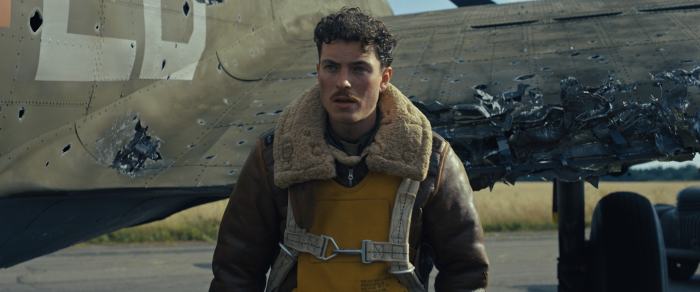
Header image:  Austin Butler in Masters of the Air. (Source: Apple TV+)

#FilmReview – Masters of the Air, Episode Seven

#FilmReview – Masters of the Air, Episode Seven

By Dr Luke Truxal

Editorial note: On 26 January 2024, Apple TV+ launched the much-anticipated series Masters of the Air. This series follows the actions of the US 100th Bomb Group during the Combined Bomber Offensive in the Second World War. As the series is being aired, our Book Reviews Editor, Dr Luke Truxal, the author of Uniting against the Reich (2023), will critically review each episode.  

For the first time in the Masters of the Air television series, I was genuinely disappointed in an episode. There were two significant issues with this episode. The first major problem has now become a glaring problem for the show, which is the inability to tell a story outside the US 100th Bomb Group with the quality that it deserves. This is either because the show relies so heavily on veteran accounts that it cannot tell the larger story or because the show only half-heartedly covers the topic, like checking a box on an essay due at the end of class. The second major issue is that this episode wasted priceless minutes of television time covering stories and plots that, in the grand scheme of things, are not as important as other aspects of the air war. In many respects, this is likely a major reason why the show will do some more box-checking in the coming episodes. The series spends too much screen time on less critical plots and must condense more essential stories into the final two episodes.

For this review, I will not give an overview of the episode and jump straight into the problems because there is much to criticise. The first major issue that this episode, and the show more generally, struggle with is its treatment of those not members of the 100th Bomb Group. First, generals are written as blundering fools who do not care about their men. In the third episode, Colonel Curtis LeMay’s aggressiveness is blamed for the disaster of the Schweinfurt-Regensburg raid, even though he flew in the lead plane for the mission. Also, it left out the debates that US VIII Bomber Command struggled with in determining whether to send out the raid. This theme continued in this episode. While the episode did a good job of covering the aftermath of the 6 March 1944 Berlin raid well, during the planning and briefing of the 8 March raid, the writers decided to portray the commander of the US Eighth Air Force, Lieutenant General James Doolittle, and the commander of the United States Strategic Air Forces in Europe, Lieutenant General Carl Spaatz, as blundering fools who are using the same navigational route for back to back raids. As an audience member, it is hard to decide whether the showrunners want us to believe these men are unintelligent, lazy, or do not care. Most likely all the above. For perspective, the navigational route was chosen because it avoided flak concentrations and limited combat losses.[1]

Masters_Of_The_Air_Photo_010707
Kai Alexander and Bailey Brook in Masters of the Air. (Source: Apple TV+)

The show did not stop there. At the end of this episode, the new commander of the 100th Bomb Group, Lieutenant Colonel John Bennett, lays out the latest air strategy for gaining air superiority at the end of the episode to Captain Robert Rosenthal. He states that the new strategy going into March and April 1944 will be to win the air war by using the bombers as bait for the fighters so that the newly arrived long-range escort fighters, the North American P-51 Mustangs, can shoot down the German fighters. There are so many ways in which that scene does an injustice to the strategic, operational, and tactical changes Spaatz and Doolittle implemented at the beginning of 1944. Starting with the strategic picture. Spaatz rightfully argued that Operation OVERLORD could not go forward if the air superiority had not been gained before troops began landing in Normandy. This was a huge point of contention between Spaatz and the commander of the Allied Expeditionary Air Forces, Air Chief Marshal Leigh-Mallory.[2] Spaatz went into 1944 to grind down the Luftwaffe through a large series of air battles carried out through the skilful concentration of all American air forces in the European and Mediterranean Theaters of Operations. Spaatz deserves much credit for bringing maximum pressure to bear on the Luftwaffe and degrading their combat effectiveness, starting with Big Week from 20 to 25 February 1944 and continuing through March and April 1944. Furthermore, the tactical changes implemented by the Eighth Air Force came from Doolittle. Doolittle changed the fighter tactics when he took over the Eighth Air Force from Lieutenant General Ira Eaker in January 1944. This came in two parts. First, American fighter pilots were no longer merely escorts as they were in 1943. Once engaged, American fighter pilots were to pursue German fighters even if it meant leaving the bomber stream. This was a more effective means to gain air superiority by prioritising shooting down German fighters. Additionally, Doolittle adopted the idea of using a bouncing fighter group, whose job was to roam the edges of the bomber formation in search of German fighters preparing to attack the bombers. These are well-known changes to scholars of the air war and can be easily told on screen to an audience. However, by stating that the generals wanted to use the bombers as bait, the show has given the impression to the audience that the American generals do not care about their losses and that this is simply a numbers game for the brass.

Another problem with this show is the anti-British bias that shows up. By this point, I wonder whether the showrunners think the British military can do anything well. While the criticisms of the British night bombing strategy in the second episode of the series were warranted, the scene did not convey the message well. I initially thought this was merely a poorly written-scene. At this point in the series, I think it is safe to say that whoever is writing the scenes regarding the British military holds them in contempt. It comes up again and again throughout the episodes. Sometimes in tiny doses. At other times, quite openly, as we saw in episodes two and six. In this episode, we get two more doses of British failures. While listening to the radio at Stalag Luft III, the Americans hear about the British failure to take Monte Casino in Italy. Later in the episode, there is the failure of the Great Escape, in which 76 British and Commonwealth prisoners escape the camp. Only three can evade captivity and get back home. Of the 73 that were captured, 50 were executed in retaliation. This is a significant moment for those living at Stalag Luft III and is a sign of British and Commonwealth prisoners continuing to wage war against the Germans using whatever means are at their disposal, including escape. Instead, it is portrayed as another British failure, and the consequences make life at the camp harder for the Americans of the 100th Bomb Group interred there. These are just two examples of the shortcomings of this show to tell the bigger picture. Where Band of Brothers (2001) and The Pacific (2010) did a much better job providing context, Masters of the Air has fallen dreadfully short by putting so much emphasis on the perspective of the airmen. There is no sugarcoating it: this show is bad at telling stories outside the 100th Bomb Group.

These problems pale in comparison to the poor use of screen time in this episode. Much of this episode was dedicated to two plots that did not serve a significant purpose and took away screen time to lay the groundwork for more critical plots. First, much of the plot at Stalag Luft III centred on maintaining some news of the outside world using a handmade radio that the airmen kept hidden. While this did indeed happen, the radio plot took away time that could have be en better spent. While at Stalag Luft III, Major John Egan handled security, and Major Buck Clevan oversaw education at the South Compound.[3] Telling these stories provides more insight into camp life than focusing on losing and rebuilding a radio. Furthermore, the show ended teasing that the Tuskegee airmen would first appear in the eighth or nine episodes. It would have been nice to use some of the time in this episode to show the challenges black airmen faced in their fight to serve their country as fighter pilots and help orchestrate significant civil rights changes in the military through their service. Instead, like with the film Red Tails, Masters of the Air has chosen to skip the crucial challenges faced during training in the United States. This was a big missed opportunity. This is why this episode is so bad. The US 332nd Fighter Group’s story deserves more than a token appearance in the television series. Either tell the story well or save that story for a different television series. Simply throwing this story in without telling the back story does not do the history or airmen justice. For a better portrayal of black fighter pilots’ challenges, see the film The Tuskegee Airmen (1995).

This episode was a disappointment. This review cannot do a proper recap and review that covers every issue with this episode. Instead, I highlighted major flaws and trends in the episode and series. The treatment of other nationalities fighting against the Axis and the treatment of high-ranking officers do this series and subject a disservice. These are symptoms of long-growing problems with this show. This specific episode wasted valuable screen time on less essential plots like Captain Harry Crosby’s fictional infidelity and the time spent fixing a radio. By spending valuable minutes on these storylines, the show missed great opportunities to tell important narratives. This will have grave consequences as the show tries to introduce new storylines and wrap up the show in the final two episodes. Unfortunately, this is where the show is headed. Masters of the Air seems determined to give token coverage to serious issues while wasting valuable time on less important topics. This is an unfortunate development for a show I have come to enjoy.

Dr Luke Truxal is an adjunct at Columbia State Community College in Tennessee. He completed his PhD in 2018 from the University of North Texas with his dissertation ‘Command Unity and the Air War Against Germany.’ His previous publications include ‘Bombing the Romanian Rail Network’ in the Spring 2018 issue of Air Power History. He also wrote ‘The Politics of Operational Planning: Ira Eaker and the Combined Bomber Offensive in 1943’ in the Journal of Military Aviation History. In addition, Truxal is researching the effectiveness of joint air operations between the Allied air forces in the Second World War. He can be reached on Twitter at @Luke_Truxal.

Header image: Nate Mann in Masters of the Air. (Source: Apple TV+)

[1]  Donald Caldwell and Richard Muller, The Luftwaffe Over Germany: Defense of the Reich (Barnsley: Frontline Books, 2014), p. 168.

[2] Luke Truxal, Uniting Against the Reich: The American Air War in Europe, (Lexington: University Press of Kentucky, 2023), p. 115-7.

[3] Donald Miller, Masters of the Air: America’s Bomber Boys Who Fought the Air War Against Nazi Germany (New York: Simon and Schuster, 2006), p. 389.

#FilmReview – Masters of the Air, Episode Six

#FilmReview – Masters of the Air, Episode Six

By Dr Luke Truxal

Editorial note: On 26 January 2024, Apple TV+ launched the much-anticipated series Masters of the Air. This series follows the actions of the US 100th Bomb Group during the Combined Bomber Offensive in the Second World War. As the series is being aired, our Book Reviews Editor, Dr Luke Truxal, the author of Uniting against the Reich (2023), will critically review each episode.  

Episode six of Masters of the Air was a transition episode. From now on, the television series will focus on the stories of three main characters and the stories around them. Additionally, the show is now trying to broaden its perspective from the US 100th Bomb Group to tell other stories related to the air war. Overall, this episode did a good job of setting up this new format, but whether the show will benefit from changing its approach to storytelling remains to be seen.

John Orloff’s thesis in episode six is about three men running from their fates. The show begins with Major John Egan trying to evade German police, military, and civilians. For the first time in the show, Egan faces the consequences of his actions as he encounters German civilians who either fear him or want to kill him in retaliation for the American air raids that are killing civilians as collateral damage in their bombing campaign or more directly trying to kill them to bring pressure on German morale as we saw in the last episode. There are several moments where it seems like Egan will escape his fate by evading his captors, but Egan is not so fortunate. He must face the brutal experience of being a prisoner of war at Stalag Luft III.

While Egan tried to escape capture, Lieutenant Robert Rosenthal attempted to run from the burden of leadership. During the episode, Rosenthal and his crew are sent to a ‘Flak Farm’ to recuperate after being the sole plane from the 100th Bomb Group to return from the 10 October 1943 Munster raid. Rosenthal spends much of the episode distancing himself from his crew. While Rosenthal makes it clear to those around him that he feels a deep sense of duty to continue flying and fighting the war, he is also reluctant to really engage with his men during this time off. Ultimately, Rosenthal comes to terms with the reality that he is not just a pilot fighting the war against Germany but also a crucial leader for his crew and the 100th Bomb Group. This is shown in Rosenthal’s final scene. He is standing at the door of his plane and gathering the inner strength to get inside one more time. This matters to his men, and the new crews witness someone who barely survived ‘Black Week’ going back into battle with a workman-like attitude.

Finally, Captain Harry Crosby spends the episode running away from his demon, survivor’s guilt. Crosby does not discuss losing his friend, Captain Joseph ‘Bubbles’ Payne. At the beginning of the episode, he is sent to attend a series of Oxford lectures designed to encourage greater cooperation amongst Allied personnel. During this episode, he meets Subaltern Alessandra Westgate. Her role in the war is never clear, but much speculation exists. Crosby spends much of the episode trying to bury his feelings about the loss of Payne by attending lectures and parties, but he finally unloads his guilt on Westgate. He questions why he survived, and Payne did not. Ultimately, Westgate reminds Crosby that this is not his fault. It is the fault of Germany for starting this war and bringing about the destruction that has affected so many lives as a result.

Masters_Of_The_Air_Photo_010606
Austin Butler in Masters of the Air. (Source: Apple TV+)

While a solid episode, some problems need to be discussed. First, the show has gone to great lengths to try and separate the Luftwaffe and the actions of the SS and Gestapo. This plays into the ‘clean Luftwaffe’ myth, which historians like Victoria Taylor are trying to debunk with their research. The head of the Luftwaffe, Reichsmarshall Herman Goering, was one of the early members of the Nazi Party and participated in the Beer Hall Putsch in Munich. He was one of the most senior-ranking members of the Nazi Party at this point in the war. The Luftwaffe that he created embraced the ideals of the Nazi Party. The show fails to show that the Luftwaffe interrogation techniques were different because the Luftwaffe believed that they were more effective at acquiring information from American airmen. Also, this is the same Luftwaffe that executed 50 British prisoners during the Great Escape. Donald Miller wrote about why the Luftwaffe used a different interrogation approach in his book Masters of the Air.[1] This is another instance where the show might have benefited more by adding a little bit more context, but unfortunately, it failed here.

Overall, this episode showed three new aspects of the air war through the attempts by Egan, Rosenthal, and Crosby to evade their own personal battles in the air war. We see ‘Flak Houses’ covered in decent detail, the struggle of those who question why they were left behind, and finally, through Egan, we know the experience of those who try to escape but are captured. While there are problems that historians will have with this episode regarding the treatment of the Luftwaffe, this episode does highlight more aspects of the air war for audiences less educated on the experience of American airmen. Like with the first three episodes, the show struggles to put the experiences of American airmen into a broader context that audiences and scholars could really benefit from. This was another good but not great episode.

Dr Luke Truxal is an adjunct at Columbia State Community College in Tennessee. He completed his PhD in 2018 from the University of North Texas with his dissertation ‘Command Unity and the Air War Against Germany.’ His previous publications include ‘Bombing the Romanian Rail Network’ in the Spring 2018 issue of Air Power History. He also wrote ‘The Politics of Operational Planning: Ira Eaker and the Combined Bomber Offensive in 1943’ in the Journal of Military Aviation History. In addition, Truxal is researching the effectiveness of joint air operations between the Allied air forces in the Second World War. He can be reached on Twitter at @Luke_Truxal.

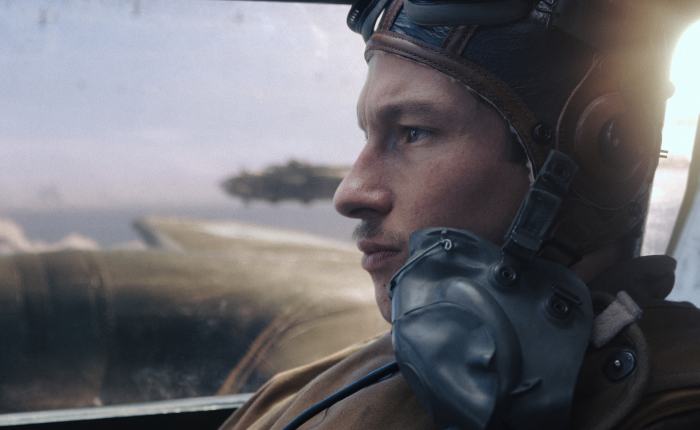
Header image: Callum Turner in Masters of the Air. (Source: Apple TV+)

[1] Donald Miller, Masters of the Air: America’s Bomber Boys Who Fought the Air War Against Nazi Germany (New York: Simon and Schuster, 2006), pp. 386-7.

#FilmReview – Masters of the Air, Episode Five

#FilmReview – Masters of the Air, Episode Five

By Dr Luke Truxal

Editorial note: On 26 January 2024, Apple TV+ launched the much-anticipated series Masters of the Air. This series follows the actions of the US 100th Bomb Group during the Combined Bomber Offensive in the Second World War. As the series is being aired, our Book Reviews Editor, Dr Luke Truxal, the author of Uniting against the Reich (2023), will critically review each episode.

At halfway through Masters of the Air, we finally reached the culmination point for the Americans during the 1943 air offensive, Black Week. There are a lot of essential storylines that the creators of Masters of the Air needed to nail with the exact right tone. For the first time in a televised depiction of the American air war against Germany, we get two new major themes the series tries to address. First, losing. Black Week, which lasted from 8 to 14 October 1943, was the final straw for the US Eighth Air Force. During the course of the week, American aircrew and bomber losses reached such a level that they could no longer maintain their air offensive. Films such as Twelve O’clock High (1949) and Memphis Belle (1990) depict the mounting casualties, but we never see the Americans lose at the end of the day. Even in Band of Brothers (2001) and The Pacific (2010), Americans perform quite well. The Market-Garden episode was the only episode amongst those previous works that depicted a setback, but it was only for a single episode. Masters of the Air has been building to this point since it began. Another major topic that the series addresses that usually gets overlooked on film is attacks on German civilians. Previous depictions of the air war typically avoid discussing the morality of the air war, but Masters of the Air takes it on. This episode breaks much ground in how the air war is depicted on film. For the first time, audiences are getting to see an American campaign end in a loss, and the United States shift towards attacks against civilians.

The episode begins with Major John Egan drinking in a B-17 Flying Fortress and struggling with losing his good friend, Major Gale Clevan. Egan has been hit hardest by the loss of his good friend. While the group is reeling, they do get some good news with the arrival of Captain Everett Blakely’s crew and navigator Second Lieutenant Harry Crosby. After everyone reconvenes at the bar, we soon learn that Crosby has been promoted to group navigator and Captain Joseph ‘Bubbles’ Payne has been demoted. Crosby is told to report to headquarters when the red light flashes to begin planning the next mission. On cue, the red light starts flashing, and viewers get a behind-the-curtain look at the chaos that occurs as the group plans for its next raid. It is not unheard of for those involved in planning to work nights and sleep during the day. Crosby mentions the stress of planning and briefing his fellow navigators. He feels the weight of the whole group on his shoulders and wonders if something he did wrong could lead to calamity.

During the briefing, the new mission and target are announced. It is Munster. The target is the marshalling yards in the city centre. During the briefing, it was also noted that the bombs would likely also hit German workers living next to the rail yards. The yards are next to the town cathedral, and the mission is flown on Sunday, 10 October 1943. This does not sit well with group members like the veteran Captain Charles Cruikshanks. He and Egan argue over the merits of attacking German civilians, including women and children. Egan argues that it will bring the war to an end earlier, but despite his words, this is really about revenge. As the conversation ends, Cruikshanks is still clearly unhappy with the tenor of the conversation and target selection. This great scene shows the divide among American airmen over the shift to area bombing during the war. American airmen knew attacking civilians through area bombing was both a war crime and morally wrong. Also, this was not how they were trained to prosecute their air offensive. Yet others, like Egan, thought it was a way to hasten the war’s end. It is a great scene that does not seek to justify area bombing but simultaneously exposes the divisions amongst the Americans over the switch in tactics. A lot of television series and movies would have punted on this topic. John Orloff, who wrote this episode, deserves much credit for tackling this subject and writing these scenes well.

Masters_of_the_Air__Photo_010503
Nate Mann in Masters of the Air, episode five. (Source: AppleTV+)

As the bombers take off, we learn that the 100th Bomb Group can only muster 17 B-17s for this raid, many of which are loaned to them by other groups. As the groups formed, we quickly learned that the 100th Bomb Group was too far behind the rest of the 14th Bombardment Wing. Making matters worse, four B-17s had to turn back due to aircraft malfunctions, leaving the strike force with only 13 B-17s. They are too far back from the other groups and short on aircraft. Egan notes that they are a perfect target for the Luftwaffe. As the bombers approached the target, German fighters attacked in massive head-on passes. One can understand why viewers might think this scene is an embellishment of the actual air battle, but it was not. Approximately 200 German fighters attacked the 14th Bombardment Wing, singling out the 100th Bomb Group in the rear of the formation. In a matter of minutes, veterans that we had come to love are shot down. Egan and Brady bail out, Cruikshanks falls out of formation, and his crew bail out, and finally, we see the B-17 with Bubbles on it take a direct hit and collide with another B-17, killing him in the explosion. The perspective has switched to Rosenthal’s aircraft and crew by this point. The combat is so fast and intense that Rosenthal and the viewers experience the same shock when they realize his ship is the last in the formation, still in the air. The music is great here to create a sense of both eeriness and fear as the aircrew comes to grips with the fact that an entire bomb group has been blasted out of the sky for the first time in the air war. During the historical raid, German fighters eliminated the 100th Bomb Group during the first 10 minutes of a 45-minute air battle.[1] The show does a great job of showing how fast and sudden these losses are.

Back at Thorpe Abbotts, everyone waits for the return of the bombers. The first sign that something is wrong occurs when a bomber from the 390th Bomb Group arrives at the airfield. Colonel Neil “Chic” Harding calls the bomber to ask what happened to his bombers and soon finds out that they are all gone. As this occurs, Rosenthal’s plane returns, giving some hope that more might have made it back. That hope is soon dashed as Rosenthal’s crew relates the mission’s events in interrogation. The mood is sombre. The episode ends with Crosby packing up his good friend Bubbles’ foot locker to send home to his family. This is where Crosby finally breaks down and cries. For many of the airmen and ground personnel in the 100th Bomb Group they have reached the end of the line for this campaign physically and emotionally. This is how the 1943 campaign ended for many other groups. This is where we leave the 100th Bomb Group in the next episode. Episodes four and five are the best of the series by far. We have seen the morality of the air war brought into question, and the Americans lost the air war in 1943. Those who worked on this project went on a limb in the last two episodes by depicting sides of the air war that scholars are familiar with but rarely make their way to the big screen. They have created two great episodes that audiences can absorb, and scholars can use to teach about the air war.

Dr Luke Truxal is an adjunct at Columbia State Community College in Tennessee. He completed his PhD in 2018 from the University of North Texas with his dissertation ‘Command Unity and the Air War Against Germany.’ His previous publications include ‘Bombing the Romanian Rail Network’ in the Spring 2018 issue of Air Power History. He also wrote ‘The Politics of Operational Planning: Ira Eaker and the Combined Bomber Offensive in 1943’ in the Journal of Military Aviation History. In addition, Truxal is researching the effectiveness of joint air operations between the Allied air forces in the Second World War. He can be reached on Twitter at @Luke_Truxal.

Header image: Callum Turner in Masters of the Air. (Source: Apple TV+)

[1] Donald Caldwell and Richard Muller, The Luftwaffe Over Germany: Defense of the Reich (Barnsley: Frontline Books, 2014), pp. 132-4.

#FilmReview – Masters of the Air, Episode Four

#FilmReview – Masters of the Air, Episode Four

By Dr Luke Truxal

Editorial note: On 26 January 2024, Apple TV+ launched the much-anticipated series Masters of the Air. This series follows the actions of the US 100th Bomb Group during the Combined Bomber Offensive in the Second World War. As the series is being aired, our Book Reviews Editor, Dr Luke Truxal, the author of Uniting against the Reich (2023), will critically review each episode.

The fourth episode of Masters of the Air was about those left behind. This is meant literally in the sense that we do not go up in the air with the planes after they take off, but we also see many of the characters on the show struggle with loss during the war. The result is that we get a good episode that portrays the struggles of airmen, ground crews, resistance fighters, and civilians left on the ground. This review will examine the episode’s analysis and responses to grief thematically rather than tackle the episode chronologically, as in past reviews.

The episode begins with a party after Lieutenant Glenn Dye’s crew completes their 25th mission. This will be the first and only crew of the original 100th Bomb Group to complete their tour of duty and go home. At the party, we are introduced to two new characters, Lieutenant Herbert Nash and Lieutenant Robert ‘Rosie’ Rosenthal. Both are green but capable and eager pilots. During the episode, Nash dances and flirts with Helen, who works for the Red Cross at Thorpe Abbotts. There are sparks between these two characters. At the same time, Rosenthal tries to understand better what he is flying into by talking to Major Gale Clevan. Nash is more successful in flirtations than Rosenthal in feeling out the veteran pilots about the nature of air combat. As the aircrews depart for their first mission the following day, Nash makes a last pass at Helen with a line that foreshadows his fate, “You might be the last pretty face that I ever see.” Nash’s fate is shown off-screen, and it falls on Rosenthal to deliver the shocking news to the young woman with whom he had developed a budding romance. In the same sequence, the news is broken to the group that Clevan and Crosby had gone down. The news that the group’s best pilot and navigator went down in separate planes stuns the group. Colonel Neil ‘Chick’ Harding and Lieutenant Joseph ‘Bubbles’ Payne express the shock that the group and audience feel when the news is broken. Two of the more critical anchors for the group have now been lost off-screen. The show does an excellent job of showing how the loss of these veteran aircrews impacts morale.

Masters_of_the_Air_Photo_010408
Callum Turner and Joanna Kulig in Masters of the Air. (Source: Apple TV+)

Along with shock, we see sympathy and grief for those living under the bombs. During the episode, Egan walks about a series of bombed homes while on leave in London. He finally can see the results of what bombing does to civilians. As he watches the rescue crews work we hear the scream of a woman who lost what appears to be her daughter. While short, this was a hard scene to watch. Seeing the woman pull the dead child out of the rubble builds sympathy between the viewers and the bombed. It is a great scene to include. It is easy for the audience to get lost in the air-to-air combat, but these bombs have consequences. Even those who play no part in this war, such as children, suffer from the air war. It is a well-written and executed scene.

Another element of processing grief for those in combat is the sense of guilt that those who survived feel. This is an area where Masters of the Air has surpassed both Band of Brothers (2001) and The Pacific (2010), in my opinion. That is not to say that the previous series ever avoided the topic, and The Pacific did lean into the post-war struggles of Eugene Sledge with post-traumatic stress syndrome. However, we never saw it portrayed so personally, with Sergeant William Quinn’s decision to leave Sergeant William Hinton behind, trapped on the B-17 Flying Fortress before it exploded. Throughout his time on the run, Quinn grapples with his guilt over leaving his comrade behind. It eats at him throughout the whole episode more so than the fear of being captured by the Germans as his fellow airmen keep asking him about what happens. This plot ends with another crewman who survived the crash, Sergeant Charles Bailey, comforting Quinn. Bailey tells Quinn that he would have made the same decision as well. Some viewers will find it easy to judge Quinn for his actions in the previous episode, but as the show eloquently shows, many of us would have made the same decision in the same circumstances. To me, this was a powerful sequence of scenes paired with the scenes of Sledge at the end of The Pacific; we get a better sense of the survivor’s guilt and its aftermath.

The last element of grief that the episode deals with is anger. During the episode, Major John Egan goes on leave in London and meets a Polish woman with whom he sleeps. As they are in bed together, they watch German bombers strike London from a distance. Egan admits that this is the first time he has seen this side of the air war. As they continue talking, the Polish woman expresses her anger and desire for revenge against the Germans for the war that they unleashed. This scene sets up viewers perfectly for Egan in this episode and in episode five. After finishing his night with the woman, Egan sees the woman grieving the loss of her daughter. He then sees a newspaper highlighting the heavy losses that the Eighth Air Force suffered on the most recent raid. Egan calls Thorpe Abbotts to learn the fate of the 100th Bomb Group and, more importantly, his best friend Clevan. Egan ends the episode by lobbying to be on the next mission. In the teaser at the end of the episode, we see that Egan desires revenge against not only the Luftwaffe but all Germans for the loss of his friend.

This might go down as one of the series’ more important episodes. It broadened the audience’s perspective of the air war. It showed the ground crews, the bombed, and how they fought the air war in their way. Some struggled to process the shock of loss either in the air or on the ground. Others struggled with survivor’s guilt. Finally, we see many turn their grief into anger and desire for payback for the anguish that they feel for the loss of their loved ones. In an episode where grief took centre stage and, in many forms, this episode handled such a delicate topic as well as you can on screen. I think this is arguably the best episode of the series up to this point.

Dr Luke Truxal is an adjunct at Columbia State Community College in Tennessee. He completed his PhD in 2018 from the University of North Texas with his dissertation ‘Command Unity and the Air War Against Germany.’ His previous publications include ‘Bombing the Romanian Rail Network’ in the Spring 2018 issue of Air Power History. He also wrote ‘The Politics of Operational Planning: Ira Eaker and the Combined Bomber Offensive in 1943’ in the Journal of Military Aviation History. In addition, Truxal is researching the effectiveness of joint air operations between the Allied air forces in the Second World War. He can be reached on Twitter at @Luke_Truxal.

Header image: Edward Ashley and Austin Butler in Masters of the Air. (Source: Apple TV+)

#FilmReview – Masters of the Air, Episode Three

#FilmReview – Masters of the Air, Episode Three

By Dr Luke Truxal

Editorial note: On 26 January 2024, Apple TV+ launched the much-anticipated series Masters of the Air. This series follows the actions of the US 100th Bomb Group during the Combined Bomber Offensive in the Second World War. As the series is being aired, our Book Reviews Editor, Dr Luke Truxal, the author of Uniting against the Reich (2023), will provide a critical review of each episode.

Three episodes in, we now better understand what the series Masters of the Air does well and where the show falls short. Let me begin this review by stating that I enjoy the series and what it deliers. Viewers gain a better perspective of the air war from the airmen who flew the missions than previous depictions. The show does justice to the US 100th Bomb Group and tells its story. This is still a good episode and series despite the criticism you will see at the end of this review. I will still recommend it to others. My problem is that the show fails to reach its full potential in telling this story. I think this is where the shows Band of Brothers (2001) and The Pacific (2010) really soared and why, for me, Masters of the Air feels so close but still not on the same level.

This week’s episode was the fateful Schweinfurt-Regensburg mission on 17 August 1943. The raid was the second unmitigated disaster that the Americans suffered in the air war that month. On 1 August 1943, the US Ninth Air Force attacked the Romanian oil refineries at Ploiești with five B-24 groups, three of which were on loan from the US Eighth Air Force. While the raid succeeded in damaging the refineries, it failed to stop Romanian oil production at the cost of 54 Consolidated B-24 Liberators and 310 airmen.[1] While Ploiești does not appear in the episode, it is crucial to understand the context of the air war in 1943. These were some of the darkest days of the air war for the Americans. The episode begins with a briefing about the Schweinfurt-Regensburg mission. Colonel Neil Harding, portrayed by James Murray, does a great job at explaining the nature of the mission, bad sports metaphors aside. The first strike force, which included the 100th Bomb Group, was to strike at German aircraft factories at Regensburg, thus drawing the bulk of the German fighter force onto their formation. He correctly explains that the bombers behind the 100th Bomb Group will move towards Schweinfurt and strike at German ball-bearing production with less resistance. The audience now has a great understanding of how the mission is supposed to work on paper.

Masters_Of_The_Air_Photo_010305
Elliot Warren as Lieutenant James Douglass, a bombardier with the US 100th Bomb Group who flies with Harry Crosby. (Source: Apple TV+)

The thesis of this entire episode was about the choices that soldiers make in war and how they impact the lives of those around them. It all begins with the poor weather delays that affected the execution of the raid. This led the US Eighth Air Force to send out Colonel Curtis LeMay’s Regensburg force five hours ahead of the rest of the force. During the raid, the creators of the show highlight several vital moments when decisions have to be made that affect the lives of the airmen in this episode. The first happens when Roy Claytor’s plane is shot down. As the crew bails out, the ball turret gunner, Sergeant William Hinton, becomes trapped and cannot escape. Sergeant William Quinn, the radio operator, hears his calls and tries to aid him as the rest of the crew bail out. Unfortunately, the plane enters a spin, and the force throws Quinn against the wall. He has to choose between his life and Hinton’s. He chooses his own. Later, we see that same choice posed to Quinn again when he speaks to a member of the Belgian resistance and has to decide if he wants to try to escape or spend the remainder of the war in a prison camp. His choice has not yet been revealed, and the scene ends on a cliffhanger. Lieutenant Curtis Biddick is the second character to face a life-or-death decision. His plane is hit during the raid, and his co-pilot, Lieutenant Richard Snyder, is severely wounded. In an emotionally impactful scene, Biddick decides to try and crash land the plane to save Snyder. The rest of the crew bail out successfully, and for a moment, it appears Biddick has once again pulled off the impossible. Unfortunately, he can’t maintain control of his Boeing B-17 Flying Fortress as it crashes into the ground in a massive explosion. The final major choice we see throughout the raid is Major Gale Clevan’s choice not to bail out and keep pushing his aircraft through the raid. His choice to keep pushing on paid off, with his plane landing just short of the runway at Telergma in the French colony of Algeria. Throughout the entire episode, there are several moments where the show makes it very clear that Clevan’s decision to press on could have had catastrophic consequences for him and his crew. The show did an excellent job at showing the choices that the young airmen of the 100th Bomb Group, many in their late teens and early twenties, had to make in split seconds and their consequences.

For an episode that emphasized the importance of the decisions made in war, the biggest one was left out. On the morning of 17 August 1943, the head of the US VIII Bomber Command, Brigadier General Frederick Anderson, had to decide whether or not to scrap the Schweinfurt-Regensburg mission. Anderson, like the commander of the Eighth Air Force, Major General Ira Eaker, was under immense pressure to execute this mission. General Henry Arnold, the US Army Air Forces commander, had taken a great personal interest in the raid and its success. The raid had been put off before due to poor weather. Additionally, the Regensburg force had to leave with enough time to have light remaining to land when they reached Algeria. Anderson ultimately made the call to send LeMay’s force first through the fog while waiting for the rest of the fog to dissipate before sending the rest of the bombers. This is how the two forces end up five hours apart. [2] This brings me to my biggest criticism of the show. Three episodes in, the show struggles to discuss the air war’s wider context. In the second episode, the writers poorly executed a scene to introduce the doctrine debates between the Americans. In this episode, the decision to not fly the mission as planned does not appear on the screen, which was the raid’s most important decision. This was a big missed opportunity for the creators of Masters of the Air. Anderson had to live with the fact that his decision on 17 August 1943 cost the Eighth Air Force sixty B-17s and 559 airmen either killed or missing.[3]

When it comes to telling the story of the 100th Bomb Group and its experience during the raid, this episode did an excellent job. It showed the life-or-death decisions these young men had to make in seconds, and if they were lucky, they would have to live with the consequences of those decisions. Yet, the quality of the television show could be much improved by occasionally widening its perspective. The series has become so zoomed in on the 100th Bomb Group that it struggles to tell the bigger picture of the air war. Adding a short scene here or there to add that big-picture perspective would bring everything together and make this television series genuinely extraordinary. My criticisms aside, this is still the best series on the air war I have seen, and it deserves to be in the same conversation as the 1949 film Twelve O’clock High.

Dr Luke Truxal is an adjunct at Columbia State Community College in Tennessee. He completed his PhD in 2018 from the University of North Texas with his dissertation ‘Command Unity and the Air War Against Germany.’ His previous publications include ‘Bombing the Romanian Rail Network’ in the Spring 2018 issue of Air Power History. He also wrote ‘The Politics of Operational Planning: Ira Eaker and the Combined Bomber Offensive in 1943’ in the Journal of Military Aviation History. In addition, Truxal is researching the effectiveness of joint air operations between the Allied air forces in the Second World War. He can be reached on Twitter at @Luke_Truxal.

Header image: Edward Ashley, Matt Gavan, Callum Turner and Anthony Boyle in Masters of the Air (Source: Apple TV+)

[1] Jay A. Stout, Fortress Ploesti: The Campaign to Destroy Hitler’s Oil (Havertown, PA: Casemate Publishers, 2011), p. 76.

[2] Luke Truxal, Uniting against the Reich: The American Air War in Europe (Lexington, KT: University Press of Kentucky, 2023), pp. 71-3.

[3] Truxal, Uniting Against the Reich, pp. 76-7.

#FilmReview – Masters of the Air, Episodes One and Two

#FilmReview – Masters of the Air, Episodes One and Two

By Dr Luke Truxal

Editorial note: On 26 January 2024, Apple TV+ launched the much-anticipated series Masters of the Air. This series follows the actions of the US 100th Bomb Group during the Combined Bomber Offensive in the Second World War. As the series is being aired, our Book Reviews Editor, Dr Luke Truxal, the author of Uniting against the Reich (2023), will critically review each episode.

The first two episodes of the Apple TV+ television series Masters of the Air are a great introduction to the air war for those less familiar with the subject. Yet, they also treat the subject with the seriousness that scholars of the air war demand from media portrayals. Stylistically, the episodes blend the storytelling style of the famous documentary Target for Today (1944) with the drama of the more famous film Twelve O’clock High (1949). Other films on air power, such as Top Gun (1986), tend to romanticize or glorify air-to-air combat. The episodes do not do that. Instead, viewers better understand the nature of combat in the skies above Europe. This one-two-punch season opener stands strong on its own. This was a very promising start for Masters of the Air.

These were two great episodes for those unfamiliar with the air war in Europe. The first episode centres around the US 100th Bomb Group, which became famous for the high losses that it suffered during the summer and fall of 1943. For those who wish to spoil themselves, read the book the series is based on, Don Miller’s eponymous Masters of the Air, or Harry Crosby’s memoirs A Wing and a Prayer. John Orloff, who created the series, uses the 100th Bomb Group as a vessel to tell the larger story of the American experience in the air war. The opening scenes show young pilots and their aircrews eager to enter combat. By the end of the first episode, they return, having experienced the true horrors of fighting high above the skies in subzero temperatures.

Their first mission to Bremen begins as an introduction to what a typical mission is like for the aircrews. Gale Cleven and the rest of the aircrews are woken up in the pre-dawn hours for all the work that takes place before a mission. As the time gets closer to the start of the mission, viewers can feel the tension building slowly until the aircraft take off. During the mission, viewers get a taste of the dangers aircrews faced, such as forming up in cloud cover, flak, and German fighters. The combat scenes in this episode are fast-paced and intense. Fighters whiz by the formation in the blink of an eye, and gunners struggle to keep up with the speed of combat. Keep in mind that German pilots approached from the front to limit the ability of the bomber formation to concentrate its guns on the fighters. Doing so significantly increased the closing speed between the fighters and the bombers. Masters of the Air is not the Memphis Belle, where combat is long and prolonged. It is quick, brutal, and deadly. This episode is a great educational tool for what a typical mission could look like.

I thought the second episode did a great job of highlighting the personal relationships between the ground crews and the British civilians living near the base at Thorpe Abbotts. We see the close bonds the children near the airfield had with the ground crew. At one point, a group of children helped the ground crew clean up oil on the runway after the planes took off. For many children, these bonds lasted a lifetime. This provides viewers insight into the American and British cultural interactions during the war.

Masters_of_the_Air__Photo_010203
Raff Law and Samuel Jordan in the second episode of Masters of the Air. (Source: Apple TV+)

No depiction of the air war on film is perfect. There are some areas where the second episode struggled, but these are few and far between. Judging by online reactions, the most controversial scene involved the doctrinal debate between American and British airmen in the pub. I believe this scene did a good job of educating the public about the doctrinal differences between the two sides without having to dive into the high-level strategy meetings that occurred on this topic. The episode also demonstrates that the two allies are quite passionate about their beliefs on how best to prosecute the air war. However, the second episode failed to grasp the attitude with which the British expressed their concerns over daylight precision bombing. The British had tried and failed to carry out their own precision bombing campaign at the beginning of the war. Their experience led them to adopt night area bombing. As the more experienced partner in the alliance, the British were concerned that the Americans might be unable to maintain the attrition rate that a daylight campaign demanded. The Americans were, however, more than willing to sustain a much higher attrition rate to execute daylight precision bombing. Instead, the writers wrote a scene that wreaked of animosity between the two groups of airmen. Had the writers changed the tone of the scene, then they might not be facing the blowback that they are today. It was one scene, but even today, the emotions of the air war still run high.

Overall, the first two episodes of Masters of the Air started the series well and educated viewers about the ugly nature of the American strategic bombing campaign from the perspective of the airmen. This episode gave the audiences the basics of what to expect from typical American raids. As a result, they set the stage for the raids that would begin to stand out more in 1943, such as the upcoming 17 August 1943 Schweinfurt-Regensburg mission, a disaster for the Eighth Air Force. Masters of the Air has done an excellent job setting up the rest of the series. Now, viewers will see whether the series can maintain its form going into the darker days of the air war in the following episodes.

Dr Luke Truxal is an adjunct at Columbia State Community College in Tennessee. He completed his PhD in 2018 from the University of North Texas with his dissertation ‘Command Unity and the Air War Against Germany.’ His previous publications include ‘Bombing the Romanian Rail Network’ in the Spring 2018 issue of Air Power History. He also wrote ‘The Politics of Operational Planning: Ira Eaker and the Combined Bomber Offensive in 1943’ in the Journal of Military Aviation History. In addition, Truxal is researching the effectiveness of joint air operations between the Allied air forces in the Second World War. He can be reached on Twitter at @Luke_Truxal.

Header image: Austin Butler as Major Gale ‘Buck’ Cleven in episode one of Masters of the Air. (Source: Apple TV+)

#ResearchNote – It is time for another Biography of Ira Eaker

#ResearchNote – It is time for another Biography of Ira Eaker

By Luke Truxal

For those who study the history of the United States Air Force and its forebears, there is a noticeable gap in the historiography regarding biographies of Second World War air force commanders. There are several biographies for men such as General Carl Spaatz, General of the Air Force Henry H. Arnold, General James Doolittle, General Curtis LeMay, and even Major General Haywood Hansell. Yet, many other prominent commanders, staff officers, and theorists do not have their own biographies. However, this research note solely focuses on General Ira Eaker, who, in 1943, commanded what became the US Eighth Air Force, the Mediterranean Allied Air Forces in 1944 and was deputy Chief of the Air Staff for the United States Army Air Forces in 1945.

md31091934332

James Parton has largely written Eaker’s history in “Air Force Spoken Here”: General Ira Eaker and the Command of the Air. Parton’s biography is a strong defence of Eaker. In many cases, he has created much of the narrative that we accept regarding Eaker’s performance as a commander during the Second World War. However, there is one problem with Parton’s book; he was Eaker’s staff officer. Given this, Parton’s book jumps between biography and personal memoir in several places. For example, when writing about Eaker’s defence of daylight precision bombing at the Casablanca Conference in 1943, Parton slips into a personal memoir. In a paragraph, he describes the trip to Spaatz’s headquarters, the poker game he played with Eaker and Spaatz, and how he edited Eaker’s proposals for the Casablanca Conference.[1] It is unclear whether this can be classified as a biography since it is unclear if Parton is writing about himself or Eaker. Also, as a staff officer deeply devoted to Eaker, Parton may not be the general’s best or most objective biographer. Simply put, Eaker needs a new biography.

For those interested in writing a biography on Eaker, there are several places to start. First, Parton’s biography is a great place to get background information on Eaker, even if the analysis is sometimes questionable. Another series of sources that need to be examined are the books that Eaker published with Arnold before the Second World War. Arnold and Eaker wrote: Army Flyer, Winged Warfare, and This Flying Game.[2] These books lay out their vision for the future of air power and, in some cases, offer analysis of air campaigns during the Second World War before the entrance of the United States into the conflict. These books give some insight into Eaker as an air power theorist and precision bombing advocate before the war. Three major archives should be consulted for wartime records. First, the Library Congress has Ira Eaker’s papers. Speaking from personal experience, they are well-organised and easy to work through. Even better, several vital figures whom Eaker corresponded with also deposited their papers at the Library of Congress. Another archive to consult is the Air Force Historical Research Agency, where you can find records on the Eighth Air Force and Mediterranean Allied Air Forces. Finally, the National Archives and Records Administration has more records and correspondence.

media-456676
Air Chief Marshal Sir Arthur Harris shakes hands with Lieutenant General Ira Eaker at a handover ceremony of a US Army Air Force airfield into RAF control, c. November 1943. (Source: IWM)

Research is not the problem with writing a biography on Eaker. He wrote a lot about air power before, during, and after the Second World War. There is much research readily available on Eaker. This is purely speculation, but the reason why there is not a biography on Eaker is most likely that it is a hard biography to write. Eaker is not a polarising figure. Biographers note that they either fall in love with or hate the person they are writing about. It is hard to do that with Eaker. He is a likeable person and, at times performs quite well as a commanding officer. Yet, he also makes several significant mistakes during the war as well. It is hard to write a book analysing an officer whom both deserves blame for the failures of the 1943 air offensives against Germany and, in the same breath, say he played a major role in the success of the air war in 1944 and 1945.

In conclusion, it is time to put the James Parton book on Eaker aside and write a new biography on Eaker to start a proper historical debate on his career. There is ample archival material available to sift through and analyse. The challenge will be how to assess his performance during the war. Here is a thought to possibly hang onto for those who might want to take up this project. Maybe the challenge of writing a biography about Eaker is that he is representative of the struggles that early American air commanders faced during the strategic bombing of Germany in 1942 and 1943. Eaker was testing new ideas in a new form of warfare and without ample resources as the commander of the Eighth Air Force. He made several errors in 1943 that was amplified by his lack of resources. Yet, with more resources and experience, his performance improved over time. In many ways, Eaker represents the struggles that many American officers faced during the air war against Germany.

Dr Luke Truxal is the Book Review Editor at From Balloons to Drones and an adjunct at Columbia State Community College in Tennessee. He completed his PhD in 2018 from the University of North Texas with his dissertation ‘Command Unity and the Air War Against Germany.’ His previous publications include ‘Bombing the Romanian Rail Network’ in the Spring 2018 issue of Air Power History. He also wrote ‘The Politics of Operational Planning: Ira Eaker and the Combined Bomber Offensive in 1943’ in the Journal of Military Aviation History. In addition, Truxal is researching the effectiveness of joint air operations between the Allied air forces in the Second World War.

Header image: Major General Ira C. Eaker presents an award to an enlisted man of the 479th Anti-Submarine Group during a ceremony at an air base in St Eval, United Kingdom, c. 1943. (Source: NARA)

[1] James Parton, “Air Force Spoken Here”: General Ira Eaker & the Command of the Air (Bethesda, MD: Adler & Adler Publishers Inc., 1986), p. 220.

[2] Henry H. Arnold and Ira C. Eaker, Army Flyer (New York: Harper & Brothers Publishers, 1942); Henry H. Arnold and Ira Eaker, Winged Warfare, (New York: Harper & Brothers Publishers, 1941); Henry H. Arnold and Ira Eaker, This Flying Game, (Ramsey, New Jersey: Funk and Wagnalls Company, 1938).

#ResearchResources – Recent Articles and Books

#ResearchResources – Recent Articles and Books

Editorial note: In this series, From Balloons to Drones highlights research resources available to researchers. Contributions range from discussions of research at various archival repositories to highlighting new publications. As part of this series, we are bringing you a monthly precis of recent articles and books published in air power history. This precis will not be exhaustive but will highlight new works published in the preceding month. Publication dates may vary around the globe and are based on those provided on the publisher’s websites. If you would like to contribute to the series, please contact our Editor-in-Chief, Dr Ross Mahoney, at airpowerstudies@gmail.com or via our contact page here.

Articles

Kristen Alexander and Kate Ariotti, ‘Mourning the Dead of the Great Escape: POWs, Grief, and the Memorial Vault of Stalag Luft III,’ Journal of War & Culture Studies (2022), DOI: 10.1080/17526272.2022.2097774.

In March 1944 seventy-six Allied prisoners of war escaped from Stalag Luft III. Nearly all were recaptured; fifty were later shot. This article examines what happened in the period between recapture and the interment of the dead prisoners’ cremated remains at Stalag Luft III. It positions what came to be known as ‘the Great Escape’ as an event of deep emotional resonance for those who grieved and reveals the dual narrative they constructed to make sense of their comrades’ deaths. In discussing the iconography of the vault constructed by the camp community to house the dead POWs’ ashes, this article also suggests a dissonance in meaning between that arising from personal, familial grief and the Imperial War Graves Commission’s standardised memorial practice. Focusing on the Great Escape’s immediate aftermath from the perspective of the POWs themselves provides a more nuanced understanding of the emotional impact of this infamous event.

Susan Allen, Sam Bell and Carla Machain, ‘Air Power, International Organizations, and Civilian Casualties in Afghanistan,’ Armed Forces & Society (2022), doi:10.1177/0095327X221100780.

Can the presence of international organizations reduce civilian deaths caused by aerial bombing? This commentary examines this question in the specific context of the U.S.-led war in Afghanistan. We evaluate this based on interviews conducted with members of international organizations that were present in Afghanistan during the conflict, existing intergovernmental organizations, nongovernmental organizations, and government reports, and with quantitative data on civilian casualties between 2008 and 2013. We conclude that there is tentative evidence from Afghanistan that international organizations can in fact reduce the severity of civilian killings that result from the use of air power. However, there is much need for greater data sharing to more fully answer this important question.

Derek Lutterbeck, ‘Airpower and Migration Control,’ Geopolitics (2022), DOI: 10.1080/14650045.2022.2094776.

Migration scholarship has thus far largely neglected the role of aircraft in both (irregular) migration and state policies aimed at controlling migration. Drawing inspiration from the field of strategic studies, where ‘airpower’ has been a key theoretical concept, this article explores the role of aerial assets in states’ migration control efforts. The article discusses three main dimensions of the use of airpower in controlling migration: the increasing resort to aircraft for border enforcement purposes – or what can be referred to as ‘vertical border policing’ –, states’ tight monitoring of the aerial migration infrastructure, and the use of aircraft in migrant return operations. As a core element of state power, it is airpower’s key features of reach, speed and height which have made it a particularly useful migration control instrument.

Priya Mirza “Sovereignty of the air’: The Indian princely states, the British Empire and carving out of air-space (1911–1933),’ History and Technology (2022), DOI: 10.1080/07341512.2022.2079370.

Who owns the skies? Under British colonialism, the ownership of the skies of India was a contested matter. The onset of aviation presented a challenge to the territorial understanding between the British and semi-sovereign Indian princes, Paramountcy (1858–1947). Technology itself was a tricky area: roadways, railways, telegraphs, and the wireless were nibbling away at the sovereign spheres which Paramountcy had put in place. This paper looks at the history of aviation in princely India, from aviation enthusiasts such as the rulers of Kapurthala, Jodhpur and Bikaner to subversive princes like the Maharaja of Patiala who worked towards a military air force. The paper tracks the three stages of the journey of aviation in princely India, from individual consumption, to the historical context of World War One which aided its access and usage, and finally, the collective princely legal assertion over the vertical air above them in the position, ‘sovereignty of air’. The government’s civil aviation policy in India remained ambiguous about the princes’ rights over the air till 1931 when their sovereignty of the sky was finally recognised. The paper focuses on the Indian princes varied engagement with aviation, modernity and their space in the world.

Ayodeji Olukoju ‘Creating ‘an air sense:’ Governor Hugh Clifford and the beginnings of civil aviation in Nigeria, 1919-1920,’ African Identities (2022), DOI: 10.1080/14725843.2022.2096566.

This paper focuses on the neglected subject of the beginnings of civil aviation in Nigeria in the aftermath of World War I. Until now, the literature on civil aviation in British colonial Africa had focused largely on Kenya, Central and South Africa and on post-World War II West Africa. This paper, relying on previously unexploited archival material, examines policy debates and options considered by the Colonial Office, the Air Ministry and the Nigerian colonial government. The unique, pioneering aviation drive of Nigeria’s Governor Hugh Clifford took place in the context of immediate post-World War I dynamics: economic vicissitudes, Anglo-French rivalry in West Africa and the policy interface between London and the colonies. This paper demonstrates that aviation development in Nigeria had roots in the early 1920s, and that the initiative was not a metropolitan monopoly, thereby illustrating the extent of colonial gubernatorial autonomy vis-à-vis London.

S. Seyer, ‘An Industry Worth Protecting? The Manufacturers Aircraft Association’s Struggle against the British Surplus, 1919–1922,’ Journal of Policy History 34, no. 3 (2022), pp. 403-39.

The American aircraft industry’s important role in the economic, military, and cultural expansion of the United States over the past one hundred years has been well documented by historians. But America’s twentieth century aerial dominance was not preordained. After World War I, the nascent American aircraft industry faced a concerted British effort to dump thousands of war surplus machines on the U.S. market. With aircraft outside of the nation’s tariff regime, members of the Manufacturers Aircraft Association turned to Congress for emergency protections in the face of what they considered an existential threat. Despite efforts to equate a strong industrial base for aviation with the national defense, aircraft antidumping legislation became mired in partisan debates over tariff policy and accusations of wartime corruption. In the absence of relief from Congress, the Wright patent served as a barrier against the importation of foreign surplus machines.

Ameya Tripathi, ‘Bombing Cultural Heritage: Nancy Cunard, Art Humanitarianism, and Primitivist Wars in Morocco, Ethiopia, and Spain,’ Modernist Cultures 17, no. 2 (2022), pp. 191-220.

This article examines Nancy Cunard’s later writing on Spain as a direct legacy of her previous projects as a modernist poet, publisher and black rights activist. Cunard was a rare analyst of the links between total war, colonial counter-insurgency, and cultural destruction. Noting the desire of both the air power theorist and art collector to stereotype peoples, from Morocco to Ethiopia to Spain, as ‘primitive’, the article brings original archival materials from Cunard’s notes into dialogue with her journalism, and published and unpublished poetry, to examine how she reclaimed and repurposed primitivism. Her poems devise a metonymic and palimpsestic literary geopolitics, juxtaposing fragments from ancient cultures atop one another to argue, simultaneously, for Spain’s essential dignity as both a primitive and a civilised nation. Cunard reconciles Spain’s liminal status, between Africa and Europe, to argue for Spain’s art, and people, as part of a syncretic, universal human cultural heritage, anticipating the art humanitarianism of organisations such as UNESCO.

Books

Stephen Bourque, D-Day 1944: The Deadly Failure of Allied Heavy Bombing on June 6 (Osprey: Osprey Publishing, 2022).

D-Day is one of the most written-about events in military history. One aspect of the invasion, however, continues to be ignored: the massive pre-assault bombardment by the Allied Expeditionary Air Force (AEAF), reinforced by RAF Bomber Command and the US Eighth Air Force on June 6 which sought to neutralize the German defenses along the Atlantic Wall. Unfortunately, this failed series of attacks resulted in death or injury to hundreds of soldiers, and killed many French civilians.

Despite an initial successful attack performed by the Allied forces, the most crucial phase of the operation, which was the assault from the Eighth Air Force against the defenses along the Calvados coast, was disastrous. The bombers missed almost all of their targets, inflicting little damage to the German defenses, which resulted in a high number of casualties among the Allied infantry. The primary cause of this failure was that planners at Eighth Air Force Headquarters had changed aircraft drop times at the last moment, to prevent casualties amongst the landing forces, without notifying either Eisenhower or Doolittle.

This book examines this generally overlooked event in detail, answering several fundamental questions: What was the AEAF supposed to accomplish along the Atlantic Wall on D-Day and why did it not achieve its bombardment objectives? Offering a new perspective on a little-known air campaign, it is packed with illustrations, maps and diagrams exploring in detail the features and ramifications of this mission.

Laurence Burke II, At the Dawn of Airpower: The U.S. Army, Navy and Marine Corps’ Approach to the Airplane 1907–1917 (Annapolis, MD: Naval Institute Press, 2022).

At the Dawn of Airpower: The U.S. Army, Navy, and Marine Corps’ Approach to the Airplane, 1907-1917 examines the development of aviation in the U.S. Army, Navy, and Marine Corps from their first official steps into aviation up to the United States’ declaration of war against Germany in April, 1917. Burke explains why each of the services wanted airplanes and show how they developed their respective air arms and the doctrine that guided them.   His narrative follows aviation developments closely, delving deep into the official and personal papers of those involved and teasing out the ideas and intents of the early pioneers who drove military aviation   Burke also closely examines the consequences of both accidental and conscious decisions on the development of the nascent aviation arms.  

Certainly, the slow advancement of the technology of the airplane itself in the United States (compared to Europe) in this period affected the creation of doctrine in this period.  Likewise, notions that the war that broke out in 1914 was strictly a European concern, reinforced by President Woodrow Wilson’s intentions to keep the United States out of that war, meant that the U.S. military had no incentive to “keep up” with European military aviation.  Ultimately, however, he concludes that it was the respective services’ inability to create a strong, durable network connecting those flying the airplanes regularly (technology advocates) with the senior officers exercising control over their budget and organization (technology patrons) that hindered military aviation during this period.

Jim Leeke, Turtle and the Dreamboat: The Cold War Flights That Forever Changed the Course of Global Aviation (Dulles, VA: Potomac Books, 2022).

The Turtle and the Dreamboat is the first detailed account of the race for long-distance flight records between the U.S. Army and U.S. Navy less than fourteen months after World War II. The flights were risky and unprecedented. Each service intended to demonstrate its offensive capabilities during the new nuclear age, a time when America was realigning its military structure and preparing to create a new armed service – the United States Air Force.

The first week of October 1946 saw the conclusion of both record-breaking, nonstop flights by the military fliers. The first aircraft, a two-engine U.S. Navy P2V Neptune patrol plane nicknamed the Truculent Turtle, flew more than eleven thousand miles from Perth, Western Australia, to Columbus, Ohio. The Turtle carried four war-honed pilots and a young kangaroo as a passenger. The second plane, a four-engine U.S. Army B-29 Superfortress bomber dubbed the Pacusan Dreamboat, flew nearly ten thousand miles from Honolulu to Cairo via the Arctic. Although presented as a friendly rivalry, the two flights were anything but collegial. These military missions were meant to capture public opinion and establish aviation leadership within the coming Department of Defense.

Both audacious flights above oceans, deserts, mountains, and icecaps helped to shape the future of worldwide commercial aviation, greatly reducing the length and costs of international routes. Jim Leeke provides an account of the remarkable and record-breaking flights that forever changed aviation.

Micheal Napier, Flashpoints: Air Warfare in the Cold War (Oxford: Osprey Publishing, 2022).

The Cold War years were a period of unprecedented peace in Europe, yet they also saw a number of localised but nonetheless very intense wars throughout the wider world in which air power played a vital role. Flashpoints describes eight of these Cold War conflicts: the Suez Crisis of 1956, the Congo Crisis of 1960-65, the Indo-Pakistan Wars of 1965 and 1971, the Arab-Israeli Wars of 1967 and 1973, the Falklands War of 1982 and the Iran-Iraq War of 1980-88. In all of them both sides had a credible air force equipped with modern types, and air power shaped the final outcome.

Acclaimed aviation historian Michael Napier details the wide range of aircraft types used and the development of tactics over the period. The postwar years saw a revolution in aviation technology and design, particularly in the fields of missile development and electronic warfare, and these conflicts saw some of the most modern technology that the NATO and Warsaw Pact forces deployed, alongside some relatively obscure aircraft types such as the Westland Wyvern and the Folland Gnat.

Highly illustrated, with over 240 images and maps, Flashpoints is an authoritative account of the most important air wars of the Cold War.

David Nicolle and Gabr Ali Gabr, Air Power and the Arab World – Volume 6: World in Crisis, 1936-March 1941 (Warwick: Helion and Company, 2022).

Volume 6 of the Air Power and the Arab World mini-series continues the story of the men and machines of the first half century of military aviation in the Arab world. These years saw the Arab countries and their military forces caught up in the events of the Second World War.

For those Arab nations which had some degree of independence, the resulting political, cultural and economic strains had a profound impact upon their military forces. In Egypt the Army generally remained quiet, continuing with its often unglamorous and little appreciated duties. Within the Royal Egyptian Air Force (REAF), however, there were a significant number of men who wanted to take action in expectation of what they, and many around the world, expected to be the defeat of the British Empire.

The result was division, widespread mistrust, humiliation, and for a while the grounding of the entire REAF. In Iraq the strains of the early war years sowed the seeds of a yet to come direct armed confrontation with the British.

Volume 6 of Air Power and the Arab World then looks at the first efforts to revive both the REAF and the Royal Iraqi Air Force (RIrAF), along with events in the air and on the ground elsewhere in the Arab world from 1939 until March 1941.

This volume is illustrated throughout with photographs of the REAF, RIrAF and RAF and a selection of specially commissioned colour artworks.

Adrian Phillips, Rearming the RAF for the Second World War: Poor Strategy and Miscalculation (Barnsley: Pen and Sword, 2022).

When the RAF rearmed to meet the growing threat from Nazi Germany’s remorseless expansion in the late 1930s, it faced immense challenges. It had to manage a huge increase in size as well as mastering rapid advances in aviation technology. To protect Britain from attack, the RAF’s commanders had to choose the right strategy and the right balance in its forces. The choices had to be made in peacetime with no guidance from combat experience. These visions then had to be translated into practical reality. A shifting cast of government ministers, civil servants and industrialists with their own financial, political and military agendas brought further dynamics into play. The RAF’s readiness for war was crucial to Britain’s ability to respond to Nazi aggression before war broke out and when it did, the RAF’s rearmament was put to the acid test of battle. Adrian Phillips uses the penetrating grasp of how top level decisions are made that he honed in his inside accounts of the abdication crisis and appeasement, to dissect the process which shaped the RAF of 1940. He looks beyond the familiar legends of the Battle of Britain and explores in depth the successes and failures of a vital element in British preparations for war.

John Quaife, Battle of the Atlantic: Royal Australian Air Force in Coastal Command 1939-1945 (Newport, NSW: Big Sky Publishing, 2022).

At the outbreak of World War II, somewhat by accident — and just as the first shots of the war were fired — young Australian airmen from the Royal Australian Air Force were engaged in operations that would become known collectively as the Battle of the Atlantic. Arguably lesser-known than air campaigns in other theatres, large numbers of Australians who volunteered for service with Royal Australian Air Force, found themselves fighting in this battle. Australians were there at the outbreak and many would go on to fly some of the final missions of the war in Europe.

This book captures some of the experiences of the Royal Australian Air Force members who served with Coastal Command and, through the weight of numbers alone, stories of the Sunderland squadrons and the Battle of the Atlantic dominate the narrative. Being critical to Britain’s survival, the battle also dominated Coastal Command throughout the war but Australians served in a surprising variety of other roles. The nature of many of those tasks demanded persistence that could only be achieved by large numbers of young men and women being prepared to ‘do what it took’ to get a tedious and unrewarding job done. Over 400 did not come home.

Steven Zaloga, The Oil Campaign 1944–45: Draining the Wehrmacht’s Lifeblood (Oxford: OIsprey Publishing, 2022).

With retreating German forces losing their oilfields on the Eastern Front, Germany was reliant on its own facilities, particularly for producing synthetic oil from coal. However, these were within range of the increasingly mighty Allied air forces. In 1944 the head of the US Strategic Air Forces, General Carl Spaatz was intent on a new campaign that aimed to cripple the German war machine by depriving it of fuel.

The USAAF’s Oil Campaign built up momentum during the summer of 1944 and targeted these refineries and plants with its daylight heavy bombers. Decrypted German communications made it clear that the Oil Campaign was having an effect against the Wehrmacht. Fuel shortages in the autumn of 1944 forced the Luftwaffe to ground most of its combat units except for fighters involved in the defense of the Reich. Fuel shortages also forced the Kriegsmarine to place most of its warships in harbor except for the U-boats and greatly hampered German army campaigns such as the Battle of the Bulge in December 1944-45.

This fascinating book packed with key photos and illustrations examines the controversies and debates over the focus of the US bombing campaign in the final year of the war, and the impact it had on the war effort overall.

#BookReview – Selling Schweinfurt: Targeting, Assessment, and Marketing in the Air Campaign Against German Industry

#BookReview – Selling Schweinfurt: Targeting, Assessment, and Marketing in the Air Campaign Against German Industry

Brian D. Vlaun, Selling Schweinfurt: Targeting, Assessment, and Marketing in the Air Campaign Against German Industry. Annapolis, MD: Naval Institute Press, 2020. Illustrations. Notes. Bibliography. Index. Hbk. xiii + 320 pp.

Reviewed by Bryant Macfarlane

With Selling Schweinfurt Brian D. Vlaun, a Colonel and command pilot in the United States Air Force offers readers a history of air intelligence development of the United States Army Air Force (USAAF) with two mutually supporting goals. First, the American conception of a strategically-minded independent air power arm that ‘was well suited to the limitations of the political will, manpower pool, and military-industrial complex of the United States’ (pp. 5-6) required unquestionable battlefield impacts from bombing offensives to be politically viable. Second, providing such indisputable effects required an intellectual cadre (p. 6) of ‘academics, industrialists, lawyers, and wartime-civilian-turned-military officers who shaped the targeting decisions and air campaign assessments.’ Vlaun centres his analysis around Major General Ira C. Eaker’s US Eighth Air Force and the 1943 Allied Combined Bomber Offensive (CBO) that was intended to cripple German industrial and economic systems and establish air superiority over Europe. Leveraging thousands of declassified American and British documents, Vlaun draws upon nearly forty primary and over one hundred secondary sources to present a well-researched and highly accessible work. Vlaun pulls back the curtain on how doctrine writers or a commander’s staff profoundly impact the conception of problems and possible solutions available to a commander – especially when those organisations are vying for influence.

Selling Schweinfurt is organised chronologically along five chapters. Chapter one focuses on the development of strategic air power doctrine and requirements in the interwar years. Here, Vlaun provides the backstory on how and why US air intelligence (A2) and doctrine developed organically before sending liaisons to Britain in 1941 to observe and shape American efforts to establish a robust and capable air intelligence capacity. With the realisation that the USAAF was the most mobilised portion of the American Army, and with aviation’s ability to operate from friendly territory while actively contributing to the war in Europe, the chapter concludes with the establishment of the Eighth Air Force and the initial combat development of ‘effective’ American bombing.

Chapter two begins with acknowledging USAAF leaders that the A2 enterprise they created was too young to provide the type of in-depth strategic analysis required to ensure that the bombing efforts of the Eighth Air Force were contributing effectively to the demise of the German war-industry. In Washington and Britain, USAAF leaders turned to lawyers, bankers, economists, and industrialists to serve as a bulwark for their intelligence gaps. However, as these groups worked independently of one another and mainly without oversight, their analysis focused on gaining influence in targeting decisions and building analyses that dovetailed the specific leaders’ perspective for whom they were working. While civilian analysts argued for industrial targets, the USAAF continued to bombard U-boat pens and provide coastal patrols in what would prove to be a very futile effort to stave off German anti-shipping capacity. The chapter concludes with the January 1943 Casablanca conference that maintained a parallel but independent USAAF command and shifted more responsibility for targeting decisions onto American A2.

A formation of Boeing B-17Fs over Schweinfurt, Germany, on 17 August 1943. (Source: National Museum of the USAF)

Chapter three examines the targeting choices and the Eighth Air Forces’ demonstrated results supporting Operation POINTBLANK – the Allied campaign against the German industrial base – during the first trimester of 1943. Arguably, this period was essential to the foundational honing of aircrew skillsets; however, the period uncovered USAAF leaders’ inability to quantify results in attacking industrial targets in Germany. By the May 1943 Trident Conference, the CBO’s limited successes were doubled down upon by the Allied leadership as military and civil leaders concurred that Western European ‘air superiority was to be a joint problem and a necessary precondition for success.’ (p. 103) Trident approved a reallocation of the CBO towards German war-industries with a secondary focus on single-engine aircraft production. Air superiority was a way of preparing Western Europe for the upcoming OVERLORD invasion and pulling German air power away from the Eastern front to ease pressure on the Soviets.

Chapter four addresses the understanding that both the Americans and Germans were realising the limitations of manpower in their ability to mobilise continually, train, and deploy forces while maintaining industrial capacity. By mid-August 1943, the Americans had successfully targeted ball-bearing factories in Schweinfurt and V-weapons at Peenemünde. Despite the successful raid into Schweinfurt, scientists and political entities shifted Allied CBO priorities towards a continued focus on V-Weapons. Despite their distributed nature that limited their susceptibility to aerial bombardment, the ‘political objectives, public outrage, intelligence prestige, and strategic interaction’ colluded to darken ‘Allied airman’s hopes for victory through airpower alone.’ (p. 162)

Chapter five focuses on the successful recognition of an air-minded specialist intelligence organisation within the American War Department. While industrial raids such as Schweinfurt had proven the need for an independent A2 and G2, the Eighth Air Force’s lack of demonstratable progress led to questioning the capability of the commander of the Eighth. While the Allied CBO losses had proven the necessity of fighter escorts to the most devout adherents of the bomber’s supremacy, the intelligence analysts pinned their hopes to continued pressure on the German industry regardless of the operational realities of the CBO. In assessing the outcomes of 1943, the USAAF’s leadership chose to articulate the failure of the Eighth Air Force commander’s ‘lack of creativity and flexibility as he had underutilised and underperformed the forces he commanded’ (p. 198) instead of accepting an under-resourced and doctrinally unsound conception of the CBO from the outset.

Vlaun concludes with a compelling argument that ‘the growth of airpower cannot be thoroughly comprehended without an understanding of the maturation of its air intelligence component.’ (p. 207) While it is clear that air power proponents doggedly pursued a course to demonstrate the suasive power of strategic bombing, it is also clear that no conclusive evidence exists in the post-war analysis that industrial attacks created or exacerbated materiel bottlenecks. This is not to say that air power is without operative function.

As just one element of military power, airpower offers a means to fight at a lower cost to friendly forces along with potential for less political entanglement [however] the promise of airpower brings along with it a robust air intelligence requirement – one that starts well before bombing and continues after hostilities cease. (p. 210)

Vlaun cautions the reader against assuming that modernisation or technology is a panacea to creating an intelligence capacity for identifying the ‘perfect target.’ If Selling Schweinfurt has anything to convey, decisions are influenced by organisational determination of which data to impart. Vlaun is clear that commanders must retain perspective in targeting decisions and align intelligence roles and responsibilities with operational and strategic imperatives.

If Vlaun’s effort is to be found wanting, it is only that the narrative does not extend into the Allied CBO’s successes and the maturation of the A2 in 1944 and 1945. Selling Schweinfurt is the very best effort this reader has found to insight the staff work required of any useful command. Selling Schweinfurt’s truly accessible presentation alone is worthy of inclusion in every air power enthusiast’s bookshelf. While certainly not a biography, Vlaun presents a critique of key leaders in American air power development that fills a critical gap in the existing historiography. Specialists will particularly welcome Vlaun’s depiction of Eighth Air Force raids to Ploesti, Hüls, St. Nazaire, Regensburg, and Schweinfurt for their operational and tactical significance to the development of strategic air power. Generalist readers will appreciate Vlaun’s easy tone and accessible style in presenting the development of doctrine and intelligence organisation as the USAAF struggled to define itself as a critical element of American military power. However, Vlaun’s study’s real power is in the representation of the importance of a staff in the decision-making process of every commander. As Vlaun concludes:

It is clearly possible to launch aircraft and bomb something without solid intelligence, but without a refined sense of what to target or how to measure bombing effectiveness, airpower will be inefficient if not all together ineffective. (p. 208)

As such, Selling Schweinfurt is highly deserving of inclusion in the discussion of air power during the Second World War and beyond by specialists and generalists alike.

Bryant Macfarlane served in the United States Army from 1997 to 2019 and is a PhD student at Kansas State University studying the technological momentum of vertical flight and its effect on military culture. He can be found on Twitter @rotary_research.

Header image: On 13 May 1943, the B-17F ‘Hell’s Angels’ of the 303rd Bomb Group became the first heavy bomber to complete 25 combat missions over Europe, four days before the crew of the ‘Memphis Belle’s’. After flying 48 combat missions, ‘Hells Angels’ returned to the US for a war bond tour in 1944. (Source: National Museum of the USAF)