Editorial Note: Led by Editor Dr Mike Hankins, From Balloons to Drones, produces a monthly podcast that provides an outlet for the presentation and evaluation of air power scholarship, the exploration of historical topics and ideas, and provides a way to reach out to both new scholars and the general public. You can find our Soundcloud channel here. You can also find our podcast on Apple Podcasts and Google Podcasts.
From Balloons to Drones is excited to be joined by veteran astronaut Tom Jones to talk about the history of the US Space Shuttle Program. Having flown in space on four shuttle missions, Jones shares not only his own perspective but also reflects on the entirety of the shuttle program based on the interviews and research that informed his new book, Space Shuttle Stories: Firsthand Astronaut Accounts from All 135 Missions (2023), from Smithsonian Books.
Tom Jones is a veteran astronaut, planetary scientist, pilot, author, and speaker who completed four space shuttle missions and three spacewalks in helping build the International Space Station. Jones has authored six books, including Sky Walking: An Astronaut’s Memoir, and has written for aerospace magazines such as Air & Space Smithsonian, Aerospace America, Popular Mechanics, and The Planetary Report. A senior research scientist for IHMC, he appears regularly on television news as an expert commentator for space exploration and science stories.
Header image: Space Shuttle Atlantis takes flight on its STS-27 mission on 2 December 1988, utilising 375,000 pounds of thrust produced by its three main engines. The engines start in 3.9 seconds of ignition and go to static pump speeds of approximately 35,000 revolutions per minute during that time. (Source NASA)
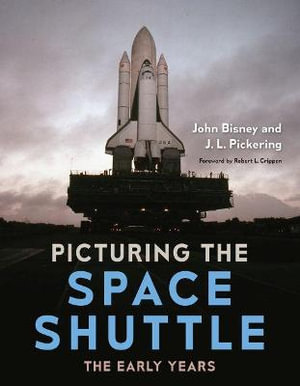
J.L. Pickering and John Bisney, Picturing the Space Shuttle: The Early Years. Gainesville, FL: University Press of Florida, 2021. Hbk. 240 pp.
Reviewed by Dr Brian Laslie
A couple of years ago, in a book review for From Balloons to Drones, I started by saying:
A different type of book necessitates a different type of book review. Herein you will not find an author’s argument or a critique thereof since the book being discussed today is a collection of photographs and an extremely fine one at that.
That book review was for J.L. Pickering and John Bisney’s Picturing Apollo 11: Rare Views and Undiscovered Moments. The same authors have followed up that superb effort with the recently released Picturing the Space Shuttle: The Early Years.
As the title suggests, the authors undertake to produce a pictorial history of – and to look at the development of – the reusable Shuttle Transportation System (STS), the Approach and Landing Tests (ALT), the astronaut class of 1978 (the ‘Thirty-Five New Guys,’ or TFNGs) and the first four STS missions that made up the test program for the new shuttle. Pickering and Bisney have again accomplished just that and produced a unique look at the early days of the space shuttle program, using rare, never-before-published photographs from the late 1970s and early 1980s. The book opens with a forward from STS-1 pilot Robert L. Crippen, who stated that he hoped the book ‘will increase your appreciation for what a remarkable accomplishment the Space Shuttle was.’ Crippen need not worry; the book does precisely that.
Although ostensibly a book of photographs, there is also enough background here to keep the layman and the historian happy with the development of the program. However, it is the photos that stand out. From Maxime Faget’s original model of a reusable space shuttle to the numerous designs, concepts, and artists’ renderings as they developed into the recognizable shuttle design that went into production, there are enough photographs in the first chapter alone to make the book worth the purchase.
This is a montage of the individual portraits of the 35-member 1978 class of astronaut candidates. The Astronaut Class of 1978, otherwise known as the ‘Thirty-Five New Guys,’ was NASA’s first new group of astronauts since 1969. This class was notable for many reasons, including having the first African-American and first Asian-American astronauts and the first women. From left to right are Guion S. Bluford, Daniel C. Brandenstein, James F. Buchli, Michael L. Coats, Richard O. Covey, John O. Creighton, John M. Fabian, Anna L. Fisher, Dale A. Gardner, Robert L. Gibson, Frederick D. Gregory, S. David Griggs, Terry J. Hart, Frederick H. (Rick) Hauck, Steven A. Hawley, Jeffrey A. Hoffman, Shannon W. Lucid, Jon A. McBride, Ronald E. McNair, Richard M. (Mike) Mullane, Steven R. Nagel, George D. Nelson, Ellison S. Onizuka, Judith A. Resnik, Sally K. Ride, Francis R. (Dick) Scobee, Rhea Seddon, Brewster H. Shaw Jr., Loren J. Shriver, Robert L. Stewart, Kathryn D. Sullivan, Norman E. Thagard, James D. Van Hoften, David M. Walker and Donald E. Williams. (Source: NASA)
Some of the great gems are the photos that show the transition from the Apollo era to the shuttle era. Nowhere is this more clearly displayed than the chapter detailing the Shuttle Enterprise’s Approach and Landing Tests. Here, Apollo mission veteran Fred Haise (Apollo 13) is joined by Gordon Fullerton, Joe Engle, and Richard Truly to test the flying characteristics of the new shuttle. Dave Scott and Deke Slayton in very late-1970s garb also make appearances in these pages (pp. 38-9). This transition is completed in the next chapter with the introduction of NASA’s next astronaut class, the ‘TFNGs,’ which introduced America and the world to the names of Guion Bluford, Anna Fisher, Robert Gibson, Steven Hawley, Sally Ride, and many others. The book includes a complete montage of the 35 Group 8 astronauts, the TFNGs (p. 71). Many of them are also pictured testing out Apollo-era spacesuits, marking the transition from old to new. If you had a favourite shuttle-era astronaut, there is a good chance they were represented in this class, and I was pleased to see photos of some of my heroes herein: Rhea Seddon, Frederick Gregory, and Shannon Lucid (65-71).
Obviously, the book really takes off (pun completely intended) with a section devoted to the first four shuttle missions, all of them aboard the Columbia. After that, the book moves from construction at Palmdale to delivery to Kennedy. The woes of Columbia’s heat-ablative tiles are adequately covered and, although the shuttle is a brand-new ship, it looks the worse for wear in several photographs (pp. 104-5). However, these problems overcome, there are some truly terrific ‘behind the scenes’ shots as Columbia is mated to the stack and rolled out to the pad. Here, there are some iconic photographs of the shuttle sitting on the pad with the setting sun turning the clouds a stunning orange and lifting into bright clear-blue Florida skies, but also some great shots ‘on orbit’ and the crews returning safely to Earth along the tanned lakebed of Edwards Air Force Base in California.
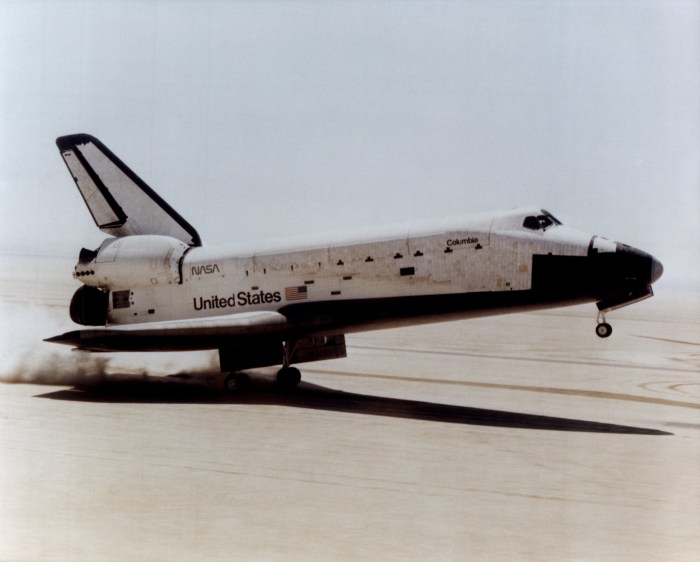
The Space Shuttle Columbia touches down on lakebed runway 23 at Edwards Air Force Base to conclude the first orbital shuttle mission, 14 April 1981. (Source: NASA)
Picturing the SpaceShuttle is another masterwork. It is truly a tour de force and a compelling collection of photographs that should be on the bookshelf of everyone who considers themselves a shuttle aficionado. One hopes that Pickering and Bisney continue to comb through the photographic archives of later shuttle missions. It has been 40 years since Columbia lifted into the sky for the first time and, perhaps even more amazing, a decade since the last shuttle returned safely to earth. As time marches on and the shuttle program recedes into memory, Pickering and Bisney have given us a reason to remember what Astronaut John Young called the ‘world’s greatest flying machine,’ the Space Shuttle.
Dr Brian Laslie is a US Air Force Historian and is the Command Historian at the United States Air Force Academy. Formerly he was the Deputy Command Historian at North American Aerospace Defense Command (NORAD) and United States Northern Command (USNORTHCOM). He is the Book Reviews Editor for From Balloons to Drones. A 2001 graduate of The Citadel and a historian of air power studies, he received his Masters’ from Auburn University Montgomery in 2006 and his PhD from Kansas State University in 2013. He is the author of Air Power’s Lost Cause: The American Air Wars of Vietnam (2021), Architect of Air Power: General Laurence S. Kuter and the Birth of the US Air Force (2017) and The Air Force Way of War (2015). The latter book was selected for the Chief of Staff of the Air Force’s 2016 professional reading list and the 2017 RAF Chief of the Air Staff’s reading list. He can be found on Twitter at @BrianLaslie.
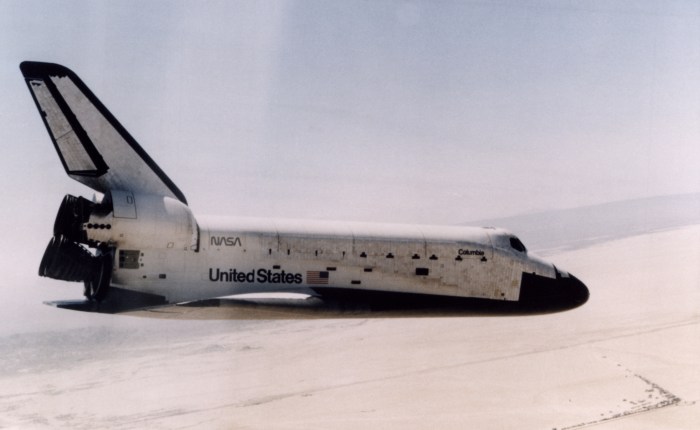
Header image: The Space Shuttle Columbia glides down over Rogers Dry Lake as it heads for a landing at Edwards Air Force Base at the conclusion of its first orbital mission on 14 April 1981. (Source: NASA)
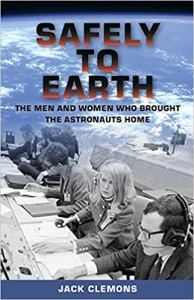
In the first of our space-related book reviews, Stages to Saturn, I discussed a book about a technology and a ‘thing,’ that thing being the family of Saturn rockets. This next review is a book about people or rather, a single person: Jack Clemons.
Author Jack Clemons is one of the 400,000 (or so) people who worked on Project Apollo. You should quickly surmise that 399,999 other stories could be told about NASA and space exploration, but this is Jack’s story. This is the story of one person’s efforts to help put Armstrong’s (and eleven others) boot prints on the moon, but at least as far as Clemons was concerned bringing him, as well as and Aldrin and Collins back to Earth. Clemons, employed by TRW Corporation and working for the Apollo program as a re-entry specialist, presents himself as part of the group of ‘Americans who embraced the study of engineering and the sciences’ (p. 3) and who joined President Kennedy’s call for landing a man on the moon, and the oft-overlooked second part of that sentence, returning him safely to Earth. The call for Clemons (p. 21) was so great that ‘I stayed in Houston for sixteen years for one reason, because that’s where NASA was.’
The prime crew of the Apollo 12 lunar landing mission is photographed during spacecraft checkout activity at North American Rockwell Space Division at Downey, California. Left to right, are astronauts Charles Conrad Jr., commander; Richard F. Gordon Jr., command module pilot; and Alan L. Bean, lunar module pilot. (Source: NASA)
HBO’s TV series From the Earth to the Moon based on the book A Man on the Moon: The Voyages of the Apollo Astronauts by Andrew Chaikin introduced viewers to stories of the Mercury, Gemini, and Apollo astronauts. In one episode, the launch of Apollo 12 is shown to be struck by lightning, and the crew is informed they must ‘switch SCE to AUX’ to start restoring power to the crippled command module. This is also where Jack Clemons book Safely to Earth: The Men and Women who brought the Astronauts Home begins as well when flight controller John Aaron makes the call to have the crew switch Signal Conditioning Electronics to Auxiliary. This is what separates Clemons work from all that has come before it – and becomes the real strength of the work; this is not a book about the astronauts themselves, but about the unnamed masses of the support team.
This is not a purely academic work, and Clemons is clearly not speaking to an exclusive audience. Instead, he brings forth in a very accessible manner what it was like to be ‘in the trenches.’ Clemons also provides a certain levity in his book. He often ‘breaks the plane’ by talking directly to the reader, a massive ‘no-no’ in most professional writing, but it works and much to Clemons credit, I found myself smirking.
The book is essentially divided into two parts: his work on the Apollo Program and his later work in the Space Shuttle program. During Apollo and found many times throughout the pages of Safely to Earth, the role of technology is clearly on display. In the modern world where our phones hold more computing power than some of the early computers, it is nearly overwhelming to remember a time where so much of a computer processing ability first had to be input by hand. In one example, Clemons notes (p. 41) that the process of entering information into the IBM mainframes and waiting for results: ‘was a tedious and labor-intensive way to grind out data, but at the time it was cutting edge, high art, and great fun.’ Clemons primary work was on reentry data (p. 70), ‘[S]ince every Apollo mission was unique, reentry procedures had to developed and tested for each one.’
During the 1980s, Clemons moved over to IBM where he worked on the Space Shuttle’s computer programs and flight software, and this work provides a good history of the development and operation of the Shuttle. During these years, Clemons, responsible for the displays and controls of the Orbiter, worked closely with the early shuttle astronauts, including Bob Crippen and Dick Truly. Ostensibly, Clemons seeks here (p. 122) to ‘to convey here a sense of the scope of this singular effort, and an appreciation for some of the unheralded people behind the scenes’ and this occurs not only in the latter half of the book but throughout the entire text. The reader gets a sense of how many people at so many levels worked towards the singular goal of space exploration.
This is a welcome addition and is truly a unique work that contributes something new to an already overcrowded field of books about manned spaceflight. Clemons brings into focus what it was like to be one of the 400,000 who contributed to getting man to the moon and in doing so broadens our understanding of getting into space in general. While those aviation, history of technology, and space readers and historians will find much to enjoy here; those interested in race and gender issues, particularly as they apply to employment in STEM career fields, will also find enjoyment in the marked switch that occurred between Apollo and the Space Transportation System programs; Clemons covers this transition particularly well. The ultimate question posed by Clemons (p. 190), and so many others in recent years, and one for which we do not have a definitive answer for is, ‘[S]o where does human spaceflight go from here?’
Dr Brian Laslie is an Air Force Historian and currently the Deputy Command Historian at North American Aerospace Defense Command (NORAD) and United States Northern Command (USNORTHCOM). A 2001 graduate of The Citadel and a historian of air power studies, he received his PhD from Kansas State University in 2013. His first book The Air Force Way of War (2015) was selected for the Chief of Staff of the Air Force’s and the Royal Air Force’s Chief of the Air Staff professional reading lists. His recently published Architect of Air Power: General Laurence S. Kuter and the Birth of the US Air Force. He lives in Colorado Springs. He can be found on Twitter at @BrianLaslie.
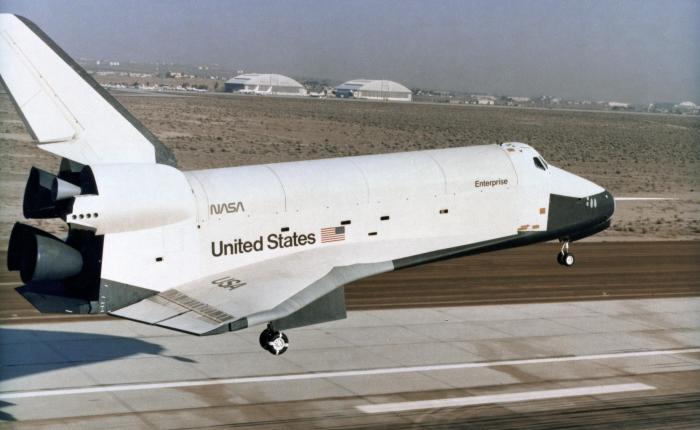
Header Image: The last of 13 captive and free-flight tests on 26 October 1977 with the space shuttle prototype Enterprise during the Approach and Landing Tests, validating the shuttle’s glide and landing characteristics. Launched from the modified Boeing 747 Shuttle Carrier Aircraft, the Enterprise’s final flight was piloted by Fred Haise and Gordon Fullerton to a landing on the main concrete runway at Edwards Air Force Base before a host of VIPs and media personnel. (Source: NASA)




 From Balloons to Drones