Air Power and the Battle of the Bismarck Sea

Air Power and the Battle of the Bismarck Sea

By Dr Alan Stephens

This week marks the 74th anniversary of the Battle of the Bismarck Sea, arguably the most significant action fought by Australians during World War II.

Between December 1941 and April 1942, Imperial Japanese forces shocked Australians with their victories over the United States at Pearl Harbor and in the Philippines; and over the British Commonwealth in Malaya, Singapore, the Dutch East Indies and Rabaul. When enemy forces occupied northern New Guinea, an invasion of Australia, with its unthinkable consequences, seemed possible. However, supported by their American and British allies, Australia’s servicemen and women regrouped and fought back.

From mid-1942 onwards, Australian victories with American support at Milne Bay and Kokoda, and the triumph of American naval air power at Coral Sea and Midway weakened Japan’s hold on New Guinea. Further Allied successes on New Guinea’s northeast coast at Buna, Gona and Sanananda between November 1942 and January 1943 left the Japanese position substantially weakened.

Then, intercepted radio messages revealed that an enemy convoy would sail from Rabaul with reinforcements for the vital Japanese garrison at Lae on the northeast coast of New Guinea in late-February. This was likely to be Japan’s last throw of the dice in New Guinea. If the convoy were stopped, then so too would be the likelihood of an invasion of Australia

Allied Air Forces under the command of the American General George Kenney immediately began preparing for an all-out assault against the convoy. A critical factor was the brilliant plan largely conceived by the Royal Australian Air Force’s (RAAF) Group Captain William “Bull” Garing. Garing had already fought in Europe for two years with the RAAF’s No. 10 Squadron, and his experience of maritime warfare was to prove decisive.

nwa0471
Group Captain Garing RAAF (standing, right) hands over information to his successor Group Captain McLachlan, seated at the office desk, c. 1943. (Source: Australian War Memorial)

It was Garing who convinced General Kenney of the need for a massive, coordinated attack. Garing envisaged large numbers of aircraft striking the convoy from different directions and altitudes, with precise timing.

Initially, the allies would rely on reconnaissance aircraft to detect the convoy, which would then be attacked by long-range United States Army Air Force (USAAF) bombers. Once the convoy was within range of the allies’ potent anti-shipping aircraft – RAAF Beaufighters, Bostons and Beauforts, and American Mitchells and Bostons – a coordinated attack would be mounted from medium, low, and very low altitudes.

During the waiting period, crews practised their navigation and honed their formation flying, bombing, and gunnery skills.

Six thousand four hundred Japanese troops embarked at Rabaul between 23 and 27 February 1943, and the convoy of eight merchant ships and eight destroyers sailed just before midnight on the 28th, planning to arrive at Lae on 3 March. Air cover was provided by about 100 fighters flying out of bases in New Ireland, New Britain and New Guinea.

The enemy convoy initially was favoured by poor weather, which hampered Allied reconnaissance. It was not until mid-morning on 2 March that USAAF B-24 Liberators sighted the ships. General Kenney immediately launched eight B-17 Flying Fortress heavy bombers, followed shortly afterwards by another 20. The B-17s attacked from an altitude of 2000 metres with 450-kilogram demolition bombs. Later in the day, another strike was made by 11 B-17s whose crews reported that vessels were ‘burning and exploding […] smoking and burning amidships’ and ‘left sinking’.

By nightfall, the enemy was only hours from Lae, which meant that in the morning it would be within range of the entire allied strike force. If the coordinated attack were to succeed, the precise location of the convoy had to be known at daybreak; consequently, throughout the night, it was tracked by an RAAF Catalina from No. 11 Squadron, which occasionally dropped bombs and flares to keep the Japanese soldiers in a state of anxiety. Also during the night, eight RAAF Beaufort torpedo bombers from No. 100 Squadron took-off from Milne Bay to try to use the darkness to their advantage. The heavy frontal weather made navigation hazardous, and only two aircraft found the convoy. Neither scored a hit.

The moment the Allied Air Forces had been waiting for came on the morning of 3 March 1943, when the Japanese convoy rounded the Huon Peninsula. For much of the time the adverse weather had helped the enemy avoid detection, but now clear conditions favoured the allies. Over 90 aircraft took-off from Port Moresby and set heading for their rendezvous point. While the strike force was en route, RAAF Bostons from No. 22 Squadron bombed the enemy airfield at Lae.
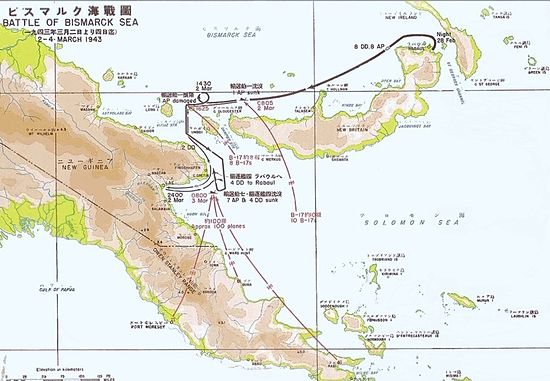
550px-battle_of_the_bismark_sea

By 9:30 a.m. the AAF formations had assembled, and by 10:00 a.m. the Battle of the Bismarck Sea had begun.

The allies attacked in three waves and from three levels, only seconds apart. First, 13 USAAF B-17s bombed from medium altitude. In addition to the obvious objective of sinking ships, those attacks were intended to disperse the convoy by forcing vessels to break station to avoid being hit.

Second, 13 RAAF Beaufighters from No. 30 Squadron hit the enemy from very low level, lining up on their targets as the bombs from the B-17s were exploding. With four cannons in its nose and six machine guns in its wings, the Beaufighter was the most heavily armed fighter in the world. The Australians’ job was twofold: to suppress anti-aircraft fire, and to kill ships’ captains and officers on their bridges.

The Beaufighters initially approached at 150 metres above the sea in line astern formation. The pilots then descended even lower, to mast-level height, set full power on their engines, changed into line abreast formation, and approached their targets at 420 kilometres an hour.

It seems that some of the Japanese captains thought the Beaufighters were going to make a torpedo attack because they altered course to meet the Australians head-on, to present a smaller profile. Instead, they made themselves better targets for strafing. With a slight alteration of heading the Beaufighters were now in an ideal position to rake the ships from bow to stern, which they did, subjecting the enemy to a withering storm of cannon and machine gun fire.

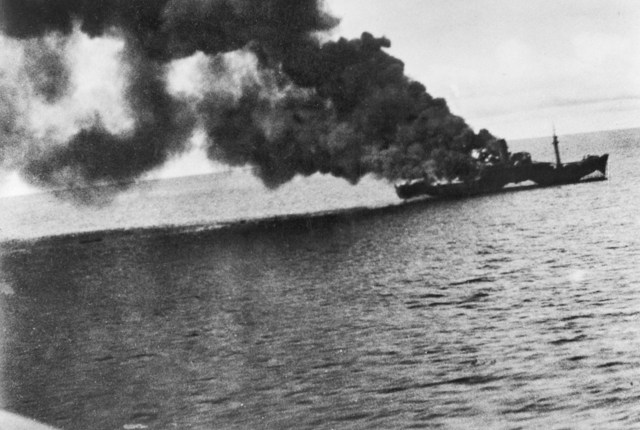
127965
A Japanese transport on fire during the Battle of the Bismarck Sea. (Source: Australian War Memorial)

According to the official RAAF release:

[e]nemy crews were slain beside their guns, deck cargo burst into flame, superstructures toppled and burned.

With the convoy now dispersed and in disarray, the third wave of attackers was able to concentrate on sinking ships. Thirteen American B-25 Mitchells made a medium level bombing strike while, simultaneously, a mast-level attack was made by 12 specially modified Mitchells, known as ‘commerce destroyers’ because of their heavy armament. The commerce destroyers were devastating, claiming seventeen direct hits. Close behind the Mitchells, USAAF Bostons added more firepower.

Following the coordinated onslaught, Beaufighters, Mitchells and Bostons intermingled as they swept back and forth over the convoy, strafing and bombing. Within minutes of the opening shots, the battle had turned into a rout. At the end of the action:

[s]hips were listing and sinking, their superstructure smashed and blazing, and great clouds of dense black smoke [rose] into a sky where aircraft circled and dived over the confusion they had wrought among what, less than an hour earlier, had been an impressively orderly convoy.

Overhead the surface battle, 28 USAAF P-38 Lightning fighters provided air defence for the strike force. In their combat with the Zeros which were attempting to protect the convoy, three of the Lightnings were shot down, but in turn, the American pilots claimed 20 kills. Apart from those three P-38s, the only other allied aircraft lost was a single B-17, shot down by a Zero.

With their armament expended the allied aircraft returned to Port Moresby. However, there was to be no respite for the enemy. Throughout the afternoon the attacks continued. Again, B-17s struck from medium level, this time in cooperation with Mitchells and RAAF Bostons flying at very low level. (Incidentally, the Bostons were led by Squadron Leader Charles Learmonth, after whom the RAAF’s present-day base in north-west Australia is named.) At least 20 direct hits were claimed against the by-now devastated convoy.

That was the last of the coordinated attacks. The victory had been won. For the loss of a handful of aircraft, the Allied Air Forces had sunk twelve ships – all eight of the troop transports and four of the eight destroyers – and had killed more than 3,000 enemy soldiers.

The brilliantly conceived and executed operation had smashed Japanese hopes of regaining the initiative in New Guinea and had eliminated any possibility that Australia might be invaded. In the words of the supreme command of the Southwest Pacific Area, General Douglas MacArthur, the Battle of the Bismarck Sea was ‘the decisive aerial engagement’ of the war in the Southwest Pacific.

However, there was still a terrible yet essential finale to come. For several days after the battle, Allied aircrews patrolled the Huon Gulf, searching for and strafing barges and rafts crowded with survivors. It was grim and bloody work, but as one RAAF Beaufighter pilot said, every enemy soldier they prevented from getting ashore was one less for their Army colleagues to face. Moreover, after fifteen months of Japanese brutality, the great immorality, it seemed to them, would have been to have ignored the rights of their soldiers.
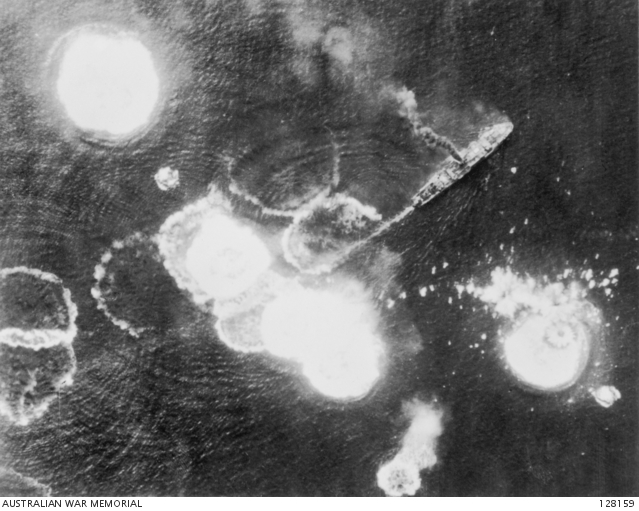
128159
A Japanese destroyer steaming astern while under attack by USAAF bombers during the Battle of the Bismarck Sea. (Source: Australian War Memorial)

Japanese media never mentioned the battle, but in a macabre footnote, two weeks later, Tokyo announced that in future all Japanese soldiers were to be taught to swim.

The Battle of the Bismarck Sea was a master-class in air power. The RAAF and the USAAF had smashed Japanese hopes of regaining the initiative in New Guinea; they had forced the enemy into a defensive posture from which ultimate victory was unlikely, and they had eliminated any possibility that Australia might be invaded.

This was arguably Australia’s most important victory in World War II.

This post first appeared at The Central Blue, the blog of the Sir Richard Williams Foundation.

Dr Alan Stephens is a Fellow of the Sir Richard Williams Foundation. He has been a senior lecturer at UNSW Canberra; a visiting fellow at ANU; a visiting fellow at UNSW Canberra; the RAAF historian; an advisor in federal parliament on foreign affairs and defence; and a pilot in the RAAF, where his experience included the command of an operational squadron and a tour in Vietnam. He has lectured internationally, and his publications have been translated into some twenty languages. He is a graduate of the University of New South Wales, the Australian National University, and the University of New England. Dr Stephens was awarded an OAM in 2008 for his contribution to Australian military history.

Header Image: During the Battle of the Bismarck Sea in which the Japanese suffered heavy losses while attempting to reinforce their garrison at Lae, a RAAF Beaufighter attacks a camouflaged Japanese transport. A burst is poured into the burning vessel. (Source: Australian War Memorial)
#ResearchNote – Air Power and the Challenge of Professional Military Education

#ResearchNote – Air Power and the Challenge of Professional Military Education

By Dr Ross Mahoney

I have just come back from a conference at the Royal Military College of Canada on the theme of the ‘Education of an Air Force’ that was well worth the visit. I am sure most readers will agree that the subject of education is of vital importance and this is something that has been increasingly realised in recent years as modern air forces seek to grapple with the challenges that confront them in the operational sphere.

Ideas such as conceptual innovation have become catchphrases for efforts such as the Royal Air Force’s (RAF) Thinking to Win programme, the Royal Australian Air Force’s (RAAF) Plan JERICHO and the Royal Canadian Air Force’s (RCAF) AIRpower in Formation process. Underpinning these, to a greater or lesser degree, is the importance of air power education. Indeed, as Lieutenant-General Michael Hood, Commander of RCAF, recently noted in the introduction to an article in the Royal Canadian Air Force Journal on air power education and professional air power mastery:

There is also a requirement to continually review the training and education we give to all ranks to ensure that it is configured to deliver what we need within the contemporary environment.[1]

Nevertheless, phrases like the one above can often be a case of rhetoric versus reality, though having heard General Hood speak at the opening of the conference; I do believe he means what he says about the importance of education. The conference was historically focussed, but by observing the past, as historians, we can identify areas that can be points of friction and that need to be considered when attempting to introduce reform in the education process. What follows are just a few key areas I pondered during the conference.

Training or Education?

Perhaps the first thing that came to mind was what were we considering? The conference included the word education in the title but was this the case? Indeed, one key question that needs to be asked is whether those we study understand the distinction we make today between training and education. For me, at the most simplistic of levels, training is about skills development while education is about knowledge, understanding and critical thinking. Is this what was expected by those responsible for creating the institutions that delivered programmes related to professional development such as staff colleges. I suspect the answer is yes but the vernacular used in different eras leads to confusion. For example, Air Chief Marshal Sir Robert Brooke-Popham, first Commandant of the RAF Staff College, was clear that one issue he needed to deal with was anti-intellectualism and this is a matter of education though the term was infrequently used in the 1920s. By the 1960s, the RAF had begun, as it created a ‘progressive’ system of staff education, to differentiate between the two subjects. Nevertheless, we must be clear about what we are talking about if reform is to be achieved.

Culture

Military organisations are conservative in character. This is not to suggest that they are not innovative but rather to reflect that they are predominantly reactive rather than revolutionary. Thus, change, unless triggered by defeat, public opinion or budgetary cuts, can be difficult and challenging. This is ultimately a cultural issue and one that needs to be considered when introducing change. Leaders need to bring people along with them on the journey they seek to engender rather than just demanding that it happens. This applies to education as well. If education is to be improved, the organisation’s employees need to understand the need for this process. They need to be shown its value, and this has to be enunciated in a clear and meaningful manner. Indeed, in the modern era where most air forces have been in continuous operations for at least the past decade and a half, it needs to be illustrated why education is of value for those with operational experience. This comes back to the first point above, for example, we train an officer to fly rather than educate them.

The Role of Senior Leadership

eisenhower_visits_air_university
From left, General Dwight Eisenhower, US Army Chief of Staff; Major General Muir Fairchild, Air University commander; and Major General David Schlatter, the Air University deputy commanding general (education), review an Air University organizational chart during Eisenhower’s visit to Maxwell on 9 April 1947. (Source: Wikimedia)

This brings me to the next important issue; the role of senior leaders. These are the people who lead change. Indeed, at the conference, when I made a comment about the culture of military organisations, Harold Winton, Professor Emeritus at the United States Air Force’s (USAF) School of Advanced Air and Space Studies (SAASS), quite rightly made the impassioned argument that when a leader who believes in education comes along, perhaps once every 15 to 20 years, then we should take advantage of that person. I completely agree, a champion who can provide top cover is essential, and it appears that RCAF have that in Hood while in the 1970s, the RAF had Marshal of the RAF Lord Cameron, who supported the creation of the position of Director of Defence Studies. Furthermore, support from senior leaders can help shape the culture and values of the organisation by providing an example to subordinates.

Non-Standard Education

What I mean here is the use of non-staff college education for officers, mainly higher research degrees such as MPhils and PhDs. In modern militaries, it is usual that officers going through the staff college system receive some form of credits towards a postgraduate degree, typically an MA. For example, British officers can work towards an MA in Defence Studies that builds on the Advanced Command and Staff Course at the Joint Services Command and Staff College. However, this is a relatively standard route and one that has been developed within the Staff College environment. What appears to be less typical, though needs to more readily embraced, is the encouragement of nurtured personal to undertake further research in the form of MPhils and PhDs. USAF do a good job of this through SAASS, and the RAF has a good fellowship scheme that not only encourages Masters work but also supports PhDs through the Portal Fellowship. This need to be promoted as higher research encourages critical thinking and air forces need such people to help develop their conceptual understanding of air power in the defence sphere. Nevertheless, air forces also need to encourage and reward personnel for taking ownership of their education irrelevant of whether the service sponsors it or not. Personnel need to be shown that in developing their critical thinking skills these are as valued as their operational ones. Also, where applicable, personnel should be encouraged to write in various forums from websites, such as this one, The Central Blue, War on the Rocks and The Strategy Bridge, to professional journals. However, this requires encouragement and critical mass and it is interesting to reflect that the RAF, RCAF and USAF all have journals but the RAAF does not, though the latter’s Air Power Development Centre does produce useful material. Overall, by encouraging ‘non-standard education’, air forces have the opportunity to develop knowledge and encourage informed discussion about air power in the public and policy sphere rather than what often currently occurs.

Officers or NCOs? Alternatively, Both?

An interesting point that came up in one discussion phase of the conference was the question of NCOs. All of the papers dealt with officer education with most focussed on the staff college scenario. However, what of NCOs and their education? We often hear phrases such as ‘whole force’ used to describe the personnel of an air force. As such, should we not be educating the NCO corps? Another challenge is that the current NCO corps is becoming better educated; it not unusual to find airmen and women entering service with degrees. If we are to develop the ‘whole force’ then similar opportunities afforded to the officer corps should be made available to NCOs especially as they are promoted and take on senior leadership roles. This is probably a conference of its own but a subject area that deserves consideration both in a contemporary as well as historical sense.

What I have written here is by no means the panacea for professional military education, and indeed much of this is axiomatic of any analysis of the field. Indeed, most of these challenges are just as applicable to each of the services; however, I would suggest that these difficulties need to be overcome and also understood in the context of air forces seeking to improve education provision. Nevertheless, the conference provided plenty of food for thought on the subject of the education of air forces as modern services strive to deal with operational and personnel challenges that they currently confront and will continue to do so into the 21st century. Another key positive of this conference was the involvement of the RCAF both regarding the opportunity to visit the Canadian Aerospace Warfare Centre but also to hear how they are dealing with current challenges.

This post also appears at The Central Blue.

Dr Ross Mahoney is an independent historian and defence specialist based in Australia. Between 2013 and 2017, he was the resident Historian at the Royal Air Force Museum, and he is a graduate of the University of Birmingham (MPhil and PhD) and the University of Wolverhampton (PGCE and BA). His research interests include the history of war in the twentieth and twenty-first centuries, air power and the history of air warfare, and the social and cultural history of armed forces. To date, he has published several chapters and articles, edited two books, and delivered papers on three continents. He is a member of the Royal Historical Society and is an Assistant Director of the Second World War Research Group. He is a member of the Royal Historical Society and an Assistant Director of the Second World War Research Group. He blogs at Thoughts on Military History, and can be found on Twitter at @airpowerhistory.

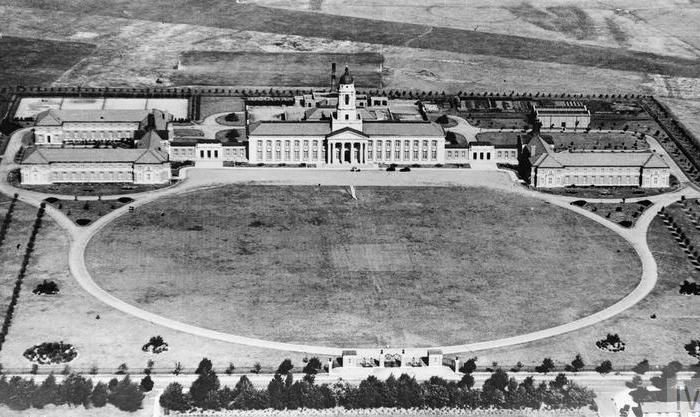
Header Image: Aerial view of the completed RAF College at Cranwell in the 1930s. (Source: © IWM ((MOW) C 4070))

[1] Lieutenant-General Michael Hood, ‘Introduction’ to Brad Gladman, Richard Goette, Richard Mayne, Shayne Elder, Kelvin Truss, Pux Barnes, and Bill March, ‘Professional Airpower Mastery and the Royal Canadian Air Force: Rethinking Airpower Education and Professional Development,’ Royal Canadian Air Force Journal, 5(1) (2016), p. 9.