#BookReview – A Thunder Bird in Bomber Command

#BookReview – A Thunder Bird in Bomber Command

By Dr Ross Mahoney

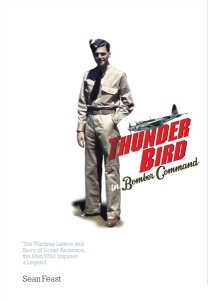
Sean Feast, A Thunder Bird in Bomber Command: The Wartime Letters and Story of Lionel Anderson, the Man who Inspired a Legend. London: Fighting High Publishing, 2015. Foreword. Appendices. Sources. Index. Hbk. xiii + 169 pp.

lionel-book

Thunderbirds are go! It is not often that you get to write those immortal words at the start of a review to do with a book on Bomber Command; however, this is no ordinary book. Indeed, it is a book that will be of interest to two distinct groups of people. First, there are those with an interest in the experience of Bomber Command operations during the Second World War. Second, there are those with a passion for the 1960s TV show Thunderbirds and other production that came from Gerry Anderson’s fertile imagination. This, of course, begs the question of how these two seemingly disparate interests are linked. Well, as Shane Rimmer, who provided the voice to Scott Tracey, recollected in the foreword to the book, the inspiration was ‘direct and personal – from his elder brother Lionel who had given up his life as a pilot during the Second World War’ (p.ix).

This biography, therefore, tells the story of Lionel Anderson, Gerry Anderson’s older brother through the letters that he sent home while also considering the impact of his death on his younger brother. The book details Lionel Anderson’s early interest in flying and his decision to volunteer as aircrew in the RAF (p.3). The book then follows a chronological order following Lionel Anderson’s experience of flying training to through to undertaking operations as part of No. 515 Squadron, which formed part of Bomber Command’s No. 100 (Bomber Support) Group. The unit had been established in October 1942 from the so-called Defiant Flight at RAF Northolt and at that time formed part of Fighter Command. The unit was then equipped with the Bristol Beaufighter and then the de Havilland Mosquito. Lionel Anderson joined No. 515 Squadron in early 1943 (p.77). The squadron was involved in operating Moonshine, Mandrel, and Serrate electronic warfare systems that had emerged as part of the pantheon of homing and jamming systems that developed during the Second World War. These were designed to provide support in an ongoing battle to defeat German equipment, such as the Freya radar net as well as defeat German night fighters. In this, Sean Feast provides a good overview of No. 515 Squadron’s role in this area.

large_0000001
Hawker Hurricane Mark X, AG111 ‘HK-G’, of No. 59 Operational Training Unit, on the ground at Milfield, Northumberland. Although bearing the unit codes of the Fighter Leaders School (based at Charmy Down, Wiltshire), AG111 does not appear to have been officially transferred to them. It was passed later to No. 57 OTU at Eshott, Northumberland, and crashed after colliding with a Supermarine Spitfire over Wooler on 5 May 1943. (Source: © IWM (CH 9222))

The section dealing with Lionel Anderson’s time with No. 59 Operational Training Unit is, however, problematic. Feast suggests that in late 1942, Anderson’s course transferred to Brunton, which was No. 59 OTU’s satellite airfield and that while there they became known as No. 559 Squadron.  Additionally, Feast suggests that, as No. 559 Squadron, the unit could be called on to intercept incoming aircraft as part of ‘Saracen scheme’ (p.76). This is where it becomes murky as there does not appear to be a No. 559 Squadron. There is no Operations Record Book for No. 559 Squadron and C.G. Jefford’s work on RAF squadrons does not list the unit.[1] However, No. 559 Squadron was a numberplate reserved for No. 59 OTU if activated as part of Plan BANQUET. Additionally, Ray Sturtivant’s work on flying training units does suggest that, in March 1943, the squadron number above was used.[2] So what is to be made of this? First, Plan BANQUET, which originated in 1940, had been revised in May 1942. Part A of the Fighter Command element of the revised plan – BANQUET FIGHTER – called for aircraft and crews from OTUs to form squadrons as reinforcements, as such; they would have received a numberplate. This process was activated by a codeword ‘APPLE’.[3] Nevertheless, as Jefford noted, the squadron numberplates allocated to fighter OTUs were not used as the units were not mobilised.[4] Second, it is reasonable that crews at OTU’s were aware of this plan, and their designation if activated. It is probably this that is being recollected rather than an official designation. This of course raises the question of whether matters, which is clearly subjective. I would suggest that the pilots being trained by No. 59 OTU were aware of their reserve role and the details of the unit’s designation. It highlights the tension between the operational record and memory and how it can be distorted.

The earlier sections of the book that detail Lionel Anderson’s decision to volunteer, his training in America and time at an Advanced Flying Unit are, for me, the real gem of this book as it is here where the letters home find their place. Indeed, the reason for this appears to be that the last letter kept by Lionel Anderson’s mother, Deborah comes from this period. As Feast explains, Deborah Anderson had reproduced the letters into a pair of hard-backed exercise books, and this is all that was left of Lionel Anderson’s correspondence (pp.69-70). This helps explain why the book’s subtitle is ‘The Wartime Letters and Story’ as the latter period has been reconstructed from other sources. Nevertheless, the use of letters in the earlier part of the book help us explore what it was like to serve in the RAF during the war and the experience of training in America. In one letter, Lionel Anderson described the planned graduation dance they held at the end of his training in America. ‘We invite our instructors and friends we have made during our stay here and, of course, we have plenty of girls.’ This recollection (p.55) both highlights the friendly relations between American and Britain but also one recurring theme in the letters, girls.

Overall, as with many books of this type, this is a fascinating insight into life in the RAF. It is made all the more interesting given the links between Lionel Anderson and his younger brother’s later work.

This book review originally appeared at Thoughts on Military History.

Dr Ross Mahoney is an independent historian and defence specialist based in Australia. Between 2013 and 2017, he was the resident Historian at the Royal Air Force Museum, and he is a graduate of the University of Birmingham (MPhil and PhD) and the University of Wolverhampton (PGCE and BA). His research interests include the history of war in the twentieth and twenty-first centuries, air power and the history of air warfare, and the social and cultural history of armed forces. To date, he has published several chapters and articles, edited two books, and delivered papers on three continents. He is a member of the Royal Historical Society and is an Assistant Director of the Second World War Research Group. He is a member of the Royal Historical Society and an Assistant Director of the Second World War Research Group. He blogs at Thoughts on Military History, and can be found on Twitter at @airpowerhistory.

Header Image: The prototype Boulton Paul Defiant fighter, which first flew in August 1937. This aircraft type equipped the so-called Defiant Flight at RAF Northolt, which eventually became No. 515 Squadron. (Source: © IWM (MH 5507))

[1] Wing Commander C.G. Jefford, RAF Squadrons: A Comprehensive Record of the Movement and Equipment of all RAF Squadrons and their Antecedents since 1912, 2nd Edition, (Shrewsbury: Airlife, 2001).

[2] Ray Sturtivant, Flying Training and Support Units since 1912 (Staplefield: Air-Britain, 2007), p.242.

[3] Anon, The Air Defence of Great Britain – Volume V: The Struggle for Air Supremacy, January 1942-May 1945, (Air Historical Branch Narrative), pp.10-1.

[4] Jefford, RAF Squadrons, p.188.

#ResearchNote – Operation HUSKY’s Air Battle by the Numbers

#ResearchNote – Operation HUSKY’s Air Battle by the Numbers

By Alexander Fitzgerald-Black

In 1991, Samuel W. Mitcham Jr. and Fredrich von Stauffenberg published The Battle of Sicily: How the Allies Lost Their Chance for Total Victory. In it, they offered a scathing review of the performance of the Allied militaries in Operation HUSKY, the 1943 invasion of Sicily. Theirs is the standard interpretation about the battle for Sicily: the Allies bungled total victory through national squabbles which allowed the Germans to mount a skilful withdrawal even against complete Allied air and naval supremacy while outnumbered by Allied armies by factors of up to 8:1.[1]

Part of their critique is the effectiveness of the Allied air forces. They called into question claims Allied commanders made at finding 1,100 Axis aircraft littering aerodromes and landing grounds across the island. According to Colonel Lioy of the Italian Air Force historical division, Allied claims vastly overstated the reality as the island had long harboured aircraft cemeteries from previous battles. He believed that the Allied bomber offensive only accounted for 100. Lioy pegged total Axis aircraft losses from 3 July to 17 August at not over 200. Finally, Mitcham and von Stauffenberg noted that Axis statistics they consulted show that the Germans and Italians lost 225 and 95 aircraft respectively to all causes between 1 July and 5 September 1943.[2]

large1
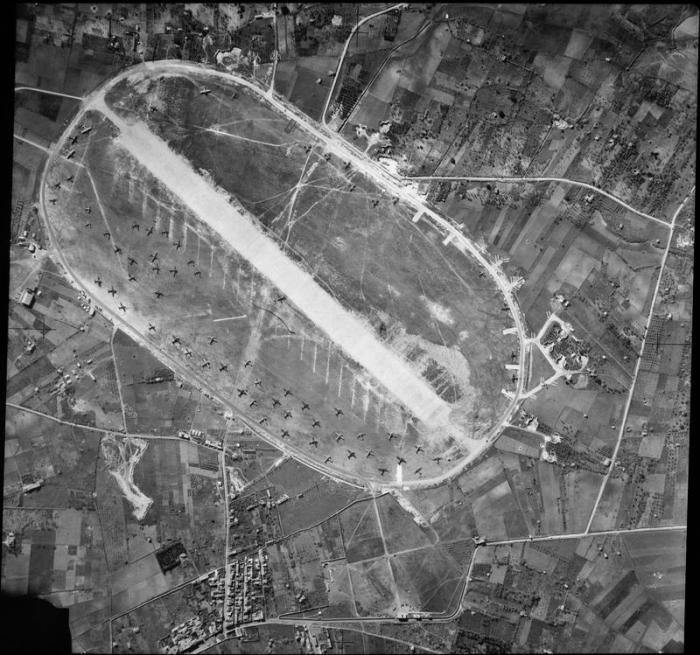
Vertical aerial reconnaissance view of Castelvetrano airfield, Sicily, the day before a successful attack was made on it by Malta-based Bristol Blenheims of Nos. 18 and 107 Squadrons RAF. A number of Junkers Ju 52 and Savoia Marchetti SM 82 transport aircraft, many of which were destroyed during the raid, can be seen parked around the airfield perimeter. (Source: © IWM (C 4183))

These figures do not stand up to the scrutiny of other sources. First, Williamson Murray’s excellent study of the Luftwaffe: Strategy for Defeat, cited reliable quartermaster general figures for German losses throughout the war. German losses in the May to August period in the Mediterranean Theatre stood at 1,600, matching those of the other major fronts. This number included 711 German aircraft lost in July 1943 alone, a figure 27 percent higher than that of the 558 German aircraft lost on the Eastern Front during the massive battles of Kursk-Orel in July.[3]

Second, Adolf Hitler’s own figures are at variance with Mitcham and von Stauffenberg’s statistics. Hitler was particularly displeased with the ground organisation in Sicily and southern Italy. On 13 July, he sent a message to Benito Mussolini complaining of ‘more than 320 fighters destroyed on the ground as the result of Allied aerial attack in the last three weeks.’ When the two dictators met at Feltre on 19 July, Hitler further noted that between 300 and 400 aircraft out of 500 to 600 were destroyed on the ground in the recent Allied air offensive.[4]

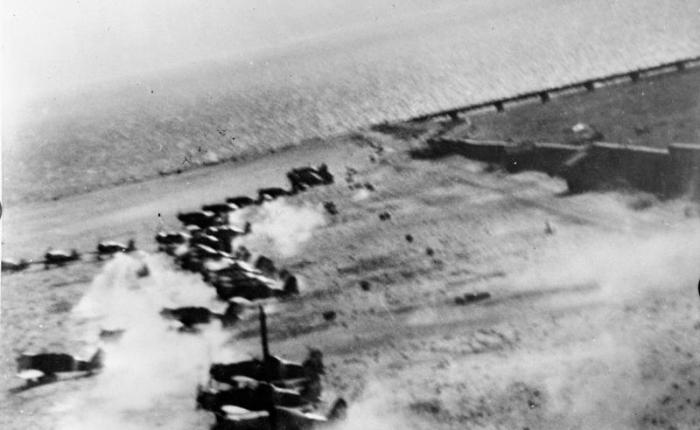
Perhaps Hitler was particularly upset with a 15 July raid on Vibo Valentia, where the bulk of the remainder of the German fighter force had settled after withdrawing from Sicily. A force of 117 B-25 Mitchells and B-26 Marauders apparently caught Jagdgruppe Vibo on the ground. Lieutenant Köhler, a German ace with over 20 victories to his credit, wrote:

Toward noon 105 [sic] bombers came and destroyed the Jagdgruppe Vibo Valentia, which had about 80 aircraft. Not a machine was left intact, not even the [Junkers] which had just landed. Fuel trucks, hangars, aircraft, autos, everything was burning. The German fighters in Italy have been wiped out.[5]

Specifically, the raid eliminated Steinhoff’s JG 77, I/JG 53 (which lost 20 aircraft), and much of II/JG 27. After the raid, only survivors of II and III/JG 27 remained operational in southern Italy.

large2
Wrecked and damaged Italian fighters outside bomb-shattered hangars at Catania, Sicily, under the scrutiny of an airman, shortly after the occupation of the airfield by the RAF. (Source: © IWM (CNA 1352)

The weight of evidence seems to go against Mitcham and von Stauffenberg’s conclusions. Furthermore, while it is true that many of the 1,100 aircraft abandoned on Sicily were from previous battles, the Allies still denied their use to Axis salvage details. Italian losses during the campaign are less easy to come by. However, one source noted that they may have been as high as 800 aircraft over two months – although the same source lowballs the German figure at 586.[6]

The Mediterranean was a meat grinder of Axis aviation. For the war, Axis aircraft losses in the Mediterranean stand at 17,750, much higher than the 11,000 on the Eastern Front, and closer to the 20,419 on the Western Front than one might assume.[7] The air superiority battles around and above Operation HUSKY in the summer of 1943 were a significant milestone in the air war against the European Axis. Indeed, Murray described Sicily as ‘the greatest air battle of the Mediterranean war’ based on the scale of German losses.[8] This result was achieved by an efficient Allied air force that has often been denied the credit it so rightfully earned.

large3
Supermarine Spitfire Mark Vs of No. 243 Squadron RAF undergo maintenance at Comiso, Sicily. Photographed over the tail section of an abandoned Messerschmitt Bf 109G of 6/JG53. (Source: © IWM (CNA 1029))

Alexander Fitzgerald-Black completed his MA thesis, ‘Eagles over Husky: The Allied Air Forces and the Sicilian Campaign, 14 May to 17 August 1943,’ with The Gregg Centre for the Study of War and Society, University of New Brunswick in 2014. He is in the process of turning this work into a manuscript for publication with Helion & Company. Alex lives with his wife in Moncton, Canada. He operates his own blog at alexfitzblack.wordpress.com and can be reached on Twitter @AlexFitzBlack.

Header Image: A line of Macchi MC200 fighters on Reggio di Calabria airfield under attack by cannon fire from two Bristol Beaufighter Mark ICs of No. 272 Squadron RAF Detachment flying from Luqa, Malta. (Source: © IWM (CM 1298))

[1] See Lee Windsor, “The Eyes of All Fixed on Sicily’: Canada’s Unexpected Victory, 1943,’ Canadian Military History, 22:3 (2013), pp. 6-7 for a summary of this literature. General Max Ulrich, commander of the 29th Panzer Grenadier Division offered the 8:1 ratio when comparing the odds his forces faced.

[2] Samuel W. Mitcham Jr. and Fredrich von Stauffenberg, The Battle of Sicily: How the Allies Lost Their Chance for Total Victory (Mechanicsburg, PA: Stackpole Books, 2007 [1991]), p. 305.

[3] Williamson Murray, Strategy for Defeat: The Luftwaffe, 1933-1945 (Maxwell AFB, Alabama: Air University Press, 1983), “Table XXX”, p. 148.

[4] Albert N. Garland and Howard M. Smyth, The United States Army in World War II, The Mediterranean Theatre of Operations: Sicily and the Surrender of Italy (Washington, D.C.: US Army Centre of Military History, 1993[1965]), p. 240 and p. 243.

[5] Brian Cull with Nicola Malizia and Frederick Galea, Spitfires over Sicily: The Crucial Role of the Malta Spitfires in the Battle of Sicily, January – August 1943 (London: Grub Street, 2000), p. 166.

[6] Hans Werner Neulen, In the Skies of Europe: Air forces allied to the Luftwaffe, 1939-1945 (Ramsbury, Marlborough: The Crowood Press Ltd., 2005), p. 72.

[7] Robert S. Ehlers, The Mediterranean Air War: Airpower and Allied Victory in World War II (Lawrence, KS: University Press of Kansas, 2015), 403.

[8] Murray, Strategy for Defeat, p. 164.

Hammer and Anvil: Catching the Axis in a Catch-22

Hammer and Anvil: Catching the Axis in a Catch-22

By Alexander Fitzgerald-Black

“That’s some catch, that Catch-22.”

USAAF Captain John Yossarian, fictional protagonist, Catch-22 by Joseph Heller

Political Scientist Robert A. Pape published Bombing to Win in 1996.[1] In that work, Pape argued that air power be of limited effectiveness when attacking purely strategic targets such as the enemy’s morale, leadership, or communications. Instead, the most effective use of air power is alongside ground forces in a ‘hammer and anvil’ approach.

large3
Four Curtiss Kittyhawk Mark IIIs of No. 112 Squadron RAF based at Agnone, Sicily, in stepped line-astern formation, flying south along the Gulf of Catania. (Source: © IWM (CNA 1136))

The air force acts as the hammer while the field force serves as the anvil. Theoretically, any army confronted by an air force with air superiority and an opposing army is in a predicament. The commander can choose to concentrate his forces, leaving them open to the hammer – tactical air power. Alternatively, he can disperse his troops, at which point the anvil – the opposing army – can isolate and destroy these smaller units in a piecemeal fashion.[2] This is what makes air superiority so tantalising in modern warfare. It forces one side into a catch-22. The fundamental principle is that air superiority denies the opposing force freedom of movement. It does not always work out as cleanly as the hammer and anvil concept suggests (and as the below examples illustrate), but removing the opposing force’s freedom of movement is a sure way to win a battle or, perhaps, a war.

The Allies caught the Axis armies in a hammer and anvil catch-22 in Sicily in 1943. The successful Allied landings in Operation HUSKY and the ensuring air battles won the Allies air superiority over the island. Heavy losses in the invasion’s first days and the threat the well-positioned landings posed to their airfields forced the German and Italian air forces to withdraw from the island days into the battle. Field Marshal Albert Kesselring had to rely on ground troops to hold the island and keep Italy in the war as long as possible. To achieve their aim, the Allies needed to secure the island and use it as an advanced staging ground to force Italy from the war.

Some of the heaviest fighting occurred in the island’s centre, on the inland hinge of the Etna Line. Kesselring hoped to hold the Allies at bay using a mountainous ring around Sicily’s active volcano, Mount Etna. 1st Canadian Division, undergoing its baptism of fire in this war, drew the task of punching a hole in the Axis line alongside their counterparts in 1st US Division, the Big Red One.

large1
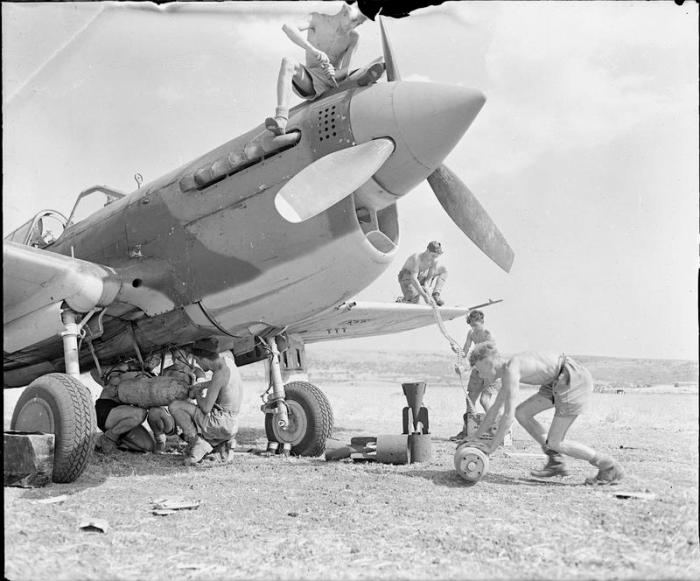
Armourers load a Curtiss Kittyhawk Mark III of No. 239 Wing RAF with 250-lb GP bombs and re-arm the machine guns in the wings, at Agnone, Sicily, for a forthcoming sortie against enemy positions in the foothills of Mount Etna. (Source: © IWM (CNA 1134))

As the Americans engaged in heavy fighting near Troina to the north, the Canadians advanced on Regalbuto to the south. In this attack, the Canadians leant heavily on artillery and air support. Air power was to focus primarily on reaching beyond the range of artillery where Allied intelligence expected much enemy traffic movement:

[i]t was believed that the enemy would withdraw when the assault developed, and it was hoped that the air attack would pin him down to the ground and prevent this operation.[3]

Allied intelligence also believed that the Germans were using the town as a motor pool for their vehicles and guns.

The Canadian anvil struck as the hammer waited overhead. Allied fighter-bombers claimed over 40 enemy motor vehicles destroyed on 2 August between Regalbuto and Adrano.[4] Between the fighting in and around Regalbuto and losses sustained during their withdrawal on Highway 121, the Hermann Göring Division’s panzer engineer battalion was effectively ‘eliminated as a combat force.’[5] The Allies successfully flushed the Germans from their positions after a gruelling attritional struggle. They forced the Germans to use the roads in large numbers, increasing already heavy casualties.

large2
A German Mk III tank knocked out during the fierce street fighting in Centuripe during the drive on Messina. (Source: © IWM (NA 5389))

A similar situation developed in the Battle of Troina. This time, however, the Germans made a much longer stand. Between 31 July and 6 August 1943, 15th Panzer Grenadier Division lost 1,600 men; 10 percent of the division’s strength or 40 percent of the fighting troops. The German commander, General Eberhard Rodt, later noted that losses from heavy artillery fire and massive carpet bombings on the hills and firing positions around the town were very high.[6] Allied aircraft caught a large amount of Axis motor transport on Highway 120 between Troina and Randazzo. Fighter-bombers claimed 50 vehicles strafed and bombed near Cesaro on 2 August.[7] It is possible that this was a reinforcement or supply column for the Troina garrison. Finally, Rodt notes that while his men were able to break contact with the Americans, they were often attacked and suffered losses from low-level aircraft while moving from Troina towards Bronte and Randazzo. Again, the Allies forced an Axis withdrawal to occur in daylight, adding to losses from the earlier attritional struggle.[8]

The German Army was just starting to get used to fighting with minimal support from the Luftwaffe. Air superiority over Sicily enabled the Allies to make use of this hammer and anvil to significant effect. Although elements of four German divisions escaped across the Strait of Messina in mid-August, those units were hollow shells of their former selves.[9] Air power and the catch-22 Allied air superiority forced the Axis into played a significant role in this outcome. The loss of Sicily opened the Mediterranean to Allied shipping, supported the Russians on the Eastern Front, and drove Italy ever closer to surrender.

large4
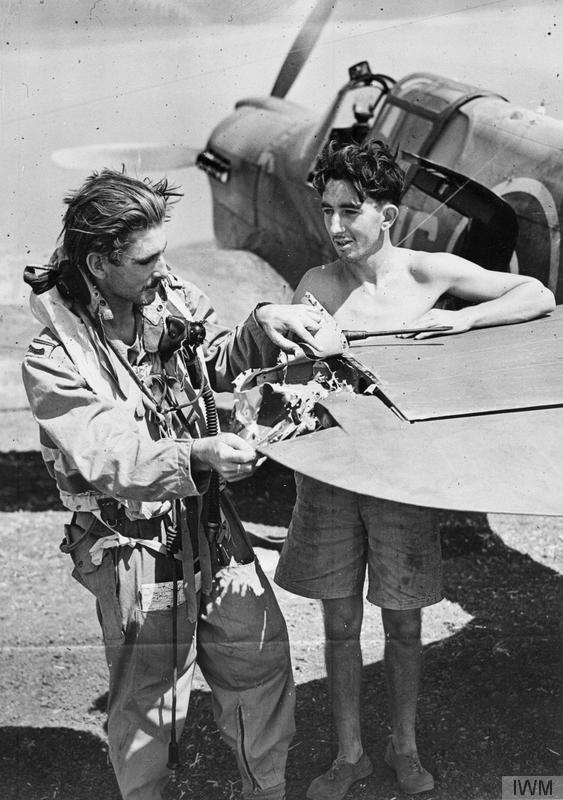
Flying Officer Colin Edmends from Australia and his fitter, D. McMinnemy, inspect the tail of his Curtiss Kittyhawk after it was damaged during a sortie over Catania. (Source: © IWM (CNA 1139))

Robert Pape’s writing on air power remains fairly controversial. Other air power theorists argue that the opposing force’s command and control, specifically regarding leadership and communications, are ideal targets. Foremost among these advocates is Colonel (Ret.) John Warden III, who wrote The Air Campaign, while he was at the National War College in the mid-1980s. However, in the estimation of this author, due to the case study examined above, Pape’s hammer and anvil approach have merit. As Philips Payson O’Brien notes in How the War Was Won, ‘except for killing every one of the combatants fighting against you, the only way to “win” a war is to stop your enemy from moving.’[10] Both theories advocate a solution to this problem. The difference is that one gives air power a complimentary role while the other affords it the leading role. In the Second World War, the debate was between the theatre air power school and the victory through air power school. The RAF and USAAF each had advocates for both of these approaches. This debate continues to this day.

Alexander Fitzgerald-Black completed his MA thesis, ‘Eagles over Husky: The Allied Air Forces and the Sicilian Campaign, 14 May to 17 August 1943,’ with The Gregg Centre for the Study of War and Society, University of New Brunswick in 2014. He is in the process of turning this work into a manuscript for publication with Helion & Company. Alex lives with his wife in Moncton, Canada. He operates his own blog at alexfitzblack.wordpress.com and can be reached on Twitter @AlexFitzBlack.

Header Image: A Martin Baltimore of the Tactical Bomber Force of the North West African Air Forces, flying over its target by a road in Sicily, while bombing retreating German forces heading for Messina, August 1943. (Source: © IWM (C 3772))

[1] Robert A. Pape, Bombing to Win: Air Power and Coercion in War (Ithaca, NY: Cornell University Press, 1996).

[2] Robert A. Pape, ‘The True Worth of Air Power,’ Foreign Affairs, 83:2 (2004), p. 119.

[3] Directorate of History and Heritage [DHH], Canadian Military Headquarters [CMHQ] Report No. 135, ‘Canadian Operations in Sicily, Part II Section 2, The Pursuit of the Germans from Vizzini to Adrano, 15 July to 6 August,’ p. 92.

[4] DHH, CMHQ Report No. 135, p. 92.

[5] Samuel W. Mitcham Jr. and Friedrich von Stauffenberg, The Battle of Sicily: How the Allies Lost Their Chance for Total Victory (Mechanicsburg, PA: Stackpole Books, 2007), p. 254.

[6] US Army Military History Institute, D.739.F6713, Foreign Military Studies [FMS] C-077, ‘15th Panzer Grenadier Division in Sicily,’ report by Eberhard Rodt and staff, 18 June 1951, p. 25.

[7] DHH, CMHQ Report No. 135, p. 92.

[8] Rodt FMS C-077, p.26.

[9] Lee Windsor, “The Eyes of All Fixed on Sicily’: Canada’s Unexpected Victory, 1943,’ Canadian Military History, 22:3 (Summer 2013), p. 31.

[10] Philips Payson O’Brien, How the War Was Won: Air-Sea Power and Allied Victory in World War II (Cambridge: Cambridge University Press, 2015), pp. 487-488.

#ResearchNote – Air Power in the Next Generation

#ResearchNote – Air Power in the Next Generation

By Dr Ross Mahoney

0001

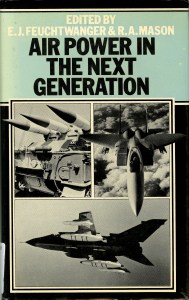
In 1979, The Macmillan Press published Air Power in the Next Generation that E.J. Feuchtwanger and Group Captain R.A. Mason edited. For me, and my current research trajectory on command and staff training in the RAF, what is remarkable about this book is that it was the first significant output from a newly established post for the Service, that of Director of Defence Studies (DDefS).

In 1977, Mason, who retired as an Air Vice-Marshal and was a professor at the University of Birmingham, became the first incumbent to the DDefS post at the RAF Staff College at Bracknell. The position of DDefS was established due to the perceived state of thinking on air power within the RAF as well as public awareness of the Service’s role. In a letter to AOC-in-C Support Command, Air Marshal Sir Reginald Harland, CAS, Air Chief Marshal Sir Neil Cameron, noted that the position was being established ‘to help provide a new stimulus to air power thinking’ throughout the RAF.[1] This point was also emphasised in the terms of reference for the DDefS post as was the need to ‘write on air power and defence issues,’ which was to be encouraged.[2]

While there was some controversy over the establishment of the DDefS position, Mason was well qualified for the job, and despite an initial lack of resources, he quickly got to work. In April 1977, a symposium was held at the University of Southampton, which formed the basis for Air Power in the Next Generation. Mason was undoubtedly supported in his early efforts by the degree of top cover he was afforded by CAS and other officers interested in the discussion of air power, such as the Director-General of Training, Air Vice-Marshal Frederick Sowrey.[3] Indeed, Cameron long had an interest in the study of air power and, as Group Captain J.A.G. Slessor, son of the former CAS, reflected, he was the only Chief to come to discuss the subject with his father.[4]

What of the book? It consists of 10 chapters based on the presentations delivered at the symposium. The opening chapter builds on Cameron’s opening presentation and reinforces the importance of protection by senior leaders. Had Cameron not been interested in both the subject matter and the importance of establishing a post to advocate for thinking about air power, it is hard to imagine that the position would have been created. Even if it had, it probably would have taken a very distinct direction to the one that it has. Other contributions came from a number senior serving or retired officers from not just the RAF but also the USAF, Luftwaffe and the Isreali Air Force. There were also contributions from academics such as John Erickson, who covered the expansion of Soviet Air Power. The conclusion from Major-General Lloyd R. Leavitt Jr. of the USAF on the ‘Lessons from South East Asia’ is particularly apropos for the current era as well as the 1970s. Leavitt, who retired as a Lieutenant-General, concluded that there was a need to enunciate and educate the body politic about the relevance of the system they were investing in noting that:

[…] in order to achieve the understanding and support of the people who have to pay the bills, the taxpayers and their elected representatives, we must go to the people and go through the press to the people with logical clear explanations about the involvements of air power – why the air force needs things, why this system is needed, and why that system is needed.[5]

Apart from the contents of the book, what is the significance of the establishment of the DDefS post? It is hard to assess, and hopefully, more answers will emerge as I continue to research the subject. However, a few tentative thoughts are warranted. First, the RAF at least recognised the challenge of its predicament in the 1970s and established a post to try and encourage the Service to discuss taxing questions over its role and employment. This was essential in the decade after the RAF handed over the strategic nuclear deterrent to the Royal Navy. This had been the RAF’s focal point during the early Cold War, and the Service needed to try and enunciate its relevance in a changing defence landscape. Whether it was successful in doing that is not to be discussed here. However, the post has offered a focal point for thinking about the RAF’s role, and individual DDefS’ have made a contribution to British air power thinking with publications similar to Air Power in the Next Generation being produced on important themes as well as the postholders numerous individual contributions on the subject of air power. These have become essential sources of informal doctrine, but they have, by dint of circumstances, varied regarding when they were produced and what they covered. Indeed, at the moment, I am trying to map the various outputs generated by DDefS’ both during their time in post and after to seek to contextualise what they wrote, when they wrote it and their impact. Some DDefS’ have produced more than others, in part, due to operational circumstances though there may be other factors at play. This latter aspect will be difficult to measure, but one thing that is already clear is that context is critical.

This post first appeared at Thoughts on Military History.

Dr Ross Mahoney is an independent historian and defence specialist based in Australia. Between 2013 and 2017, he was the resident Historian at the Royal Air Force Museum, and he is a graduate of the University of Birmingham (MPhil and PhD) and the University of Wolverhampton (PGCE and BA). His research interests include the history of war in the twentieth and twenty-first centuries, air power and the history of air warfare, and the social and cultural history of armed forces. To date, he has published several chapters and articles, edited two books, and delivered papers on three continents. He is a member of the Royal Historical Society and is an Assistant Director of the Second World War Research Group. He is a member of the Royal Historical Society and an Assistant Director of the Second World War Research Group. He blogs at Thoughts on Military History, and can be found on Twitter at @airpowerhistory.

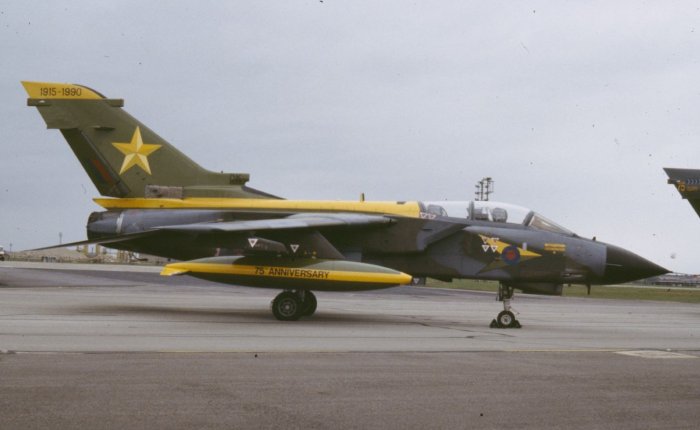
Header Image: Panavia Tornado GR1 of No. 31 Squadron at RAF Fairford, c. 1990 (Source: Wikimedia Commons)

[1] Author’s Personal Collection, Letter from the Chief of the Air Staff to AOC-in-C Support Command, 2 November 1976. I am grateful to Air Vice-Marshal Professor R.A. Mason for a copy of this and other documents linked to the establishment of the DDefS post.

[2] Author’s Personal Collection, Terms of Reference for Director of Defence Studies appended to a Letter from the Chief of the Air Staff to AOC-in-C Support Command, 2 November 1976, p. 1.

[3] Graham Pitchfork, The Sowreys: A Unique and Remarkable Record of One Family’s Sixty-Five Years of Distinguished RAF Service (London: Grub Street, 2012), p. 216.

[4] Marshal of the Royal Air Force Lord Cameron of Balhousie, In the Midst of Things (London: Hodder and Stoughton, 1986), pp. 106-8, 194-5, p. 200, fn9.

[5] Major-General Lloyd R. Leavitt Jr., ‘Lessons from South East Asia,’ in E.J. Feuchtwanger and Group Captain R.A. Mason (eds.), Air Power in the Next Generation (London: The Macmillan Press, 1979), p. 85.


#BookReview – The Mediterranean Air War: Airpower and Allied Victory in World War II

#BookReview – The Mediterranean Air War: Airpower and Allied Victory in World War II

By Alexander Fitzgerald-Black

Robert S. Ehlers Jr., The Mediterranean Air War: Airpower and Allied Victory in World War II. Lawrence, KS: University Press of Kansas, 2015. Notes. Bibliography. Index. Hbk. 536 pp.

9780700620753

The Second World War’s Mediterranean Theatre of Operations was a sideshow, right? The road to defeating Nazi Germany where the Western Allies were concerned lay through Normandy, not North Africa. The Allies launched their great Combined Bomber Offensive from the United Kingdom as this incredible animation from the American Air Museum shows. Other efforts were relatively unimportant and sapped resources from where the real air battle took place. Alternatively, were they?

Robert S. Ehlers Jr.’s The Mediterranean Air War: Airpower and Allied Victory in World War II offers a valuable counter-narrative. The Mediterranean was not a sideshow. In fact, it was a critical theatre for Allied victory. Adolf Hitler committed the Wehrmacht to the Mediterranean in 1941 to support Benito Mussolini’s faltering armies in Greece and North Africa. Four years later the consequence of this simple plan was 400,000 Italian and 730,000 German casualties. However, human casualties only tell part of the tale. The European Axis lost 42 percent of its merchant shipping in the Mediterranean. The Allies all but destroyed the Regia Aeronautica by mid-1943 while the Luftwaffe lost 17,750 aircraft in the Mediterranean throughout the war. By comparison, the Germans lost 20,419 aircraft on the Western Front while losing only 11,000 on the Eastern Front.

This is just the strategic picture. Ehlers’s work also talks logistics. Historians have often highlighted the importance of tank strength in the Western Desert. The side that could field the most tanks had the advantage. Since both sides had to maintain their forces across long supply chains the ability to retrieve and repair damaged battlefield equipment was crucial. The same was true for aircraft. The Royal Air Force created an efficient system for repair and salvage early in the campaign. Air Vice-Marshal Graham Dawson, the RAF’s Chief Maintenance Officer in the Mediterranean, organized the effort. Dawson was a Battle of Britain veteran who received a Mention in Dispatches for superb engine repair efforts in 1940. He coordinated his crews’ efforts with local Egyptian shops that could repair and manufacturer parts. Dawson’s command was innovative. It created modifications that allowed Hurricane fighters to engage high-flying Junkers Ju 86P photo reconnaissance aircraft. The aircraft’s service ceiling was 36,000 feet, yet the modified version achieved its first victory over the Nile at 49,000 feet.

large2
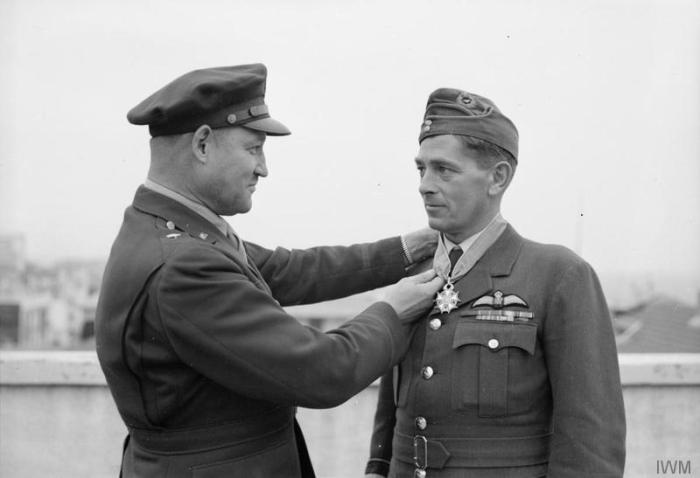
Air Vice-Marshal Graham Dawson, Director of Maintenance and Supply, Mediterranean Allied Air Forces, is presented with the American Legion of Merit in the degree of Commander, by Brigadier-General Harold A. Barton, Commanding General of the USAAF Service Command, Mediterranean Theatre of Operations, during a parade at Algiers. (Source: © IWM (CNA 2721))

The Mediterranean was ultimately a battle for sea lines of communication or SLOCs. Air superiority was essential to winning this and other battles. With the war in North Africa won, Ehlers argues that the Western Allies were right to take the war to Sicily and then on to mainland Italy. After securing air superiority, the Allied air forces were free to expand their cooperation with Allied armies. The Allies produced great results when the services coordinated their efforts. In the first half of 1944, Operations STRANGLE and DIADEM sought to defeat German forces barring the way to Rome. STRANGLE was an air campaign aimed at depriving the Germans of supplies while DIADEM was a large-scale ground offensive with air support. On its own, air power’s effectiveness was limited. The Germans lost 20 trucks per day during STRANGLE, but that number rose to 100 per day during DIADEM. Pressure from the army kept enemy transports on the road in large numbers, making them easier prey for prowling fighter-bombers. Together these operations cost the Germans Rome and 80,000 casualties.

Ehlers convincingly argues that the final air campaigns flown from bases in Italy shortened the war and saved lives. Targets included the Luftwaffe, the German oil industry, and German lines of communication to the Eastern Front. Instructors who seek to offer their students a fresh perspective on the Mediterranean Theatre of Operations will do well to include this book on their reading lists.

This post first appeared at Fighter-Bomber’s Blog.

Alexander Fitzgerald-Black completed his MA thesis, ‘Eagles over Husky: The Allied Air Forces and the Sicilian Campaign, 14 May to 17 August 1943,’ with The Gregg Centre for the Study of War and Society, University of New Brunswick in 2014. He is in the process of turning this work into a manuscript for publication with Helion & Company. Alex lives with his wife in Moncton, Canada. He operates his own blog at alexfitzblack.wordpress.com and can be reached on Twitter @AlexFitzBlack.

Header Image: A formation of five Blenheim Mark IVs of No. 14 Squadron RAF in flight over the Western Desert. A Curtiss Kittyhawk, one of the escorting fighters, can be seen on the far right (Source: © IWM (CM 3108))