Editorial note: This article first appeared on the author’s website. It has been reproduced here with permission.
The Korean War is often described as the ‘Forgotten War’ due to it being sandwiched between the more commonly known Second World War and the Vietnam War. Furthermore, a debate persists over its character, with some referring to it as ‘police action.’ Despite this, the Korean War has received its fair share of examination by historians since the conflict ended. Arguably, the most comprehensive history in the English language is Allan Millett’s history of the conflict. So far, two volumes of The War for Korea (2005 and 2010) out of a projected three have been published, covering the period up to 1951. From an Australian perspective, the late Jeffrey Grey’s work on the role of British Commonwealth armies, The Commonwealth Armies and the Korean War (1988), remains a key work.
In addition to Grey’s work, the key source on Australia’s involvement in the Korean War remains the two-volume official history written by Robert O’Neill. Starting research in 1970, O’Neill’s two-volume history dealt with strategy and diplomacy in its first volume, while the second volume covered the combat operations of the military forces deployed, including the experience of the Royal Australian Air Force (RAAF). While the first volume has generally been praised, the second volume has been described by at least one critic as a ‘regimental history.[1] Indeed, with specific reference to the RAAF’s contribution, Glen St John Barclay questioned the validity of volume two, arguing ‘if one is not going to make even a passing reference to the aviators of the US Air Force and Navy who achieved total command of the skies for the United Nations Forces in Korea. This is Hamlet without the Prince of Denmark, indeed.’[2]
O’Neill’s appointment nevertheless marked a significant departure from previous official historians, who were journalists by background. Here, the Australian Government made a conscious decision to appoint an academic – O’Neill also served as the Head of the Australian National University’s Strategic and Defence Studies Centre at the time he researched and wrote the official history. Since O’Neill’s appointment, the subsequent official histories published in Australia have adopted a significantly more academic tone. Moreover, as Peter Edwards, the Official Historian of Australia’s involvement in Southeast Asian Conflicts, 1948-1975 has written, O’Neill ‘pioneered the coverage in official histories of the strategic and diplomatic policy-making that led Australian forces to be involved in conflicts, with the same precision and authority as had always been given to the experience of those forces.’ [3]
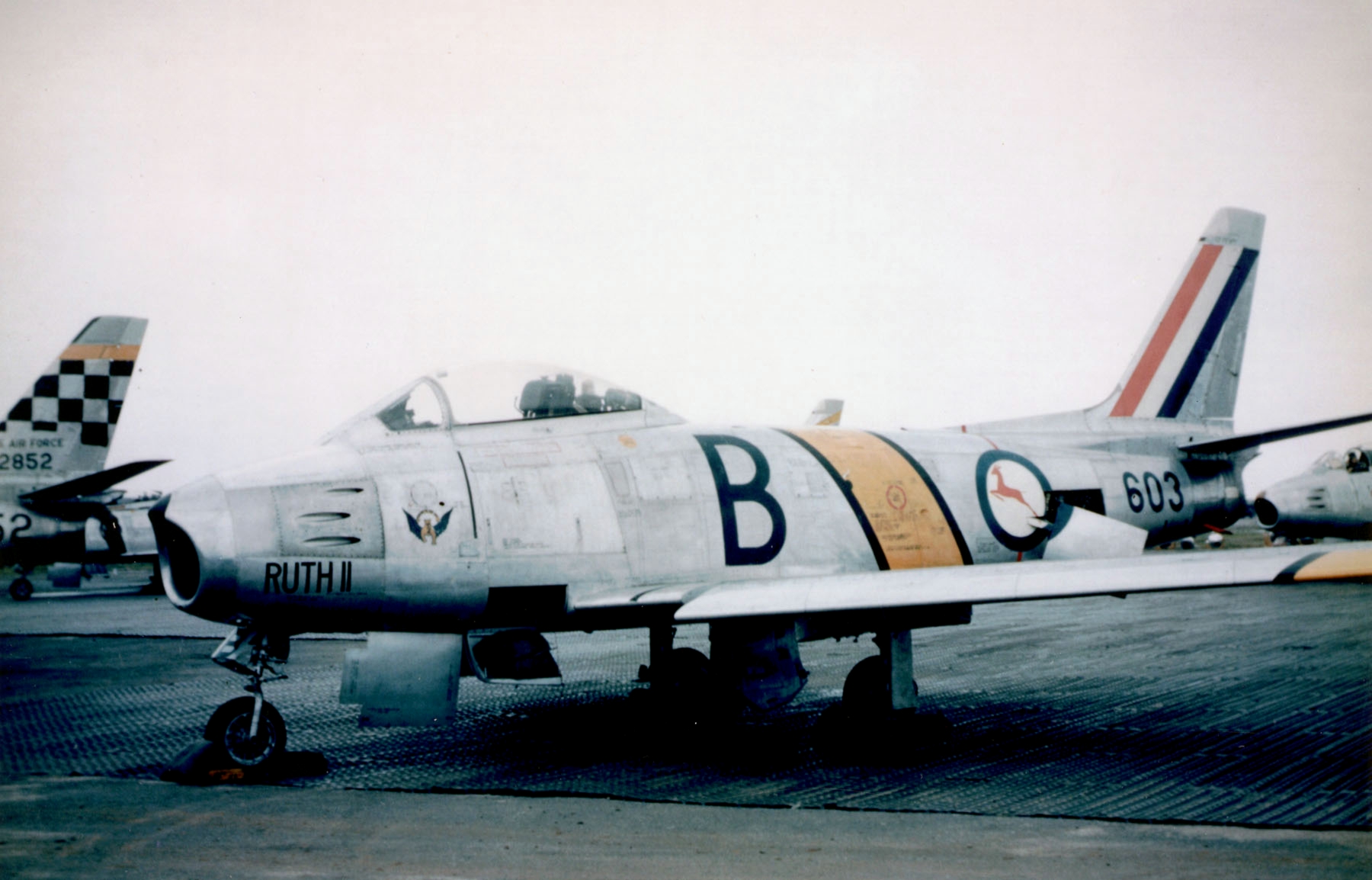
A South African Air Force North American F-86F Sabre from No. 2 Squadron at Tsuiki air base, Japan, in 1953. No. 2 Squadron SAAF was attached to the US Air Force 18th Fighter-Bomber Wing during the Korean War. (Source: Wikimedia)
Returning to air power, the historiography is generally dominated by accounts detailing the role of primarily the United States Air Force, with some attention paid to US naval air power and the role of US Marine Corps aviation. Key amongst these is Conrad Crane’s American Airpower Strategy in Korea (2000). Crane is critical of the USAF’s official history published by Robert Futrell in the 1960s, noting that The United States Air Force in Korea, 1950-1953 (1961) ‘emphasizes the success of air power in Korea and not the air force’s failure to learn enough from that ordeal.’[4] The role of naval aviation is dealt with in Richard Hallion’s 1986 work, The Naval Air War in Korea. Xiaoming Zhang’s 1998 article in The Journal of Military History and his 2002 book Red Wings over the Yalu remain the key works in the English language that examine the Chinese and Soviet use of air power over Korea.[5] Of interest is John Sherwood’s 1996 cultural history of US pilots during the Korean War, Officers in Flight Suits: The Story of American Air Force Fighter Pilots in the Korean War. In addition to these works, a useful general introduction to the subject can be found in Michael Napier’s 2021 history, Korean Air War.
Dealing with Australian air power, writing on the experience of the RAAF began even before the war had ended when George Odgers published Across the Parallel in 1952. Odgers had served as a public relations officer for the RAAF in Korea and had access to No. 77 Squadron that would have been hitherto unheard of for other writers of the time. The work was generally well received at the time of its publication, although it is now somewhat dated. Odgers would later write a biography of Wing Commander Richard Cresswell, Mr Double Seven (2008), who commanded No. 77 Squadron during 1951. Few personnel accounts of the RAAF’s involvement in the air war over Korea have been published. A notable exception is Colin King’s Luck is No Accident (2001).
Little was published on the RAAF’s operations in Korea until the arrival in 1994 of David Wilson’s Lion Over Korea. The RAAF’s role in Korea was discussed by Alan Stephens in the second volume of the Air Force’s official history, Going Solo, in 1995. Stephens’ work is arguably the most comprehensive treatment of the campaign, despite the experience in Korea warranting only a single chapter. The volume, however, situates the deployment in context and links it to other ongoing issues in the history of the RAAF at the time. Then, at the turn of the 21st Century, Doug Hurst published The Forgotten Few (2000) while more recently Owen Zupp has published an account of Australia’s contribution to the air war (2024).
Despite the lack of personal accounts and Hurst’s contention that the No. 77 Squadron represented a ‘forgotten few,’ there has been a surprising amount published for what was ostensibly a small contribution to the war effort. Nevertheless, there are problems. While it might be argued that much has been written about the RAAF’s contribution to the air war, their contribution can still be overlooked. For example, In from the Cold, a 2020 edited collection reflecting on Australia’s contribution to the Korean War, did not include a chapter on the RAAF. Based on a 2011 conference at the Australian War Memorial, the event featured chapters on the Australian Army and the Battle of Maryang San, as well as the four-month deployment of the Royal Australian Navy’s aircraft carrier, HMAS Sydney. However, the closest we see the RAAF discussed is in a chapter on coalition air operations by Richard Hallion.[6]
Additionally, apart from Stephens’ work, the cited works above primarily focus on the experience of No. 77 Squadron. Little attempt is made to link expertise back to the development and operations of the RAAF in Australia and other places such as Malaya. Indeed, any consideration of Australian air power strategy in this period cannot separate Korea from Malaya, as the two campaigns were clearly linked in the mind of the Australian government.[7]
Dr Ross Mahoney is an independent scholar specialising in the history of war, with a particular focus on the use of air power and the history of air warfare. He is the Editor-in-Chief of From Balloons to Drones and currently the Senior Historian within the Heritage Policy team at Brisbane City Council in Australia. He has nearly 20 years of experience in the education, museum and heritage sectors in Australia and the United Kingdom, including serving as the inaugural Historian at the Royal Air Force Museum between 2013 and 2017. His other research interests are military leadership and command, military culture, and the history and development of professional military education. He also maintains an interest in transport history. He has published numerous articles, chapters and encyclopedia entries, edited two books, and delivered papers on three continents. His website is here.
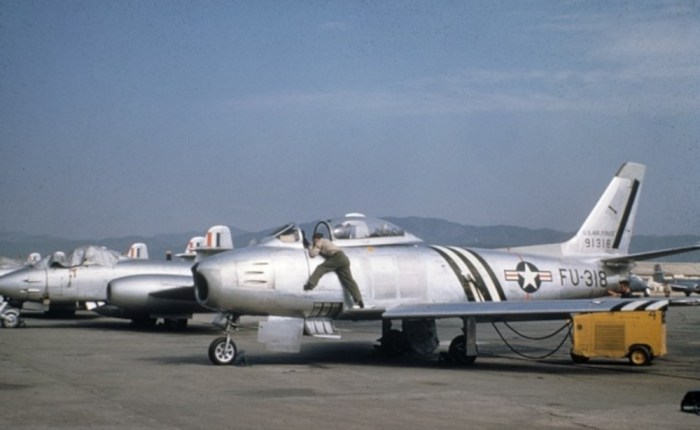
Header image: A United States Air Force North American F-86 Sabre parked alongside Gloster Meteor Mk8s on No. 77 Squadron of the Royal Australian Air Force at Iwakuni in Japan, June 195. (Source: Australian War Memorial)
[1] Glen St John Barcley, ‘Australian Historians and the Study of War, 1975-88,’ Australian Journal of Politics & History 41, no. 1 (1995), p. 241.
[2] Barclay, ‘Australian Historians and the Study of War,’ p. 241.
[3] Peter Edwards, ‘Robert O’Neill and the Australian Official War Histories: Policy and Diplomacy’ in Daniel Marston and Tamara Leahy (eds.), War, Strategy and History: Essays in Honour of Professor Robert O’Neill (Canberra, ACT: ANU Press, 2016), p. 71.
[4] Wayne Thompson, ‘Book Review – American Airpower Strategy in Korea, 1950-1953 by Conrad Crane,’ Journal of American History 87, no. 4 (2001), p. 1565.
[5] Xiaoming Zhang, ‘China and the Air War in Korea, 1950-1953,’ The Journal of Military History 62, no. 2, (1998), pp. 335–70.
[6] Richard Hallion, ‘The Air War in Korea: Coalition Air Power in the Context of Limited War’ in John Blaxland, Michael Kelly and Brewin Higgins (eds.), In from the Cold: Reflections of Australia’s Korean War (Canberra, ACT: ANU Press, 2020), p. 129, 141.
[7] Mark Lax, Malayan Emergency and Indonesian Confrontation, 1950 to 1966 (Newport, NSW: Big Sky Publishing, 2021), p. 75.
In 1970, the United States Air Force’s (USAF) Contemporary Historical Examination of Current Operations (CHECO) project, which produced around 250 volumes on various subjects, published a volume on the air operations of the RAAF over Vietnam.[1] The volume on the RAAF was one of several that examined non-US subjects; other air forces analysed included the Republic of Vietnam Air Force, the Royal Thai Air Force, and the Republic of Korea Air Force. Notably, the report on the RAAF, authored by James T. Bear, described the Australian effort over Southeast Asia as producing a ‘fruitful association’ with the USAF.[2] However, while the Americans, through the extensive distribution of this report to various commands, were aware of the views espoused by Project CHECO, the RAAF was not, as they were not included on the distribution list. As a result, this issue is often ignored by those using this source when writing on Australian air operations over Vietnam. For example, in a recent 2019 article in Sabretache, the journal of the Military Historical Society of Australia, Justin Chadwick made much of Bear’s report by describing its contents. However, Chadwick failed to address the distribution issue or whether the RAAF was aware of the report’s contents.[3] Nonetheless, Bear’s report, and others covering subjects pertinent to Australian air operations over Vietnam, were used by Chris Coulthard-Clark when researching and writing his volume on the RAAF in Vietnam as part of ‘The Official History of Australia’s Involvement in Southeast Asian Conflicts, 1948-1975.’ Moreover, the report is a valuable starting point for any discussion about Australia’s place in the air wars over Vietnam and the impact of the conflict on the RAAF.
More recently, however, air power historians have begun to discuss the air war over Vietnam more nuancedly. For example, in his 2021 history of the air war over Vietnam, Air Power’s Lost Cause, Brian Laslie, building on the work of scholars such as Mark Clodfelter, argued that the US fought six separate air wars during the conflict.[4] These campaigns included the strategic air campaign against North Vietnam; the battle for air superiority over North Vietnam; the USAF’s air war over South Vietnam; the US Navy’s air war over North and South Vietnam; air operations over Laos and Cambodia; and the US Army’s air mobility operations. However, while this classification helps describe US air operations over Vietnam, in excluding the experience of other nations involved in these ‘air wars,’ historians fail to tell a cohesive story about the use of air power over Vietnam.
Rations and supplies are unloaded from a UH-1B Iroquois helicopter of No. 9 Squadron RAAF, by troops of 7th Battalion, The Royal Australian Regiment, near the village of Long Dien during Operation Ulmarra, August 1967. (Source: Wikimedia)
Two reasons explain why historians fail to tell a cohesive story of air operations over Vietnam. First, from an American perspective, Vietnam is viewed as an inherently US war, especially regarding military operations. As Andrew Weist has remarked, ‘[r]emainders of the Vietnam War litter the cultural landscape of the United States.’[5] These reminders and the associated issues of ownership over the experience of the Vietnam War are often reinforced by popular accounts of the war, such as Ken Burns and Lynn Novick’s 2017 documentary The Vietnam War and debates related to America supposedly repeating the mistakes of Vietnam in its recent operations in Iraq and Afghanistan.[6] This has led historians to focus solely on the American experience and not to fully incorporate the story of those other nations that fought in the Vietnam War. Where they are included, their experience is often viewed as a sideshow to the main American effort. Indeed, as Bear’s CHECO report on the Australians noted, in the view of the USAF, ‘only Australia played a significant role in the air war.’[7]
The second reason concerns how the history of the RAAF in Vietnam has been written. This relates to the state of Australian military historiography and, from the perspective of the RAAF, how the Air Force’s narrative has shaped the latter’s account.[8] Apart from Coulthard-Clark’s 1995 official history, The RAAF in Vietnam: Australian Air Involvement in the Vietnam War 1962-1975, the literature on the RAAF’s service in Vietnam has primarily been the preserve of either the Air Force’s official histories or popular accounts, including veterans’ memoirs.[9] This situation mirrors concerns highlighted by John Ferris in 1998 when he reflected that most writers on air power history more broadly tend to be:
[t]he children of airmen, have been military personnel themselves, and have been employed at a historical office or service school in Canada, Germany, the United Kingdom, or the United States.[10]
This is undoubtedly the case with the history of the RAAF over Vietnam. Indeed, the RAAF has shaped the narrative surrounding the Air Force’s operations over Vietnam in two ways. First, the RAAF has published two official histories that span the Vietnam War period. The first, Going Solo, covered the period from 1945 to 1972 and was written by Alan Stephens, the former RAAF Historian. The second volume, Taking the Lead, written by Mark Lax, a RAAF Air Commodore, covers the period from 1972 to 1996. Neither book focuses singularly on Australian air operations over Vietnam. However, given the importance of the conflict to the RAAF, the war is integral to their analysis, particularly in Stephens’ volume. While both Stephens and Lax served in the RAAF and were academically trained historians, they were well placed to write these histories, thereby enhancing the value of these books. Nonetheless, as official histories, these works are often regarded as providing a definitive account of their subject. However, official histories are often the first rather than the last word on their topic.
The second way the RAAF has influenced the narrative of its operation over Vietnam is that the first book on Australian air operations during the conflict, Mission Vietnam, was commissioned by the Air Force. Research for Mission Vietnam, written by George Odgers, the Director of Public Relations in the Department of Air, began in 1971 before Australian air operations in Vietnam ended in 1972.[11] The book appeared in 1974, the year before the RAAF deployed Detachment ‘S’. As such, it does not comprehensively capture all RAAF operations associated with the Vietnam War. On publication, the RAAF News was convinced that Odgers’ volume would have ‘widespread appeal’ while one 1974 review in The Canberra Times described it as ‘essential reading.’[12] Illustrative of its importance in shaping the narrative, Mission Vietnam will be republished by the RAAF’s History and Heritage branch.
Beyond these volumes, discussions of RAAF operations over Vietnam have typically been left to popular accounts or memoirs, including those published under the auspicious of the Air Force’s Air and Space Power Centre and the History and Heritage Branch.[13] For example, Jeff Pedrina’s account Wallaby Airlines was initially published in 2006 by the Air Power Development Centre (as ASPC was then known). It was recently reissued in 2023 as part of the Australian Air Campaign Series (AACS) produced by the History and Heritage Branch.[14] Similarly, as part of the AACS, in 2022, the History and Heritage Branch published an abridged version of Air Vice-Marshal Reed’s autobiography, Invited to a War.[15] Reed had served in Vietnam, flying Phantoms on exchange with the USAF. Many of these works represent what has invariably been described as Australia’s ‘democratic’ approach to military history, which focuses on the experiences of veterans.[16] In this sense, every participant’s views and recollections are equal and should be heard. There are, however, exceptions to this democratic approach. For example, Steven Paget’s recent examination of the operations of No. 2 Squadron over Vietnam usefully places the challenges the RAAF faced in achieving interoperability with the USAF into context.[17]
Aerial view of the aircraft revetments at Phan Rang airbase in July 1967. No. 2 Squadron RAAF Canberra bombers are parked in the bays located in the immediate foreground. (Source: Australian War Memorial)
Given much of the above, how would a more integrated and cohesive account of Vietnam’s air wars look? First, from an Australian perspective, we need to move away from focusing solely on the Australian experience of the Vietnam War. As Thomas Richardson argued, such perspectives distort our view of Australia’s ‘success or failure’ in Vietnam.[18] This applies equally to the RAAF and the Australian Army. Second, with regard to the broader picture of air operations over Vietnam, consideration of the experience of non-US units would help inform wider discussions on the character and challenges of coalition air operations in this period by considering issues such as cooperation and friction. While official and authorised accounts address some of these challenges, their aim of foregrounding the Australian experience through a functional approach to history, based on the RAAF’s roles, limits how far they can analyse these issues.[19]
Some indication of how to produce such a history can be gleaned from Paget’s work on No. 2 Squadron operations. Paget rightly noted that the experience of No. 2 Squadron highlighted issues in command and control, standardisation, tactics, training and procedures, and the sustainment of operations. However, these themes can be further analysed through additional examples of Australia’s experience in Vietnam. For example, the experience of RAAF officers on secondment as airborne Forward Air Controllers offers a valuable opportunity to understand how lessons are learnt and shared between air forces. Similarly, before the deployment of No. 2 Squadron, No. 35 Squadron was already fully integrated into the USAF command-and-control apparatus. Moreover, unlike No. 2 Squadron, No. 35 Squadron operated an aircraft type that the US would not deploy to South Vietnam until later in the war. However, it appears that the USAF did not take the opportunity to study the RAAF’s use of the Caribou, which raises questions about why this might have been.[20] As such, understanding the experience of No. 35 Squadron would further enrich our understanding of the air wars over Vietnam by exploring cultural issues that either help or retard the lessons learnt process. Finally, we must consider what the deployment of RAAF air assets to Vietnam contributed to the overall war effort, given that, for example, during February 1968, at the height of the Tet Offensive, the Air Force accounted for only around one per cent of all attack sorties flown.[21] This was undoubtedly a significant effort for the RAAF. Still, it highlights the problem of deploying only single unit types rather than a cohesive operational package comprising several squadrons of the same type. As such, within the context of wider coalition operations, we must further question why the RAAF deployed the force it did and how it sought to influence and shape ongoing operations.
Dr Ross Mahoney is the Editor-in-Chief of From Balloons to Drones. He is an independent scholar specialising in the history of war with particular reference to the use of air power and the history of air warfare. He is currently the Senior Historian within the City Architecture and Heritage Team at Brisbane City Council in Australia. He has nearly 20 years of experience in the education, museum and heritage sectors in Australia and the United Kingdom. Between 2013 and 2017, he was the inaugural Historian at the Royal Air Force Museum in the UK. In Australia, he has worked as a Historian for the Department of Veterans’ Affairs and taught at the Strategic and Defence Studies Centre at The Australian National University based at the Australian War College. His research interests are focused on the history of war, specifically on the history of air power and air warfare, military leadership and command, military culture, and the history and development of professional military education. He also maintains an interest in transport history. He has published numerous articles, chapters and encyclopedia entries, edited two books, and delivered papers on three continents. His website is here, and he can be found on Twitter at @airpowerhistory.
Header image: DHC-4 Caribous of the RAAF Transport Flight arrived in South Vietnam in 1964 to work with the South Vietnamese and U.S. Air Forces to transport soldiers and supplies to combat areas in South Vietnam. (Source: Wikimedia)
[1] James T. Bear, ‘The RAAF in SEA’ (CHECO Division, 1970); Warren A. Trest, ‘Projects CHECO and Corona Harvest: Keys to the Air Force’s Southeast Asia Memory Bank,’ Aerospace Historian 33, no. 2 (1986), pp. 114-20; Major Daniel Hoadley, ‘What Just Happened? A Historical Evaluation of Project CHECO’ (MA Thesis, USAF School of Advanced Air and Space Studies, 2013).
[2] Bear, ‘The RAAF in SEA,’ p. 1. During the Vietnam War, the RAAF contributed significantly to the Australian effort in the conflict. While some flights had taken place in South Vietnam by a Dakota of No. 2 Squadron’s transport flight in 1963, the first significant deployment of RAAF assets took place in 1964 when six DHC-4 Caribous of the recently formed RAAF Transport Flight Vietnam – later renumbered as No. 35 Squadron in 1966 – were deployed as part of Australia’s early efforts in supporting the war. After the deployment of No. 35 Squadron, the RAAF’s primary involvement took the form of No. 9 Squadron equipped with Bell UH-1B Iroquois helicopters and No. 2 Squadron with GAF Canberra bombers. Notably, 36 fighter pilots served as airborne Forward Air Controllers with the USAF’s 19th and 20th Tactical Air Support Squadrons flying Cessna O-1 Bird Dogs, Cessna O-2 Skymasters, and Rockwell OV-10 Broncos. Additionally, six RAAF pilots flew USAF McDonnell F-4 Phantoms during the war as part of the 12th Tactical Fighter Wing. There were also those units – Nos. 36 and 37 Squadron – who maintained a strategic air bridge between Australia and Vietnam, including aeromedical evacuation. Lockheed Neptune maritime patrol aircraft regularly patrolled the sea lines of communication between Australia and Vietnam, such as during Operation Trimdon in 1965. In addition to the deployed squadrons, various elements of the RAAF provided valuable ground support, including airfield construction, air defence guards, and medical personnel. Officially, RAAF operations over Vietnam ended in February 1972 when the last Caribous of No. 35 Squadron left the country. However, in 1975, as South Vietnam finally fell, the RAAF deployed Detachment ‘S’ to Vietnam to withdraw Australian national and embassy staff and distribute Red Cross aid.
[3] Justin Chadwick, “Nothing to diminish their glamour’: Project CHECO and the RAAF,’ Sabretache 60, no. 4 (2019), pp. 23-34.
[4] Brian Laslie, Air Power’s Lost Cause: The American Air Wars of Vietnam (Lanham, MD: Roman and Littlefield, 2021), p. 2; Mark Clodfelter, ‘The Limits of Airpower or the Limits of Strategy: The Air Wars in Vietnam and Their Legacies,’ Joint Forces Quarterly 78 (2015), pp. 111-24.
[5] Andrew Weist, ‘Introduction’ in Andrew Weist (ed.), Rolling Thunder in a Gentle Land: The Vietnam War Revisited (Oxford: Osprey Publishing, 200), p. 16.
[6] Andrew Gawthorpe, ‘Ken Burns, the Vietnam War, and the Purpose of History,’ Journal of Strategic Studies 43, no. 1 (2020), pp. 154-69.
[8] Jeffrey Grey, ‘Cuckoo in the Nest? Australian Military Historiography: The State of the Field,’ History Compass 6, no. 2 (2008), pp. 455-68.
[9] Chris Coulthard-Clark, The RAAF in Vietnam: Australian Air Involvement in the Vietnam War, 1962-1975 (Sydney, NSW: Allen & Unwin in association with the Australian War Memorial, 1995). For the RAAF’s official histories, see: Alan Stephens, Going Solo: The Royal Australian Air Force, 1946-1971 (Canberra, ACT: AGPS Press, 1995); Lax, Taking the Lead. For memoirs and autobiographies, for example, see: Gary Cooper and Robert Hillier, Sock it to ‘em Baby: Forward Air Controller in Vietnam (Crows Nest, NSW: Allen and Unwin, 2006); David Evans, Down to Earth: The Autobiography of Air Marshal David Evans, AC, DSO, AFC (Canberra, ACT: Air Power Development Centre, 2011).
[10] John R. Ferris, ‘Review Article – The Air Force Brats’ View of History: Recent Writing and the Royal Air Force, 1918–1960,’ The International History Review 20, no. 1 (1998), p. 119.
[11] George Odgers, Mission Vietnam: Royal Australian Air Force Operations, 1964-1972 (Canberra, ACT: Australian Government Publishing Service, 1974); ‘History of War,’ The Canberra Times, 18 June 1971, p. 1.
[12] ‘“Mission Vietnam” sure to have widespread appeal,’ RAAF News, 1 August 1974, p. 3; “Written the Way it Was in Vietnam Air War,’ The Canberra Times, 16 August 1974, p. 9.
[13] Examples of books published under the auspicious of the RAAF’s Air and Space Power Centre that discuss Vietnam include: John Bennett, Highest Traditions: The History of No. 2 Squadron RAAF (Canberra, ACT: Australian Government Publishing Service, 1995); Graham O’Brien, Always There: A History of Air Force Combat Support (Canberra, ACT: Air Power Development Centre, 2009); Chris Clark, The RAAF at Long Tan (Canberra, ACT: 2010); Evans, Down to Earth; Bob Howe, Dreadful Lady over the Mekong Delta: An Analysis of RAAF Canberra Operations in the Vietnam War (Canberra, ACT: Air Power Development Centre, 2016). For an example of a book produced in conjunction with the History and Heritage Branch, see: Bob Grandin, Answering the Call: Life of a Helicopter Pilot in Vietnam and Beyond (Newport, NSW: Big Sky Publishing, 2019).
[14] Jeff Pedrina, Wallaby Airlines: Twelve Months Caribou Flying in Vietnam (Tuggeranong, ACT: Air Power Development Centre, 2006). Pedrina, Wallaby Airlines: Twelve Months flying the Caribou in Vietnam (Newport, NSW: Big Sky Publishing, 2022).
[15] Air Vice Marshal Alan Reed, Invited to a War (Newport, NSW: Big Sky Publishing, 2002).
[16] Thomas Richardson, Destroy and Build: Pacification in Phuc Tuy, 1966-72 (Melbourne, VIC: Cambridge University Press, 2017), p. 5.
[17] Steven Paget, ‘Magpies and Eagles: Number 2 Squadron, Royal Australian Air Force, and the Experience of Coalition Warfare in Vietnam’ in Steven Paget (ed.), Allies in Air Power: A History of Multinational Air Operations (Lexington, KT: The University Press of Kentucky, 2021), pp. 142-67.
Editorial Note: During 2019, From Balloons to Drones will be running a series of articles looking at various aspects of the air war over Vietnam from the French-Indochina War through to the end of the Vietnam War. To kick off this series, Assistant Editor, Dr Michael Hankins, provides a brief overview of the historiography of the air war. While not conclusive, it does give an idea of the critical strands present in the historiography and highlights where there are some important omissions such as a scholarly examination of air power during the French-Indochina War. If you would like to be a part of that discussion by submitting your work to the series, please email our editor, Dr Ross Mahoney, at airpowerstudies@gmail.com or via our contact page here. The official call for papers is here.
Here at From Balloons to Drones, we are launching a series of articles on the air war in Vietnam. This is no easy task, as writing about the Vietnam War is akin to strolling into a minefield: There is a good chance of causing an explosion. Historian Robert Citino stated it best:
Anyone who tries to draw conclusions from the Vietnam War will almost certainly anger the legions of Americans who have already made up their minds about it.[1]
In the U.S. especially, the debate over the war rages in both public and academic spheres regarding what happened and what it means for American society.[2] As the war in its entirety remains controversial, the sub-field on the air wars has developed its own debates and tropes. This article is intended as a quick guide to some of that literature as well as an introduction to a few of the broader arguments and issues that loom over the entire field. If there is any single takeaway from a survey of the literature of the Vietnam War (and its air components in particular), it is that the war remains contested but relevant, and there is plenty of work for scholars left to do in deepening our understanding of the conflict.
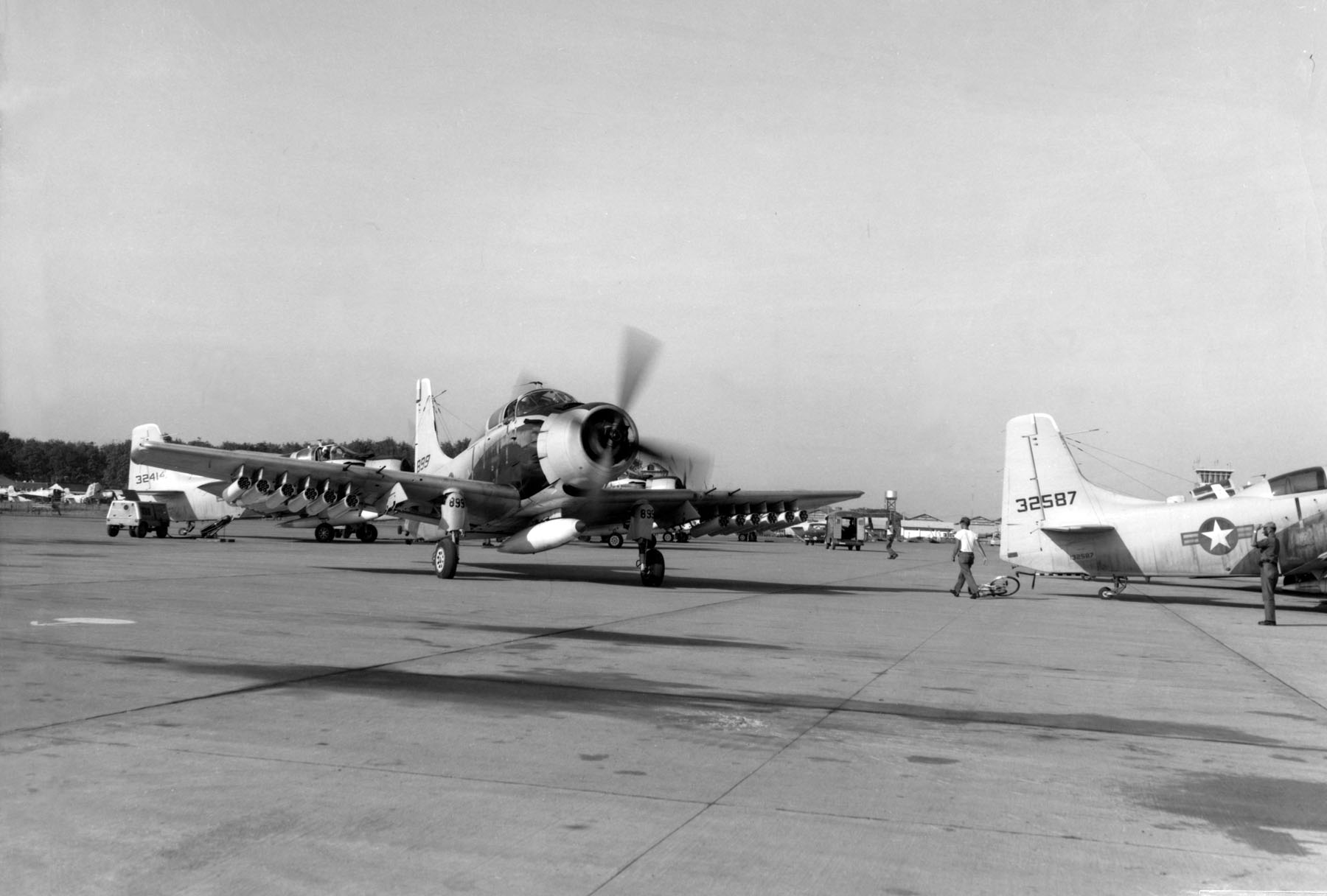
A Vietnamese Air Force student pilot and a USAF instructor sit side by side in a VNAF Douglas A-1E Skyraider taxing to the runway at Bien Hoa air base, Vietnam, c. 1965. (Source: Wikimedia)
General Histories
Because there is less of a standing consensus regarding the Vietnam War than in some other conflicts, finding an entry point can be difficult. Perhaps the most middle-of-the-road overview of the entire conflict (written primarily from the American perspective) is still George C. Herring’s America’s Longest War: The United States and Vietnam, 1950–1975 (1979). Originally written in 1979, it is now in its fifth edition (released in 2013) as Herring continually updated it to incorporate new scholarship. Another useful overview is Where the Domino Fell: America and Vietnam 1945-2010 (2014) by James Olson and Randy Roberts. This is the sixth edition of a book initially published in 1991 and constantly updated. The book is still mostly from the American perspective but delves a little bit deeper into some of the backgrounds to the conflict regarding French colonialism and the ideology of Ho Chi Minh, which itself is highly contested.[3] Olson and Roberts are more pointed in their argument that the war was unwinnable for the U.S.
For a more traditional operational look, Phillip Davidson’s Vietnam at War: The History, 1946-1975 (1988) is a valuable in-depth examination of both the French and American phases of the war. For a contrasting, but still, mostly operational look at the war, the works of Gregory Daddis are perhaps the best place to start. It is fair to say that Daddis is the current leader of the field when it comes to military histories of the Vietnam War. His trilogy of books is useful and wide-ranging. No Sure Victory: Measuring U.S. Army Effectiveness and Progress in the Vietnam War (2011) examines the ways that U.S. forces measured progress and success, which led them to make many faulty assumptions. Westmoreland’s War: Reassessing American Strategy in Vietnam (2014) and Withdrawal: Reassessing America’s Final Years in Vietnam (2017) each examine the American strategic and operational approaches in the first and second half of the conflict respectively.
What these books do not address as much are the pacification programs (also known as ‘the other war’) and a perspective internal to South Vietnam. Thankfully, more historians are entering the field and producing exciting work in these areas. Jessica Chapman’s Cauldron of Resistance: Ngo Dinh Diem, the United States, and 1950s Southern Vietnam (2013) are one of the most exciting new books in the field, examining the Ngo Dinh Diem regime and the three organisations internal to South Vietnam that resisted it the most. Andrew Gawthorpe’s To Build as Well as Destroy: American Nation Building in South Vietnam (2018) is probably the best look at pacification so far, although it proves to be a promising topic that shows much room to grow.
It is important to note that a book such as Olsen’s and Robert’s (and to some degree Daddis’) are responding to an earlier strain of works that argued the opposite. This argument was that the war was winnable, but that American leaders (mostly civilian political leadership and some military leaders) fundamentally misunderstood the war and for one reason or another, snatched defeat from the jaws of victory. Perhaps the most widely-read work that takes that argument is Harry Summers’ On Strategy: A Critical Analysis of the Vietnam War (1982), which analyses the war through a particular interpretation of Clausewitz. Most works that take this tack posit that America could have won the war earlier by going with a more all-out, aggressive military strategy.
The Air War(s)
That more aggression could have produced victory was certainly the belief of many U.S. Air Force leaders. For example, speaking to Air Force Academy cadets in 1986, General Curtis LeMay was asked whether the U.S. could have won the war. He responded: ‘In any two-week period you care to mention.’[4] Many books on the air war take a similar approach, such as On Yankee Station: The Naval Air War Over Vietnam (1987) by John Nichols and Barrett Tilman. This argument is especially common among oral histories and memoirs. There are a plethora of such books, particularly by pilots eager to share their ‘There I was…’ stories and many of these works are very useful. The best is Airpower in Three Wars: World War II, Korea, Vietnam(1978) from the Commander of 7th Air Force, General William Momyer (pronounced Moe-Mye-er). Other notable entries in this category include Ed Rasimus’ Palace Cobra: A Fighter Pilot in the Vietnam Air War (2006), Robin Olds’ Fighter Pilot: The Memoirs of Legendary Ace Robin Olds (2010), Ken Bell’s 100 Missions North: A Fighter Pilot’s Story of the Vietnam War (1993), and Robert Wilcox’s oral history of the Top Gun program, Scream of Eagles: The Creation of Top Gun and the U.S. Air Victory in Vietnam (1990), to name a few.
However, most of the literature from historians regarding the air campaigns have argued the opposite: that a more aggressive bombing approach earlier in the war was not feasible for a variety of reasons. One of the earliest books to push for this line of thinking is Mark Clodfelter’s The Limits of Air Power: The American Bombing of North Vietnam (1989). This book is, in this author’s opinion, still the most important book on the air war in Vietnam and one of the most important works in the field of air power history in general. Other works have made similar or related arguments but in more specific areas. Earl Tilford’s Crosswinds: The Air Force’s Setup in Vietnam (1993) looks at the years leading up to the war and argues that the Air Force’s structure and doctrine did not lend itself to the type of fighting in Vietnam.[5] For an operational look at the air campaigns through this lens, the most useful works are Jacob Van Staaveren’s Gradual Failure: The Air War over North Vietnam, 1965-1966 (2002) and Wayne Thompson’s To Hanoi and Back: The United States Air Force and North Vietnam, 1966-1973 (2000) each of which focuses on a distinct time frame. The Linebacker II campaign sometimes called the ‘11-day war’ or ‘the Christmas bombing’ can be contentious. The best operational account of it so far is Marshall Michel’s The Eleven Days of Christmas: America’s Last Vietnam Battle (2001), which blames Air Force leaders rather than political leaders for the mission’s problems.
Many of the more popular memoirs deal with air-to-air aspect, although such encounters were rare, as the North Vietnamese Air Force tended to average thirty to forty operational fighters at any given time (compared to the thousands of aircraft the U.S. had in-theatre). There are some broader examinations of the air-to-air aspect. The most comprehensive is Marshall Michel’s Clashes: Air Combat over North Vietnam, 1965-1972 (1997), although Craig Hannah’s brief Striving for Air Superiority: The Tactical Air Command in Vietnam (2001) is also useful.[6] Because the war featured an expansion of tactical air power, many works deal with a diversity of air power roles, one of the best entry points is Donald Mrozek’s Air Power and the Ground War in Vietnam: Ideas and Actions(1988). Part of the problem with the use of tactical air power in Vietnam was the confusing command structures and service rivalries. Ian Horwood’s Interservice Rivalry and Airpower in the Vietnam War (2006) is perhaps the best text examining that issue and is a useful general exploration of tactical airpower in the south.
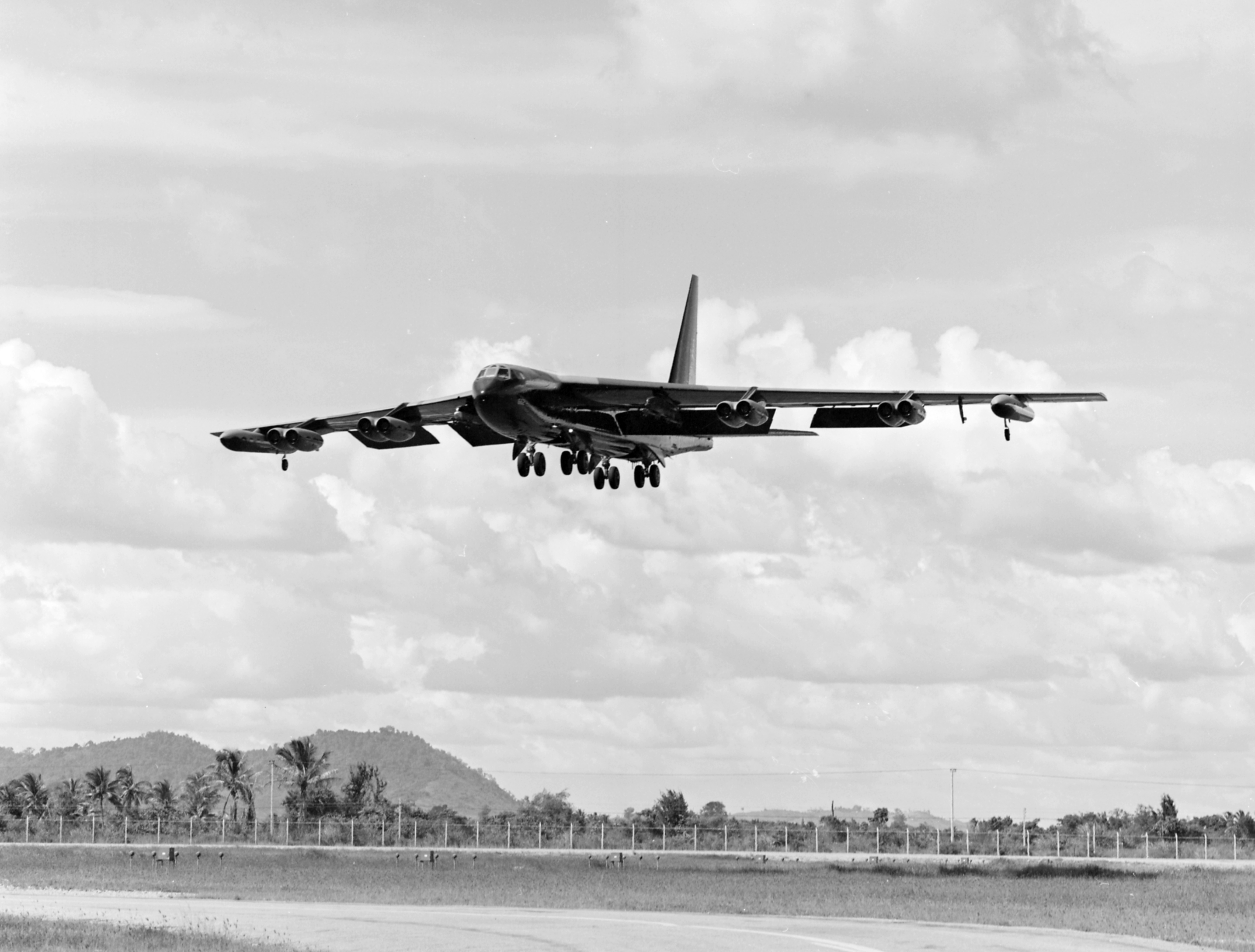
A U.S. Air Force Boeing B-52D Stratofortress aircraft coming in for a landing at U-Tapao air base, Thailand, after a mission over Vietnam, 30 October 1972. (Source: Wikimedia)
The problems that the US military experienced in Vietnam led to a long period of change afterwards, as the various services all raced to reform themselves not to repeat the perceived mistakes of the war. However, the services disagreed (with each other and within themselves) about what precisely the mistakes were and how to solve them. The period following the war, from the late 1970s until 1991, was essentially a second ‘interwar period,’ similar in some ways to the 1920s and 1930s. The degree to which the Vietnam War was used as an impetus for change in the air power realm has been covered in many works. There are so many volumes on this subject that they would require a separate article on their own, although some useful starting places include Brian Laslie’s The Air Force Way of War: U.S. Tactics and Training after Vietnam (2015), Mike Worden’s The Rise of the Fighter Generals: The Problem of Air Force Leadership, 1945–1982 (1998), and C.R. Anderegg’s Sierra Hotel: Flying Fighters in the Decade After Vietnam(2001). You can find a historic book review of this latter title here.
Although many of the works listed here are of high quality, there are some inherent limitations to the field. Most of them are limited to studying a specific geographical area or timeframe (or both), and there are fewer works that take a comprehensive look at the entirety of the air wars. Some such works are forthcoming, but there is more room for more books that take this wider approach. Most works are written by people who have some tie to the military. Many are veterans of the war or have served in the time since. Many more are civilian employees of the military (of which this author is one as well, so take my recommendations with a grain of salt of course). Many of the books listed here are from government or military presses. None of this is to imply that they are of lesser quality or that they have any particular biases (indeed, much of the material from Air University Press can be interpreted as critical of the Air Force), but it does mean that the perspectives given are limited. Further limiting our view of the war is the paucity of books written by women and people of colour. The majority (although not all) of the books in the field are from the perspective of men, predominantly white – a limitation that is hopefully in the process of being alleviated as new and diverse scholars continue to enter the field.
There is a reason to believe that the field of Vietnam War histories is on the verge of a turning point, as the previous generation who remembers the war as a part of their lives is starting to give way to a new generation that has no personal memory of the war. New sources and new perspectives are beginning to emerge, as new and old scholars alike develop not only new answers to questions but new questions. It is an exciting time to be a historian of this era.
Conclusion
There is an overwhelming number of works about the air wars in Vietnam. This brief survey, focusing on significant monographs, is not meant to be comprehensive, but merely a guide to some of the more influential works and themes. There are many wonderful and useful works not mentioned here, and that is not meant as a slight against any of them. For more, any serious student of the Vietnam War must become quickly aware of the work of Dr Edward Moïse. Not only are his own works useful reading, but his website contains quite possibly the largest bibliography of works on the Vietnam War, many of which are annotated and organised into searchable categories. This is an invaluable resource.
Despite the large size of the field, there is much work left to be done. While there are many memoirs and oral histories of various aspects of the war, we still need scholarly monographs on the air wars in Laos and Cambodia, on Air America (the CIA’s air effort), on the defoliation operations, and on-air mobility both in terms of troop movements and airlift of supplies and humanitarian efforts. Many of the works mentioned do discuss air power used by the Army and Marines, but more works focusing on these aspects are needed. Perhaps the two most significant gaps in the field are a good scholarly analysis of the use of air power during the French-Indochina War and a discussion of the perspective of the North Vietnamese Air Force. Chinese involvement in terms of providing pilot training and providing some actual pilots could also be examined in more depth. Of course, there is always room for new interpretations of ideas that have been previously discussed. Several excellent books do exist on these topics, but there is room for scholars to expand our knowledge and understanding. This is just a tip of the iceberg of some of the exciting work left to be done in the field.
The Vietnam War is a conflict that will continue to be controversial as those involved on all sides continue to grapple with its legacy. We here at From Balloons to Drones hope that the upcoming series of articles from a variety of perspectives can help move that discussion forward.
Dr Michael Hankins is Professor of Strategy at the USAF Air Command and Staff College eSchool, and former Instructor of Military History at the U.S. Air Force Academy. He earned his PhD from Kansas State University in 2018 with his dissertation, ‘The Cult of the Lightweight Fighter: Culture and Technology in the U.S. Air Force, 1964-1991.’ He completed his master’s thesis at the University of North Texas in 2013, titled “The Phantom Menace: The F-4 in Air-to-Air Combat in the Vietnam War.” He has a web page here and can be found on Twitter at @hankinstien.
Header Image: A USAF Douglas A-26C Invader loaned to France during the Indochina War. This aircraft was loaned to France from March 1952 to November 1955. (Source: Wikimedia)
[1] Robert M. Citino, Blitzkrieg to Desert Storm: The Evolution of Operational Warfare (Lawrence, KS: The University of Kansas Press, 2004), 254.
[2] For insightful studies of the memory of the Vietnam-American War, see Christian G. Appy, American Reckoning: The Vietnam War and Our National Identity (New York: Viking Press, 2015); Patrick Hagopian, The Vietnam War in American Memory Veterans, Memorials, and the Politics of Healing (Amherst, MA: University of Massachusetts Press, 2012); and Gregory Daddis, ‘The Importance of the Vietnam War’s Tet Offensive,’ War on the Rocks, 29 January 2018.
[3] Determining whether Ho Chi Minh was primarily a nationalist or a communist has been a major point of contention in the literature. Olsen and Roberts argue that he was in fact both, and that for him, those concepts cannot be separated.
[4] See Earl Tilford, ‘Linebacker II: The Christmas Bombing,’ The VVA Veteran, January/February 2014. This quote from LeMay is widely cited in many works.


 From Balloons to Drones