#BookReview – Air Power’s Lost Cause: The American Air Wars of Vietnam

#BookReview – Air Power’s Lost Cause: The American Air Wars of Vietnam

Brian D. Laslie, Air Power’s Lost Cause: The American Air Wars of Vietnam. London: Rowman and Littlefield, 2021. Notes. Appendices. Bibliography. Hbk. xiii + 272 pp.

Reviewed by Dr Maria E. Burczynska

61L-j+UtOpL._AC_UF894,1000_QL80_

The Vietnam War, also known as the Second Indochina War, or as referred to in Vietnam – the American War is a topic widely covered in academic and popular literature. Among the various publications, Brian D. Laslie provides a unique perspective on the American air campaign in Vietnam. Published as a part of the War and Society series by Rowman and Littlefield, Laslie’s work is an attempt to produce a comprehensive and critical overview of the air war over Vietnam, Laos and Cambodia. To achieve that, Laslie posits three questions: was the disjointed and ineffective use of air power in Vietnam preventable? What should control of the air looked like? Finally, would a different command and control structure have made any difference to the potential outcome of the conflict? (p. 3)

The title, Air Power’s Lost Cause, already gives away the book’s leading theme. The concept of a ‘lost cause’ is most widely associated with the American Civil War of 1861 to 1865, regarding the Confederacy fighting a heroic and noble battle against all the odds, effectively losing the war. The creation and evolution of that myth as well as its influence on the American memory of the Civil War, has been widely discussed in the literature, for example, by Gary Gallagher and Alan T. Nolan in The Myth of the Lost Cause and Civil War History, or William C. Davis in The Cause Lost: Myths and Realities of the Confederacy. However, in a wider context, ‘lost cause’ is used to describe a pseudohistorical narrative justifying one’s loss on a battlefield and often leading to a belief that a conflict was doomed to failure, despite all the best, full of self-sacrifice efforts of those who fought for the cause.

Laslie invites the reader to explore the ‘lost cause’ concept in the context of the Vietnam War. What one could expect from such an invitation is, therefore, a typical ‘lost cause’ narrative: the United States fought a heroic, full of sacrifice-fight against communism but eventually lost due to several strategic and/or political mistakes which, if rectified, would have brought an opposite outcome to the conflict. When speaking of the American air power in Vietnam, the ‘lost cause’ narrative focuses predominantly on the persistent belief that more intense bombing earlier in the conflict, instead of the gradual escalation that characterised Operation Rolling Thunder, could have a decisive effect and change the outcome of the war and that the Operation Linebacker II (with the heavy bombing attacks it brought) was successful in bringing the North Vietnamese Government to the negotiating table and ended the conflict. Laslie debunks those myths. Conducting a detailed and comprehensive analysis of the various actions undertaken by US air power as well as discussing its limitations such as, for example, the difficulty in effectively countering guerrilla tactics, he provides a compelling argument that even with the technological superiority the air campaign in Vietnam was unable to impact the outcome of the war significantly.
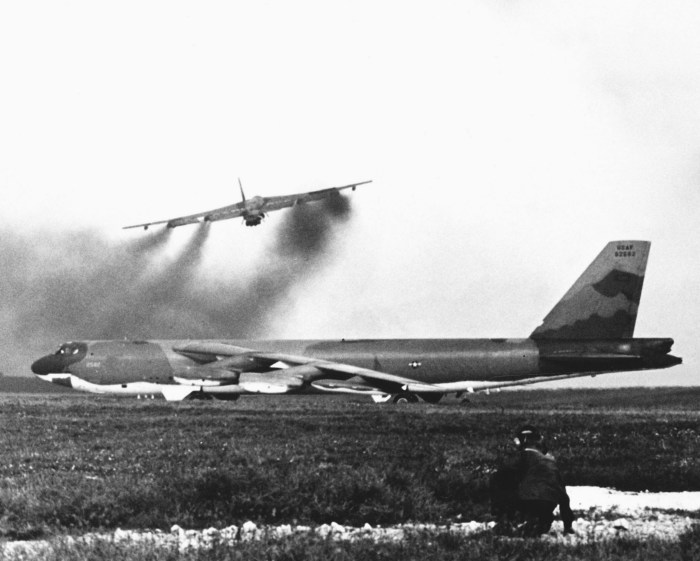
B-52Gs_at_Andersen_AFB_during_Linebacker_II_1972
A US Air Force Boeing B-52G Stratofortress from the 72nd Strategic Wing (Provisional) waits beside the runway at Andersen Air Force Base, Guam, as another B-52 takes off for a bombing mission over North Vietnam during Operation Linebacker II on 15 December 1972. (Source: Wikimedia)

While the ‘lost cause’ concept is the leading theme for the discussion, the book is structured to reflect Laslie’s other argument – the disjointed character of what is known, especially in Western literature, as the Vietnam War. The War is often perceived as one large conflict, whereas there was no overarching campaign (not to mention an overarching strategy) during the American involvement. Laslie steps back from this holistic approach and offers a different perspective suggesting that several air wars took place at the time over Vietnam, Laos and Cambodia. Therefore, in his book, he identifies and discusses the following ‘wars’: the air-to-ground war in North Vietnam, the air-to-air war in North Vietnam, the air-to-ground war in South Vietnam, the US Navy air-to-air and air-to-ground war in North and South Vietnam, and the secret air war over Laos and Cambodia and against the Ho ChiMinh Trail. By looking at several air wars rather than one, the reader is confronted with an incredibly detailed picture of the situation at the strategic, operational and tactical levels of war.

But looking at the individual air wars is not the only way Laslie is trying to offer a comprehensive view of American involvement in Southeast Asia’s air campaigns. He also successfully combines US Air Force and US Navy perspectives, often treated separately in the literature. Discussing the participation of different services implies that a recurring point in Laslie’s analysis is the interservice rivalry and the complete lack of cohesive command and control between the Army, Navy and Air Force or even within them. These are not novel ideas as these issues are well-known and well-researched in the broader literature on the war in Vietnam. However, Laslie analyses American involvement as a series of separate air wars with their distinctive circumstances and obstacles. This allows him to discuss how these hurdles dictated each campaign’s outcomes.. Changing the perspective and critically analysing the context, objectives and limitations of each of those separate air wars illustrates the level of complexity of the conflict in Vietnam. It also supports Laslie’s main argument on the US air power’s ‘lost cause’, meticulously explaining why the popular myth of heavier bombings being potentially more effective is simply not true.

With his background as the Command Historian at the United States Air Force Academy and drawing on an impressive range of primary and secondary sources, Laslie provides a well-researched piece on a subject that one would have thought nothing new could be added. It is undoubtedly a result of extensive archival research and the inclusion of the Contemporary Historical Examination of Current Operations Reports of Southeast Asia (1961–1975) (an impressive list of which has been included as Appendix B). As an American scholar, Laslie is well aware of the potential bias his project may be susceptible to. To avoid that, he is trying to provide a balanced approach by including the perspective of the North Vietnamese Air Force in the discussion. However, that has been possible to achieve only partially due to the limited number of Vietnamese sources available to non-Vietnamese scholars. Nevertheless, Laslie highlights an existing gap in the Western understanding of air campaigns during the Vietnam War and opens an important discussion on the need to investigate the North Vietnamese experience. Whereas it demonstrates the potential for further research, one should ask how feasible it is for an American scholar to access North Vietnamese archives and look at the official sources held there.

Laslie posits that ‘the point of this book is to add something new to the discussion of air power and the war in Southeast Asia’ (p. 4). He succeeded in achieving that goal. Air Power’s Lost Cause will certainly be of interest to military professionals and academics as well as members of a wider audience seeking to improve their understanding, firstly, of the history of the US involvement in Vietnam and, secondly, the complexity of air campaigns in that conflict.

Dr Maria E. Burczynska is a Lecturer in Air Power Studies at the Department of History, Politics and War Studies, University of Wolverhampton. She is involved in designing and delivering an online MA course on Air Power, Space Power and Cyber Warfare. She obtained her PhD from the University of Nottingham, where she worked on a project focused on European air power and its involvement in different forms of multinational cooperation. Her thesis, titled ‘The potential and limits of air power in contemporary multinational operations: the case of the UK, Polish and Swedish air forces,’ is making an essential contribution to the field of air power studies, which remains primarily dominated by the US case. The Royal Air Force Museum recognised her research’s significance, awarding her the Museum’s RAF Centenary PhD Bursary in Air Power Studies in April 2019. Maria’s research interests are in military and security studies in national and international dimensions. She is particularly interested in contemporary European air forces and their participation in multinational operations and initiatives and the influence of national culture on the military culture of individual air forces. She can be found on Twitter at @BurczynskaMaria.

Header image: A US Air Force North American F-100D Super Sabre fires a salvo of 2.75-inch rockets against an enemy position in South Vietnam in 1967. (Source: Wikimedia)

#Commentary – Transferring Polish MiG-29s to Ukraine: why is it easier said than done?

#Commentary – Transferring Polish MiG-29s to Ukraine: why is it easier said than done?

By Dr Maria E. Burczynska 

In the light of the ongoing war in Ukraine and the support provided by other states, it seems like, for the past month, discussions (at least those air power-related) revolved around two topics: no-fly zones and the potential transfer of Polish MiG-29 fighter jets to the Ukrainian Air Force. While the potential consequences of the former have been analysed and commented on by several professionals, security analysts and researchers, the reasoning behind the decisions regarding Polish MiG-29s are less discussed. The coverage has been mainly limited to reporting the progress of the potential deal (or, more recently, calling it off) between Poland, the US and Ukraine. What would it mean then for Poland (and NATO) if those fighter jets were transferred to Ukraine, and why such a move is more complicated than it seems?

The MiG-29 saga can be traced back to EU foreign affairs chief Josep Borrell announcing on 27 February a €450m scheme to fund weapons for Ukraine, which would include providing fighter jets. These were supposed to be post-Soviet aircraft with which Ukrainian pilots are familiar. The following day Ukrainian authorities announced in a Tweet that the Ukrainian Air Force was to receive a total of 70 fighter planes from Poland (28 MiG-29), Slovakia (12 MiG-29) and Bulgaria (16 MiG-29 and 14 Su-25). At the same time, Borrell backtracked on his announcement and acknowledged that the potential transfer of those aircraft would have to be agreed upon bilaterally by individual states rather than sponsored by the EU. On Tuesday, these news reports were quickly denied by Slovakia and Bulgaria. Also, Polish President, Andrzej Duda, speaking alongside NATO Secretary-General Jens Stoltenberg at the Łask Air Base in Poland, clearly stated that Poland would not send their jets to Ukraine as that would suggest a military interference and NATO is not part of that conflict. Following a plea by Ukrainian President Volodymyr Zelensky to supply his country with more firepower, US Secretary of State Antony Blinken announced on Sunday, 6 March, that Poland has been given ‘the green light’ to provide the Ukrainian Air Force with MiG-29s and indicated the possibility that in turn the Polish Air Force could be supplied with new F-16s. On Tuesday, 8 March, the following statement was made by the Polish Minister of foreign affairs, Zbigniew Rau:

The authorities of the Republic of Poland, after consultations between the President and the Government, are ready to deploy – immediately and free of charge – all their MIG-29 jets to the Ramstein Air Base and place them at the disposal of the Government of the United States of America.

At the same time, Poland requests the United States to provide us with used aircraft with corresponding operational capabilities. Poland is ready to immediately establish the conditions of purchase of the planes.

The Polish Government also requests other NATO Allies – owners of MIG-29 jets – to act in the same vein.

The US rejected the proposal as ‘not tenable’ because it presents serious logistical challenges and ‘raises serious concerns for the entire NATO alliance.’ General Tod D. Wolters, Commander for the US European Command, later repeated that stance and added that such a move, while not increasing the effectiveness of the Ukrainian Air Force, could be seen as escalatory in the conflict with Russia. Also, German Chancellor Olaf Scholz opposed the proposal of transferring Polish MiGs via Ramstein, saying ‘we want to de-escalate the conflict, we want to see an end to this conflict.’ The argument of possible escalation the transfer could bring is dominant in the discussions around the topic. It also explains Poland’s motivation not to take the final decision unilaterally. As explained by President Duda in a joint press conference with the US Vice President Kamala Harris, as a NATO member, Poland cannot decide on an issue that could impact the security of the whole Alliance. Therefore they ‘wanted NATO as a whole to make a common decision so that Poland remains a credible member of NATO.’ A potential escalation of the conflict quite rightly dominates the discussion on the MiGs transfer, but what are the other ‘logistical challenges’ as mentioned by the US authorities that such a move would entail?

The MiG-29s currently possessed by the Polish Air Force is a remnant of its past. As a former Soviet bloc country, Poland had in its inventory mostly aircraft built either in the Soviet Union or under their licence, so, for example, the fighter fleet consisted of MiG-21, MiG-23, MiG-29, and Su-22, where only the latter two types had any modern combat capability. As a result of post-1990 modernisation conducted in the Polish Armed Forces, the former two types (MiG-21 and MiG-23) were withdrawn from service by 2004. As per MiG-29s, many of those purchased at the time by Poland was not a brand-new platform. In fact, ten jets were acquired from the Czech Republic in 1995, and an additional 22 were bought from Germany in 2003.[1] The latter ones were in a much worse condition than the others and required a major overhaul. As a result, only fourteen out of those 22 were operational in the Polish Air Force. In 2021, Poland had 28 MiG fighters.[2] One could ask how much difference would those aging platforms make if transferred to the Ukrainian Air Force? Ukrainian air fleet consists of post-Soviet platforms including, for example, MiG-29, Sukhoi-27, or Sukhoi-25. Therefore, transferring aircraft with which pilots are familiar makes perfect sense. Especially while there are still pilots who can fly them, as with every aircraft lost in a fight, an experienced pilot is lost. Also, since the start of the war, neither the Ukrainian side nor the Russian has secured air superiority, although both have suffered losses. As reported on the Oryx list of equipment losses, to date, the Ukrainian Air Force lost 12 fixed-wing aircraft while, on the Russian side, 16 fixed-wing platforms were destroyed and one damaged. Certainly, in such a situation, additional MiGs are needed to fill the emerging gap and ensure that Russia is still denied air superiority. However, would they be a game-changer as compared with the highly effective Ukrainian air defence? It has already been suggested to provide Ukraine with ground-based air defence systems as an alternative solution to transferring fighter jets – simpler logistically and less risky of conflict escalation.

CLEAR SKY 2018
A Ukrainian MiG-29 Fulcrum takes off from Starokostiantyniv Air Base on 9 October 2018 as part of the Clear Sky 2018 exercise. (Source: Wikimedia)

On a similar note, however, one could also ask what it would mean for Poland’s defence if these aircraft were to be transferred to the Ukrainian Air Force. Indeed, such a move would leave the Polish Air Force with a capability gap as MiGs are the only fighter jets in their fleet. The multi-role F-16s Poland also possesses could potentially take over that role. However, that would mean that the F-16s cannot perform other roles they are capable of, like engaging in air-to-ground missions. Therefore, transferring MiGs would weaken Poland’s (and NATO’s defence), leaving a capability gap that would need to be filled.

A solution to that, as it seems, could be the potential deal between Poland and the US, resulting in acquiring ‘aircraft with corresponding operational capabilities’ as suggested in the Ministerial statement. There are, however, certain logistical difficulties to such a move. Firstly, there is a backlog in the production of F-16s; therefore, immediate delivery of new aircraft to fill the gap is not an option. Secondly, to acquire new jets and fill the gap promptly, Poland would have to jump the queue as it would be not the only country waiting for those platforms, and, at the moment, priority has been given to Taiwan. Also, acquiring used aircraft would present similar difficulties as they will have to be replaced with new platforms to start with and then most likely undergo an overhaul before being sold. Therefore, it is not a quick nor easy solution.

Furthermore, purchasing aircraft to replace MiGs presents potential training and personnel challenges. Despite what type is being acquired, personnel (both pilots and ground crew) must be trained, and air bases need to be prepared. Moreover, as one could expect, training a fourth-generation fighter pilot is a lengthy and multi-level process.[3] For example, the first deployment of Polish F-16s happened in 2016 – ten years after they were bought by the Polish Air Force when four of the fighters joined Operation Inherent Resolve in Kuwait. Under special circumstances, like a developing conflict in a neighbouring country, it could be suspected that training could be sped up. However, this certainly cannot happen overnight and would still require time and resources. Also, a valid question remains about the personnel currently working with MiG-29s. They would need to be re-trained for a new platform type (whatever that would be). However, it is also quite possible that they may not qualify for that because of age. Therefore, one could ask whether it is a good moment to make them redundant and whether such a move would not further weaken Poland’s defence capability.

There are also technical issues that need to be addressed before the fighter jets are transferred. When Poland joined NATO in 1999, it meant a major military transformation, part of which was focused on increasing compatibility with the Alliance’s systems. That meant that the existing aircraft had to be fitted. For example, with equipment allowing for secure communication with the platforms belonging to other NATO members or equipment allowing for its correct identification as friend or foe. As Ukraine is not part of NATO, those systems would need to be removed. Furthermore, one should remember that as NATO aircraft, the avionics in Polish MiGs were re-scaled from metric to the imperial system. Moreover, that not only involved upgrading or re-scaling the equipment and creating a whole new mindset, so the personnel did not need to make calculations to operate in the air constantly. Therefore, before the fighters were to be transferred, their avionics would need to be re-scaled back to the metric system, or otherwise, it would cause a significant challenge for Ukrainian pilots if they had to make the calculations manually under war conditions.

Another issue is the logistics of the potential transfer itself. Since flying those MiGs from a NATO airbase, whether in Germany or Poland, has been ruled out, it is unclear how they would be delivered. One scenario mentioned using a non-aligned country as a middleman – a base where the re-painted Ramstein fighters could fly to and then continue their journey to Ukraine. Kosovo was suggested as one of the possible options that would rule out NATO or the EU’s direct participation in the transfer. Nevertheless, with Russia warning that the use of other countries’ airfields for basing Ukrainian military aviation with the subsequent use of force against Russia’s army can be regarded as the involvement of these states in an armed conflict,’ it seems that such a move would likely lead to an escalation of the ongoing war.

The potential transfer of Polish MiG-29s to the Ukrainian Air Force proves to be not as straightforward as the political rhetoric may paint it. Quite the opposite – it is a lengthy, costly, and complex process. Moreover, its potential consequences range from the escalation of the conflict through to the weakening Poland’s defence capability (as well as NATO’s eastern flank in a time of war taking place on its border) to the many logistical challenges. Therefore, the decision should not be taken unilaterally by one country but rather carefully considered by the whole Alliance, as the consequences it may bring will also need to be faced collectively by all its members.

Dr Maria E. Burczynska is a Lecturer in Air Power Studies at the Department of History, Politics and War Studies, University of Wolverhampton where she is involved in designing and delivering an online MA course on Air Power, Space Power and Cyber Warfare. She obtained her PhD from the University of Nottingham where she worked on a project focused on European air power and its involvement in different forms of multinational cooperation. Her thesis, titled ‘The potential and limits of air power in contemporary multinational operations: the case of the UK, Polish and Swedish air forces,’ is making an important contribution to the field of air power studies, which remains to date largely dominated by the US case. The significance of her research was recognised by the Royal Air Force Museum awarding her the Museum’s RAF Centenary PhD Bursary in Air Power Studies in April 2019. Maria’s research interests are in the broad area of military and security studies in both, the national and international dimension. She is particularly interested in contemporary European air forces and their participation in multinational operations and initiatives as well as the influence of national culture on the military culture of individual air forces. She can be found on Twitter at: @BurczynskaMaria.

Header image: A US Air Force General Dynamics F-16C from the 183rd Fighter Wing, Illinois Air National Guard, flies in formation with a Polish Mikoyan-Gurevich MiG-29A from the 1st Tactical Squadron over Krzesiny air base, Poland, on 15 June 2005. Both aircraft participated in exercise ‘Sentry White Falcon 05.’ (Source: Wikimedia)

[1] Zbigniew Średnicki, ‘Modernizacja techniczna sił powietrznych,’ Przegląd Sił Zbrojnych, 3 (2015), p. 11.

[2] ‘Chapter 4: Europe,’ The Military Balance, 122.1 (2022), p. 136.

[3] Ewa Korsak and Magdalena Kowalska-Sendek, ‘Andrenalina, predkosc i spelnienie marzen,’ Polska Zbrojna 8, no. 868 (2018), pp. 12-8.

From Balloons to Drones – 5 Years On

From Balloons to Drones – 5 Years On

By Dr Ross Mahoney

Five years ago, on 15 June 2016, From Balloons to Drones was launched. From Balloons to Drones was established with the simple vision of providing an open access online platform for the analysis and debate of air power history, theory, and contemporary operations in their broadest sense, including space and cyber power. Since establishing From Balloons to Drones, we have published 195 posts of various types ranging from articles to book reviews. More recently, in 2019, we started producing a popular podcast series with interviews with leading air power specialists. Overall, the site has received over 130,000 hits since 2016.

None of the above would have been achieved without the support of our editors, contributors, and readers. Personally, I am grateful to all the members of the From Balloons to Drones editorial team for their continuing hard work, especially as it is all done voluntarily. Indeed, when the site was established, it was run by one person, our Editor-in-Chief, Dr Ross Mahoney. However, over time, the editorial team has grown and evolved. In 2018, long-time contributors Dr Brian Laslie, Dr Michael Hankins, and Alex Fitzgerald-Black came onboard as editors. While Alex has moved on, we have continued to build and strengthen the editorial team with the addition of Victoria Taylor and Dr Luke Truxal to the team. As we look forward to the next five years of From Balloons to Drones, I am pleased to announce the addition of two new editors to the team: Dr Maria Burczynska and Ashleigh Brown. Maria is a Lecturer in Air Power Studies at the University of Wolverhampton in the UK, while Ashleigh, a PhD student at UNSW Canberra, is a researcher for the Official History of Australian Operations in Iraq & Afghanistan and Australian Peacekeeping Operations in East Timor. The addition of Maria and Ashleigh will help strengthen the team in several areas, and we are looking forward to what the future holds with them.

I am also grateful to all our contributors and readers. Without our contributors, there would be nothing to publish and, as such, no website. However, we are always on the lookout for new contributions either from established authors or from new and emerging scholars within the air power studies community. If you are interested in contributing, then visit our submissions page to find out how to contribute.

So, what about the future? More of the same but better. We still hold true to our original vision of providing an avenue for debate and discussion about air power. We will aim to continue to refine what we offer in terms of content and build on the success of the past five years. We have more articles, book reviews and podcasts in the pipeline. However, we are always keen to hear your views on what we publish. If there is an area of research that needs to be given more coverage, please let us know.

Finally, as a bit of fun to celebrate our fifth birthday, here are the top five most-read posts since our launch in 2016:

  1. Michael Hankins, ‘Inventing the Enemy: Colonel Toon and the Memory of Fighter Combat in Vietnam’
  2. Michael Hankins, ‘A Discourse on John Boyd: A Brief Summary of the US Air Force’s Most Controversial Pilot and Thinker’
  3. Liam Barnsdale, ‘Royal Air Force ‘wings’ Brevets in Second World War Propaganda’
  4. Justin Pyke, ‘Blinded by the Rising Sun? American Intelligence Assessments of Japanese Air Power, 1920-41: Part 1 – The 1920s’
  5. Jeff Schultz, ‘Supporting the Secret War: T-28s over Laos, 1964-1973 – Part 1: Training’

Header image: Pilatus PC-21A aircraft from No 4 Squadron based at RAAF Base Williamtown fly in formation on return from Sydney in support of an Air Force 2021 commemorative service held at the Anzac Memorial in Hyde Park. (Source: Australian Department of Defence)