#FilmReview – Masters of the Air, Episode Eight

#FilmReview – Masters of the Air, Episode Eight

By Dr Luke Truxal

Editorial note: On 26 January 2024, Apple TV+ launched the much-anticipated series Masters of the Air. This series follows the actions of the US 100th Bomb Group during the Combined Bomber Offensive in the Second World War. As the series is being aired, our Book Reviews Editor, Dr Luke Truxal, the author of Uniting against the Reich (2023), will critically review each episode.  

With only one more episode left, Masters of the Air turned in another disappointing performance in episode eight. The poor pacing of episode seven and, to some degree, episode six has forced the show into a dilemma, namely, what to cover in the final episodes. The showrunners have now decided to cover the significant events of the summer, fall, and early winter of 1944 that shaped the lives of the US 100th Bomb Group, the 332nd Fighter Group, and the prisoners at Stalag Luft III in just 51 minutes. That is too much to ask of any television series. This episode failed largely due to poor pacing and trying to cover too many topics without going into depth on any of them. As a result, the show gave each storyline a token appearance, and, as such, it lacked the substance of the series’ first five episodes. Given this, one must wonder if this series had been written and filmed with the intent of being a much longer television series and how poorly these subjects were covered.

Episode eight covers three main storylines. For the 100th Bomb Group at Thorpe Abbotts, the focus is Major Harry Crosby’s mental and physical breakdown due to the stress of planning missions that force him to be sent on a four-week leave. The second major plot revolves around the prisoners at Stalag Luft III and their preparations to fight back, escape, or be marched to another camp. Finally, the series introduced a new storyline with only one episode remaining, namely that of the famous 332nd Fighter Group – a unit composed of African-American personnel and more commonly known as the ‘Tuskegee Airmen.’ Even though there are some good moments where the show portrays the real struggles of these men, by grazing the surface of each one of these topics, viewers and historians come away asking for more. Masters of the Air tried to do too much, and this episode and the rest of the series paid the price.

Much of the Crosby plot in this episode focuses on his work as a staff officer and his ultimate breakdown. The lead-up to Operation OVERLORD, the landing in Normandy and, ultimately, the liberation of France, has Crosby working for days without sleep. Crosby narrates himself trying to push through and continue planning missions as he feels the weight of each mission on his shoulders. He consumes coffee like water and even resorts to taking medication to keep himself awake. Eventually, he passes out in front of Lieutenant Colonel John ‘Jack’ Kidd from exhaustion. This ultimately leads the new commander of the 100th Bomb Group, Colonel Thomas Jeffrey, to order Crosby to take a four-week vacation to recharge his batteries. This shows the war’s effect on those serving behind the front lines and involved in planning the conduct of the Second World War. This is something that did not get enough coverage in Band of Brothers or The Pacific. With the notable exception of Kenneth More’s portrayal of Captain Jonathan Shepard in Sink the Bismarck in 1960, this is something not often captured well in war films. However, throughout the Second World War, staff officers played a vital role in the success of their units, and it was not uncommon for those leading from the rear to suffer significant health crises because they quite literally worked themselves to death. Notably, for example, Major General Theodore Roosevelt Jr., the eldest son of the US President, died of a heart attack while serving as the Assistant Division Commander of the US 4th Infantry Division during the fighting in Normandy. Dealing with this issue was a nice addition to the series.

Masters of the Air introduced the story of the 332nd Fighter Group, more commonly known as the ‘Tuskegee Airmen,’ in this episode. There are a host of problems with this plot line. First, telling the story of this all-black fighter group is important, but giving the group only minutes of screen time in the second to last episode of the series does not do their story justice. Either increase the number of episodes to tell the story well or save that story for its separate mini-series. The last-minute addition of the 332nd Fighter Group also created additional problems with this plot. For example, we are never really introduced to the group itself and their previous struggles to get into combat. From training and through participation in the North African and Sicilian Campaigns, black fighter pilots faced an uphill struggle to prove their worth. Furthermore, the group became more widely known for their more conservative escort fighter tactics, leading them to snuggle tightly to the bomber formations. This hallmark of the 332nd Fighter Group contributed to their ability to reduce bomber losses while on escort duty and earned them a sterling reputation throughout the US Army Air Forces (USAAF). This moves us into the key individuals. Colonel Benjamin O. Davis Jr. is never really introduced. His story is critical here.

While the episode focuses on Lieutenants Alexander Jefferson and Richard Macon from the 332nd Fighter Group, they do not receive a proper introduction either. They are flung at us. Finally, the only mission we see is the 332nd providing close air support for Operation DRAGOON, the landings in southern France in August 1944. During this episode, Jefferson and Macon are shot down and then captured by the Germans. They go through the same interrogations that Egan also experienced in episode six. The key difference here is that the Germans used the state of racism in the United States to get Jefferson and Macon to turn on their country. While this fails, it is one of the few hints of these men’s challenges in fighting for their country. Instead of putting a face on racism, Masters of the Air decided to keep it faceless and very much in the background. Once again, this was another missed opportunity. In short, by dedicating so little time to this plot in previous episodes or by not expanding the episode count to tell this story well, we get additional problems. The 332nd Fighter Group’s story is glossed over, key individuals get a footnote, and finally, racism hardly appears in the episode.
Masters_of_the_Air_Photo_010812
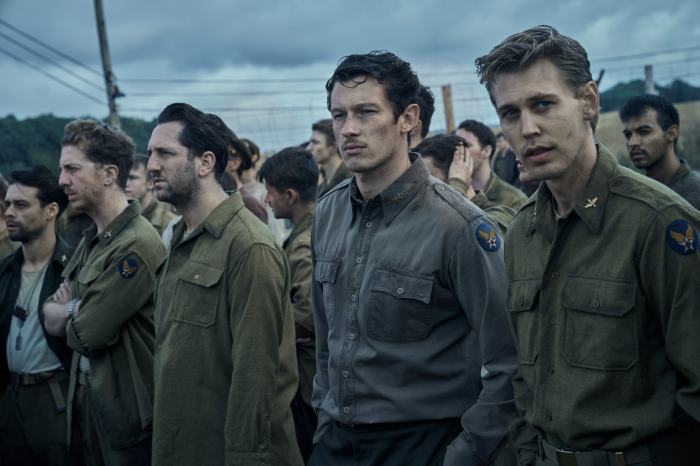
Adam Long, Matt Gavan, Callum Turner and Austin Butler in Masters of the Air. (Source: Apple TV+)

At Stalag Luft III, we see the Americans struggle with being cut off from the events of the world and the daily boring, melancholy life that takes over. It is a real struggle for Major John Egan, who wants to do something. Meanwhile, Major Gale Clevan tries to organise men to build a new water well. This leads to a fight between the two officers. Eventually, we see Jefferson and Macon arrive at the camp. When they arrived, some men regarded them as heroes, referring to them as the ‘Red Tails.’ Few American airmen knew of the 332nd Fighter Group besides their tail markings. Most did not know that they were an all-black fighter unit. So, this scene where they are greeted as heroes does not land well. Some American airmen did know about the 332nd Fighter Group, but they arrived later at the camp. Most of the airmen interred at Stalag Luft III were shocked to find that black fighter pilots were flying in the USAAF. This scene seems flung at the viewers without any context, especially considering that viewers never got to see the 332nd Fighter Group fly an escort mission in this episode. As the episode ends at Stalag Luft III, the airmen realise that they must work together to prepare for liberation, execution, a forced march to another camp, or escape. By the end of the episode, the different plot lines introduced in episodes six, seven, and eight finally start coming together to set up the series finale.

Overall, this episode fails because it tries to do too much. It tried to cover much of the fighting in 1944 in a single episode and juggled too many plots. In attempting to cover so many stories, we see the episode fail to introduce new characters, units, and stories well properly. Context is missing a lot of the time with each of these plots. Viewers are zipping from story to story like the fast-forward button has been hit on 1944 so we can get to the end of the war. This left a lot to be desired. One positive aspect of the episode was the analysis of Crosby’s physical and mental breakdown as a staff officer. However, one bright spot, in an episode that gave token coverage to a wide range of important historical events and topics, did not help this episode. Ultimately, the approach taken did not serve the series or the history well. One must wonder if this series was written with more episodes in mind and had been forced to make dramatic cuts at some point during the production process.

Dr Luke Truxal is an adjunct at Columbia State Community College in Tennessee. He completed his PhD in 2018 from the University of North Texas with his dissertation ‘Command Unity and the Air War Against Germany.’ His previous publications include ‘Bombing the Romanian Rail Network’ in the Spring 2018 issue of Air Power History. He also wrote ‘The Politics of Operational Planning: Ira Eaker and the Combined Bomber Offensive in 1943’ in the Journal of Military Aviation History. In addition, Truxal is researching the effectiveness of joint air operations between the Allied air forces in the Second World War. He can be reached on Twitter at @Luke_Truxal.

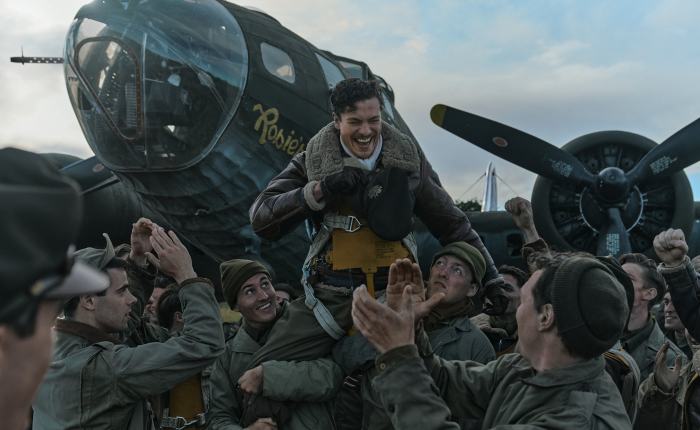
Header image: Josiah Cross in Masters of the Air. (Source: Apple TV+)
#FilmReview – Masters of the Air, Episode Seven

#FilmReview – Masters of the Air, Episode Seven

By Dr Luke Truxal

Editorial note: On 26 January 2024, Apple TV+ launched the much-anticipated series Masters of the Air. This series follows the actions of the US 100th Bomb Group during the Combined Bomber Offensive in the Second World War. As the series is being aired, our Book Reviews Editor, Dr Luke Truxal, the author of Uniting against the Reich (2023), will critically review each episode.  

For the first time in the Masters of the Air television series, I was genuinely disappointed in an episode. There were two significant issues with this episode. The first major problem has now become a glaring problem for the show, which is the inability to tell a story outside the US 100th Bomb Group with the quality that it deserves. This is either because the show relies so heavily on veteran accounts that it cannot tell the larger story or because the show only half-heartedly covers the topic, like checking a box on an essay due at the end of class. The second major issue is that this episode wasted priceless minutes of television time covering stories and plots that, in the grand scheme of things, are not as important as other aspects of the air war. In many respects, this is likely a major reason why the show will do some more box-checking in the coming episodes. The series spends too much screen time on less critical plots and must condense more essential stories into the final two episodes.

For this review, I will not give an overview of the episode and jump straight into the problems because there is much to criticise. The first major issue that this episode, and the show more generally, struggle with is its treatment of those not members of the 100th Bomb Group. First, generals are written as blundering fools who do not care about their men. In the third episode, Colonel Curtis LeMay’s aggressiveness is blamed for the disaster of the Schweinfurt-Regensburg raid, even though he flew in the lead plane for the mission. Also, it left out the debates that US VIII Bomber Command struggled with in determining whether to send out the raid. This theme continued in this episode. While the episode did a good job of covering the aftermath of the 6 March 1944 Berlin raid well, during the planning and briefing of the 8 March raid, the writers decided to portray the commander of the US Eighth Air Force, Lieutenant General James Doolittle, and the commander of the United States Strategic Air Forces in Europe, Lieutenant General Carl Spaatz, as blundering fools who are using the same navigational route for back to back raids. As an audience member, it is hard to decide whether the showrunners want us to believe these men are unintelligent, lazy, or do not care. Most likely all the above. For perspective, the navigational route was chosen because it avoided flak concentrations and limited combat losses.[1]

Masters_Of_The_Air_Photo_010707
Kai Alexander and Bailey Brook in Masters of the Air. (Source: Apple TV+)

The show did not stop there. At the end of this episode, the new commander of the 100th Bomb Group, Lieutenant Colonel John Bennett, lays out the latest air strategy for gaining air superiority at the end of the episode to Captain Robert Rosenthal. He states that the new strategy going into March and April 1944 will be to win the air war by using the bombers as bait for the fighters so that the newly arrived long-range escort fighters, the North American P-51 Mustangs, can shoot down the German fighters. There are so many ways in which that scene does an injustice to the strategic, operational, and tactical changes Spaatz and Doolittle implemented at the beginning of 1944. Starting with the strategic picture. Spaatz rightfully argued that Operation OVERLORD could not go forward if the air superiority had not been gained before troops began landing in Normandy. This was a huge point of contention between Spaatz and the commander of the Allied Expeditionary Air Forces, Air Chief Marshal Leigh-Mallory.[2] Spaatz went into 1944 to grind down the Luftwaffe through a large series of air battles carried out through the skilful concentration of all American air forces in the European and Mediterranean Theaters of Operations. Spaatz deserves much credit for bringing maximum pressure to bear on the Luftwaffe and degrading their combat effectiveness, starting with Big Week from 20 to 25 February 1944 and continuing through March and April 1944. Furthermore, the tactical changes implemented by the Eighth Air Force came from Doolittle. Doolittle changed the fighter tactics when he took over the Eighth Air Force from Lieutenant General Ira Eaker in January 1944. This came in two parts. First, American fighter pilots were no longer merely escorts as they were in 1943. Once engaged, American fighter pilots were to pursue German fighters even if it meant leaving the bomber stream. This was a more effective means to gain air superiority by prioritising shooting down German fighters. Additionally, Doolittle adopted the idea of using a bouncing fighter group, whose job was to roam the edges of the bomber formation in search of German fighters preparing to attack the bombers. These are well-known changes to scholars of the air war and can be easily told on screen to an audience. However, by stating that the generals wanted to use the bombers as bait, the show has given the impression to the audience that the American generals do not care about their losses and that this is simply a numbers game for the brass.

Another problem with this show is the anti-British bias that shows up. By this point, I wonder whether the showrunners think the British military can do anything well. While the criticisms of the British night bombing strategy in the second episode of the series were warranted, the scene did not convey the message well. I initially thought this was merely a poorly written-scene. At this point in the series, I think it is safe to say that whoever is writing the scenes regarding the British military holds them in contempt. It comes up again and again throughout the episodes. Sometimes in tiny doses. At other times, quite openly, as we saw in episodes two and six. In this episode, we get two more doses of British failures. While listening to the radio at Stalag Luft III, the Americans hear about the British failure to take Monte Casino in Italy. Later in the episode, there is the failure of the Great Escape, in which 76 British and Commonwealth prisoners escape the camp. Only three can evade captivity and get back home. Of the 73 that were captured, 50 were executed in retaliation. This is a significant moment for those living at Stalag Luft III and is a sign of British and Commonwealth prisoners continuing to wage war against the Germans using whatever means are at their disposal, including escape. Instead, it is portrayed as another British failure, and the consequences make life at the camp harder for the Americans of the 100th Bomb Group interred there. These are just two examples of the shortcomings of this show to tell the bigger picture. Where Band of Brothers (2001) and The Pacific (2010) did a much better job providing context, Masters of the Air has fallen dreadfully short by putting so much emphasis on the perspective of the airmen. There is no sugarcoating it: this show is bad at telling stories outside the 100th Bomb Group.

These problems pale in comparison to the poor use of screen time in this episode. Much of this episode was dedicated to two plots that did not serve a significant purpose and took away screen time to lay the groundwork for more critical plots. First, much of the plot at Stalag Luft III centred on maintaining some news of the outside world using a handmade radio that the airmen kept hidden. While this did indeed happen, the radio plot took away time that could have be en better spent. While at Stalag Luft III, Major John Egan handled security, and Major Buck Clevan oversaw education at the South Compound.[3] Telling these stories provides more insight into camp life than focusing on losing and rebuilding a radio. Furthermore, the show ended teasing that the Tuskegee airmen would first appear in the eighth or nine episodes. It would have been nice to use some of the time in this episode to show the challenges black airmen faced in their fight to serve their country as fighter pilots and help orchestrate significant civil rights changes in the military through their service. Instead, like with the film Red Tails, Masters of the Air has chosen to skip the crucial challenges faced during training in the United States. This was a big missed opportunity. This is why this episode is so bad. The US 332nd Fighter Group’s story deserves more than a token appearance in the television series. Either tell the story well or save that story for a different television series. Simply throwing this story in without telling the back story does not do the history or airmen justice. For a better portrayal of black fighter pilots’ challenges, see the film The Tuskegee Airmen (1995).

This episode was a disappointment. This review cannot do a proper recap and review that covers every issue with this episode. Instead, I highlighted major flaws and trends in the episode and series. The treatment of other nationalities fighting against the Axis and the treatment of high-ranking officers do this series and subject a disservice. These are symptoms of long-growing problems with this show. This specific episode wasted valuable screen time on less essential plots like Captain Harry Crosby’s fictional infidelity and the time spent fixing a radio. By spending valuable minutes on these storylines, the show missed great opportunities to tell important narratives. This will have grave consequences as the show tries to introduce new storylines and wrap up the show in the final two episodes. Unfortunately, this is where the show is headed. Masters of the Air seems determined to give token coverage to serious issues while wasting valuable time on less important topics. This is an unfortunate development for a show I have come to enjoy.

Dr Luke Truxal is an adjunct at Columbia State Community College in Tennessee. He completed his PhD in 2018 from the University of North Texas with his dissertation ‘Command Unity and the Air War Against Germany.’ His previous publications include ‘Bombing the Romanian Rail Network’ in the Spring 2018 issue of Air Power History. He also wrote ‘The Politics of Operational Planning: Ira Eaker and the Combined Bomber Offensive in 1943’ in the Journal of Military Aviation History. In addition, Truxal is researching the effectiveness of joint air operations between the Allied air forces in the Second World War. He can be reached on Twitter at @Luke_Truxal.

Header image: Nate Mann in Masters of the Air. (Source: Apple TV+)

[1]  Donald Caldwell and Richard Muller, The Luftwaffe Over Germany: Defense of the Reich (Barnsley: Frontline Books, 2014), p. 168.

[2] Luke Truxal, Uniting Against the Reich: The American Air War in Europe, (Lexington: University Press of Kentucky, 2023), p. 115-7.

[3] Donald Miller, Masters of the Air: America’s Bomber Boys Who Fought the Air War Against Nazi Germany (New York: Simon and Schuster, 2006), p. 389.

#FilmReview – Masters of the Air, Episode Six

#FilmReview – Masters of the Air, Episode Six

By Dr Luke Truxal

Editorial note: On 26 January 2024, Apple TV+ launched the much-anticipated series Masters of the Air. This series follows the actions of the US 100th Bomb Group during the Combined Bomber Offensive in the Second World War. As the series is being aired, our Book Reviews Editor, Dr Luke Truxal, the author of Uniting against the Reich (2023), will critically review each episode.  

Episode six of Masters of the Air was a transition episode. From now on, the television series will focus on the stories of three main characters and the stories around them. Additionally, the show is now trying to broaden its perspective from the US 100th Bomb Group to tell other stories related to the air war. Overall, this episode did a good job of setting up this new format, but whether the show will benefit from changing its approach to storytelling remains to be seen.

John Orloff’s thesis in episode six is about three men running from their fates. The show begins with Major John Egan trying to evade German police, military, and civilians. For the first time in the show, Egan faces the consequences of his actions as he encounters German civilians who either fear him or want to kill him in retaliation for the American air raids that are killing civilians as collateral damage in their bombing campaign or more directly trying to kill them to bring pressure on German morale as we saw in the last episode. There are several moments where it seems like Egan will escape his fate by evading his captors, but Egan is not so fortunate. He must face the brutal experience of being a prisoner of war at Stalag Luft III.

While Egan tried to escape capture, Lieutenant Robert Rosenthal attempted to run from the burden of leadership. During the episode, Rosenthal and his crew are sent to a ‘Flak Farm’ to recuperate after being the sole plane from the 100th Bomb Group to return from the 10 October 1943 Munster raid. Rosenthal spends much of the episode distancing himself from his crew. While Rosenthal makes it clear to those around him that he feels a deep sense of duty to continue flying and fighting the war, he is also reluctant to really engage with his men during this time off. Ultimately, Rosenthal comes to terms with the reality that he is not just a pilot fighting the war against Germany but also a crucial leader for his crew and the 100th Bomb Group. This is shown in Rosenthal’s final scene. He is standing at the door of his plane and gathering the inner strength to get inside one more time. This matters to his men, and the new crews witness someone who barely survived ‘Black Week’ going back into battle with a workman-like attitude.

Finally, Captain Harry Crosby spends the episode running away from his demon, survivor’s guilt. Crosby does not discuss losing his friend, Captain Joseph ‘Bubbles’ Payne. At the beginning of the episode, he is sent to attend a series of Oxford lectures designed to encourage greater cooperation amongst Allied personnel. During this episode, he meets Subaltern Alessandra Westgate. Her role in the war is never clear, but much speculation exists. Crosby spends much of the episode trying to bury his feelings about the loss of Payne by attending lectures and parties, but he finally unloads his guilt on Westgate. He questions why he survived, and Payne did not. Ultimately, Westgate reminds Crosby that this is not his fault. It is the fault of Germany for starting this war and bringing about the destruction that has affected so many lives as a result.

Masters_Of_The_Air_Photo_010606
Austin Butler in Masters of the Air. (Source: Apple TV+)

While a solid episode, some problems need to be discussed. First, the show has gone to great lengths to try and separate the Luftwaffe and the actions of the SS and Gestapo. This plays into the ‘clean Luftwaffe’ myth, which historians like Victoria Taylor are trying to debunk with their research. The head of the Luftwaffe, Reichsmarshall Herman Goering, was one of the early members of the Nazi Party and participated in the Beer Hall Putsch in Munich. He was one of the most senior-ranking members of the Nazi Party at this point in the war. The Luftwaffe that he created embraced the ideals of the Nazi Party. The show fails to show that the Luftwaffe interrogation techniques were different because the Luftwaffe believed that they were more effective at acquiring information from American airmen. Also, this is the same Luftwaffe that executed 50 British prisoners during the Great Escape. Donald Miller wrote about why the Luftwaffe used a different interrogation approach in his book Masters of the Air.[1] This is another instance where the show might have benefited more by adding a little bit more context, but unfortunately, it failed here.

Overall, this episode showed three new aspects of the air war through the attempts by Egan, Rosenthal, and Crosby to evade their own personal battles in the air war. We see ‘Flak Houses’ covered in decent detail, the struggle of those who question why they were left behind, and finally, through Egan, we know the experience of those who try to escape but are captured. While there are problems that historians will have with this episode regarding the treatment of the Luftwaffe, this episode does highlight more aspects of the air war for audiences less educated on the experience of American airmen. Like with the first three episodes, the show struggles to put the experiences of American airmen into a broader context that audiences and scholars could really benefit from. This was another good but not great episode.

Dr Luke Truxal is an adjunct at Columbia State Community College in Tennessee. He completed his PhD in 2018 from the University of North Texas with his dissertation ‘Command Unity and the Air War Against Germany.’ His previous publications include ‘Bombing the Romanian Rail Network’ in the Spring 2018 issue of Air Power History. He also wrote ‘The Politics of Operational Planning: Ira Eaker and the Combined Bomber Offensive in 1943’ in the Journal of Military Aviation History. In addition, Truxal is researching the effectiveness of joint air operations between the Allied air forces in the Second World War. He can be reached on Twitter at @Luke_Truxal.

Header image: Callum Turner in Masters of the Air. (Source: Apple TV+)

[1] Donald Miller, Masters of the Air: America’s Bomber Boys Who Fought the Air War Against Nazi Germany (New York: Simon and Schuster, 2006), pp. 386-7.

#FilmReview – Masters of the Air, Episode Four

#FilmReview – Masters of the Air, Episode Four

By Dr Luke Truxal

Editorial note: On 26 January 2024, Apple TV+ launched the much-anticipated series Masters of the Air. This series follows the actions of the US 100th Bomb Group during the Combined Bomber Offensive in the Second World War. As the series is being aired, our Book Reviews Editor, Dr Luke Truxal, the author of Uniting against the Reich (2023), will critically review each episode.

The fourth episode of Masters of the Air was about those left behind. This is meant literally in the sense that we do not go up in the air with the planes after they take off, but we also see many of the characters on the show struggle with loss during the war. The result is that we get a good episode that portrays the struggles of airmen, ground crews, resistance fighters, and civilians left on the ground. This review will examine the episode’s analysis and responses to grief thematically rather than tackle the episode chronologically, as in past reviews.

The episode begins with a party after Lieutenant Glenn Dye’s crew completes their 25th mission. This will be the first and only crew of the original 100th Bomb Group to complete their tour of duty and go home. At the party, we are introduced to two new characters, Lieutenant Herbert Nash and Lieutenant Robert ‘Rosie’ Rosenthal. Both are green but capable and eager pilots. During the episode, Nash dances and flirts with Helen, who works for the Red Cross at Thorpe Abbotts. There are sparks between these two characters. At the same time, Rosenthal tries to understand better what he is flying into by talking to Major Gale Clevan. Nash is more successful in flirtations than Rosenthal in feeling out the veteran pilots about the nature of air combat. As the aircrews depart for their first mission the following day, Nash makes a last pass at Helen with a line that foreshadows his fate, “You might be the last pretty face that I ever see.” Nash’s fate is shown off-screen, and it falls on Rosenthal to deliver the shocking news to the young woman with whom he had developed a budding romance. In the same sequence, the news is broken to the group that Clevan and Crosby had gone down. The news that the group’s best pilot and navigator went down in separate planes stuns the group. Colonel Neil ‘Chick’ Harding and Lieutenant Joseph ‘Bubbles’ Payne express the shock that the group and audience feel when the news is broken. Two of the more critical anchors for the group have now been lost off-screen. The show does an excellent job of showing how the loss of these veteran aircrews impacts morale.

Masters_of_the_Air_Photo_010408
Callum Turner and Joanna Kulig in Masters of the Air. (Source: Apple TV+)

Along with shock, we see sympathy and grief for those living under the bombs. During the episode, Egan walks about a series of bombed homes while on leave in London. He finally can see the results of what bombing does to civilians. As he watches the rescue crews work we hear the scream of a woman who lost what appears to be her daughter. While short, this was a hard scene to watch. Seeing the woman pull the dead child out of the rubble builds sympathy between the viewers and the bombed. It is a great scene to include. It is easy for the audience to get lost in the air-to-air combat, but these bombs have consequences. Even those who play no part in this war, such as children, suffer from the air war. It is a well-written and executed scene.

Another element of processing grief for those in combat is the sense of guilt that those who survived feel. This is an area where Masters of the Air has surpassed both Band of Brothers (2001) and The Pacific (2010), in my opinion. That is not to say that the previous series ever avoided the topic, and The Pacific did lean into the post-war struggles of Eugene Sledge with post-traumatic stress syndrome. However, we never saw it portrayed so personally, with Sergeant William Quinn’s decision to leave Sergeant William Hinton behind, trapped on the B-17 Flying Fortress before it exploded. Throughout his time on the run, Quinn grapples with his guilt over leaving his comrade behind. It eats at him throughout the whole episode more so than the fear of being captured by the Germans as his fellow airmen keep asking him about what happens. This plot ends with another crewman who survived the crash, Sergeant Charles Bailey, comforting Quinn. Bailey tells Quinn that he would have made the same decision as well. Some viewers will find it easy to judge Quinn for his actions in the previous episode, but as the show eloquently shows, many of us would have made the same decision in the same circumstances. To me, this was a powerful sequence of scenes paired with the scenes of Sledge at the end of The Pacific; we get a better sense of the survivor’s guilt and its aftermath.

The last element of grief that the episode deals with is anger. During the episode, Major John Egan goes on leave in London and meets a Polish woman with whom he sleeps. As they are in bed together, they watch German bombers strike London from a distance. Egan admits that this is the first time he has seen this side of the air war. As they continue talking, the Polish woman expresses her anger and desire for revenge against the Germans for the war that they unleashed. This scene sets up viewers perfectly for Egan in this episode and in episode five. After finishing his night with the woman, Egan sees the woman grieving the loss of her daughter. He then sees a newspaper highlighting the heavy losses that the Eighth Air Force suffered on the most recent raid. Egan calls Thorpe Abbotts to learn the fate of the 100th Bomb Group and, more importantly, his best friend Clevan. Egan ends the episode by lobbying to be on the next mission. In the teaser at the end of the episode, we see that Egan desires revenge against not only the Luftwaffe but all Germans for the loss of his friend.

This might go down as one of the series’ more important episodes. It broadened the audience’s perspective of the air war. It showed the ground crews, the bombed, and how they fought the air war in their way. Some struggled to process the shock of loss either in the air or on the ground. Others struggled with survivor’s guilt. Finally, we see many turn their grief into anger and desire for payback for the anguish that they feel for the loss of their loved ones. In an episode where grief took centre stage and, in many forms, this episode handled such a delicate topic as well as you can on screen. I think this is arguably the best episode of the series up to this point.

Dr Luke Truxal is an adjunct at Columbia State Community College in Tennessee. He completed his PhD in 2018 from the University of North Texas with his dissertation ‘Command Unity and the Air War Against Germany.’ His previous publications include ‘Bombing the Romanian Rail Network’ in the Spring 2018 issue of Air Power History. He also wrote ‘The Politics of Operational Planning: Ira Eaker and the Combined Bomber Offensive in 1943’ in the Journal of Military Aviation History. In addition, Truxal is researching the effectiveness of joint air operations between the Allied air forces in the Second World War. He can be reached on Twitter at @Luke_Truxal.

Header image: Edward Ashley and Austin Butler in Masters of the Air. (Source: Apple TV+)

#Podcast – “The Americans were clearly defeated in 1943…”: An Interview with Dr Luke Truxal

#Podcast – “The Americans were clearly defeated in 1943…”: An Interview with Dr Luke Truxal

Editorial Note: Led by Editor Dr Mike Hankins, From Balloons to Drones, produces a monthly podcast that provides an outlet for the presentation and evaluation of air power scholarship, the exploration of historical topics and ideas, and provides a way to reach out to both new scholars and the general public. You can find our Soundcloud channel here. You can also find our podcast on Apple Podcasts and Google Podcasts.

Dr Luke Truxal is the author of the new book Uniting Against the Reich: The American Air War in Europe from the University Press of Kentucky. In it, he traces how the structure of command over air forces in the Second World War created a mess of problems. Only late in 1943 and into 1944 did these command structures change, enabling air power to become more effective. In this interview, Truxal takes us into the dramatic relationships between leaders like Dwight Eisenhower, Carl Spaatz, and more, showing why, in positions of leadership, personality matters.

41KKUqJT9LL._SL500_

Dr Luke Truxal is an adjunct at Columbia State Community College in Tennessee. He completed his PhD in 2018 from the University of North Texas with his dissertation ‘Command Unity and the Air War Against Germany.’ His previous publications include ‘Bombing the Romanian Rail Network’ in the Spring 2018 issue of Air Power History. He also wrote ‘The Politics of Operational Planning: Ira Eaker and the Combined Bomber Offensive in 1943’ in the Journal of Military Aviation History. In addition, Truxal is researching the effectiveness of joint air operations between the Allied air forces in the Second World War. He can be reached on Twitter at @Luke_Truxal.

Header image: A formation of Boeing B-17F Flying Fortresses over Schweinfurt, Germany, on 17 August 1943. (Source: National Museum of the United States Air Force)

#ResearchNote – It is time for another Biography of Ira Eaker

#ResearchNote – It is time for another Biography of Ira Eaker

By Luke Truxal

For those who study the history of the United States Air Force and its forebears, there is a noticeable gap in the historiography regarding biographies of Second World War air force commanders. There are several biographies for men such as General Carl Spaatz, General of the Air Force Henry H. Arnold, General James Doolittle, General Curtis LeMay, and even Major General Haywood Hansell. Yet, many other prominent commanders, staff officers, and theorists do not have their own biographies. However, this research note solely focuses on General Ira Eaker, who, in 1943, commanded what became the US Eighth Air Force, the Mediterranean Allied Air Forces in 1944 and was deputy Chief of the Air Staff for the United States Army Air Forces in 1945.

md31091934332

James Parton has largely written Eaker’s history in “Air Force Spoken Here”: General Ira Eaker and the Command of the Air. Parton’s biography is a strong defence of Eaker. In many cases, he has created much of the narrative that we accept regarding Eaker’s performance as a commander during the Second World War. However, there is one problem with Parton’s book; he was Eaker’s staff officer. Given this, Parton’s book jumps between biography and personal memoir in several places. For example, when writing about Eaker’s defence of daylight precision bombing at the Casablanca Conference in 1943, Parton slips into a personal memoir. In a paragraph, he describes the trip to Spaatz’s headquarters, the poker game he played with Eaker and Spaatz, and how he edited Eaker’s proposals for the Casablanca Conference.[1] It is unclear whether this can be classified as a biography since it is unclear if Parton is writing about himself or Eaker. Also, as a staff officer deeply devoted to Eaker, Parton may not be the general’s best or most objective biographer. Simply put, Eaker needs a new biography.

For those interested in writing a biography on Eaker, there are several places to start. First, Parton’s biography is a great place to get background information on Eaker, even if the analysis is sometimes questionable. Another series of sources that need to be examined are the books that Eaker published with Arnold before the Second World War. Arnold and Eaker wrote: Army Flyer, Winged Warfare, and This Flying Game.[2] These books lay out their vision for the future of air power and, in some cases, offer analysis of air campaigns during the Second World War before the entrance of the United States into the conflict. These books give some insight into Eaker as an air power theorist and precision bombing advocate before the war. Three major archives should be consulted for wartime records. First, the Library Congress has Ira Eaker’s papers. Speaking from personal experience, they are well-organised and easy to work through. Even better, several vital figures whom Eaker corresponded with also deposited their papers at the Library of Congress. Another archive to consult is the Air Force Historical Research Agency, where you can find records on the Eighth Air Force and Mediterranean Allied Air Forces. Finally, the National Archives and Records Administration has more records and correspondence.

media-456676
Air Chief Marshal Sir Arthur Harris shakes hands with Lieutenant General Ira Eaker at a handover ceremony of a US Army Air Force airfield into RAF control, c. November 1943. (Source: IWM)

Research is not the problem with writing a biography on Eaker. He wrote a lot about air power before, during, and after the Second World War. There is much research readily available on Eaker. This is purely speculation, but the reason why there is not a biography on Eaker is most likely that it is a hard biography to write. Eaker is not a polarising figure. Biographers note that they either fall in love with or hate the person they are writing about. It is hard to do that with Eaker. He is a likeable person and, at times performs quite well as a commanding officer. Yet, he also makes several significant mistakes during the war as well. It is hard to write a book analysing an officer whom both deserves blame for the failures of the 1943 air offensives against Germany and, in the same breath, say he played a major role in the success of the air war in 1944 and 1945.

In conclusion, it is time to put the James Parton book on Eaker aside and write a new biography on Eaker to start a proper historical debate on his career. There is ample archival material available to sift through and analyse. The challenge will be how to assess his performance during the war. Here is a thought to possibly hang onto for those who might want to take up this project. Maybe the challenge of writing a biography about Eaker is that he is representative of the struggles that early American air commanders faced during the strategic bombing of Germany in 1942 and 1943. Eaker was testing new ideas in a new form of warfare and without ample resources as the commander of the Eighth Air Force. He made several errors in 1943 that was amplified by his lack of resources. Yet, with more resources and experience, his performance improved over time. In many ways, Eaker represents the struggles that many American officers faced during the air war against Germany.

Dr Luke Truxal is the Book Review Editor at From Balloons to Drones and an adjunct at Columbia State Community College in Tennessee. He completed his PhD in 2018 from the University of North Texas with his dissertation ‘Command Unity and the Air War Against Germany.’ His previous publications include ‘Bombing the Romanian Rail Network’ in the Spring 2018 issue of Air Power History. He also wrote ‘The Politics of Operational Planning: Ira Eaker and the Combined Bomber Offensive in 1943’ in the Journal of Military Aviation History. In addition, Truxal is researching the effectiveness of joint air operations between the Allied air forces in the Second World War.

Header image: Major General Ira C. Eaker presents an award to an enlisted man of the 479th Anti-Submarine Group during a ceremony at an air base in St Eval, United Kingdom, c. 1943. (Source: NARA)

[1] James Parton, “Air Force Spoken Here”: General Ira Eaker & the Command of the Air (Bethesda, MD: Adler & Adler Publishers Inc., 1986), p. 220.

[2] Henry H. Arnold and Ira C. Eaker, Army Flyer (New York: Harper & Brothers Publishers, 1942); Henry H. Arnold and Ira Eaker, Winged Warfare, (New York: Harper & Brothers Publishers, 1941); Henry H. Arnold and Ira Eaker, This Flying Game, (Ramsey, New Jersey: Funk and Wagnalls Company, 1938).

Clearing the Skies for the Red Army – Part 2: The Destruction of Luftflotte IV

Clearing the Skies for the Red Army – Part 2: The Destruction of Luftflotte IV

By Dr Luke Truxal

Editorial Note: In the conclusion of a two-part series on the contribution of US air power to the conduct of the Second Iași-Chișinău Offensive, Dr Luke Truxal examines the role of the US Fifteenth Air Force in the destruction of Luftflotte IV in the lead up to the launch of the Second Iași-Chișinău Offensive by the Red Army in August 1944. You can read the first part of this article here

On 6 June 1944, the same day that the Allies landed in Normandy to begin the liberation of western Europe, the US Fifteenth Air Force attacked Galati airfields. This represented a new phase of the air war over Romania, one where Luftflotte IV came under direct attack because of an American air superiority campaign. This article will contend that the American attacks against Luftflotte IV, at the request of the Soviets, contributed to the success of the Second Iași-Chișinău Offensive.

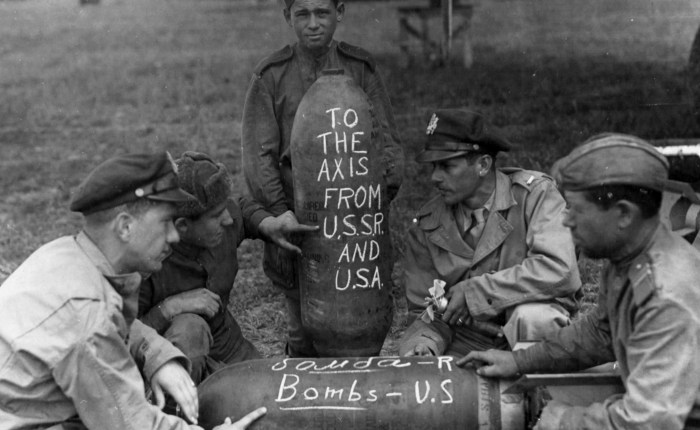
When American bombers flew from Soviet bases against Axis forces in Romania on 6 June 1944, it marked the first time in the war that they took off from behind Soviet lines to attack Axis targets. This mission was a part of Operation FRANTIC I, the first shuttle bombing missions from western Allied bases to Soviet bases. After leaving their bases in Ukraine, American bombers struck the primary Axis airfield in Romania at Galati. One hundred and four American B-17s and 42 P-51s of the Fifteenth Air Force attacked the German and Romanian air facilities at Galati. Fourteen Axis fighters along with another 25 spotted near the airfield engaged the strike force. During the ensuing air battle, American fighters accounted for six Axis fighters at the loss of two American fighters. The 104 B-17s dropped 155.3 tons of explosive bombs and 51.3 tons of incendiary bombs on the airfield and its facilities. Much of the buildings, hangers, and facilities at Galati were destroyed or damaged during the bombing. Of the 40 aircraft still on the ground during the attack, the Fifteenth Air Force destroyed eight and damaged 11.[1] FRANTIC I’s final mission was an attack on the Focsani airfield on 11 June and a return to the American airfields in Italy. Flying from the Soviet bases, 121 B-17s dropped 223.9 tons of bombs on the Focsani airfield escorted by 52 P-51s. The bombers struck the barracks and workshops along with additional facilities. The attacking force engaged 15 to 20 ME 109s and FW 190s over Focsani.[2]

FRE_008681
A P-51 Mustang nicknamed ‘Tempus Fugit’ of the 31st Fighter Group, Fifteenth Air Force in 1944. (Source: IWM (FRE 8681))

In another attempt to weaken Axis air power over Romania, the Americans executed Operation FRANTIC III, the first fighter sweep shuttle mission to the Soviet Union. According to the FRANTIC III plan on 11 July 1944, the purpose of the mission was to send 72 P-38s and 48 P-51s from the 306th Fighter Wing of the Fifteenth Air Force to execute counter-air operations from the American airfields located behind the Soviet lines in Ukraine. The three tactical objectives of FRANTIC III included: strafing of aircraft at Mielec, Poland; strafing of aircraft airfield and dive-bombing of the facilities at Lviv; strafing of targets that are identified through photo reconnaissance while in the Soviet Union.[3] At 7:45 AM on 22 July 1944, the 82nd and 31st Fighter Groups of the 306th Fighter Wing took off from their bases in Italy to attack the Romanian airfields near Zilistea and Buzau. When approaching the target, the American fighters dropped to an altitude of 5,000 feet. When they reached 4,000 feet, they passed several Axis aircraft flying near the airfield. The 82nd Fighter Group bypassed them to attack the airfields, while the 31st Fighter Group provided air cover. Once below 4,000 feet, Romanian anti-aircraft fire engaged the formations. The city of Ploesti began to deploy a smokescreen as they noticed the incoming American fighters. The 82nd Fighter Group attacked five airfields: Zilistea, Buzau, and three satellite fields. The 82nd Fighter Group destroyed 41 aeroplanes on the ground. Both the 82nd Fighter Group and 31st Fighter Group destroyed another 15 aeroplanes in the air at the loss of five P-38s. After the attack, the two groups reassembled and proceeded to their airbases located in Ukraine at Piryatin, Poltava, and Mirgorod.[4]

The next day the 306th Fighter Wing received orders to attack the German airfield at Mielec. One problem that the 306th Fighter Wing ran into was the fact that the Soviet offensive against German Army Group Center, codenamed Operation BAGRATION, had driven within 88 miles of the airfield, and there was concern that the Americans might accidentally strafe a Soviet ground formation. Additionally, poor weather delayed the attack until 25 July. By that time, the Soviet advance was 48 miles away from the airfield.[5] On 25 July, 36 P-38s and 36 P-51s of the 306th Fighter Wing attacked the airfield at Mielec, destroying anywhere from nine to 16 German aircraft on the ground. South of Mielec the fighters spotted a train and column of trucks which were also attacked destroying four locomotives and 14 trucks. On their way back to their bases in Ukraine, the fighter formation stumbled across a German bomber formation of 36 German JU-87 bombers without an escort. The American fighters engaged and destroyed 29 of the bombers. By the end of the day, the American fighters returned to their bases without suffering a loss.[6] The 26 July mission was a low-level fighter sweep of Ploesti and Bucharest and then a return to the Fifteenth Air Force bases in Italy. Poor weather forced the formation to divert to the Galati and Zilestea area. This led to an engagement with German fighters that resulted in 20 German fighters being shot down at the loss of two P-38s. [7]

The Red Army requested more follow up counter-air operations on the eve of the Second Iași-Chișinău Offensive. The Red Army General Staff sent a request to Deane’s counterpart in Moscow, Major General Robert L. Walsh, who oversaw all American air operations on the Eastern Front. Walsh sent an urgent message to the commander of the United States Strategic Air Forces in Europe, Lieutenant General Carl Spaatz, on 2 August. He wrote, ‘The Soviets requested that we concentrate our attacks on the following: enemy airdromes just south of the Iasi-Akkerman front.’ This included at least twelve airfields near the front lines. The Soviets provided a list, which Walsh transmitted directly to Spaatz. [8] The Americans had already carried out three fighter-bomber missions against German airfields in July.[9]

Operation Frantic
Russian officers chat with Colonel Barton, Commanding Officer of the 483rd Bomb Group, and Colonel Rice of the 2nd Bomb Group at Mirgorod. The girl in the center is an interpreter. (Source: National Museum of the USAF)

This request led to FRANTIC IV, the second all fighter shuttle mission of the war conducted by the 306th Fighter Wing. On 4 August, 45 P-38s of the 82nd Fighter Group took off to strafe the airfields around Focsani, while 45 P-51s of the 52nd Fighter Group provided air cover. The attack destroyed four Axis aircraft, three locomotives, and one tank car. Additionally, the P-38s strafed the hangers, buildings, and troop trains. Afterwards, the 306th Fighter Wing proceeded to Poltava. On 6 August, 30 P-51s and 30 P-38s of the 306th Fighter Wing took off from Poltava for the return fighter sweep. The 306th Fighter Wing destroyed 30 railway cars, 11 locomotives, four tank cars, and one aircraft at Cariova and Ploesti.[10]

After 2 June, the Luftwaffe’s sorties declined to 1,347 sorties.[11]  This data is also backed up by Fifteenth Air Force studies done after the fall of Romania of the air defences in the Ploesti and Bucharest area. The study estimated that in April 1944, Axis aircraft deployed around Bucharest and Ploesti numbered 200 to 255. Those numbers declined after the counter-air operations began. By May 1944, the number of Axis aircraft deployed to the area was anywhere between 125 to 145. In June, the numbers further decreased to 95 to 110 aircraft located in that same area. By August, Axis air power had declined in the Bucharest-Ploesti area to approximately 40 to 45 aircraft.[12] According to an American assessment of the decline, the Fifteenth Air Force concluded that the decline resulted from American counter-air operations and a redeployment of Luftwaffe forces to other theatres.[13] American counter-air operations and additional attacks against vital parts of Romania, significantly reduced Axis air power in the country during the summer of 1944. This, in part, explains part of the reason for the success of the Second Iași-Chișinău Offensive. Axis air power in the region had been, for the most part, eliminated.

In conclusion, the successful air superiority campaign against Axis air in Romania reveals a lot about the Allied offensives in Romania. First, the American Fifteenth Air Force played a pivotal role in the Second Iași-Chișinău Offensive by clearing the skies of Axis air power.  Next, this is an excellent example of successful joint operations. The Fifteenth Air Force worked in conjunction with the Red Army to attack targets of importance to the Soviet ground war in a timely fashion. Finally, from a historiography standpoint, more needs to be written about this subject. Preliminary research into these air operations indicates that American air operations in the Balkans were not confined strictly to attacking targets related to oil production.

Dr Luke Truxal is an adjunct at Columbia State Community College in Tennessee. He completed his PhD in 2018 from the University of North Texas with his dissertation ‘Command Unity and the Air War Against Germany.’ His previous publications include ‘Bombing the Romanian Rail Network,’ in the Spring 2018 issue of Air Power History. He has also written ‘The Politics of Operational Planning: Ira Eaker and the Combined Bomber Offensive in 1943’ in the Journal of Military Aviation History. Truxal is currently researching the effectiveness of joint air operations between the Allied air forces in the Second World War. He can be reached on Twitter at: @Luke_Truxal.

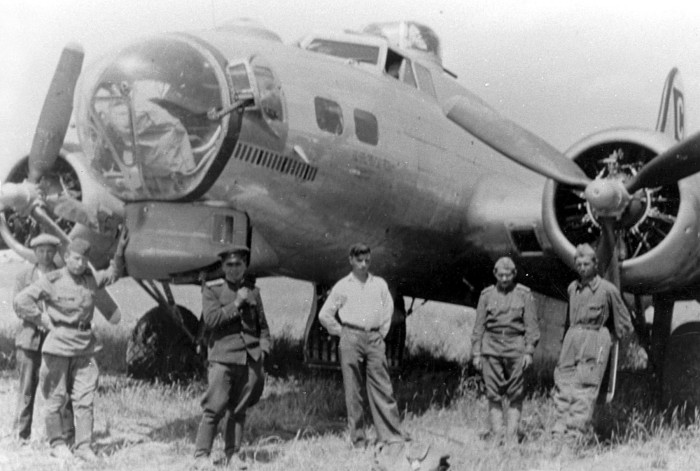
Header Image: American and Russian soldiers in 1944 during Operation FRANTIC. In the background is a B-17 Flying Fortress bomber and a C-47 Dakota transport aircraft. (Source: Wikimedia)

[1] United States Air Force Historical Research Agency (USAFHRA), Montgomery, AL, Call 622.430-6, Headquarters Eastern Air Command, ‘Eastern Command Narrative of Operations: 2nd Italy-Russia Shuttle Operation – 2 June 1944.’

[2] USAFHRA, Call 622.430-6, MASAF, “Excerpt-MASAF Intops Summary No. 325, 11 June: Foscani North Aerodrome Installations 5th Wing,” 11 June 1944.

[3] USAFHRA, Call 622.430-6, Headquarters Fifteenth Air Force, ‘Fifteenth Air Force Plan for Operation Frantic III,’ 11 July 1944.

[4] USAFHRA, Call 622.430-6, Headquarters 306th Fighter Wing, ‘Narrative Report of Frantic III Operation,’ 28 July 1944.

[5] Ibid.

[6] Ibid.

[7] Ibid.

[8] Library of Congress (LoC), Papers of General Carl Spaatz, Robert L. Walsh to Spaatz and Eaker, 2 August 1944.

[9] LoC, Spaatz Papers, George McDonald to Anderson (“Frantic”), 21 August 1944.

[10] USAFHRA, Call 622.430-6, 306th Fighter Wing, “INTOPS No. 381,” 7 August 1944.

[11] Hardesty and Ilya Grinberg, Red Phoenix Rising: The Soviet Air Force in World War II (Lawrence, KS: University of Kansas Press, 2012), p. 292

[12] Ike Skelton Combined Arms Research Library, Army Air Force Evaluation Board, ‘Army Air Force Evaluation Board Report VI: Ploesti,’ n.d., p. 21.

[13] Ibid, p. 19.

Clearing the Skies for the Red Army – Part One: Learning from Failure

Clearing the Skies for the Red Army – Part One: Learning from Failure

By Dr Luke Truxal

Editorial note: On 20 August 1944, the Soviet Union launched two army group sized formations, the Second and Third Ukrainian Fronts, against Axis Army Group South Ukraine. Army Group South Ukraine had been tasked with defending Romania. During this offensive, known as the Second Iași-Chișinău Offensive, the Soviets routed the Third and Fourth Romanian Armies and destroyed the German Sixth Army. By the end of the offensive on 29 August, the Romanian fascist government under Prime Minister Ion Antonescu was overthrown, and Romania defected to the Allies. In the first of a two-part series on the contribution of US air power to the conduct of the Second Iași-Chișinău Offensive, Dr Luke Truxal examines some of the lessons and issues that emerged from the First Iași-Chișinău Offensive between April and June 1944.

Few historians have delved deeply into the history of the Second Iași-Chișinău Offensive. Those who have written about the campaign typically only analyse the ground war. The foremost authority on the ground war on the Eastern Front, David Glantz, has covered the fighting in Romania in two of his books. In Red Storm Over the Balkans, Glantz analyses the First Iași-Chișinău Offensive. He also writes about the Second Iași-Chișinău Offensive in his overview of the fighting on the Eastern Front. Neither work referred to the air war that influenced the outcome of the fighting on the ground. Rob Citino, in his analysis of the fighting in Romania, excludes the air war.[1] Likewise, much of the historiography of the air war has overlooked the role of American air support provided to the Soviets during the invasion of Romania and focused more on the attacks against the Romanian oil industry. James Lea Cate and Wesley Frank Craven, in the official history of the United States Army Air Forces in the Second World War, focus strictly on the bombing of Romanian oil at the exclusion of the interdiction and air superiority campaigns. As a result, their narrative remained unchallenged for years.[2] In the 1990s, historians began to examine other aspects of the air war over Romania, including attacks against Romanian civilians and an air interdiction campaign.[3]

FRE_000860
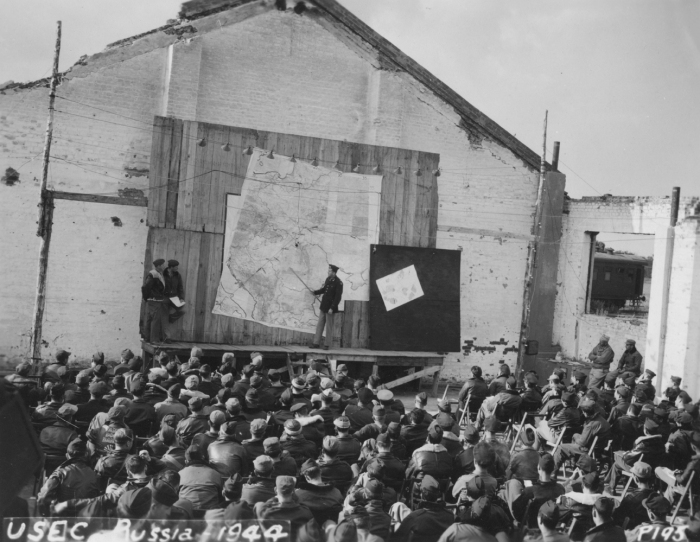
Personnel of the 96th Bomb Group and the 452nd Bomb Group receive briefing against the wall of a bombed-out railway building in Poltava, Russia during Operation FRANTIC in summer 1944. (Source: IWM (FRE 860))

This first article examines the lessons learned from the First Iași-Chișinău Offensive and the Soviet-American planning that led to an aggressive air suppression campaign against Axis air forces in Romania.  As a result of this work, the US Fifteenth Air Force, under the command of Major General Nathan Twining, was able to execute a successful air superiority campaign that aided the Soviet advance into Romania in August 1944 during the Second Iași-Chișinău Offensive from 20 to 29 August 1944. The success of this air campaign was due to the considerable level of coordination between the Fifteenth Air Force and the Red Army before launching the offensive against the Luftwaffe. The architect of this coordination was none other than the commander of the United States Strategic Air Forces in Europe (USSTAF), Lieutenant General Carl Spaatz. In establishing air superiority over Romania, the Fifteenth Air Force ground down German and Romanian air assets from as high as 255 aircraft deployed in the Bucharest area in April 1944 to as low as 40 aircraft in that same area by August 1944.[4]

The unsuccessful first attempt to seize Romania came during the First Iași-Chișinău Offensive between 8 April to 6 June 1944. The Second and Third Ukrainian Fronts aggressively pressed forward after their success in Ukraine. Despite initial breakthroughs, the German and Romanian forces counter-attacked and held the frontier, then known as Bessarabia. Soviet forces suffered setbacks both on land and in the air.

Perhaps the only positive to come from the First Iași-Chișinău Offensive for the Allies was the establishment of a system to coordinate the operations of the Fifteenth Air Force with Soviet ground forces. The system, established over the course of March and April 1944, coordinated Fifteenth Air Force air operations through the Red Army General Staff in Moscow. This laid the groundwork for future coordination when the Soviets resumed their invasion of Romania. United States Army representative in Moscow, Major General John R. Deane, worked tirelessly during March and April to establish a system to coordinate Fifteenth Air Force operations with the Red Army. Ultimately, the Soviets only agreed to an indirect communication system through Moscow to the Second and Third Ukrainian Fronts. On 20 April, General Aleksei Antonov, Deputy Chief of Staff of the Soviet Armed Forces, made it clear to Deane that any such coordination had to be done through Moscow. Antonov went on to say that his superior, Field Marshal Aleksandr Vasilievsky, Chief of Staff of the Soviet Armed Forces, did not believe that the Soviet forces advancing into Romania needed an air liaison officer.[5] This created a slow process when it came to coordinating air attacks with Soviet forces. According to Deane, without the liaison officers, coordination passed from Spaatz to Deane. Afterwards, Deane scheduled a meeting with his counterpart, Major General N. V. Slavin, who then sought approval of the air attacks from his superior Antonov. Antoniv communicated with Soviet field commanders to determine if the American missions interfered with their operations. Antonov then relayed everything back through the same chain. This was not the ideal means of coordinating air missions with the Red Army.[6] Nevertheless, while deeply flawed, the system did allow for the Soviets and Americans to coordinate a bombing campaign in Romania.

Starting in June 1944, the Fifteenth Air Force began to carry out air support operations once again for the Red Army in Romania at the direction of Spaatz. The first area of focus was the Luftwaffe in Romania. One of the critical factors for German success in the First Iași-Chișinău Offensive was that German air power had checked the Red Air Force.  From May to June 1944, the Luftwaffe regained a level of air superiority in the skies over northern Romania. A series of intense air battles took place over the town of Iași between German and Soviet airmen for control of the skies. In Red Phoenix Rising, Von Hardesty and Ilya Grinberg state that the air battles over Iași were some of the most intense of the air war on the Eastern Front. Due to the strategic importance of the Romanian oil refineries, the Luftwaffe transferred some of their most experienced air units to aid in defence of Iași. On 28 April alone the Luftwaffe flew 807 sorties over Iași. The following day the Germans flew another 1,181 sorties against the Soviets. During the entire week, the Germans launched 4,000 sorties against Soviet troops located in the Iași sector. By comparison, the Soviets only carried out 1,970 sorties of their own during that same period. [7]

The Soviet Fifth Air Army tried to enlarge its own air operations to counter the Germans throughout May. Starting on 28 May, forward units of the Soviet Fifth Air Army attempted to reverse the gains made by the Luftwaffe. They attacked German and Romanian airfields located at Roman and Khushi. The goal was to destroy 200 Axis aircraft located at these two locations. Romanian and German forces located the attacking force. The raid only destroyed 35 German and Romanian aircraft. The Germans responded on 30 May. The Luftwaffe flew 2,082 sorties against the Second Ukrainian Front, countered by only 703 sorties flown by the Soviet Fifth Air Army. Throughout the fighting over Iasi, German fighters continued not only to carry out close air support missions of their own but also disrupted those of the Soviet Fifth Air Army.[8]

Operation Frantic
A Badly damaged US B-17 bomber and Russian soldiers in Poltava, Russia, on 22 June 1944 during Operation FRANTIC. (Source: National Museum of the USAF)

As this was happening, the Soviets relayed their struggles against Luftflotte IV to the Americans. On 13 May, the head of USSTAF intelligence, Colonel L.P. Weicker, and Red Air Force General D.D. Grendal met as a part of a conference between the USSTAF air staff and the Red Army to discuss the air war on the Eastern Front. The Soviets provided the Americans with their analysis of the deployment of the Luftwaffe on the Eastern Front. According to Soviet air intelligence, the Germans had concentrated 500 of their 900 bombers on the Eastern Front in the south-facing the Second and Third Ukrainian Front. Additionally, the Luftwaffe deployed 240 of its 650 fighters on the Eastern Front in the south. At the same time, approximately half of the German aerial reconnaissance aircraft were also deployed on the Soviet Southwest Front. In total, 970 of the 2,090 aircraft deployed on the Eastern Front were arrayed against the Soviet Second and Third Ukrainian Front. [9]  During the same meeting, Grendal informed the Americans that many German aircraft began operating from Romania after they retreated from the Ukraine. Those at the meeting recalled: ‘The Soviets estimate that at present the Germans have in excess of 1,000 aircraft on the Roumanian territory.’[10] With this information, the Soviets and Americans were now able to eliminate the threat that Luftflotte IV presented to ground operations.

One means of providing more direct aid to the Soviet advance was through shuttle bombing missions, codenamed Operation FRANTIC. During these missions, American bombers from bases either in the United Kingdom or Italy would fly attack a German target on the Eastern Front, then continue east and land at Soviet airfields. FRANTIC I’s planning and execution was designed to aid the Soviet air power in the Iasi-Chișinău sector. In the 22 May draft of FRANTIC I, the Americans contemplated ‘an operation from Foggia against airfields in the Galatz area, followed by 3 operations from Russian bases against targets selected by the Russians.’[11] The Americans believed that attacking Axis airfields in Romania could alleviate the pressure on the Second and Third Ukrainian Fronts. On 27 May, the commander of the Mediterranean Allied Air Force (MAAF), Lieutenant General Ira Eaker, laid out the proposed plan to Twining. He wrote: ‘Fifteenth Air Force will conduct its first FRANTIC bombing operation on the first day weather permits after June first. Force will consist of 130 B-17s and 70 P-51s.’ Eaker then briefed Twining on the preferred targets that the USSTAF wanted to strike, which included the Galatz airfields, an aircraft factory at Mieléc, and an aircraft factory at Riga.[12] While the factories at Mieléc and Riga were on the list, the Galatz airfields had a more immediate effect on air operations in Romania. According to a briefing memo dated 28 May 1944 for the Fifteenth Air Force: ‘The German Air Force in the Southeast, Luftflotte IV, has been forced to withdraw its aircraft to a small number of fields in the Foscani-Galatz area. While recent coverage of this area is not complete, latest photography indicates over 550 aircraft (principally fighters, ground support and bombers) on five fields in the area, of which 450 are on the two Foscani landing grounds and Zilistea.’[13] The primary objective of FRANTIC I was the destruction of these airfields.

On 2 June 1944, the Fifteenth Air Force carried out FRANTIC I. The 2nd, 97th, 99th, and 483rd Bomb Groups, struck the Debreczen marshalling yards before continuing to the Russian airfields located at Poltava in modern-day Ukraine. This had been a last-minute request by the Soviets. Therefore, the Americans added to their first mission as a part of FRANTIC I.[14] With the first leg complete, the Fifteenth Air Force then prepared to strike at the target that American and Soviet planners wanted to get in Romania, Axis air power.

Operation Frantic
Russian pilots and ground crew stand in front of a Petlyakov Pe-2 at Poltava, Russia, during Operation FRANTIC in June 1944. The American is Technical Sergeant Bernard J. McGuire of the 348th Bomb Squadron, 99th Bomb Group. (Source: National Museum of the USAF)

We can take two lessons away from the failures of the First Iași-Chișinău and the period afterwards. First, the Allies recognised the reasons for the shortcomings of the offensive in the air and on the ground. Remarkably, they were able to figure out what went wrong with the offensive in a matter of days and weeks. As a result, the Allies spent the following month, May 1944, working to fix the problem. That problem, the threat posed by Luftflotte IV, became the main topic of discussion when planning the FRANTIC shuttle missions between the Americans and the Soviets. At the end of these planning sessions, both sides agreed that the Fifteenth Air Force needed to pour more resources into defeating Luftflotte IV before the next major ground offensive. This set the stage for the air superiority campaign that would begin on 2 June 1944.

Dr Luke Truxal is an adjunct at Columbia State Community College in Tennessee. He completed his PhD in 2018 from the University of North Texas with his dissertation ‘Command Unity and the Air War Against Germany.’ His previous publications include ‘Bombing the Romanian Rail Network,’ in the Spring 2018 issue of Air Power History. He has also written ‘The Politics of Operational Planning: Ira Eaker and the Combined Bomber Offensive in 1943’ in the Journal of Military Aviation History. Truxal is currently researching the effectiveness of joint air operations between the Allied air forces in the Second World War. He can be reached on Twitter at: @Luke_Truxal.

Header Image: American and Russian soldiers in 1944 during Operation FRANTIC. In the background is a B-17 Flying Fortress bomber and a C-47 Dakota transport aircraft. (Source: Wikimedia)

[1] For a comprehensive history of the First Iasi-Chișinău Offensive, see David Glantz, Red Storm Over the Balkans: The Failed Soviet Invasion Spring 1944 (Lawrence, KS: University Press of Kansas, 2006), pp. 60-70, 76-100. Glantz is the first historian provide a detailed analysis of the Red Army’s failed first attempt to take Romania. He argues that the history of the campaign was forgotten because of its shortcomings. Glantz also covers the Second Iasi-Chișinău Offensive in David Glantz and Jonathan House, When Titans Clashed: How the Red Army Stopped Hitler (Lawrence, KS: University Press of Kansas, 1995), pp. 218-21. See also Rob Citino, The Wehrmacht’s Last Stand: The German Campaigns of 1944-1945 (Lawrence, KS: University Press of Kansas, 2017), pp. 307-12.

[2] Wesley F. Craven and James L. Cate (eds.), The Army Air Forces in World War II, Volume 6: Europe, Argument to VE Day, January 1944 to May 1945 (Chicago, IL: The University Press of Chicago, 1951), pp. 280-7. Examples of other historians who have also focused only on the oil bombing in Romania include Donald Miller, Masters of the Air: America’s Bomber Boys Who Fought the Air War Against Nazi Germany (New York: Simon and Schuster, 2006), pp. 312-21. While Miller is a popular historian, the influence of his book on the public at large has influenced how many outside the academic community view the air war against Romania. Tami Davis Biddle, Rhetoric and Reality in Air Warfare: The Evolution of British and American Ideas About Strategic Bombing, 1914-1945 (Princeton, NJ: Princeton University Press, 2002), pp. 236-43.

[3] For more scholarship that covers the bombing of Romania outside the spectrum of oil see Mark Conversino, Fighting with the Soviets: The Failure of Operation FRANTIC, 1944-1945 (Lawrence, KS: University Press of Kansas, 1997). For an analysis of the Mediterranean Allied Air Forces’ attacks against Romanian rail targets and the mining of the Danube see Robert S. Ehlers Jr., The Mediterranean Air War: Air Power and Allied Victory in World War II (Lawrence, KS: University Press of Kansas, 2009), p. 364 and pp. 373-7; Conrad Crane, Bombs, Cities, and Civilians: American Air Power Strategy in World War II (Lawrence, KS: University Press of Kansas, 1993), pp. 95-8. To date, the best analysis of the attacks against Romanian civilians is Richard Overy, Bombers and the Bombed: Allied Air War Over Europe, 1940-1945 (New York: Penguin Books, 2004), p. 8, 404, and 413. For further analysis of attacks against the Romanian infrastructure see Luke Truxal, ‘Bombing the Romanian Rail Network,’ Air Power History 65, no. 1 (2018). For a short summary of American and Soviet coordination during the Second Jassy-Chișinău Offensive see Luke Truxal, ‘Forgotten Fights: The Second Jassy-Chișinău Offensive and the Destruction of German Sixth Army,’ National World War II Museum, 14 September 2020.

[4] Ike Skelton Combined Arms Research Library Digital Library, US Army Command and General Staff College, Army Air Force Evaluation Board, ‘Army Air Force Evaluation Board Report VI: Ploesti,’ n.d., , p. 21.

[5] US Library of Congress, Personal Papers of General Carl Spaatz, 30 Mission Moscow to AFHQ, Combined Chiefs of Staff, and British Chiefs of Staff, 20 April 1944. See also Truxal, ‘Bombing the Romanian Rail Network,’ pp. 17-8.

[6] John R. Deane, The Strange Alliance (London: John Murray, 1947), pp. 127-8. See also Truxal, ‘Bombing the Romanian Rail Network,’ p. 18.

[7] Von Hardesty and Ilya Grinberg, Red Phoenix Rising: The Soviet Air Force in World War II (Lawrence, KS: University of Kansas Press, 2012), pp. 286-7.

[8] Hardesty and Grinberg, Red Phoenix Rising, pp. 287-9.

[9] United States Air Force Historical Research Agency (USAFHRA), Call 622.430-6, Fred Anderson to Carl Spaatz, ‘Report on visit to Russia by Mission of USSTAF Officers,’ Exhibit D. Williamson Murray places Luftflotte IV’s numbers at 390 ground attack aircraft, 160 single-engine fighters, and 45 twin-engine fighters. William Murray, Strategy for Defeat: The Luftwaffe, 1933-1945, (Montgomery, AL: Air University Press, 1983), p. 285.

[10] USAFHRA, Anderson to Spaatz, ‘Report on visit to Russia by Mission of USSTAF Officers,’ Exhibit B.

[11] USAFHRA, Call 622.430-6, To Spaatz, ‘Plan for Operation “Frantic,”’ 22 May 1944.

[12] USAFHRA, Call 622.430-6, Ira Eaker to Nathan Twining, 27 May 1944.

[13] USAFHRA, Call 622.430-6, 1. Headquarters Fifteenth Air Force, ‘Annex No. I Combat Operation Enroute Fifteenth Air Force Plan for Operation ‘Frantic Joe’ Part One,’ 28 May 1944.

[14] USAFHRA, Call 622.430-6, ‘Debreczen-Damage Assessment’; USAFHRA, Call 622.430-6, Headquarters Eastern Air Command, ‘Eastern Command Narrative of Operations: 1st Italy-Russia Shuttle Operation-2 June 1944.’

From Balloons to Drones – 5 Years On

From Balloons to Drones – 5 Years On

By Dr Ross Mahoney

Five years ago, on 15 June 2016, From Balloons to Drones was launched. From Balloons to Drones was established with the simple vision of providing an open access online platform for the analysis and debate of air power history, theory, and contemporary operations in their broadest sense, including space and cyber power. Since establishing From Balloons to Drones, we have published 195 posts of various types ranging from articles to book reviews. More recently, in 2019, we started producing a popular podcast series with interviews with leading air power specialists. Overall, the site has received over 130,000 hits since 2016.

None of the above would have been achieved without the support of our editors, contributors, and readers. Personally, I am grateful to all the members of the From Balloons to Drones editorial team for their continuing hard work, especially as it is all done voluntarily. Indeed, when the site was established, it was run by one person, our Editor-in-Chief, Dr Ross Mahoney. However, over time, the editorial team has grown and evolved. In 2018, long-time contributors Dr Brian Laslie, Dr Michael Hankins, and Alex Fitzgerald-Black came onboard as editors. While Alex has moved on, we have continued to build and strengthen the editorial team with the addition of Victoria Taylor and Dr Luke Truxal to the team. As we look forward to the next five years of From Balloons to Drones, I am pleased to announce the addition of two new editors to the team: Dr Maria Burczynska and Ashleigh Brown. Maria is a Lecturer in Air Power Studies at the University of Wolverhampton in the UK, while Ashleigh, a PhD student at UNSW Canberra, is a researcher for the Official History of Australian Operations in Iraq & Afghanistan and Australian Peacekeeping Operations in East Timor. The addition of Maria and Ashleigh will help strengthen the team in several areas, and we are looking forward to what the future holds with them.

I am also grateful to all our contributors and readers. Without our contributors, there would be nothing to publish and, as such, no website. However, we are always on the lookout for new contributions either from established authors or from new and emerging scholars within the air power studies community. If you are interested in contributing, then visit our submissions page to find out how to contribute.

So, what about the future? More of the same but better. We still hold true to our original vision of providing an avenue for debate and discussion about air power. We will aim to continue to refine what we offer in terms of content and build on the success of the past five years. We have more articles, book reviews and podcasts in the pipeline. However, we are always keen to hear your views on what we publish. If there is an area of research that needs to be given more coverage, please let us know.

Finally, as a bit of fun to celebrate our fifth birthday, here are the top five most-read posts since our launch in 2016:

  1. Michael Hankins, ‘Inventing the Enemy: Colonel Toon and the Memory of Fighter Combat in Vietnam’
  2. Michael Hankins, ‘A Discourse on John Boyd: A Brief Summary of the US Air Force’s Most Controversial Pilot and Thinker’
  3. Liam Barnsdale, ‘Royal Air Force ‘wings’ Brevets in Second World War Propaganda’
  4. Justin Pyke, ‘Blinded by the Rising Sun? American Intelligence Assessments of Japanese Air Power, 1920-41: Part 1 – The 1920s’
  5. Jeff Schultz, ‘Supporting the Secret War: T-28s over Laos, 1964-1973 – Part 1: Training’

Header image: Pilatus PC-21A aircraft from No 4 Squadron based at RAAF Base Williamtown fly in formation on return from Sydney in support of an Air Force 2021 commemorative service held at the Anzac Memorial in Hyde Park. (Source: Australian Department of Defence)

#Podcast – The Bomber Mafia: An Interview with Dr Micheal Hankins, Dr Brian Laslie, and Dr Luxe Truxal

#Podcast – The Bomber Mafia: An Interview with Dr Micheal Hankins, Dr Brian Laslie, and Dr Luxe Truxal

Editorial Note: Led by our Editor Dr Mike Hankins, From Balloons to Drones produces a monthly podcast that provides an outlet for the presentation and evaluation of air power scholarship, the exploration of historical topics and ideas, and provides a way to reach out to both new scholars and the general public. You can find our Soundcloud channel here. You can also find our podcast on Apple Podcasts and Google Podcasts.

The recent publication of Malcolm Gladwell’s The Bomber Mafia has generated much interest in the topic of strategic bombing during the Second World War. In our latest podcast episode, three of the editors at From Balloons to Drones, Dr Mike Hankins, Dr Brian Laslie, and Dr Luke Truxal, discuss the book and go beyond it to talk about various issues related to bombing during the Second World War.

Dr Michael Hankins is the Curator of US Air Force History at the Smithsonian National Air and Space Museum. He is a former Professor of Strategy at the USAF Air Command and Staff College eSchool, and former Instructor of Military History at the U.S. Air Force Academy. He earned his PhD from Kansas State University in 2018 with his dissertation, ‘The Cult of the Lightweight Fighter: Culture and Technology in the U.S. Air Force, 1964-1991.’ He completed his master’s thesis at the University of North Texas in 2013, titled ‘The Phantom Menace: The F-4 in Air-to-Air Combat in the Vietnam War.’ He has a web page here and can be found on Twitter at @hankinstien.

Dr Brian Laslie is a US Air Force Historian and currently the Command Historian at the USAF Academy. A 2001 graduate of The Citadel and a historian of air power studies, he received his Masters’ from Auburn University Montgomery in 2006 and his PhD from Kansas State University in 2013. He is the author of three books with his most recent being Air Power’s Lost Cause: The American Air Wars of Vietnam (2021). His first book, The Air Force Way of War (2015) was selected for the Chief of Staff of the Air Force’s 2016 professional reading list and the 2017 RAF Chief of the Air Staff’s reading list. He can be found on Twitter at @BrianLaslie.

Dr Luke Truxal is an adjunct at Columbia State Community College in Tennessee. He completed his PhD in 2018 from the University of North Texas with his dissertation ‘Command Unity and the Air War Against Germany.’ His previous publications include ‘Bombing the Romanian Rail Network,’ in the Spring 2018 issue of Air Power History. He has also written ‘The Politics of Operational Planning: Ira Eaker and the Combined Bomber Offensive in 1943’ in the Journal of Military Aviation History. Truxal is currently researching the effectiveness of joint air operations between the Allied air forces in the Second World War. He can be reached on Twitter at @Luke_Truxal.

Header image: Boeing B-29 Superfortresses drop bombs over Rangoon, Burma in 1945. The nearest aircraft is a B-29-25-BA of the 871st Bomb Squadron, 497th Bomb Group, 20th Air Force. (Source: Wikimedia)