John M. Slemp, Bomber Boys: WWII Flight Jacket Art. self-published: www.wwiibomberboys.com, 2024. Hbk. 371 pp.
At the National Museum of the United States Air Force in Dayton, Ohio, a glass case between the Second World War and Korean War exhibits displays artwork painted on the back of seventeen A-2 jackets. Each jacket is a work of art, and each has a story detailing the wearer’s unique identity. Sometimes, they contained simple unit insignia, or the number of missions flown, and other jackets had full murals of the aircraft, pin-ups, cartoon characters, or nose art from the aeroplane.
Bomber Boys: WWII Flight Jacket Art is a love story to these A-2 jackets when leather was the ‘ideal canvas’ (p. 16). At the same time, it is a book on cultural history, military history, military uniforms, and, to the extent that wearers of the jacket might get away with it, a social commentary on the units the American airmen served in. As the author John Slemp notes, the A-2 jackets became ‘mobile signposts reflecting the distinct mortal challenges every flyer faced’ (p. v.). Although the jackets were technically uniform items and, therefore, not to be altered, senior leaders turned a blind eye to many uniform modifications. Learning to ‘read’ these jackets might, to the uninitiated, be like attempting to read Mayan glyphs. However, Slemp deftly walks the reader through what each marking indicates and, thus, what the wearer conveyed to other members of his unit and others he (and it was always he) might come into contact with.
The jackets contained in this book represent a ‘cultural and historical significance’ (p. v.). The book’s highlight is obviously the jackets, photographed in high resolution, and each picture is beautifully displayed. Jimmy Stewart’s jacket is one of those appearing in the book (pp. 182-3), and the author also weaves in fighter squadrons.
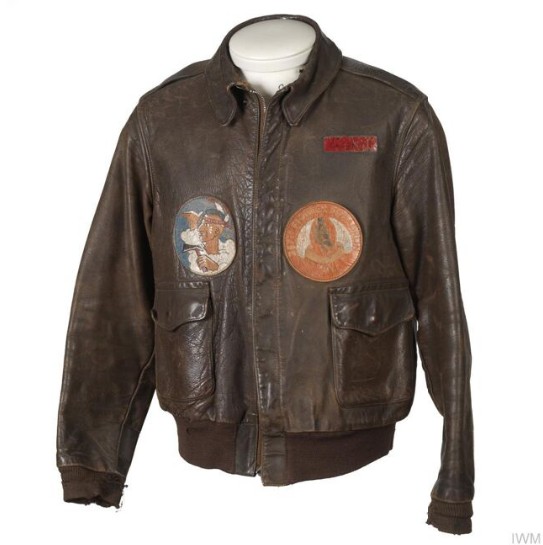
An A-2 jacket of 1st Lieutenant ‘Eugene’ Greenwell, who served at Steeple Morden, Cambridgeshire with the US 357th Fighter Squadron, 355th Fighter Group. Later, he joined the newly formed 2nd Scouting Force (still based at Steeple Morden), a formation of fighter aircraft that were specially tasked with going forward in advance of the heavy bomber formations to visually check the all-important weather conditions en-route to the target area, diminishing the risk of bombers having to abort their missions due to heavy cloud. Although expressly forbidden to engage enemy forces because of their reconnaissance role, 2nd SF did account for several enemy aircraft. By their final mission of 25 April 1945, 2nd SF was credited with thirteen kills in the air, two ground, two probable and eight damaged. Among that total, Greenwell is confirmed as having destroyed the 355th Group’s first Me 262 jet fighter on the ground at Neuberg airfield on 23 February 1945. (Source: IWM (UNI 13858))
The book, written over the course of a decade, also includes numerous veteran vignettes; black and white photographs – similar to the Medal of Honor: Portraits of Valor book by Peter Collier (Author), Nick Del Calzo (Photographer) – give an aging human face to the stories. Slemp also includes other ‘artifacts’ in this work, including Captain Walter Thompson’s bomb tags and the cotter pins that armed the bomb: on each tag, he wrote the date, bombing location, and bomb load (pp. 94-5). A map with hand-drawn pictures and annotations for each flyer’s bombing missions, including one mission to ‘Big B’ Berlin (pp. 122-3).
While the book focuses primarily on the European Theater of Operations, Slemp does turn his attention to the Mediterranean and North African theatre and the China, Burma, and India theatre. Not forgotten, Slemp includes a small section on the Women Airforce Service Pilots (WASPs). Most of the women of the WASPs turned their A-2 jackets in, although Dawn Seymour kept hers, and its photograph clearly shows the Disney-designed Fifi gremlin emblem (p. 306).
As noted earlier, this book is a love letter to the American bomber jacket. Slemp clearly shows the American Airmen’s influence on the future of fashion as the bomber jacket became a symbol of American masculinity and impacted fashion writ large. The Beatles, Steve McQueen, Indiana Jones, and the 1990s rap trio Salt-N-Peppa all appear sporting various versions of the iconic jacket.
While the US$129.95 price tag will put some people off, the cost is certainly worth it. A blurb seems inarticulate for the gift that author and photographer John Slemp has given the historical community. The work is an absolute must-own for those with a passion for the history of the Second World War and historians of air power and American fashion. A superb cultural history of the American airman.
Dr Brian Laslie is a noted air power historian, having authored The Sundowners, Pegasus, and Little Butch: Carrier Air Group Eleven and the War in the Pacific, 1943-1945 (2025), Air Power’s Lost Cause: The American Air Wars of Vietnam (2021), Architect of Air Power: General Laurence S. Kuter and the Birth of the US Air Force (2017) and The Air Force Way of War (2015). The latter book was selected for the Chief of Staff of the Air Force’s 2016 professional reading list and the 2017 RAF Chief of the Air Staff’s reading list. US Air Force Historian and Command Historian at the United States Air Force Academy. Formerly, he was the Deputy Command Historian at the North American Aerospace Defense Command (NORAD) and United States Northern Command (USNORTHCOM). A 2001 graduate of The Citadel and a historian of air power studies, he received his Masters’ from Auburn University Montgomery in 2006 and his PhD from Kansas State University in 2013.
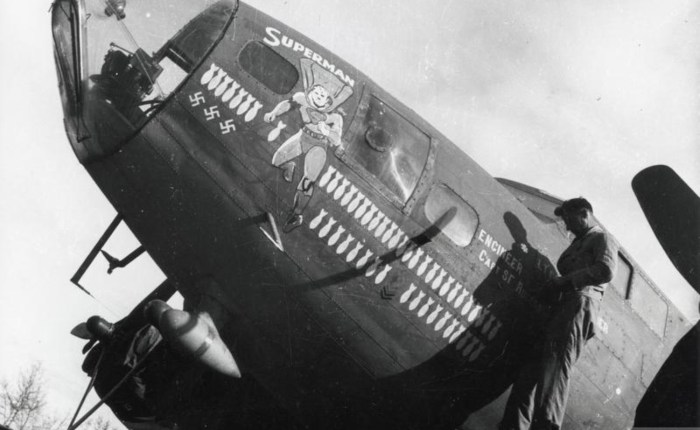
Header image: A ground crewman of the US 97th Bomb Group, 15th Air Force with the nose art of a Boeing B-17 Flying Fortress nicknamed ‘Superman.’ (Source: IWM (FRE 14013))
Editorial Note: Between February and April 2018, The Central Blue and From Balloons to Drones, will be publishing a series of articles that examine the requirements of high-intensity warfare in the 21st Century. These articles provide the intellectual underpinnings to a seminar on high-intensity warfare held on 22 March by the Williams Foundation in Canberra, Australia. In this last article in the series, Dr Ross Mahoney, editor of From Balloons to Drones, considers the need to understand the culture of air forces as a starting point for analysing the challenges they face in preparing for future warfare.
To say that ‘culture eats strategy for breakfast’ is a hackneyed quote is an understatement. Indeed, the critical problem here is that the phrase is used so often that it has increasingly lost any meaning to be useful as a lens through which to analyse organisational behaviour. What do we mean by culture? Why does it eat strategy for breakfast? What is the relevance of culture to air forces and how can we conceptualise its meaning for a force structure seeking to grapple with the challenge of high-intensity warfare.
Broadly speaking culture is the values, beliefs and assumptions that shape the behaviour of a group. Culture exists at several levels and finds its outgrowth in both ideational and materialist areas. Regarding levels of culture, authors often discuss strategic, organisational, sub- and countercultures as critical areas of analysis, though not often together. However, while understanding the culture of an organisation is useful for conceptualising the ideas that underpin the behaviour of a group, the term is not without its challenges. Primarily, the issue of definition remains contested, and the term culture has become malleable and nebulous. Added to this is the unwillingness of some to engage deeply with the anthropological origins of culture. Nonetheless, several of the articles in this joint high-intensity war series run by From Balloons to Drones and The Central Blue have alluded to the importance of establishing the ‘right’ culture in an organisation. As such, this article, which forms part of a larger project by the author on the culture of small air forces, seeks to offer some thoughts on the meaning of culture and unpack its ‘black box’ of tricks.[1]
Sources of Culture
Broadly, military culture is derived from two sources. ‘First, culture is derived from what individuals bring to the military from broader society and second, it is a consequence of military experience and training.’[2] Concerning the former; social, educational, and economic backgrounds are essential frames of reference. For example, due to the social background of its officer class, many of the ideas underpinning early Royal Air Force (RAF) culture, such as honour, strength of character, sympathy, resolution, energy, and self-confidence found parallels with those present in public schools of the period. This was because it was from this source that the RAF sought its preferred recruits. The latter issue of operational experience is especially critical for small air forces, such as the Royal Australian Air Force (RAAF), as they typically operate in a coalition context. As such, it is axiomatic that large air forces with whom small air forces operate will have influenced their cultural evolution. Indeed, in the RAAF, and other Commonwealth air forces, we see a degree of mimetic isomorphism in their evolution at both the ideational and materialist levels with regards to the influence of the RAF. However, in more recent years, the US military has become a more pervasive influence, and this is especially noticeable in areas such as the such as operating American military hardware.
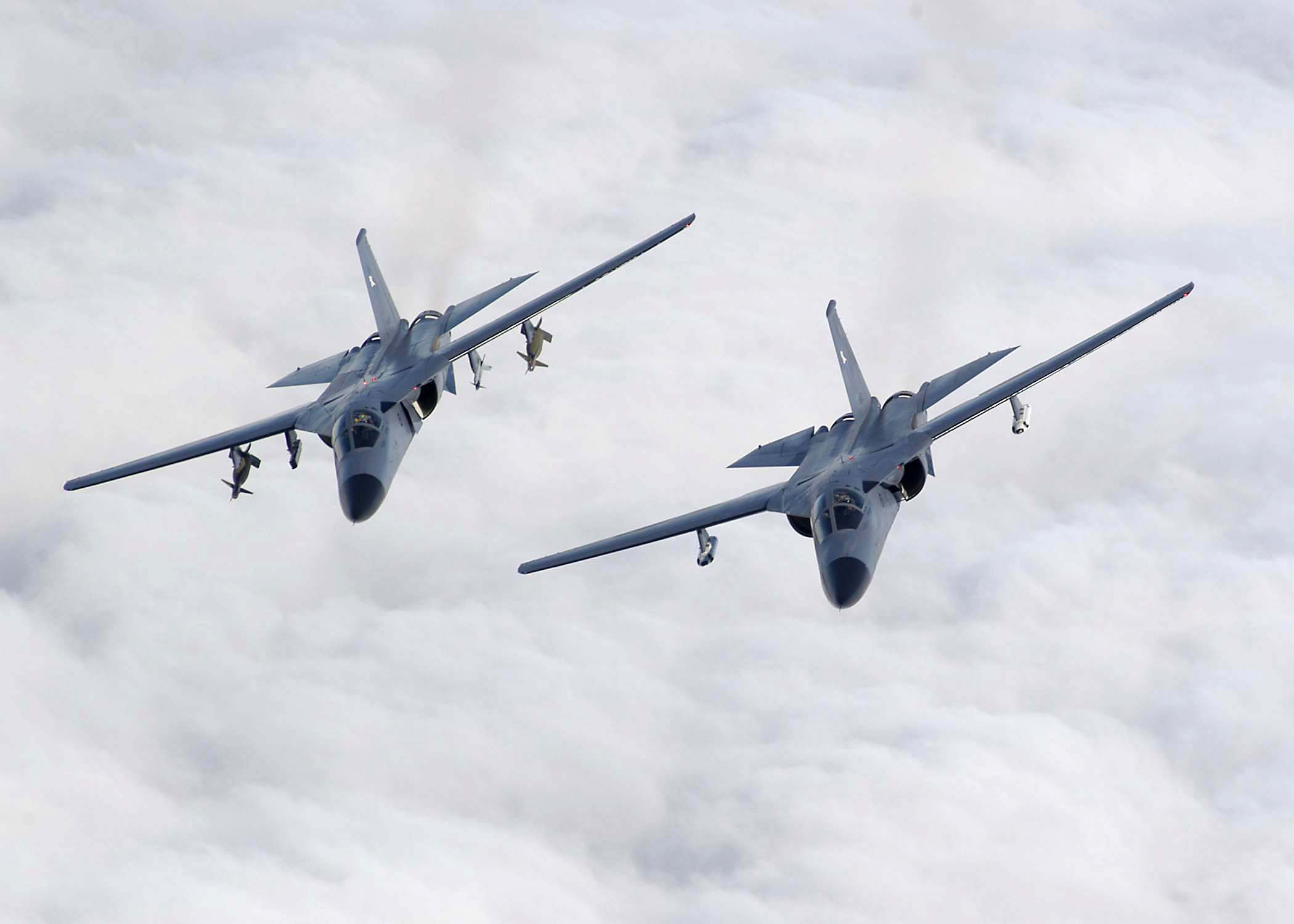
F-111s from No. 6 Squadron, RAAF Base Amberley, arrive over Melbourne on the eve of the Australian International Airshow at Avalon, c. 2005. (Source: Australian Department of Defence)
As well as societal factors and experience, broader environmental considerations also influence culture. Specifically, the environment in which air forces operate has helped shaped their culture. As Ian Shields reflected, the conception of time and space by air force personnel is different from those of the other services, in part, because of the nature of the air domain. Characteristics such as speed, reach and height are seen as defining the use of the air domain, and factors such as the large area of operations, flexibility, tempo, and the number of personnel directly involved in the delivery of air power continue to shape the culture of many air forces.[3] While it is possible to suggest that this is a parochial single service observation, it is worth considering that this is not limited to air force personnel. For example, Roger Barnett, a retired US Navy Captain, has suggested that the US Navy thinks different to its sister services, in part, because of its maritime context.[4] However, while differences do exist, there are often shared aspects of culture between the services, which have been underexamined.
A Transnational Air Force Culture?
National air forces have, like any other organisation, their own inherent culture and ethos. The ideas underpinning air force culture frames the way in which air forces view their role in a countries national security structures. It is the values and ethics of these organisations that make them distinct. These values are often derived from a countries national character and influenced by sources such as social background. For example, in 1919, Air Marshal Sir Hugh Trenchard espoused the RAF’s values as that of the ‘Air Force spirit.’[5] Underpinning this value was a recognition that for the RAF to develop and survive, there was a need to generate a culture commiserate with the organisation’s defence mission. For Trenchard, central to this process was the development of the RAF’s social capital through the ‘Extreme Importance of Training.’
While national character and environmental factors have influenced the values of air forces, it is possible to suggest that there are several broad ideas that can be seen to transcend national barriers when it comes to discussing the culture of air forces. Specifically, the belief in command of the air and assumption of independence pervades the structure of air forces to a greater or lesser degree depending on national proclivities. Command of the air stems from the belief that to enable the effective use of the battlespace requires control of the air. This view is as much cultural as it is conceptual as it resonates with the idea that to command air power efficiently requires a force well versed in the employment of aviation at the strategic level. However, this is an idea that increasingly became associated with strategic bombing rather than a broader conception of the strategic use of the air domain to achieve effect. This is unfortunate as while bombing may have for a time been seen as the means through which to employ air power it ignores broader thinking on its application often evident in doctrine. Indeed, if doctrine is not only a guide on how to apply military force but also an illustration of how military organisations think, then a careful analysis of these critical ‘stories’ illustrates a more nuanced way of thinking than often suggested. For example, AP1300, the RAF’s capstone doctrine of the interwar years, dealt with more than just bombing. Moreover, while written in the context of a period when the RAF provided Britain’s strategic nuclear deterrent, the fourth edition of AP1300, published in 1957, recognised the need for a balanced air force to deal with different contingencies.[6]
The assumption of independence has become the cornerstone of most air forces and has been a contentious area for debate amongst the services and external parties. Indeed, some have viewed the emergence of independent air forces as an impediment to national security. For example, as Robert Farley has written, ‘The United States needs air power, but not an air force.’[7] While it is true that the emergence of a third service in many countries has generated tension between the services, it is overstating the argument to lay much of this blame at the door of air forces. For example, many of the interwar debates between the RAF and its sister services can be seen as an issue of control and the desire of the British Army and Royal Navy to see returned what they perceived as their air arms. However, if military aviation is to be efficiently utilised in any future conflict, then there is a need to have personnel well versed and educated in the strategic application of air power who can sell its relevance and use in the joint sphere to both the other services and policymakers. Indeed, in many respects, it is this idea that underpins recent developments in the Royal Canadian Air Force (RCAF). It can be argued that since unification in 1968, while Canada had military aviation, it did not do air power thinking at the strategic level.[8] This has begun to change.
While the ideas underpinning the culture of an air force has many sources, senior leaders are central to driving the development of the organisation. A crucial role of the senior leader is that of the strategic builder, in that they set the vision and pace for an organisation’s development. Senior leaders provide the necessary architecture that ensures an organisation moves in a consistent direction and is fit for purpose.[9] The clearest example of a strategic builder in the development of an air force’s culture comes from the experience of Marshal of the Royal Air Force Viscount Trenchard. When Trenchard returned as the RAF’s Chief of the Air Staff (CAS) in 1919, he had to deal with several crucial strategic challenges as the Service transitioned from wartime to peace. First, Trenchard had to deal with demobilisation, which linked to the second challenge of establishing the permanency of the RAF. This, of course, was also linked to the final issue of finding a peacetime role for the RAF. Trenchard quickly recognised the utility of aerial policing in the British Empire as a means of ensuring the final challenge. However, to ensure the longevity of the RAF, Trenchard espoused the value of the ‘Air Force spirit,’ which focused and the development of the Service’s personnel. Central to this was the establishment of three key institutions that helped transfer the RAF’s culture and ethos. These were the RAF (Cadet) College at Cranwell, the RAF Staff College and the apprentice scheme at RAF Halton. Through these institutions and other schemes such as Short Service Commissions, Trenchard ensured the RAF’s independence. As the RAF noted in 1926 a ‘spirit of pride in [the RAF] and its efficiency permeates all ranks.’[10] However, this was not without its problems.
Modern air forces also face numerous challenges in a disruptive world ranging from issues of retention to dealing with the changing geostrategic environment while still operating in persistent counterinsurgency operations. To deal with these challenges, air forces such as the RAF, RCAF, and the RAAF have launched several initiatives to reinvigorate themselves and promote cultural change in their organisations. For example, the RAAF’s Plan Jericho, launched in 2015, seeks to:
[t]ransform [the RAAF] into a fifth-generation enabled force that is capable of fighting and winning in 2025; a modern, fully integrated combat force that can deliver air and space power effects in the information age.[11]
Such a forward-looking aim will not only need to see a change in the way the RAAF works and operates but also supportive strategic builders who will provide the support and architecture that will lead the project to fruition and success. Indeed, Trenchard’s advantage over his modern-day counterparts is that he served as CAS for just over a decade and was able to leave the RAF when he felt it was safe to do so. In the modern era, no air force chief serves for such a tenure. As such, it will be necessary for the successive chiefs to buy into the vision created by their predecessors to ensure cultural change is not only generated but becomes established in the way air forces think and operate. For example, the ideas promulgated this series on the need for Australian expeditionary air wings and exploitation of the electromagnetic spectrum will require the support of senior leaders who not only support such ideas but can communicate their effectiveness to the other service and government departments. This, as Randall Wakelam suggested, will need air force officers who emerge into senior leadership positions to be well educated in the profession of arms and air power.
Power and Consent
The maintenance of a culture that allows air forces to fulfil their stated defence mission requires not only strategic builders but also the development of a power and consent relationship between the many ‘tribes’ that make up these organisations. Air forces consist of several different subcultures, or tribes, such as pilots, aircrew, and ground crew. The emergence of such cultures can potentially affect the performance of air forces. As such, it is a crucial role of strategic builders to ensure that the challenges created by the existence of these different ‘tribes’ in air forces are managed to ensure the organisation is fit for purpose. All personnel need to feel as if they are members of the same organisation seeking to achieve shared goals. It is arguably for this reason why we have seen the emergence of management phrases such as the ‘Whole Force’ in modern air forces such as the RAF. However, such constructs are made challenging by the dominance of pilots who only make up a small proportion of air force personnel but dominate senior leadership positions. As Air Marshal Sir John Curtiss reflected, ‘It’s a pilots air force,’ and ‘pilots have always been more equal than others.’[12] Curtiss was the Air Commander during the Falklands War and a navigator in RAF Bomber Command during the Second World War. Curtiss’ reflection neatly sums up the ethos of the RAF and many other air forces with their focus on pilots and flying. For the RAF, this ethos was codified by the emergence of the General Duties Branch in the interwar years and that, apart from professional branches, officers had to be pilots and then specialise.[13] While this model became increasingly untenable and a bifurcation of the RAF branch system emerged, pilots remain the Service’s preferred senior leaders. This remains true of many air forces. For example, while the RAAF have had an engineer as their CAS, Air Marshal Sir James Rowland was required to transfer to the General Duties (aircrew) Branch to take up his position thus illustrating the power of this construct.[14] Rowland had also served as a pilot during the Second World War. The United States Air Force has taken this model even further with senior leaders being broadly split between the so-called ‘Bomber Barons’ during the Service’s early years and then the emergence of the ‘Fighter Generals’ after the Vietnam War.
There are undeniable examples, such as in the early years of the RAF, where the development of an ethos framed around pilots and flying was essential both for the maintenance of independence and for maintaining the focus of air forces on the delivery of air power. However, a critical question that needs to be asked by modern air forces is whether this ethos needs to change so that they remain effective in the twenty-first century. While having an aviator as the professional head of an air force makes a degree of sense, that person need not necessarily be a pilot. They need to have experience in the delivery of air power and have professional mastery of the subject but does the number of hours flown make them well suited for senior positions? Also, are aviators, in general, the right people to run, for example, the personnel department of an air force? Indeed, there is a need to change the organisational models used by air forces to broaden the base of power and consent and diversify the opportunities for all tribes by efficiently managing talent. This will require a change in culture to ensure air forces remain effective.
Summary – Why does this Matter?
Culture remains a complex and contested area of study, and some might argue whether it matters in the modern world. However, in a disruptive world where military forces are called on to operate in increasingly complex environments, having the right culture is paramount. Moreover, while this series of articles have focused on the requirements of so-called high-intensity warfare, the reality is that while future warfare is likely to be a case of Another Bloody Century, conflicts will be conducted in and across all domains utilising both conventional and unconventional means. Additionally, as the UK Ministry of Defence’s Future Air and Space Operating Concept noted in 2012, the ‘future operating environment is likely to be congested, cluttered, contested, connected and constrained.’[15] As such, air forces will need to adapt to the changing character of warfare and ask some complicated questions about both their culture and organisation to be effective and fit for purpose. For example, should air forces be the controlling agencies for the overall management of the space and cyber domains? Alternatively, does the management of these domains by air forces move them away from their primary task of generating air power? To answer these questions, it is imperative that air forces understand their culture and from whence it comes as it shapes how they confront and adapt to emerging challenges. This is not something that air forces, and the military more broadly, has been good at and that needs to change.
Dr Ross Mahoney is an independent historian specialising air power and the history of air warfare. He is the editor of From Balloons to Drones, an online platform that seeks to provide analysis and debate about air power history, theory, and contemporary operations. Between 2013 and 2017, he was the resident Historian at the Royal Air Force Museum in the United Kingdom, and he is a graduate of the University of Birmingham (MPhil and PhD) and the University of Wolverhampton (BA (Hons) and PGCE). To date, he has published several chapters and articles, edited two books, and delivered papers on three continents. In 2016, he was elected as a member of the Royal Historical Society, and in 2011 he was a West Point Fellow in Military History at the United States Military Academy as part of their Summer Seminar in Military History programme. He is an Assistant Director of the Second World War Research Group
Header Image: RAF Remotely Piloted Air System ‘Wings’, which differ from the current RAF pilot badge by having blue laurel leaves to identify the specialisation. (Source: UK MoD Defence Imagery)
[1] For this author’s discussion of early RAF culture, see: Ross Mahoney, ‘Trenchard’s Doctrine: Organisational Culture, the ‘Air Force spirit’ and the Foundation of the Royal Air Force in the Interwar Years,’ British Journal for Military History, 4:2 (2018), pp. 143-77.
[3] Ole Jørgen Maaø, ‘Leadership in Air Operations – In Search of Air Power Leadership,’ RAF Air Power Review, 11:3 (2008), pp.39-50.
[4] Roger Barnett, Navy Strategic Culture: Why the Navy Thinks Differently (Annapolis, MD: Naval Institute Press, 2009).
[5] The National Archives, UK (TNA), AIR 8/12, [Cmd. 467], Permanent Organization of the Royal Air Force, A Note by the Secretary of State for Air on a Scheme Outlined by the Chief of the Air Staff, 11 December 1919, p. 4.
[6] AP1300 – Royal Air Force Manual: Operations, Fourth Edition (London: Air Ministry, 1957), p. 24.
[7] Robert Farley, Grounded: The Case for Abolishing the United States Air Force (Lexington, KT: University Press of Kentucky, 2014), p. 1.
[8] Brad Gladman et al, ‘Professional Airpower Mastery and the Royal Canadian Air Force: Rethinking Airpower Education and Professional Development,’ Royal Canadian Air Force Journal, 5:1 (2016), p. 10.
[9] David Connery, ‘Introduction’ in David Connery (ed.), The Battles Before: Case Studies of Australian Army Leadership after the Vietnam War (Newport, NSW: Big Sky Publishing, 2016), pp. x-xi.
[10] TNA, AIR 8/97, The Organisation of the Royal Air Force, 1919-1926, p. 5.
[11] Anon, Jericho: Connected, Integrated (Canberra, ACT: Royal Australian Air Force, 2015), p. 3.
[12] Air Marshal Sir John Curtiss, ‘Foreword to the First Edition’ in Wing Commander (ret’d) C.G. Jefford, Observers and Navigators: And Other Non-Pilot Aircrew in the RFC, RNAS and RFC, Updated and Expanded Edition (London: Grub Street, 2014), p. vii.
[13] The RAF did at one point have airman pilots in the interwar years and during the Second World War.
[14] Alan Stephens, The Australian Centenary History of Defence: Volume II – The Royal Australian Air Force (Melbourne, VIC: Oxford University Press, 2001), p. 296.
[15] Development, Concept and Doctrine Centre, Joint Concept Note 3/12 – Future Air and Space Operating Concept (London: Ministry of Defence, 2012), para. 202.



 From Balloons to Drones