#ResearchNote – The Royal Australian Air Force and the historiography of the ‘air wars’ over Vietnam

#ResearchNote – The Royal Australian Air Force and the historiography of the ‘air wars’ over Vietnam

By Dr Ross Mahoney

In 1970, the United States Air Force’s (USAF) Contemporary Historical Examination of Current Operations (CHECO) project, which produced around 250 volumes on various subjects, published a volume on the air operations of the RAAF over Vietnam.[1] The volume on the RAAF was one of several that examined non-US subjects; other air forces analysed included the Republic of Vietnam Air Force, the Royal Thai Air Force, and the Republic of Korea Air Force. Notably, the report on the RAAF, authored by James T. Bear, described the Australian effort over Southeast Asia as producing a ‘fruitful association’ with the USAF.[2] However, while the Americans, through the extensive distribution of this report to various commands, were aware of the views espoused by Project CHECO, the RAAF was not, as they were not included on the distribution list. As a result, this issue is often ignored by those using this source when writing on Australian air operations over Vietnam. For example, in a recent 2019 article in Sabretache, the journal of the Military Historical Society of Australia, Justin Chadwick made much of Bear’s report by describing its contents. However, Chadwick failed to address the distribution issue or whether the RAAF was aware of the report’s contents.[3] Nonetheless, Bear’s report, and others covering subjects pertinent to Australian air operations over Vietnam, were used by Chris Coulthard-Clark when researching and writing his volume on the RAAF in Vietnam as part of ‘The Official History of Australia’s Involvement in Southeast Asian Conflicts, 1948-1975.’ Moreover, the report is a valuable starting point for any discussion about Australia’s place in the air wars over Vietnam and the impact of the conflict on the RAAF.

More recently, however, air power historians have begun to discuss the air war over Vietnam more nuancedly. For example, in his 2021 history of the air war over Vietnam, Air Power’s Lost Cause, Brian Laslie, building on the work of scholars such as Mark Clodfelter, argued that the US fought six separate air wars during the conflict.[4] These campaigns included the strategic air campaign against North Vietnam; the battle for air superiority over North Vietnam; the USAF’s air war over South Vietnam; the US Navy’s air war over North and South Vietnam; air operations over Laos and Cambodia; and the US Army’s air mobility operations. However, while this classification helps describe US air operations over Vietnam, in excluding the experience of other nations involved in these ‘air wars,’ historians fail to tell a cohesive story about the use of air power over Vietnam.

Australian_soldiers_unloading_rations_from_a_9_Squadron_helicopter_in_1967
Rations and supplies are unloaded from a UH-1B Iroquois helicopter of No. 9 Squadron RAAF, by troops of 7th Battalion, The Royal Australian Regiment, near the village of Long Dien during Operation Ulmarra, August 1967. (Source: Wikimedia)

Two reasons explain why historians fail to tell a cohesive story of air operations over Vietnam. First, from an American perspective, Vietnam is viewed as an inherently US war, especially regarding military operations. As Andrew Weist has remarked, ‘[r]emainders of the Vietnam War litter the cultural landscape of the United States.’[5] These reminders and the associated issues of ownership over the experience of the Vietnam War are often reinforced by popular accounts of the war, such as Ken Burns and Lynn Novick’s 2017 documentary The Vietnam War and debates related to America supposedly repeating the mistakes of Vietnam in its recent operations in Iraq and Afghanistan.[6] This has led historians to focus solely on the American experience and not to fully incorporate the story of those other nations that fought in the Vietnam War. Where they are included, their experience is often viewed as a sideshow to the main American effort. Indeed, as Bear’s CHECO report on the Australians noted, in the view of the USAF, ‘only Australia played a significant role in the air war.’[7]

The second reason concerns how the history of the RAAF in Vietnam has been written. This relates to the state of Australian military historiography and, from the perspective of the RAAF, how the Air Force’s narrative has shaped the latter’s account.[8] Apart from Coulthard-Clark’s 1995 official history, The RAAF in Vietnam: Australian Air Involvement in the Vietnam War 1962-1975, the literature on the RAAF’s service in Vietnam has primarily been the preserve of either the Air Force’s official histories or popular accounts, including veterans’ memoirs.[9] This situation mirrors concerns highlighted by John Ferris in 1998 when he reflected that most writers on air power history more broadly tend to be:

[t]he children of airmen, have been military personnel themselves, and have been employed at a historical office or service school in Canada, Germany, the United Kingdom, or the United States.[10]

This is undoubtedly the case with the history of the RAAF over Vietnam. Indeed, the RAAF has shaped the narrative surrounding the Air Force’s operations over Vietnam in two ways. First, the RAAF has published two official histories that span the Vietnam War period. The first, Going Solo, covered the period from 1945 to 1972 and was written by Alan Stephens, the former RAAF Historian. The second volume, Taking the Lead, written by Mark Lax, a RAAF Air Commodore, covers the period from 1972 to 1996. Neither book focuses singularly on Australian air operations over Vietnam. However, given the importance of the conflict to the RAAF, the war is integral to their analysis, particularly in Stephens’ volume. While both Stephens and Lax served in the RAAF and were academically trained historians, they were well placed to write these histories, thereby enhancing the value of these books. Nonetheless, as official histories, these works are often regarded as providing a definitive account of their subject. However, official histories are often the first rather than the last word on their topic.

The second way the RAAF has influenced the narrative of its operation over Vietnam is that the first book on Australian air operations during the conflict, Mission Vietnam, was commissioned by the Air Force. Research for Mission Vietnam, written by George Odgers, the Director of Public Relations in the Department of Air, began in 1971 before Australian air operations in Vietnam ended in 1972.[11] The book appeared in 1974, the year before the RAAF deployed Detachment ‘S’. As such, it does not comprehensively capture all RAAF operations associated with the Vietnam War. On publication, the RAAF News was convinced that Odgers’ volume would have ‘widespread appeal’ while one 1974 review in The Canberra Times described it as ‘essential reading.’[12] Illustrative of its importance in shaping the narrative, Mission Vietnam will be republished by the RAAF’s History and Heritage branch.

Beyond these volumes, discussions of RAAF operations over Vietnam have typically been left to popular accounts or memoirs, including those published under the auspicious of the Air Force’s Air and Space Power Centre and the History and Heritage Branch.[13] For example, Jeff Pedrina’s account Wallaby Airlines was initially published in 2006 by the Air Power Development Centre (as ASPC was then known). It was recently reissued in 2023 as part of the Australian Air Campaign Series (AACS) produced by the History and Heritage Branch.[14] Similarly, as part of the AACS, in 2022, the History and Heritage Branch published an abridged version of Air Vice-Marshal Reed’s autobiography, Invited to a War.[15] Reed had served in Vietnam, flying Phantoms on exchange with the USAF. Many of these works represent what has invariably been described as Australia’s ‘democratic’ approach to military history, which focuses on the experiences of veterans.[16] In this sense, every participant’s views and recollections are equal and should be heard. There are, however, exceptions to this democratic approach. For example, Steven Paget’s recent examination of the operations of No. 2 Squadron over Vietnam usefully places the challenges the RAAF faced in achieving interoperability with the USAF into context.[17]

Aircraft_revetments_at_Phan_Rang_Air_Base_with_No._2_Squadrons_Canberras
Aerial view of the aircraft revetments at Phan Rang airbase in July 1967. No. 2 Squadron RAAF Canberra bombers are parked in the bays located in the immediate foreground. (Source: Australian War Memorial)

Given much of the above, how would a more integrated and cohesive account of Vietnam’s air wars look? First, from an Australian perspective, we need to move away from focusing solely on the Australian experience of the Vietnam War. As Thomas Richardson argued, such perspectives distort our view of Australia’s ‘success or failure’ in Vietnam.[18] This applies equally to the RAAF and the Australian Army. Second, with regard to the broader picture of air operations over Vietnam, consideration of the experience of non-US units would help inform wider discussions on the character and challenges of coalition air operations in this period by considering issues such as cooperation and friction. While official and authorised accounts address some of these challenges, their aim of foregrounding the Australian experience through a functional approach to history, based on the RAAF’s roles, limits how far they can analyse these issues.[19]

Some indication of how to produce such a history can be gleaned from Paget’s work on No. 2 Squadron operations. Paget rightly noted that the experience of No. 2 Squadron highlighted issues in command and control, standardisation, tactics, training and procedures, and the sustainment of operations. However, these themes can be further analysed through additional examples of Australia’s experience in Vietnam. For example, the experience of RAAF officers on secondment as airborne Forward Air Controllers offers a valuable opportunity to understand how lessons are learnt and shared between air forces. Similarly, before the deployment of No. 2 Squadron, No. 35 Squadron was already fully integrated into the USAF command-and-control apparatus. Moreover, unlike No. 2 Squadron, No. 35 Squadron operated an aircraft type that the US would not deploy to South Vietnam until later in the war. However, it appears that the USAF did not take the opportunity to study the RAAF’s use of the Caribou, which raises questions about why this might have been.[20] As such, understanding the experience of No. 35 Squadron would further enrich our understanding of the air wars over Vietnam by exploring cultural issues that either help or retard the lessons learnt process. Finally, we must consider what the deployment of RAAF air assets to Vietnam contributed to the overall war effort, given that, for example, during February 1968, at the height of the Tet Offensive, the Air Force accounted for only around one per cent of all attack sorties flown.[21] This was undoubtedly a significant effort for the RAAF. Still, it highlights the problem of deploying only single unit types rather than a cohesive operational package comprising several squadrons of the same type. As such, within the context of wider coalition operations, we must further question why the RAAF deployed the force it did and how it sought to influence and shape ongoing operations.

Dr Ross Mahoney is the Editor-in-Chief of From Balloons to Drones. He is an independent scholar specialising in the history of war with particular reference to the use of air power and the history of air warfare. He is currently the Senior Historian within the City Architecture and Heritage Team at Brisbane City Council in Australia. He has nearly 20 years of experience in the education, museum and heritage sectors in Australia and the United Kingdom. Between 2013 and 2017, he was the inaugural Historian at the Royal Air Force Museum in the UK. In Australia, he has worked as a Historian for the Department of Veterans’ Affairs and taught at the Strategic and Defence Studies Centre at The Australian National University based at the Australian War College. His research interests are focused on the history of war, specifically on the history of air power and air warfare, military leadership and command, military culture, and the history and development of professional military education. He also maintains an interest in transport history. He has published numerous articles, chapters and encyclopedia entries, edited two books, and delivered papers on three continents. His website is here, and he can be found on Twitter at @airpowerhistory.

Header image: DHC-4 Caribous of the RAAF Transport Flight arrived in South Vietnam in 1964 to work with the South Vietnamese and U.S. Air Forces to transport soldiers and supplies to combat areas in South Vietnam. (Source: Wikimedia)

[1] James T. Bear, ‘The RAAF in SEA’ (CHECO Division, 1970); Warren A. Trest, ‘Projects CHECO and Corona Harvest: Keys to the Air Force’s Southeast Asia Memory Bank,’ Aerospace Historian 33, no. 2 (1986), pp. 114-20; Major Daniel Hoadley, ‘What Just Happened? A Historical Evaluation of Project CHECO’ (MA Thesis, USAF School of Advanced Air and Space Studies, 2013).

[2] Bear, ‘The RAAF in SEA,’ p. 1. During the Vietnam War, the RAAF contributed significantly to the Australian effort in the conflict. While some flights had taken place in South Vietnam by a Dakota of No. 2 Squadron’s transport flight in 1963, the first significant deployment of RAAF assets took place in 1964 when six DHC-4 Caribous of the recently formed RAAF Transport Flight Vietnam – later renumbered as No. 35 Squadron in 1966 – were deployed as part of Australia’s early efforts in supporting the war. After the deployment of No. 35 Squadron, the RAAF’s primary involvement took the form of No. 9 Squadron equipped with Bell UH-1B Iroquois helicopters and No. 2 Squadron with GAF Canberra bombers. Notably, 36 fighter pilots served as airborne Forward Air Controllers with the USAF’s 19th and 20th Tactical Air Support Squadrons flying Cessna O-1 Bird Dogs, Cessna O-2 Skymasters, and Rockwell OV-10 Broncos. Additionally, six RAAF pilots flew USAF McDonnell F-4 Phantoms during the war as part of the 12th Tactical Fighter Wing. There were also those units – Nos. 36 and 37 Squadron – who maintained a strategic air bridge between Australia and Vietnam, including aeromedical evacuation. Lockheed Neptune maritime patrol aircraft regularly patrolled the sea lines of communication between Australia and Vietnam, such as during Operation Trimdon in 1965.  In addition to the deployed squadrons, various elements of the RAAF provided valuable ground support, including airfield construction, air defence guards, and medical personnel. Officially, RAAF operations over Vietnam ended in February 1972 when the last Caribous of No. 35 Squadron left the country. However, in 1975, as South Vietnam finally fell, the RAAF deployed Detachment ‘S’ to Vietnam to withdraw Australian national and embassy staff and distribute Red Cross aid.

[3] Justin Chadwick, “Nothing to diminish their glamour’: Project CHECO and the RAAF,’ Sabretache 60, no. 4 (2019), pp. 23-34.

[4] Brian Laslie, Air Power’s Lost Cause: The American Air Wars of Vietnam (Lanham, MD: Roman and Littlefield, 2021), p. 2; Mark Clodfelter, ‘The Limits of Airpower or the Limits of Strategy: The Air Wars in Vietnam and Their Legacies,’ Joint Forces Quarterly 78 (2015), pp. 111-24.

[5] Andrew Weist, ‘Introduction’ in Andrew Weist (ed.), Rolling Thunder in a Gentle Land: The Vietnam War Revisited (Oxford: Osprey Publishing, 200), p. 16.

[6]  Andrew Gawthorpe, ‘Ken Burns, the Vietnam War, and the Purpose of History,’ Journal of Strategic Studies 43, no. 1 (2020), pp. 154-69.

[7] Bear, ‘The RAAF in SEA,’ p. 1.

[8] Jeffrey Grey, ‘Cuckoo in the Nest? Australian Military Historiography: The State of the Field,’ History Compass 6, no. 2 (2008), pp. 455-68.

[9] Chris Coulthard-Clark, The RAAF in Vietnam: Australian Air Involvement in the Vietnam War, 1962-1975 (Sydney, NSW: Allen & Unwin in association with the Australian War Memorial, 1995). For the RAAF’s official histories, see: Alan Stephens, Going Solo: The Royal Australian Air Force, 1946-1971 (Canberra, ACT: AGPS Press, 1995); Lax, Taking the Lead. For memoirs and autobiographies, for example, see: Gary Cooper and Robert Hillier, Sock it to ‘em Baby: Forward Air Controller in Vietnam (Crows Nest, NSW: Allen and Unwin, 2006); David Evans, Down to Earth: The Autobiography of Air Marshal David Evans, AC, DSO, AFC (Canberra, ACT: Air Power Development Centre, 2011).

[10] John R. Ferris, ‘Review Article – The Air Force Brats’ View of History: Recent Writing and the Royal Air Force, 1918–1960,’ The International History Review 20, no. 1 (1998), p. 119.

[11] George Odgers, Mission Vietnam: Royal Australian Air Force Operations, 1964-1972 (Canberra, ACT: Australian Government Publishing Service, 1974); ‘History of War,’ The Canberra Times, 18 June 1971, p. 1.

[12] ‘“Mission Vietnam” sure to have widespread appeal,’ RAAF News, 1 August 1974, p. 3; “Written the Way it Was in Vietnam Air War,’ The Canberra Times, 16 August 1974, p. 9.

[13] Examples of books published under the auspicious of the RAAF’s Air and Space Power Centre that discuss Vietnam include: John Bennett, Highest Traditions: The History of No. 2 Squadron RAAF (Canberra, ACT:  Australian Government Publishing Service, 1995); Graham O’Brien, Always There: A History of Air Force Combat Support (Canberra, ACT: Air Power Development Centre, 2009); Chris Clark, The RAAF at Long Tan (Canberra, ACT: 2010); Evans, Down to Earth; Bob Howe, Dreadful Lady over the Mekong Delta: An Analysis of RAAF Canberra Operations in the Vietnam War (Canberra, ACT: Air Power Development Centre, 2016). For an example of a book produced in conjunction with the History and Heritage Branch, see: Bob Grandin, Answering the Call: Life of a Helicopter Pilot in Vietnam and Beyond (Newport, NSW: Big Sky Publishing, 2019).

[14] Jeff Pedrina, Wallaby Airlines: Twelve Months Caribou Flying in Vietnam (Tuggeranong, ACT: Air Power Development Centre, 2006). Pedrina, Wallaby Airlines: Twelve Months flying the Caribou in Vietnam (Newport, NSW: Big Sky Publishing, 2022).

[15] Air Vice Marshal Alan Reed, Invited to a War (Newport, NSW: Big Sky Publishing, 2002).

[16]  Thomas Richardson, Destroy and Build: Pacification in Phuc Tuy, 1966-72 (Melbourne, VIC: Cambridge University Press, 2017), p. 5.

[17] Steven Paget, ‘Magpies and Eagles: Number 2 Squadron, Royal Australian Air Force, and the Experience of Coalition Warfare in Vietnam’ in Steven Paget (ed.), Allies in Air Power: A History of Multinational Air Operations (Lexington, KT: The University Press of Kentucky, 2021), pp. 142-67.

[18] Richardson, Destroy and Build, p. 6.

[19] Coulthard-Clark, The RAAF in Vietnam, pp. xii.

[20] Bear, ‘The RAAF in SEA,’ p. 30.

[21] Bernard Nalty, Air War over South Vietnam, 1968-1975 (Washington DC: United States Air Force History and Museum Program, 2000), p. 19.

#BookReview – Air Power’s Lost Cause: The American Air Wars of Vietnam

#BookReview – Air Power’s Lost Cause: The American Air Wars of Vietnam

Brian D. Laslie, Air Power’s Lost Cause: The American Air Wars of Vietnam. London: Rowman and Littlefield, 2021. Notes. Appendices. Bibliography. Hbk. xiii + 272 pp.

Reviewed by Dr Maria E. Burczynska

61L-j+UtOpL._AC_UF894,1000_QL80_

The Vietnam War, also known as the Second Indochina War, or as referred to in Vietnam – the American War is a topic widely covered in academic and popular literature. Among the various publications, Brian D. Laslie provides a unique perspective on the American air campaign in Vietnam. Published as a part of the War and Society series by Rowman and Littlefield, Laslie’s work is an attempt to produce a comprehensive and critical overview of the air war over Vietnam, Laos and Cambodia. To achieve that, Laslie posits three questions: was the disjointed and ineffective use of air power in Vietnam preventable? What should control of the air looked like? Finally, would a different command and control structure have made any difference to the potential outcome of the conflict? (p. 3)

The title, Air Power’s Lost Cause, already gives away the book’s leading theme. The concept of a ‘lost cause’ is most widely associated with the American Civil War of 1861 to 1865, regarding the Confederacy fighting a heroic and noble battle against all the odds, effectively losing the war. The creation and evolution of that myth as well as its influence on the American memory of the Civil War, has been widely discussed in the literature, for example, by Gary Gallagher and Alan T. Nolan in The Myth of the Lost Cause and Civil War History, or William C. Davis in The Cause Lost: Myths and Realities of the Confederacy. However, in a wider context, ‘lost cause’ is used to describe a pseudohistorical narrative justifying one’s loss on a battlefield and often leading to a belief that a conflict was doomed to failure, despite all the best, full of self-sacrifice efforts of those who fought for the cause.

Laslie invites the reader to explore the ‘lost cause’ concept in the context of the Vietnam War. What one could expect from such an invitation is, therefore, a typical ‘lost cause’ narrative: the United States fought a heroic, full of sacrifice-fight against communism but eventually lost due to several strategic and/or political mistakes which, if rectified, would have brought an opposite outcome to the conflict. When speaking of the American air power in Vietnam, the ‘lost cause’ narrative focuses predominantly on the persistent belief that more intense bombing earlier in the conflict, instead of the gradual escalation that characterised Operation Rolling Thunder, could have a decisive effect and change the outcome of the war and that the Operation Linebacker II (with the heavy bombing attacks it brought) was successful in bringing the North Vietnamese Government to the negotiating table and ended the conflict. Laslie debunks those myths. Conducting a detailed and comprehensive analysis of the various actions undertaken by US air power as well as discussing its limitations such as, for example, the difficulty in effectively countering guerrilla tactics, he provides a compelling argument that even with the technological superiority the air campaign in Vietnam was unable to impact the outcome of the war significantly.

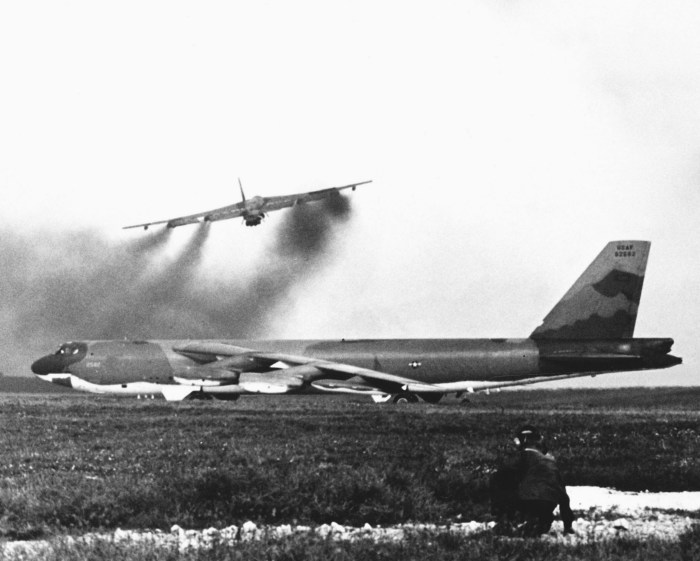
B-52Gs_at_Andersen_AFB_during_Linebacker_II_1972
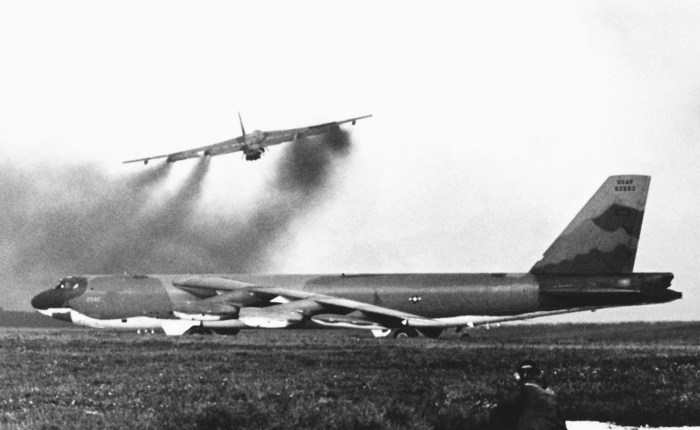
A US Air Force Boeing B-52G Stratofortress from the 72nd Strategic Wing (Provisional) waits beside the runway at Andersen Air Force Base, Guam, as another B-52 takes off for a bombing mission over North Vietnam during Operation Linebacker II on 15 December 1972. (Source: Wikimedia)

While the ‘lost cause’ concept is the leading theme for the discussion, the book is structured to reflect Laslie’s other argument – the disjointed character of what is known, especially in Western literature, as the Vietnam War. The War is often perceived as one large conflict, whereas there was no overarching campaign (not to mention an overarching strategy) during the American involvement. Laslie steps back from this holistic approach and offers a different perspective suggesting that several air wars took place at the time over Vietnam, Laos and Cambodia. Therefore, in his book, he identifies and discusses the following ‘wars’: the air-to-ground war in North Vietnam, the air-to-air war in North Vietnam, the air-to-ground war in South Vietnam, the US Navy air-to-air and air-to-ground war in North and South Vietnam, and the secret air war over Laos and Cambodia and against the Ho ChiMinh Trail. By looking at several air wars rather than one, the reader is confronted with an incredibly detailed picture of the situation at the strategic, operational and tactical levels of war.

But looking at the individual air wars is not the only way Laslie is trying to offer a comprehensive view of American involvement in Southeast Asia’s air campaigns. He also successfully combines US Air Force and US Navy perspectives, often treated separately in the literature. Discussing the participation of different services implies that a recurring point in Laslie’s analysis is the interservice rivalry and the complete lack of cohesive command and control between the Army, Navy and Air Force or even within them. These are not novel ideas as these issues are well-known and well-researched in the broader literature on the war in Vietnam. However, Laslie analyses American involvement as a series of separate air wars with their distinctive circumstances and obstacles. This allows him to discuss how these hurdles dictated each campaign’s outcomes.. Changing the perspective and critically analysing the context, objectives and limitations of each of those separate air wars illustrates the level of complexity of the conflict in Vietnam. It also supports Laslie’s main argument on the US air power’s ‘lost cause’, meticulously explaining why the popular myth of heavier bombings being potentially more effective is simply not true.

With his background as the Command Historian at the United States Air Force Academy and drawing on an impressive range of primary and secondary sources, Laslie provides a well-researched piece on a subject that one would have thought nothing new could be added. It is undoubtedly a result of extensive archival research and the inclusion of the Contemporary Historical Examination of Current Operations Reports of Southeast Asia (1961–1975) (an impressive list of which has been included as Appendix B). As an American scholar, Laslie is well aware of the potential bias his project may be susceptible to. To avoid that, he is trying to provide a balanced approach by including the perspective of the North Vietnamese Air Force in the discussion. However, that has been possible to achieve only partially due to the limited number of Vietnamese sources available to non-Vietnamese scholars. Nevertheless, Laslie highlights an existing gap in the Western understanding of air campaigns during the Vietnam War and opens an important discussion on the need to investigate the North Vietnamese experience. Whereas it demonstrates the potential for further research, one should ask how feasible it is for an American scholar to access North Vietnamese archives and look at the official sources held there.

Laslie posits that ‘the point of this book is to add something new to the discussion of air power and the war in Southeast Asia’ (p. 4). He succeeded in achieving that goal. Air Power’s Lost Cause will certainly be of interest to military professionals and academics as well as members of a wider audience seeking to improve their understanding, firstly, of the history of the US involvement in Vietnam and, secondly, the complexity of air campaigns in that conflict.

Dr Maria E. Burczynska is a Lecturer in Air Power Studies at the Department of History, Politics and War Studies, University of Wolverhampton. She is involved in designing and delivering an online MA course on Air Power, Space Power and Cyber Warfare. She obtained her PhD from the University of Nottingham, where she worked on a project focused on European air power and its involvement in different forms of multinational cooperation. Her thesis, titled ‘The potential and limits of air power in contemporary multinational operations: the case of the UK, Polish and Swedish air forces,’ is making an essential contribution to the field of air power studies, which remains primarily dominated by the US case. The Royal Air Force Museum recognised her research’s significance, awarding her the Museum’s RAF Centenary PhD Bursary in Air Power Studies in April 2019. Maria’s research interests are in military and security studies in national and international dimensions. She is particularly interested in contemporary European air forces and their participation in multinational operations and initiatives and the influence of national culture on the military culture of individual air forces. She can be found on Twitter at @BurczynskaMaria.

Header image: A US Air Force North American F-100D Super Sabre fires a salvo of 2.75-inch rockets against an enemy position in South Vietnam in 1967. (Source: Wikimedia)

#Podcast – The Vietnam War 50 Years Later: An Interview with Dr Michael E. Weaver

#Podcast – The Vietnam War 50 Years Later: An Interview with Dr Michael E. Weaver

Editorial Note: Led by Editor Dr Mike Hankins, From Balloons to Drones produces a monthly podcast that provides an outlet for the presentation and evaluation of air power scholarship, the exploration of historical topics and ideas, and provides a way to reach out to both new scholars and the general public. You can find our Soundcloud channel here. You can also find our podcast on Apple Podcasts and Google Podcasts.

50 years ago, in January 1973, the Paris Peace Accords were signed. This ended major U.S. combat operations in the Vietnam War. To look back on the air campaigns that were so crucial to that war, we talk with Dr Michael Weaver, assistant professor at the US Air Force’s Air Command and Staff College and author of The Air War in Vietnam from Texas Tech University Press. Join us as we look at the use of air power in Southeast Asia and talk about some of the legacies it leaves behind.

41bAUBRryqL._AC_SY580_Dr Michael E. Weaver is an Associate Professor of History at the USAF Air Command and Staff College. He has authored five air power articles and a book on the 28th Infantry Division. His second book, The Air War in Vietnam, was published in 2022. Weaver received his doctorate from Temple University in 2002, where he studied under Russell Weigley.
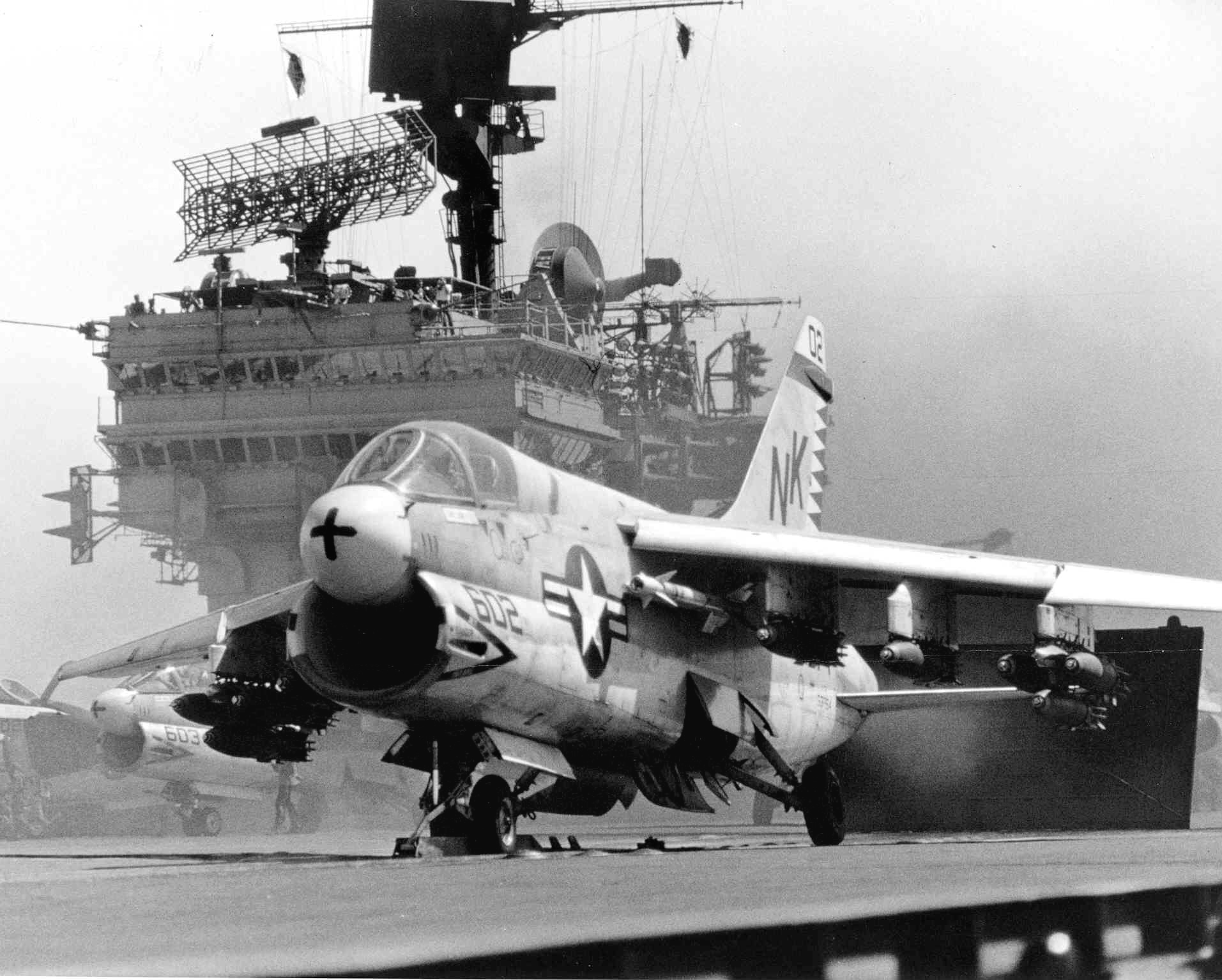
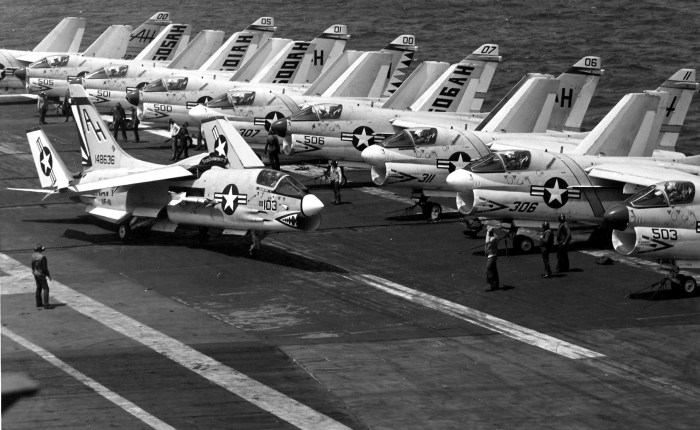
Header image: View of the flight deck of the USS Ticonderoga (CVA-14) during her last deployment to Vietnam as an attack carrier between 1 February and 18 September 1969. Various aircraft of Carrier Air Wing 16 are visible on deck: a Vought F-8H Crusader of VF-111 ‘Sundowners,’ four LTV A-7B Corsair II of  VA-87 ‘Golden Warriors,’ and five A-7Bs of VA-25 ‘Fist of the Fleet.’ (Source: Wikimedia)

#HistoricBookReview – Clashes: Air Combat Over North Vietnam, 1965-1972

#HistoricBookReview – Clashes: Air Combat Over North Vietnam, 1965-1972

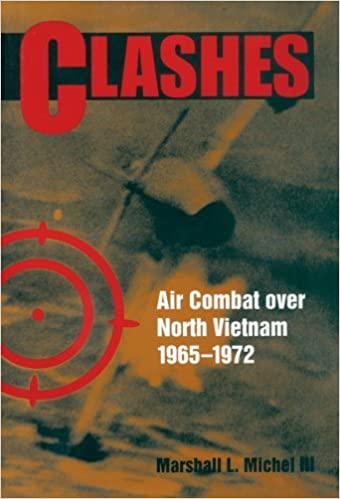
Marshall L. Michel III, Clashes: Air Combat Over North Vietnam, 1965-1972. Annapolis, MD: Naval Institute Press, 1997. Appendices. Endnotes. Index. 340 pp.

Reviewed by Dr James Young

51YBhdWpj9L._SX338_BO1,204,203,200_

As indicated by the title, Marshall Michel’s Clashes is a chronological examination of the air war over North Vietnam. At the time of its publication in 1997, Clashes was the first comprehensive treatment of the conflict to take advantage of North Vietnamese sources. Unlike most of his predecessors, Michel consciously avoided basing his main argument on the political issues surrounding Operations ROLLING THUNDER and LINEBACKER. These political issues include targeting choices by the White House, bombing halts, and rules of engagement enforced by US Navy (USN) and the United States Air Force (USAF) Pacific Air Forces (PACAF). Instead, Michel focuses on the ‘military significance [USAF’s and USN’s bombing campaigns had] in the larger context of the Cold War and possible U.S.-Soviet military confrontation,’ as ‘this was the one area of the Vietnam War that had military significance in the global balance of power.’ (p. 1) Within this framework, Michel posits that the twin campaigns were a ‘test of American air combat performance,’ (p. 1) and then proceeds to explain how the USAF and USN largely failed the exam.

Michel’s organisation is simple, with Clashes divided into two chronological sections. The first of these begins with a discussion of air combat in general, the two American services’ thoughts on fighter doctrine, and how the USN and USAF evaluated these theories in a series of rigorously controlled exercises. Michel takes great pains to point out that these exercises, conducted in the clear skies and low humidity of the western United States, led to a misplaced faith in American technological superiority as the war began. After this introduction, Clashes transitions to the initial campaign against North Vietnam. After a cursory discussion of operational goals, Michel starts with the initial USN air raids and the gradual escalation that became ROLLING THUNDER. Clashes highlights the friction that emerged from both services’ aircrew rotation policies, internal and external service rivalries, a harsh climate and, most importantly, a rapidly evolving and uncooperative enemy. By the end of Part I, Clashes makes two things clear. First, the North Vietnamese proved to be far more capable opponents than the American forces expected, with their Integrated Air Defence System (IADS) arguably the deadliest of its kind in the entire world. Second, it became clear that the USAF/USN’s already inadequate conventional capabilities had worsened throughout ROLLING THUNDER.

A-7A_Corsair_II_of_VA-27_about_to_launch_from_USS_Constellation_(CVA-64)_in_the_Gulf_of_Tonkin_on_27_August_1968_(NNAM.1996.253.7075.035)
A US Navy Vought A-7A Corsair II from VA-27 prepares to be catapulted off the flight deck of the aircraft carrier USS Constellation (CVA-64) in the Gulf of Tonkin on 27 August 1968. It is armed with Mark 82 227 kg Snakeye bombs and AIM-9B Sidewinder missiles. VA-27 was assigned to Attack Carrier Air Wing 14 aboard the Constellation for a deployment to Vietnam from 29 May 1968 to 31 January 1969. (Source: Wikimedia)

Having presented the reader with this sobering assessment, Michel begins Part 2 by stating, ‘[t]he judgments about air-to-air combat during Rolling Thunder were a Rorschach test for the U.S. Air Force and Navy.’ (p. 181) The USAF’s leadership had a ‘clear lack of interest in improving its air training’ (p. 185) for several disparate reasons. In contrast, the USN’s admirals ensured that its crews were ‘prepared for the new round of air combat anywhere in the world’ (p. 188) by both enforcing new doctrine and modifying existing equipment. Michel manages to deftly interweave both services’ advances using simple yet accurate language concerning ordnance, electronics, and airframes. Finally, unlike other works before it, Clashes concludes Part II’s introductory chapter with a discussion of the North Vietnamese Air Force’s (NVAF’s) contemporaneous improvement in doctrine, equipment, and training. In this manner, Michel sets the table for the remainder of Part II by ensuring the reader understands why Operations LINEBACKER I and II are not simple continuations of ROLLING THUNDER. As with Part I, Michel’s writing ability stands out as he discusses how the USAF and USN engaged the NV-IADS. Only a prohibitive amount of resources prevented steep losses among strike aircraft for the USAF (p. 242-6). In contrast, the USN’s emphasis on the Top Gun program, missile improvements, and strike doctrine resulted in ‘MiGs concentat[ing] almost exclusively on Air Force sorties’ (p. 277) due to heavy losses. By drawing this stark contrast, Michel both explicitly condemns USAF leadership for their choices from 1968-1972. He implicitly proves his thesis by establishing a connection between difficulties in Southeast Asia being indicative of the USAF’s conventional capabilities in a broader Cold War sense.

Although subsequent books, such as Craig C. Hanna’s Striving for Air Superiority (2002) and Wayne Thompson’s To Hanoi and Back (2000) have taken advantage of more recently declassified documents, Clashes remains a work of tremendous value for anyone interested in post-Second World War air combat. Michel’s reliance on official USAF and USN primary documents, such as Project CHECO, the USAF’s Red Baron report, and the USN’s Ault Report, erases much of the ideological clutter affecting previous works that dealt with the war. When coupled with his skilful prose, the overall result is a balanced, informative account that is quite accessible. Clashes’ continued relevance would make it equally at home in a public library, a professional military course, or an undergraduate Vietnam course. Even beyond these uses, it remains an excellent cautionary tale of what can occur when an air service fails to rigorously test, train, and exercise its doctrine before entering a conflict. It is highly recommended for anyone interested in Cold War military history for all these reasons.

Dr James Young is an air power historian, aviation enthusiast and military analyst. His writing credits include the USNI’s 2016 Cyberwarfare Essay Contest, articles in ArmorThe Journal of Military History, Marine Corps University Press Expeditions, and USNI Proceedings. In addition to his historical work and the critically acclaimed Usurper’s War-series, he has collaborated with bestselling authors Sarah Hoyt, S.M. Stirling, and David Weber.

Header Image: A US Air Force Boeing B-52G Stratofortress from the 72nd Strategic Wing (Provisional) waits beside the runway at Andersen Air Force Base, Guam, as another B-52 takes off for a bombing mission over North Vietnam during Operation LINEBACKER II on 15 December 1972. (Source: Wikimedia)

#BookReview – Drone War Vietnam

#BookReview – Drone War Vietnam

David Axe, Drone War Vietnam. Barnsley: Pen and Sword, 2021. Illustrations. Bibliography. Index. Hbk. viii + 166 pp.

Reviewed by Dr Roger Connor

9781526770264

The rapidly expanded use of military drones for surveillance and targeted strikes has generated greater interest in 20th Century military drone development and use over the past two decades. The most prolific antecedent to the General Atomics Predator was the US Air Force’s (USAF) Vietnam-era employment of Ryan 147 ‘Lightning Bug,’ a variant of the Firebee turbine-powered target drone developed in the late 1940s. In all, 3,435 Lightning Bug combat missions were flown over the South-East Asia combat by 1,106 of what today would be regarded as ‘attritable’ drones. Launched from a DC-130 mothership and recovered in flight after popping a parachute by CH-3 helicopters, these unconventional reconnaissance remotely piloted aircraft fit the traditional rationale for drones – the D’s: Dull, Dirty (nuclear), or Dangerous operations. Over North Vietnam, Lightning Bug flights freed RF-101 and other reconnaissance crews from particularly hazardous or politically sensitive missions, such as documenting air defence sites, especially S-75 (NATO designated SA-2) surface-to-air missile complexes. Some even performed propaganda leaflet drops. While the 147s flew unarmed in operations, considerable development occurred in equipping them with precision-guided ordnance, but the war ended before they were suitable for deployment.

David Axe, a self-described journalist, filmmaker, and blogger, has produced a slick-looking, if somewhat anemic, study of the Ryan Lightning Bugs. Organized into sixteen short chapters of roughly four-to-eight pages, each separated by photographic spreads, the first three chapters address the early history of the Lightning Bugs, framing them as a response to the challenge of the Soviet S-75 (SA-2) surface-to-air missile. Chapters four to fifteen document various episodes of operations of operations over North Vietnam with an emphasis on Ryan’s response to the challenges encountered. The final chapter documents Ryan’s next generation Model 154 drone.

DC-130_Hercules_taking_off_with_Firebee_drones_for_recon_mission_over_Vietnam
A US Air Force Lockheed DC-130A Hercules taking off on a mission in Southeast Asia, carrying two Ryan AQM-34 Firebee drones, c. 1969. Firebees flew reconnaissance missions using a pre-programmed guidance system or by remote control from the DC-130 crew. (Source: Wikimedia)

Drone War Vietnam attempts a survey of Lightning Bug operations while linking them with post-war strategic applications of remotely piloted aircraft and the broader narrative of drone development. The primary attraction for Axe’s narrative is that it is well-illustrated with images that do not appear in other works on the topic. Many of these photos originated with the Ryan archives, now in possession of the San Diego Air and Space Museum Archives. These include multiple perspectives of drone operators in DC-130 motherships and a Marine Corps CH-37 helicopter used in drone recovery operations that crashed in just such an attempt. As a visual record of this technological niche, Axe’s monograph is the best available in print.

Unfortunately, Axe’s narrative is disappointing. A significant factual error in the first two sentences of the introduction sets the tone (incorrectly describing the well-documented 2001 first strike made from an MQ-1). Casual errors such as Mutually Assured Destruction being described as having existed in 1950 also crop up. While these contextual errors are frustrating, fundamental errors on the topic are less forgivable. For instance, Axe notes, ‘[B]etween 1966 and the end of the Vietnam War, Army helicopters attempted 2,745 drone recoveries and completed 2,655 of them: a 96.7 per cent success rate’ (p. 90). This is a nice recitation of facts, except that almost exclusively USAF helicopters of the 350th Strategic Reconnaissance Squadron performed the duty – a critical fact that does not appear in the text. Axe’s writing style is accessible, but sometimes overly so with the use of incomplete sentences, for example, ‘[N]o opportunity to bait an S-75 battery’ (p. 80).

Axe’s understanding of the sweep of drone history is poor. He takes an American-centric focus, but even then, has ignored the broader historiography of remotely piloted aircraft development. Instead, he describes drone history as Kettering Bug begets Denny Radioplane begets Firebee. A quick look at H.R. Everett’s Unmanned Systems of World War II (2015) should have been enough to avoid such a flawed chronology. Meanwhile, the technical aspects inherent in the Lightning Bug’s achievements receive little attention, particularly concerning the challenges and limitations of operating and recovering the drones. Likewise, the incredible advances in inertial navigation that made autonomous flight in contested airspace possible pass with only a couple of sentences.

The text is not footnoted, and tellingly, neither Axe nor his editor understood the difference between primary and secondary sources as they are delineated in his bibliography, though almost nothing he includes there would be considered a primary source. Even obvious sources, like the Project CHECO report on Buffalo Hunter (the late war phase of Lightning Bug operations), easily obtainable online, are missing.

Most of Axe’s narrative is a retelling of William Wagner’s Lightning Bugs and other Reconnaissance Drones (1982). Wagner’s forty-year-old effort is the historian’s more thorough and polished option. Axe at least credits Wagner, a former Ryan Aeronautical executive, with much of his content, but this effort is a poor imitation of the original. Where Axe does improve on Wagner is in the contextual frame of drone operations, for which he adds a geopolitical frame of the various events and geographical operations. These are often over-simplistic, but they do succeed in making the book more accessible for an enthusiast audience interested in the hardware but with less understanding of the history and establishing a more well-rounded narrative. However, this contextual frame is often awkwardly executed in a way that does little to inform the application of drones, for example, a three-page chapter on the Gulf of Tonkin incident. The flip side is that Axe spends less than a third of the monograph on Lightning Bug operations in the Vietnam War. Instead, with Wagner as his primary source, he spends as much time on China overflights and ELINT (electronic intelligence) variants used to monitor North Korea as the far more substantive deployments over North Vietnam. Axe’s supposedly operational history thus primarily reflects a contractor perspective with very little of the service experience one might expect from this type of study.

These shortcomings become very apparent when examining a campaign like Linebacker II. As Wagner himself noted, Lightning Bug operations reached their peak during the operation. Axe’s telling of the story is almost exclusively in the frame of B-52 experience, which is a nice contextual detail, but adds nothing to the understanding of how or why remotely piloted aircraft were significant to the campaign.

QH-50_DD-692_1967
A QH-50 DASH anti-submarine drone on board the destroyer USS Allen M. Sumner during a deployment to Vietnam. The photo was taken between April and June 1967. (Source: Wikimedia)

Axe pays some attention to remotely piloted adjuncts to the Lightning Bugs such as the Lockheed D-21 and Ryan 154 Compass Arrow, both focused on the Chinese nuclear program. The decision to include these is somewhat odd as they are outside of his Southeast Asian narrative. While the Compass Arrow has at least a corporate family tree associated with the Lightning Bugs, the D-21 has no operational or technical overlap. Meanwhile, Axe makes no mention of the other prominent drone programs employed in South-East Asia such as the QU-22 and the QH-50 drone helicopter. The QU-22 were droned Beechcraft Bonanzas used as communication relay platforms for the Igloo White ‘electronic fence’ of ground sensors on the Ho Chi Minh trail. The QH-50s were used primarily to spot naval gunfire. The QU-22 and QH-50 provide a useful frame for understanding the broader requirement for drone aircraft and the inherent limitations of the technology. It is this sort of assessment and analysis that is most notably absent. Instead, Axe is content to conclude that the legacy of the Lightning Bugs was to show that the Predator’s milestones weren’t new (p. 150). Nuanced quibbles about what was new with Predator aside (quite a lot, in fact), this rather obvious point could have also been made about drone aircraft in World War II. The 147 (along with QU-22s and QH-50s) demonstrated an emergent association between remotely piloted remotely piloted aircraft and the goal of risk reduction in limited war, which was something revolutionary, but the author did is not well versed enough in the topic to see it.

Besides Wagner, there is another useful study, which Axe neglected entirely, specifically Steve Miller’s nearly 700-page self-published The 99th Strategic Reconnaissance Squadron: The Air Force’s Story of Unmanned Reconnaissance in the Vietnam War (2017). Though Miller would have benefited greatly from an editor, it is a useful expansion on Wagner’s dated history, written by a Lightning Bug veteran and introduces a trove of primary source documentation, as well as a much-needed USAF operational perspective. He also brings in the QU-22 story. If Axe had focused more on veterans’ experiences like Miller, Drone War Vietnam might have been worth recommending. Instead, it is a pale shadow of Wagner’s better publication.

With the disappointments inherent in Axe’s monograph, one wonders what an effective revision of Wagner’s solid work might look like. However, Kevin Wright’s We Were Never There: CIA U-2 Operations Over Europe, the USSR and the Middle East, 1956-1960 (2021) gives an idea of what might be possible. Linking mission reports, operational context, supported by high-quality maps and graphics, he has developed a glossy enthusiast-style publication that meets scholarly standards of documentation while proving attractive and accessible for the aviation general-interest audience. A similar work on the Lightning Bugs would help both the scholarly study and enthusiast appreciation of remotely piloted and autonomous aircraft operations.

Dr Roger Connor curates several collections at the Smithsonian National Air and Space Museum, including remotely piloted and autonomous aircraft, vertical flight, Army ground force aviation, cockpit equipment, and aviation infrastructure. He earned his PhD from George Mason University in 2020 with his dissertation, ‘Rooftops to Rice Paddies: Helicopters, Aerial Utopianism, and the Creation of the National Security State.’

Header image: The US Air Force Ryan AQM-34L Firebee drone ‘Tom Cat’ of the 556th Reconnaissance Squadron flew 68 missions over North Vietnam before being shot down by anti-aircraft fire over Hanoi. (Source: Wikimedia)

#AirWarBooks – Dr Michael Hankins

#AirWarBooks – Dr Michael Hankins

Editorial Note: In the next instalment of our Air War Books series, our Podcast Editor, Dr Michael Hankins, discusses the ten books that have influenced and shaped his writing as an air power historian.

Before I became a historian, I was a professional musician, and one of the most fun things that musicians do is sit around and talk about their influences. What did you listen to over the years that made you play the way that you play and compose music the way you do? The #AirWarBooks series here is a similar opportunity for us air power historians to talk about what books influenced us most. But, of course, the way any historian interrogates the past is rooted in many things, not just what books they read, but also their values, beliefs, background, and maybe even what kind of music they like.

That said, here are ten books that influenced my approach to studying and writing about air power history and technology. Not all of them are about aviation, but they shaped my approach to history in key ways. I’ll discuss the non-aviation books first:

soldiers-and-ghosts

J.E. Lendon, Soldiers and Ghosts: A History of Battle in Classical Antiquity (New Haven, CT: Yale University Press, 2006). So why is a book about Greco-Roman Warfare on my list of military aviation books? Because Lendon’s amazing work links culture and memory to the practice of warfare in specific and compelling ways. He argues that the Greeks and the Romans looked to the past – a culturally constructed, imagined past—to inform what they thought warfare should look like. I noticed some similar trends when I studied fighter pilot culture and began working on my first book, Flying Camelot. I don’t think I could have written that book without Lendon’s influence.

David Nye, America as Second Creation: Technology and Narratives of New Beginnings (Boston, MS: MIT Press, 2003). This book is not about aircraft specifically, but it is about the cultural power of technology. I’ve been deeply influenced by Nye’s examination of how specific technologies came to symbolize cultural narratives about the origins and evolution of the United States. The idea that a piece of technology could be a symbol that tells a specific story to a specific culture, almost defining their sense of identity in a way, is an idea that continues to define my own work.

Jill Lepore, The Name of War: King Philip’s War and the Origins of American Identity (New York: Vintage, 1998). There may not have been any aircraft in King Phillip’s War, but what I found so compelling about Lepore’s work here is the power of how people talk about the past. This book is less about the war and more about how it came to be remembered by the opposing sides, and how the language used to describe the past can create whole systems of meaning that shape the future. This idea, so powerfully explored here, has shaped my approach to studying later conflicts from the Korean and Vietnam Wars to the Gulf War and beyond.

1799111

Mark Clodfelter, The Limits of Air Power: The American Bombing of North Vietnam (New York: Free Press, 1989). Finally, some aeroplanes! There is a rich literature about air power in the Vietnam War, but I still think Clodfelter’s classic holds up as one of the most important. Even over 30 years later, his argument is still controversial: that strategic bombing in Vietnam was not effective, that air power, although very important, has limits. Nevertheless, his explanation and comparison of the different goals, limits, and methods of the Johnson and Nixon administrations’ approaches to bombing is still useful and insightful. Even for those who disagree with it, this book remains a giant in the field for a reason.

John Flanagan, Vietnam Above the Treetops: A Forward Air Controller Reports (New York: Praeger Publishers, 1992). There are a lot of pilot and aircrew memoirs from Vietnam, and many of them are very good. But, for some reason, Flanagan’s tale of flying O-1 Bird Dogs on the incredibly dangerous low-and-slow FAC missions in Southeast Asia has stuck with me much more than any other pilot memoirs I’ve read. Starting at the USAF Academy, Flanagan was a deeply principled man who was surprised at how the military handled itself in Vietnam. His story includes the way he wrestled with himself about the war and described in detail the brutal missions and the horrific things he saw. His story also includes a detailed look at how the US brought South Korean troops into the war – something not covered much in other works. There are many great memoirs to read, but if you can only read one, this would be my pick.

Tami Davis Biddle, Rhetoric and Reality in Air Warfare: The Evolution of British and American Ideas about Strategic Bombing, 1914-1945 (Princeton, NJ: Princeton University Press, 2004). Of all the books on bombing in the Second World War (and there are seemingly too many to count), Biddle’s work is one of the best. She highlights one of major themes in air power history: the disconnect between the promises of air power and its actual results on the battlefield. This work is a wonderful look at the evolution of an idea – how strategic bombing theory grew and changed over time, and how that idea and the assumptions that grew to accompany it influenced air power leaders on both sides of the Atlantic to interpret the air war in particular ways. This mode of analysing not only what happened, but what people thought about what happened, is something I’ve tried to carry through in my own work.

Steven Fino, Tiger Check: Automating the US Air Force Fighter Pilot in Air-to-Air Combat, 1950–1980 (Baltimore, MD: Johns Hopkins University Press, 2017). Fino’s study of the evolution of fighter pilot cockpits, detailing the F-86 Sabre, F-4 Phantom, and F-15 Eagle, is still one of my favourite histories of technology. That’s not just because it’s about three of my favourite aircraft, but because of how deftly Fino – himself a former Eagle driver – connects that technology to the people using it. He illustrates the complex interactions between human and machine in the high-stress combat situation of flying fighters, and how the culture of fighter pilots evolved along with the technology. I’ve also never seen another book be so technically detailed while remaining so accessible.

Linda Robertson, The Dream of Civilized Warfare: World War I Flying Aces and the American Imagination (Minneapolis, MN: University of Minnesota Press, 2005). As a Professor of Media as opposed to a historian, Robertson comes at this study of First World War pilots with a fresh perspective. She examines how the image of the knights of the air (inaccurate as it is) was constructed and took such a grip on the public and the flyers themselves. It’s a study of the public perception of the war and of flying and expands the literature on the First World War in interesting ways.

Beyond

Stephen Bourque, Beyond the Beach: The Allied War Against France (Annapolis, MD: Naval Institute Press, 2018). Books about bombing during the Second World War are plenty, but few of them critique the allied effort in quite the way that Bourque does here. By travelling across France and consulting local archives, then comparing them to the official USAAF records, Bourque demonstrates the horrific true costs of the allied bombing campaign for French civilians. Almost as a companion piece to Tami Davis Biddle’s work, Bourque shows the human, emotional, and deeply personal costs of inaccurate bombing attacks, which wreaked destruction over France, killing tens of thousands of civilians. I read many books about bombing theory and doctrine, but this book makes those things real on a human level and made me look in a new way at a historical event that I thought I understood.

C.R. Anderegg, Sierra Hotel: Flying Air Force Fighters in the Decade After Vietnam (Washington DC: Air Force History and Museums Program, 2001). I’m not sure what it is about this book that keeps drawing me back. It’s a short volume about the transition from the Vietnam-era fighters like the F-4 Phantom, to the more advanced F-15 Eagle fighters of the 70s and 80s, and the suite of other changes that accompanied that shift, from more advanced air-to-air missiles like the AIM-9L to the changing nature of pilot culture, tactics, and training practices. Nevertheless, Anderegg’s approach – part history, part memoir – makes for very compelling, engaging reading about a fascinating topic. Maybe it’s that the subject matter is what my work focuses on, or maybe it’s the engaging writing style and interesting anecdotes, but I keep finding myself returning to this one again and again.

Dr Michael Hankins is the Curator for US Air Force, Navy, and Marine Corps post-World War II Aviation at the Smithsonian National Air and Space Museum and the author of Flying Camelot: The F-15, the F-16, and the Weaponization of Fighter Pilot Nostalgia (2021). He is a former Professor of Strategy at the USAF Air Command and Staff College eSchool, and former Instructor of Military History at the US Air Force Academy. He earned his PhD in history from Kansas State University in 2018 and his master’s in history from the University of North Texas in 2013. He has a web page here and can be found on Twitter at @hankinstien.

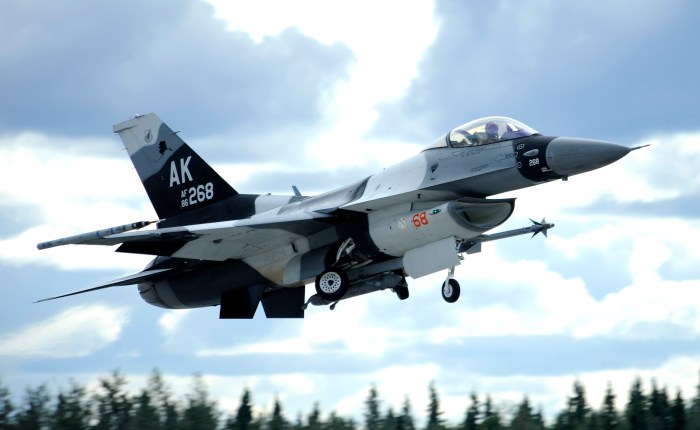
Header image: A US Air Force F-16 Fighting Falcon aircraft assigned to the 18th Aggressor Squadron takes off during Red Flag-Alaska 12-3 at Eielson Air Force Base, Alaska, 6 August 2012. Red Flag-Alaska is a series of Pacific Air Forces commander-directed field training exercises for US and partner nation forces, providing combined offensive counter-air, interdiction, close air support, and large force employment training in a simulated combat environment. (Source: Wikimedia)

#Podcast – The American Air Wars of Vietnam: An Interview with Dr Brian Laslie

#Podcast – The American Air Wars of Vietnam: An Interview with Dr Brian Laslie

Editorial Note: Led by our Editor Dr Mike Hankins, From Balloons to Drones produces a monthly podcast that provides an outlet for the presentation and evaluation of air power scholarship, the exploration of historical topics and ideas, and provides a way to reach out to both new scholars and the general public. You can find our Soundcloud channel here. You can also find our podcast on Apple Podcasts and Google Podcasts.

2022 will mark the 50th anniversary of the LINEBACKER campaigns – the last major bombing campaigns of the Vietnam War. As such, in our latest podcast, we interview Dr Brian Laslie about his latest book, Air Power’s Lost Cause: The American Air Wars of Vietnam and his evaluation of the legacy of air power’s contribution to the Vietnam War.

55870471

Dr Brian Laslie is a US Air Force Historian and currently the Deputy Command Historian at North American Aerospace Defense Command (NORAD) and United States Northern Command (USNORTHCOM). He is also the Book Reviews Editor at From Balloons to Drones. A 2001 graduate of The Citadel and a historian of air power studies, he received his Masters’ from Auburn University Montgomery in 2006 and his PhD from Kansas State University in 2013. He is the author of Architect of Air Power: General Laurence S. Kuter and the Birth of the US Air Force (2017) and The Air Force Way of War (2015). The latter book was selected for the Chief of Staff of the Air Force’s 2016 professional reading list and the 2017 RAF Chief of the Air Staff’s reading list. He can be found on Twitter at @BrianLaslie.

Header Image: 3/4 front view of a US Air Force RC-130A of the 1st Aerial Cartographic and Geodetic Squadron parked on aluminium matting at Tuy Hoa Airbase in South Vietnam in 1970. (Source: NARA)

#ResearchResources – Recent Articles and Books (May 2021)

#ResearchResources – Recent Articles and Books (May 2021)

Editorial note: In this series, From Balloons to Drones highlights research resources available to researchers. Contributions range from discussions of research at various archival repositories to highlighting new publications. As part of this series, we are bringing you a monthly precis of recent articles and books published in air power history. This precis will not be exhaustive but will highlight new works published in the preceding month. Publication dates may vary around the globe and are based on those provided on the publisher’s websites. If you would like to contribute to the series, please contact our Editor-in-Chief, Dr Ross Mahoney, at airpowerstudies@gmail.com or via our contact page here.

Chapters

Peter Elliott, ‘‘Flight without feathers is not easy’: John Tanner and the development of the Royal Air Force Museum’ in Kate Hill (ed.), Museums, Modernity and Conflict: Museums and Collections in and of War since the Nineteenth Century (London: Routledge, 2021).

The founding director of the Royal Air Force (RAF) Museum, John Tanner, was the driving force behind its creation and development between 1963 and 1987.

The RAF Museum’s successful opening at Hendon in 1972 – more than 40 years after the idea was first mooted – led to expansion, through museums dedicated to the Battle of Britain and Bomber Command. It managed the RAF’s Aerospace Museum at Cosford where Tanner, working with British Airways, built up a collection of airliners. His final collaboration created the Manchester Air & Space Museum – now part of the Museum of Science and Industry.

Tanner’s overarching aim was to create a national aviation museum for the United Kingdom, comparable with those in France, Canada and the USA. Negotiations in the early 1980s with government departments failed, ironically partly due to concerns similar to those that prompted calls for an RAF Museum in the 1930s.

This chapter details the tortuous birth of the RAF Museum, and examines the conflict between an air force museum and one covering all forms of aviation. Drawing on files in the National Archives, and the Museum’s own archive, I explain why Tanner’s vision was not realised, despite his passion, dedication and forthright advocacy.

Books

Daniel Jackson, Fallen Tigers: The Fate of America’s Missing Airmen in China during World War II (Lexington, KT: The University Press of Kentucky, 2021).

Mere months before the attack on Pearl Harbor, President Franklin D. Roosevelt sent a volunteer group of American airmen to the Far East, convinced that supporting Chinese resistance against the continuing Japanese invasion would be crucial to an eventual Allied victory in World War II. Within two weeks of that fateful Sunday in December 1941, the American Volunteer Group – soon to become known as the legendary “Flying Tigers” – went into action. Audaciously led by master tactician Claire Lee Chennault, daring airmen such as David Lee “Tex” Hill and George B. “Mac” McMillan fought enemy air forces and armies in dangerous aerial duels despite being outnumbered and outgunned. Aviators who fell in combat and survived the crash or bailout faced the terrifying reality of being lost and injured in unfamiliar territory.

In Fallen Tigers: The Fate of America’s Missing Airmen in China during World War II, historian Daniel Jackson, himself a combat-tested pilot, sheds light on the stories of downed aviators who attempted to evade capture by the Japanese in their bid to return to Allied territory. In gripping detail, he reveals that the heroism of these airmen was equaled, and often exceeded, by the Chinese soldiers and civilians who risked their lives to return them safely to American custody. His comprehensive research shows the drive to aid these airmen transcended ideology, as both Chinese Communists and Nationalists realized the commonality of their struggle against a despised enemy.

Fallen Tigers is an incredible story of survival that insightfully illuminates the relationship between missing aircrew and their Chinese allies who were willing to save their lives at any cost. Based on thorough archival research and filled with compelling personal narratives from memoirs, wartime diaries, and dozens of interviews with veterans, this vital work offers an important new perspective on the Flying Tigers and the history of World War II in China.

Ben Kite, Undaunted: Britain and the Commonwealth’s War in the Air – Volume 2 (Warwick: Helion and Company, 2021).

Undaunted is the second volume of Britain and the Commonwealth’s War in the Air 1939-45. It combines detailed studies into the tactics, techniques and technology that made British air power so effective, together with the personal accounts of the aircrew themselves. Undaunted includes chapters on air intelligence, photographic-reconnaissance and Special Duties operations. It then covers how the British Commonwealth Air Forces supported ground operations in the Western Desert, Italy, NW Europe, Burma and the SW Pacific. The book contains a number of chapters on the development of airborne forces from an air perspective and covers the use of air transport in support of General Slim’s operations in Burma. Undaunted concludes with poignant chapters on the ‘Guinea Pigs’, Prisoners of War, Air Sea Rescue and the efforts of aircrew to escape and evade when shot down. Exceptionally well-illustrated with over 150 photographs and 15 maps and diagrams, this book will undoubtedly appeal to the general reader, as well as the aficionado, who will find considerable new information.

Brian Laslie, Air Power’s Lost Cause: The American Air Wars of Vietnam (Lanham, MD: Rowman & Littlefield, 2021).

Filling a substantial void in our understanding of the history of airpower in Vietnam, this book provides the first comprehensive treatment of the air wars in Vietnam. Brian Laslie traces the complete history of these air wars from the beginning of American involvement until final withdrawal. Detailing the competing roles and actions of the air elements of the United States Army, Navy, and Air Force, the author considers the strategic, operational, and tactical levels of war. He also looks at the air war from the perspective of the North Vietnamese Air Force. Most important for understanding the US defeat, Laslie illustrates the perils of a nation building a one-dimensional fighting force capable of supporting only one type of war.

#Podcast – Pulp Vietnam: An Interview with Dr Gregory Daddis

#Podcast – Pulp Vietnam: An Interview with Dr Gregory Daddis

Editorial Note: Led by our Editor Dr Mike Hankins, From Balloons to Drones produces a monthly podcast that provides an outlet for the presentation and evaluation of air power scholarship, the exploration of historical topics and ideas, and provides a way to reach out to both new scholars and the general public. You can find our Soundcloud channel here. You can also find our podcast on Apple Podcasts and Google Podcasts.

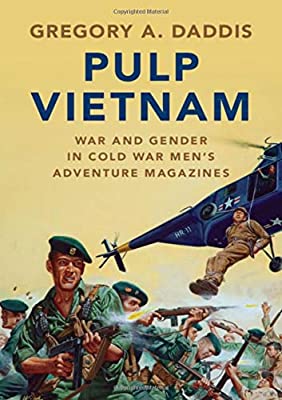
In the latest episode of our podcast series, we interview Dr Gregory Daddis about his latest book, Pulp Vietnam: War and Gender in Cold War Men’s Adventure Magazines (Cambridge University Press, 2021). Before and during the Vietnam War, some of the most popular magazines among those who served were pulp fiction men’s adventure magazines. In this interview, Daddis unpacks the relationship between fiction and reality, how we talk about wars and choose to remember them, and how constructions of gender really matter when we analyse war.

Dr Gregory A. Daddis is a Professor of History and the USS Midway Chair in Modern US Military History at San Diego State University. A retired US Army colonel, he has served in both Operations Desert Storm and Iraqi Freedom. He has authored four books, including Withdrawal: Reassessing America’s Final Years in Vietnam (2017).

Header image: Company E, 2/9 Marines, being re-supplied by a Sikorsky CH-34 during Operation Harvest Moon, 10 December 1965. (Source: Wikimedia)

#DesertStorm30 – The Ghosts of Vietnam: Building Air Superiority for Operation DESERT STORM

#DesertStorm30 – The Ghosts of Vietnam: Building Air Superiority for Operation DESERT STORM

By Dr Michael Hankins

Editorial Note: 2021 marks the 30th anniversary of Operation DESERT STORM. To mark this anniversary, during 2021, From Balloons to Drones will be publishing a series of articles that examine various aspects of DESERT STORM’s air campaign. We will be publishing pieces throughout 2021, and if you would like to contribute to the series, please contact our Editor-in-Chief, Dr Ross Mahoney, at airpowerstudies@gmail.com or via our contact page here. The official call for submissions can be found here.

I think to understand the success of Desert Storm, you have to study Vietnam.

Lieutenant General Chuck Horner, Joint Force Air Component Commander during Operation DESERT STORM[1]

This reflection applies to many aspects of the 1991 Gulf War, undeniably so in the realm of air-to-air combat. As in most wars, air-to-air combat played a relatively small role, certainly not a decisive one. However, the differences between air combat during the Vietnam War and DESERT STORM are stark. In the skies above Southeast Asia between 1965 and 1973, the United States shot down approximately 200 enemy aircraft while North Vietnamese MiGs claimed about 80 US fighters.[2] During DESERT STORM, coalition pilots shot down 42 Iraqi aircraft and only lost one to a MiG.[3] There is no single reason why air-to-air efforts were so much more successful in DESERT STORM than in Vietnam. However, several factors synergistically combined to contribute to a considerable shift in air superiority efforts: training, situational awareness, technology, and the nature of the enemy being faced. These factors were interconnected. Technologies that had first appeared in Vietnam had matured and became more reliable. These technologies were also more interwoven with training and doctrine, drastically increasing their effectiveness in situations like those faced in the Gulf in 1991.

What went wrong in Vietnam

The 1970s and 1980s constitute a second interwar period. As with the period between the First and Second World War, the years between the Vietnam War and DESERT STORM was a time of massive technological, doctrinal, and organisational change within the US military. It was also a time of competing theories and visions regarding what the future of warfare might look like. These debates centred on the idea of fixing the perceived problems of Vietnam. However, there was little agreement over what exactly the problems were and even less about how to fix them.

Regarding the air-to-air realm, clearly, there had been problems in Southeast Asia. To avoid fratricide, restrictive rules of engagement prevented most missiles from being fired in the conditions for which they were designed. At the same time, the jungle environment compounded issues from transport and maintenance that frequently damaged delicate sensor equipment. North Vietnamese MiGs often did not stick around to fight. However, their agility was effective against the larger, heavier American interceptors when they did. US pilots often had little – if any – air combat training and rarely (if ever) against aircraft that mimicked the MiGs capabilities and tactics.

An F-4C Phantom II of the 559th Tactical Fighter Squadron at Tan Son Nhut Air Base, South Vietnam, September 1967. Front to back: Captain John P. Flannery, 1st Lieutenant Lewis M. Hauser. (Source: US Air Force)

To fix these problems, two main camps emerged: the self-described ‘Fighter Mafia’ that later evolved into the larger Defense Reform Movement (Reformers) was led by former fighter pilots, analysts, engineers, and journalists linked to Colonel John Boyd.[4] They argued in favour of new aircraft that they were simple and cheap. The poor performance of missiles in Vietnam frustrated the ‘Fighter Mafia,’ who argued that the key to winning air battles required small, lightweight aircraft that emphasised maneuverability and gunnery. In their argument, aircraft did not need to be burdened with long-range radars. Countering these views was the defence establishment – the service leaders in the Pentagon, the USAF Air Staff, and other analysts, including the commander of Tactical Air Command, General Wilbur ‘Bill’ Creech. This group argued that a high-tech approach was necessary to counter the Soviet threat. They argued that although weapons may be expensive, they were not only effective but could protect more American lives and reduce casualties.[5]

These debates occurred in a context of larger doctrinal changes within all the US military services during a second interwar period of heavy debate and significant technological changes. Nonetheless, the Reformers had a large influence on the direction of air war planning in those years. However, ultimately, few of their proposed reforms truly took hold as the defence establishment had the advantage of being established and in power. However, in having to defend themselves against the Reformers’ frequent critiques, the defence establishment was forced to confront important issues, particularly regarding readiness and weapons testing procedures.

Train How We Fight

Even the most significant changes in technology would be of limited use without equal changes in training. This was something even the revered ace pilot Brigadier General Robin Olds realised. Speaking of his experience flying F-4 Phantoms in Vietnam, Olds lamented, ‘If only I’d had a gun!’ However, Olds opposed adding a gun pod to the F-4s in his unit because, as he recalled:

[o]ut of all my fighter guys, only a precious few have ever fired a gun at an aerial target, let alone learned how to dogfight with guns. Hell, they’d pile into a bunch of MiGs with their hair on fire and be eaten alive.[6]

Some US Navy officers realised the importance of air combat training, instituting the Navy Fighter Weapons School, also called TOPGUN, specifically to train F-4 and F-8 pilots how to defeat MiGs in air-to-air encounters. The school’s graduates began having success in the air battles of 1972. The US Air Force (USAF) was slower to institute similar training but did create the Red Flag exercises in 1975. The key to both programs was ‘dissimilar air combat training’ (DACT): training in mock combat against different aircraft types than one’s own. Said another way, DACT means to train how you fight.[7]

That meant that F-8, F-4, and F-105 pilots needed to square off against smaller, nimbler planes that could simulate the MiGs. T-38s, F-5s and F-86s were perfect for that. Pilots flying as these pretend adversaries became known as ‘aggressor’ squadrons. Eventually, captured MiG fighters of the 4477th Test and Evaluation Squadron (nicknamed the ‘Red Eagles’) could give coalition pilots mock combat experience against actual MiGs.[8]

We Have the Technology

The new DACT training programs were not all about maneuvers and volleyball. The programs incorporated a wide array of new tactics emerging from rapid evolution in new technologies both in new airframes and the new generations of missiles that were far more capable than their Vietnam-era ancestors. These included new fighters like USAF’s F-15 Eagle and F-16 Fighting Falcon, and the US Navy’s F-14 Tomcat and F/A-18 Hornet. A far cry from the interceptors designed in the early Cold War, these new generations of planes emphasised air combat capability as their first priority, with multi-role functions like ground attack as an add-on. In other words, these planes were agile, born to mix it up in dogfights, but could still perform the vital missions of strategic and tactical bombing, close air support, and interdiction. Like the F-16’s fly-by-wire controls, their new control systems maximised the pilot’s command over their aeroplanes. At the same time, head’s up displays enabled pilots to see vital information and keep their eyes on the skies instead of looking down at their instruments and switches.[9]

The prototypes of the YF-16 Fighting Falcon (left) were smaller, lighter, and held less electronics, optimized for the day fighter role. The production model F-16A (right) was larger to incorporate all-weather and ground attack capabilities, among other modifications. (Source: US Air Force)

One of the most significant upgrades was a new model of the heat-seeking Sidewinder missile, the AIM-9L. Unlike previous versions, the ‘L’ (nicknamed ‘Lima’) could be fired from any direction. No longer did pilots need to maneuver behind an enemy after the ‘merge’ (in which two fighters flying head-on zoom past each other before beginning a maneuvering dogfight). This new weapon complimented the new AIM-7F Sparrow missile – a radar-guided missile with improved range and look-down capability. These missiles, combined with the Hughes AN/APG-63 radar housed in the F-15 Eagle’s nose, allowed the new generation of fighters to identify their targets from far beyond what the human eye could see. It also meant they could coordinate with other coalition pilots and “sort” their targets. Maneuvering was still crucial, but as former F-15 pilot Colonel C.R. Anderegg noted:

The cycle of counter vs. counter vs. counter continued, but the fight did not start at 1,000 feet range as in the days of ’40 second Boyd.’ The struggle was starting while the adversaries were thirty miles apart, and the F-15 pilots were seriously intent on killing every adversary pre-merge.[10]

Pilots in previous decades had often decried the lack of a gun on the F-4 and were sceptical of claims that missiles were the way of the future. Missiles were problematic in Vietnam, but in the Gulf War, they dominated. Of the 42 official coalition aerial victories, three were due to ground impact. The only gun kills were two A-10 Thunderbolt IIs that shredded Iraqi helicopters with their infamous GAU-8 cannon. In one case, an F-15E Strike Eagle dropped a laser-guided GBU-10 bomb onto a helicopter and received an aerial victory credit. The remaining 36 – almost 86 per cent – were the result of a guided missile. Of the AIM-7 kills, 16 (44 per cent of the total number of missile kills) were beyond visual range attacks.[11]

Even the best-trained and equipped pilots in the world cannot use their advantages if they are unaware of the threats around them. Effective situational awareness and early warning have proven crucial to air combat success. Throughout Vietnam, several long-range radars provided this capability. Airborne radar and surveillance programs like College Eye and Rivet Top and US Navy ship-based radar-like Red Crown became invaluable to pilots during Vietnam. Bringing the variety of systems together into Project Teaball in the summer of 1972 provided an even more powerful aid to pilots aiming to take out MiGs. Nevertheless, these systems (and the many other similar efforts) had limitations. The invention of pulse-Doppler radar systems enabled a reliable way of distinguishing airborne threats from ground clutter when looking down. This innovation led to the USAF’s E-3 Sentry Airborne Warning and Control System (AWACS). The Navy used a similar concept in their E-2 Hawkeye. These systems gave operators a view of aircraft operating in the entire airspace, allowing them to pass on the word to coalition fighter pilots where the MiGs were from very long ranges. Almost every single aerial encounter during the Gulf War began with a call from AWACS or an E-2.[12]

Know Your Enemy

The US and its allies prepared for a conventional war against the Soviet-style threat that Iraq seemed to be. As the saying goes, the enemy always gets a vote. In the Gulf War case, as one General Accounting Office report put it: ‘the Iraqi air force essentially chose not to challenge the coalition.’[13] Of course, that is not entirely true, as some intense air battles did occur, and a few Iraqi pilots proved quite adept. Nevertheless, overall, the Iraqi Air Force had not invested in air-to-air combat preparedness. There was no Iraqi equivalent of Top Gun or Red Flag, and air-to-air training was lacking. One US Navy Intelligence report stated: ‘Intercept tactics and training [were] still predominantly conservative, elementary, and generally not up to western standards.’ Culturally, while US fighter pilots tended to prize aerial combat, the Iraqi Air Force culture did not, viewing ground attack as a more desirable assignment. As historian Williamson Murray argued, Iraqi pilots ‘did not possess the basic flying skills to exploit fully the capabilities of their aircraft.’[14]

F-15C Eagles of the 58th Tactical Fighter Squadron takeoff on deployment to Saudi Arabia during Operation DESERT SHIELD. (Source: US Air Force)

As F-15s flew combat air patrol missions during the opening strikes, searching for possible MiG threats, infrared cameras revealed one MiG-29 crashing into the ground. At the same time, another launched a missile that destroyed a friendly MiG-23 crossing ahead of it. In some cases, when coalition pilots obtained radar locks, Iraqi pilots made little to no attempt to maneuver before missiles destroyed their planes. When coalition planners began targeting the hardened shelters protecting Iraqi aircraft, many pilots attempted to flee to Iran. Reiterating the Iraqi fighter pilot force’s lack of competence, many of them did not have enough fuel for the trip and crashed. Coalition pilots seized the opportunity to destroy the enemy in the air as they fled.[15]

Conclusion

The lives lost in air combat during the Vietnam War are tragic. Many aircrew members died, others became prisoners, and many suffered lifelong psychological trauma. Every single loss affected the families and loved ones of those crews, creating ripple effects lasting generations. If some strands of hope can be pulled from those tragedies, one of them is that allied airmen’s struggles in the Vietnam War planted the seeds of change that led to the massive increase in air-to-air combat effectiveness in Operation Desert Storm. Technologies, training methods, and tactics first introduced in Southeast Asia continued to mature throughout the 1970s and 1980s, strengthened further by the heat of intellectual debate during those years. The coalition’s effectiveness in air-to-air combat alone did not win the Gulf War, of course. However, it did undoubtedly save many lives and contributed to the US achieving its objectives.

As Horner recalled: ‘Vietnam was a ghost we carried with us.’ One way to exorcise that ghost was by gaining control of the air in Iraq from the outset, which had not happened in Vietnam. It worked. As Horner recalled:

[e]very time the Iraqi interceptor planes, their best defences, took off, it was take off, gear up, blow up, because we had two F-15s sitting on every airfield, overhead every airfield, and so we never gave them a chance.[16]

Dr Michael Hankins is the Curator of US Air Force History at the Smithsonian National Air and Space Museum and is an Editor at From Balloons to Drones. He is a former Professor of Strategy at the USAF Air Command and Staff College eSchool, and former Instructor of Military History at the US Air Force Academy. He earned his PhD from Kansas State University in 2018, and a master’s from the University of North Texas in 2013, He has a web page here and can be found on Twitter at @hankinstien.

Header image: An F-15C Eagle of the 1st Tactical Fighter Wing during Exercise Gallant Eagle, 1986. (Source: US Air Force)

[1] ‘Oral History: Charles Horner,’ Frontline, 9 January 1996.

[2] Sources differ on exact numbers. The best work on the air-to-air aspect of Vietnam to date is Marshal Michel, Clashes: Air Combat over North Vietnam, 1965-1972 (Annapolis, MD: Naval Institute Press, 1997).

[3] Lewis D. Hill et al, Gulf War Air Power Survey: Volume V: A Statistical Compendium and Chronology (Washington D.C.; US Department of Defense, 1993), p. 637, 641, pp. 653-4; hereafter cited as GWAPS. The one loss was US Navy Lieutenant Commander Michael Scott Speicher. Information about that event can be found here: CIA, FOIA Electronic Reading Room, ‘Intelligence Community Assessment of the Lieutenant Commander Speicher Case,’ 27 March 2001.

[4] For a precis of Boyd’s career, see: Michael Hankins, ‘A Discourse on John Boyd: A Brief Summary of the US Air Force’s Most Controversial Pilot and Thinker,’ From Balloons to Drones, 22 August 2018.

[5] For a pro-reform view, see Grant Hammond, The Mind of War: John Boyd and American Security (Washington D.C.: Smithsonian Institution Press, 2001); and James Burton, The Pentagon Wars: Reformers Challenge the Old Guard (Annapolis, MD, Naval Institute Press, 1993). The defense establishment view is best represented by Walter Kross, Military Reform: The High-Tech Debate in Tactical Air Forces (Fort McNair: National Defense University Press, 1985); and James C. Slife, Creech Blue: Gen Bill Creech and the Reformation of the Tactical Air Forces, 1978-1984 (Maxwell AFB: Air University Press, 2004).

[6] Robin Olds, with Christina Olds and Ed Rasimus, Fighter Pilot: The Memoirs of Legendary Ace Robin Olds (New York: St. Martin’s Press, 2010), p. 304, 317.

[7] The best overview of the origins of the Red Flag program is Brian Laslie’s The Air Force Way of War: U.S. Tactics and Training after Vietnam (Lexington, KT: University Press of Kentucky, 2015).

[8] Gaillard R. Peck, Jr., America’s Secret MiG Squadron: The Red Eagles of Project Constant Peg (Oxford: Osprey Publishing, 2012)

[9] For a history of the development of both aircraft, see Steven A. Fino, Tiger Check: Automating the US Air Force Fighter Pilot in Air-to-Air Combat, 1950-1980 (Baltimore, MD: Johns Hopkins University Press, 2017); and Michael Hankins, ‘The Cult of the Lightweight Fighter: Culture and Technology in the U.S. Air Force, 1964-1991’ (PhD thesis, Kansas State University, 2018).

[10] C.R. Anderegg, Sierra Hotel: Flying Air Force Fighters in The Decade After Vietnam (Washington D.C.: Air Force History and Museums Program, 2001), p. 163.

[11] GWAPS Summary Report, p. 60; GWAPS V5, pp. 653-4; Daniel Haulman, ‘No Contest: Aerial Combat in the 1990s,’ Presentation, Society for Military History annual meeting, May 2001, 6; Craig Brown, Debrief: A Complete History of U.S. Aerial Engagements, 1981 to the Present (Atglen, PA: Schiffer Military History, 2007), pp. 23-149.

[12] Kenneth P. Werrell, Chasing the Silver Bullet: U.S. Air Force Weapons Development from Vietnam to Desert Storm (Washington D.C.: Smithsonian Books, 2003), pp. 187-205; Michael Hankins, ‘The Teaball Solution: The Evolution of Air Combat Technology in Vietnam, 1968-1972,’ Air Power History 63 (2016), pp. 7-24; Michael Hankins, ‘#AirWarVietnam – Making a MiG-Killer: Technology and Signals Intelligence for Air-to-Air Combat in Vietnam,’ From Balloons to Drones, 15 August 2019. For details of individual encounters, see Brown, Debrief.

[13] GAO/NSIAD-97-134, ‘Operation Desert Storm: Evaluation of the Air Campaign,’ United States General Accounting Office Report to the Ranking Minority Member, Committee on Commerce, House of Representatives, June 1997, p. 66.

[14] Williamson Murray, with Wayne M. Thompson, Air War in the Persian Gulf (Baltimore, MD: The Nautical & Aviation Publishing Company of America, 1995), 67, 92.

[15] Brown, Debrief, pp. 51-73; Murray, Air War, pp. 110-1, p. 162, 180.

[16] ‘Oral History: Charles Horner,’ Frontline, 9 January 1996.