#BookReview – Eyes All Over the Sky: Aerial Reconnaissance in the First World War

#BookReview – Eyes All Over the Sky: Aerial Reconnaissance in the First World War

By Dr Tyler Morton

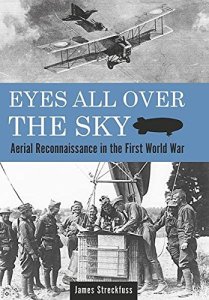
James Streckfuss, Eyes All Over the Sky: Aerial Reconnaissance in the First World War. Oxford, UK: Casemate Publishers, 2016. Maps. Bibliography. Notes. Index. Hbk. 239 pp.

51jjn6edowl

Aviation historian after aviation historian has fallen into the trap of overlooking the important role played by airborne intelligence collection platforms during the First World War. Mystified with the glamorous images of Baron von Richthofen and Eddie Rickenbacker, the historical narrative has primarily focused on the exploits of the fighter pilot. This narrative has been fueled by a general lack of scholarly writing about the important role played by airborne-derived intelligence. In Eyes All Over the Sky: Aerial Reconnaissance in the First World War, James Streckfuss seeks to remedy the oversight.

From the dawn of war, military commanders have sought enhanced intelligence to assist decision making. For much of history, the quest for better information was limited to the use of spies or, at best, the ability to obtain improved vantage points from high terrain or even trees. Almost immediately after man achieved flight, military thinkers put the air platform to intelligence use and in June 1794 the French conducted the world’s first military airborne reconnaissance sortie when they used balloons to reconnoitre Austrian forces near the town of Maubeuge on the border with Belgium. Military use of the air asset proliferated and by the start of World War I, the balloon and the aeroplane were firmly entrenched in militaries around the world. In every case, the air assets were reconnaissance platforms. This point, more than any other, drives Streckfuss’ subsequent analysis of the importance of airborne reconnaissance in the war.

large_0000001
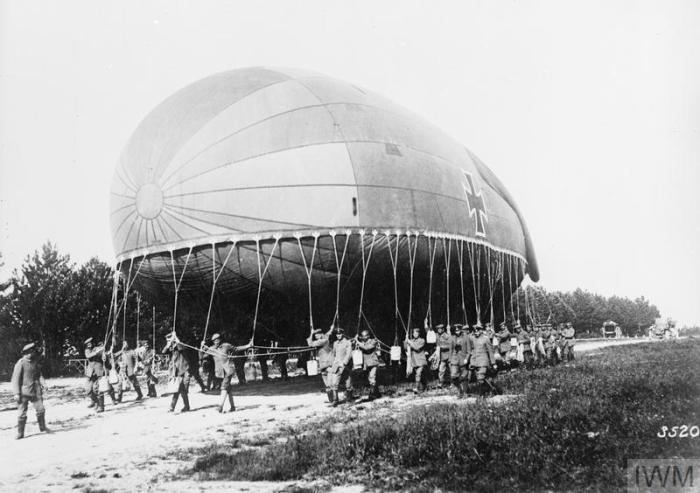
A German balloon section mooring an observation balloon to a new position. (Source: © IWM (Q 54462))

After briefly outlining the early days of the balloon – and aeroplane – based reconnaissance, Streckfuss dives right into the tactical fight of the First War. Choosing first to highlight the little-known importance of balloon reconnaissance, Streckfuss thoroughly examines all the major combatants’ use of balloons comparing the challenges faced by each as they tried to maximise the impact of this still unfamiliar capability. Of note in this section is the advanced progress which the Germans had made as compared to that of the Allies. Count Ferdinand von Zeppelin’s determination to make Germany the air power envy of the world had resulted in considerable pride and dedication to balloons. When the war began, they were significantly ahead of the Allies. Unfortunately for the Germans, their commanders on the Western Front had not been convinced of the veracity of the intelligence their airborne reconnaissance platforms provided.[1] Thus, German commanders ignored the information provided by their airmen and instead made disastrous moves that eventually resulted in the famous German retreat to the Aisne River and the subsequent stalemate that characterised much of the war.

Over the next several chapters, Streckfuss lays out a well-told story of aviation’s wartime missions of artillery spotting, infantry liaison, and photographic interpretation. These chapters magnificently describe the primary missions conducted by the various air forces during the war. As the war was, by any estimation, a war of the ‘big guns,’ the importance of aviation to the artillery mission cannot be overstated. Due to air power, the artillery could now hit targets all over the battlefield – even deep behind enemy lines – with previously unheard of accuracy. As Streckfuss writes, airborne intelligence ‘held the key to making the artillery more deadly than it had been in any previous war’ (p.84).

large_0000003
Air Mechanic Cecil Haliday of the Royal Flying Corps demonstrates a ‘C’ type aerial reconnaissance camera fixed to the fuselage of a BE2c aircraft. (Source: © IWM (Q 33850))

The book’s final chapter examines the reasons why the success of airborne reconnaissance was downplayed after the war. Thoroughly convinced that air power would be the dominant force in all future wars, airmen of the major victorious powers sought to free – or in the case of the British, keep free – their air arms from the control of the British Army and the Royal Navy. According to Streckfuss, this dogged drive for independence caused airmen to highlight the ‘power’ part of air power and to minimise the primarily ‘service’ role air power had played in the war. The ability to singlehandedly win a war was a far more compelling argument than the contributions the air forces had made in their support of the Army and Navy.

Streckfuss’ argument is compelling. Airborne reconnaissance was the primary purpose of air forces going into the First World War and, contrary to some beliefs, it contributed significantly to both victory and defeat. This new book is a welcome addition and helps fill a historiographical gap in the literature about the war and our general understanding of the importance of airborne reconnaissance. I highly recommend it for the air power expert and novice alike.

Dr Tyler Morton is a Lieutenant Colonel in the United States Air Force (USAF) and holds a PhD in Military Strategy from Air University. A graduate of the USAF’s School of Advanced Air and Space Studies (SAASS), he is currently converting his dissertation on the evolution of manned airborne intelligence collection into a book which he hopes to publish in 2017. His research interests include the history of airborne reconnaissance with a focus on airborne linguists, the role of intelligence in the formulation of grand strategy, and the importance of innovation to the next era of military capability.

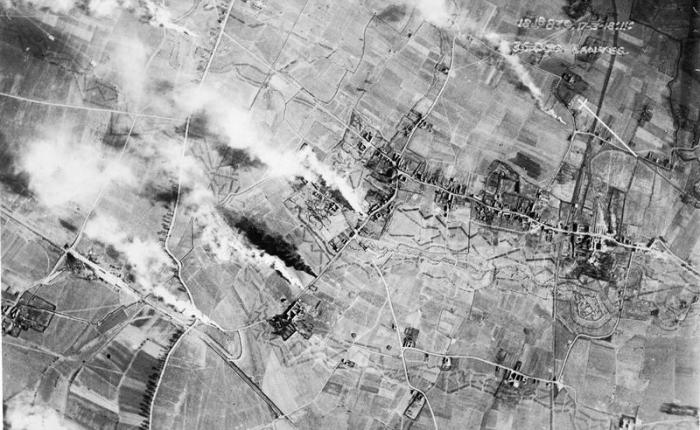
Header Image: An RAF aerial photograph showing how the enemy attempted to conceal gun positions by artificial smoke screens, which were defeated by the use of the camera. (Source: © IWM (Q 12224))

[1] Eric Dorn Brose, The Kaiser’s Army: The Politics of Military Technology in Germany During the Machine Age, 1870-1918 (New York, NY: Oxford University Press, 2001), p. 191.

A Case of Mistaken Identity: Colonel Edgar Stanley Gorrell – Part 1: Early Life

A Case of Mistaken Identity: Colonel Edgar Stanley Gorrell – Part 1: Early Life

By Johannes Allert

In the following series of posts, Johannes Allert explores Colonel Edgar Gorrell’s role in co-ordinating US civilian aviation assets in support of military aviation strategy during the Second World War.

I came solely to benefit [American] commercial aviation, to try to keep it supreme in the air, [and] to do what I could for national defense.

Edgar Gorrell speaking before the Senate Committee Investigating Air Safety – January 1936

‘Chicago Banker, Air Transport Head, Dies.’ This headline in the Associated Press dated March 5, 1945, informed the world about the passing of Colonel Edgar Staley Gorrell and indicated that the decedent’s work evolved more around finance than flying.[1]  Later that same year his alma mater at West Point paid homage to his career stating his most notable contribution ‘was his formulation of the plan for strategic air bombardment of Germany’ and further asserted his ideas concerning aerial bombing predated those of Mitchell and Douhet.[2] His brief life, however, encompassed far more than the obituaries or a singular doctrine reveal, yet his legacy quickly faded amidst the Allies’ triumph in the World War II and was further overshadowed by Strategic Air Command’s ascent during the Cold War. With the collapse of the Soviet empire, however, interest in his work reemerged in 1990 with the publication of Marvin Skelton’s article entitled ‘Colonel Gorrell and his nearly forgotten records.’ The author, utilising West Point’s Assembly, reasserts ‘one of his most notable contributions to the development of military aviation was his formulation of the plan for the strategic air bombardment of Germany.’[3] George Williams later countered this assertion arguing Gorrell merely copied theories previously proposed by Major Lord Tiverton and Hugh Trenchard.[4] Rebecca Grant, however, rebuts this notion in her article published in November 2008 and stated Gorrell’s work concerning strategic bombardment was, in fact, the key to allied’ air victory in the Second World War.[5] In actuality, his varied career concentrated on the growth and development of civil aviation yet; historians repeatedly define him as the principle architect responsible for creating the original blueprint designed to target German industry through strategic precision bombing.[6] Further, complicating matters was the fact that, unlike many of his colleagues who frequently engaged in a very public and ideologically driven campaign promoting a bomber-centric doctrine, Gorrell’s preference involved coordination of civil air assets with military airlift operations. As history demonstrates; his results lay in actual achievements that endure today.

Edgar Gorrell’s Early Years

600px-1st_aero_squadron_-_pilots_in_mexico
At field headquarters near Casas Grandes, Mexico, April 1916, dashing airmen Lieutenants Herbert A. Dargue (left), and Edgar S. Gorrell (right) pose with Signal Corps No. 43. (Source: Wikimedia)

Small in stature, yet boundless in energy, Gorrell entered the U.S. Military Academy at West Point in 1908. His classmates nicknamed him ‘Nap’ (an abbreviation for Napoleon) and the moniker proved appropriate because, like his namesake, Gorrell was indefatigable. As a young cadet, his interest in aviation blossomed when he witnessed Glen Curtiss complete the final leg of his Albany to New York flight.[7] Briefly serving as an infantry officer, Gorrell quickly transitioned to the Signal Corps and obtained a pilot’s license within its air service section. In 1916, he flew reconnaissance missions in support of General John Pershing’s Punitive Expedition against the elusive Pancho Villa. This marked the first time in American military history where powered flight and ground forces operated jointly. Although the exercise achieved less than expected results, the experience left an indelible impression upon the young aviator.[8] During America’s brief involvement in the First World War, he served under the flamboyant and controversial General William “Billy” Mitchell; however, unlike his superior, Gorrell was short on style and long on substance. While Mitchell sparred with General Benjamin Foulois over control of the America’s emerging Air Service, Gorrell created a detailed and comprehensive air offensive aimed at crippling Germany’s industrial centre. Although hostilities ceased before his plans were implemented, they were later resurrected and used as a template in the Army Air Force’s bombing campaign against Germany in the Second World War.[9]

Following the Armistice, Gorrell further burnished his credentials by chronicling America’s aviation efforts in the Great War as part of the Army’s official history – a project concocted by the general staff as an instructional aide for future wars. However, in a rush to demobilise, many perceived the gathering and analysis of squadron operations as an unnecessary task, yet Gorrell embraced the challenge and delivered a detailed report never published but often referred to as ‘The Gorrell Histories.’[10] He later incorporated aspects of his experiences in the Great War into academic lectures and speeches where he effectively debunked two myths concerning America’s involvement in the First World War. The first pertained to the ‘Billion Dollar Bonfire’ propagated by the media criticising the U.S. military’s disposal procedures of surplus aircraft at war’s end. Countering the charge of carelessness on the part of the Air Service that sent taxpayer’s dollars up in smoke, Gorrell provided a comparative analysis revealing the cost break down and the logic behind the disposal procedure.[11] Secondly, he argued that despite early setbacks associated with coordinating aircraft production congruent with allied war aims, American industry succeeded in supporting the Allied war effort by producing quality tools and equipment including the lighter and more reliable Liberty aircraft engine based upon the British Rolls-Royce design. From this and other experiences in his varied and fruitful career, Gorrell repeatedly maintained that careful planning, preparation, and just plain hard work were fundamental ingredients for success.[12]

In the next part, here, we will explore Gorrell’s role the emerging to role of civil aviation in air transport in the US.

Johannes Allert holds an MA in Military History from Norwich University and has served as an adjunct for Minnesota State University – Moorhead and Rogers State University (Oklahoma). His thesis concerning Lieutenant General Frank M. Andrews appeared in Air & Space Power Journal. He assisted in editing Naval Press Institute’s The Secret War for the Middle East – The Influence of Axis and Allied Intelligence Operations in WW II. His other articles concerning aviation appear in Minnesota History Magazine. He has also written for North Dakota History Magazine. Currently, he is a Legacy Research Fellow for the Minnesota State Historical Society and is working on a larger book project entitled Discovering Minnesota’s Lost Generation – Reflections and Remembrances of the Great War. His other ongoing book projects include Marshall’s Great Captain – The Life of Lieutenant General Frank Maxwell Andrews and Citizen-Soldier: Major General George Leach.

Header Image: A Curtiss JN-3 of the US 1st Aero Squadron during the Mexico Expedition of 1916. (Source: Wikimedia)

[1] ‘CHICAGO BANKER, AIR TRANSPORT HEAD, DIES.’ Col. Edgar Staley Gorell. 54. President of Air Transport Association of America and Chicago Investment Banker, died today of a heart condition after a brief illness. Lubbock Morning Avalanche, Tuesday, March 6, 1945, http://newspaperarchive.com, (accessed 6 February 2014), p. 1.

[2] Quoting directly from Assembly ‘One of his most notable contributions to the development of military aviation was his formulation of the plan for the strategic air bombardment of Germany. It is difficult in these days. When huge German and Japanese cities lie in heaps of rubble, to appreciate the daring imagination which conceived that plan in 1917 and 1918. No Douhet or Mitchell had yet preached the modern gospel of air power.’ Gorrell’s obituary is reproduced and available on line. Cullum No. 5049. Mar 5, 1945. Died in Wash DC. Age 54 http://apps.westpointaog.org/Memorials/Article/5049/

[3] Marvin Skelton, ‘Colonel Gorrell and his “nearly forgotten records”’, Over The Front, 5(1) (1990), pp. 56-71.

[4] George K. William, “The Shank of the Drill’: Americans and Strategical Aviation in the Great War,’ Journal of Strategic Studies, 19(3) (1996). pp. 381-431

[5] Rebecca Grant, ‘Airpower Genesis,’ Air Force Magazine, 91(11) (2008), pp. 54-57.

[6] At Strategic Air Command’s zenith, Thomas Greer’s ‘Air Army Doctrinal Roots, 1917-1918’ published in Military Affairs states Gorrell’s plan ‘was a truly striking forerunner of the doctrine which matured years later at the Air Tactical School’ and quotes (then) Major General Laurence Kuter ‘the earliest and least known statement concerning the conception of American airpower.’ Thomas Greer, ‘Air Army Doctrinal Roots, 1917-1918,’ Military Affairs, 20(4) (1956), p. 214.

[7] Mark Clodfelter, Beneficial Bombing: The Progressive Foundations of American Air Power, 1917-1945 (Lincoln, NE: University of Nebraska Press, 2010), pp. 7-8.

[8] Skelton, ‘Colonel Gorrell and his “nearly forgotten records”’, p. 56-8.

[9] In James J. Hudson, Hostile Skies: A Combat History of the American Air Service in World War I (Syracuse,: Syracuse University Press, 1968), pp. 54-8, the author chronicles the friction between Mitchell and Foulois. Mitchell arrived in France ahead of his peers and after consulting with various allied air strategists, became the self-declared American authority on air power. Contemptuous of Foulois’ Air Staff, Mitchell frequently referred them as ‘an incompetent lot’ or simply ‘carpetbaggers’ this implies they were newly arrived outsiders out to take credit for his efforts.

[10] Following the Armistice, and order was dispatched to all air units directing each to prepare a history and forward it to the Information Section. However, feedback concerning the order surfaced indicating a lack of enthusiasm for the project since ‘The Z. of A. has no further interest in war. The squadrons have but one idea – getting home. Writing history does not appeal to them.’ Consequently, M.G. Mason Patrick assigned Col. Edgar Gorrell the task of assembling a staff, gathering the information, and submitting a report to include any information that might ‘assist in establishing Army aeronautics on a sound basis for the future which would leave unanswered questions that might be asked concerning the Air Service in Europe.’ Gorrell’s History of the American Expeditionary Forces Air Service, 1917-19, Record Group 120 (National Archives, Washington, D.C. 1923), pp. 1-4.

[11] Edgar Staley Gorrell, The Measure of America’s World War Aeronautical Effort (Northfield, VT: Norwich University, 1940) pp.73-7.

[12] Gorrell’s commencement address to the Norwich Corps of Cadets on 7 June, 1937 emphasized the concepts of life time learning, empathy, and above all hard work and diligence in problem solving far outweighs the label of genius. ‘Standing on the threshold of a Profession,’ Graduation Address to the Corps of Cadets Norwich University, Northfield, VT. June 7, 1937. Courtesy of Norwich University Archives & Special Collections  http://library2.norwich.edu/catablog/aviation/gorrell-edgar-s-1891-1945