Editorial Note: Led by Editor Dr Mike Hankins, From Balloons to Drones, produces a monthly podcast that provides an outlet for the presentation and evaluation of air power scholarship, the exploration of historical topics and ideas, and provides a way to reach out to both new scholars and the general public. You can find our Soundcloud channel here. You can also find our podcast on Apple Podcasts and Google Podcasts.
During the Second World War, it was not only men who flew military aeroplanes. Many women flew all kinds of aeroplanes in various roles in the United States, many of them members of the Women’s Airforce Service Pilots (WASP). Their story did not end with the war either, as they fought for recognition as veterans throughout the 1960s and 70s. In our latest interview, From Balloons to Drones, Dr Sarah Myers joins us to discuss these women’s unique roles in the war and beyond and their legacy today.
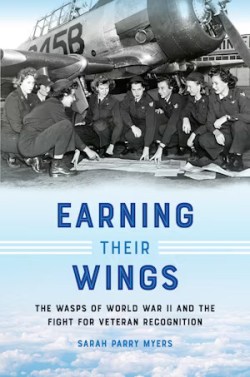
Dr Sarah Parry Myers is an Associate Professor of History at Messiah University in central Pennsylvania, where she teaches courses on 20th Century U.S. history, gender history, public history, and war and society. Myers is the author of Earning Their Wings: The WASPs of World War II and the Fight for Veteran Recognition (2023). She previously attended a National Endowment of the Humanities Summer Institute on Veterans Studies. She received a 2020-2022 National Endowment of the Humanities Dialogues on the Experience of War grant, ‘We are Veterans Too: Women’s Experiences in the U.S. Military.’
Header image: Four United States Women’s Airforce Service Pilots members receive final instructions as they chart a cross-country course on the flight line of a US airport. Assigned to the ferrying division of the United States Army Air Transport Command, the women pilots belong to the first class of American women to complete a rigorous nine-week transitional flight training course in handling B-26 Marauder medium bombers. They have been given special assignments with the US Army Air Forces as tow target pilots. (Source: US National Archives and Records Administration)
Editorial note: On 26 January 2024, Apple TV+ launched the much-anticipated series Masters of the Air. This series follows the actions of the US 100th Bomb Group during the Combined Bomber Offensive in the Second World War. As the series is being aired, our Book Reviews Editor, Dr Luke Truxal, the author of Uniting against the Reich (2023), will critically review each episode.
At halfway through Masters of the Air, we finally reached the culmination point for the Americans during the 1943 air offensive, Black Week. There are a lot of essential storylines that the creators of Masters of the Air needed to nail with the exact right tone. For the first time in a televised depiction of the American air war against Germany, we get two new major themes the series tries to address. First, losing. Black Week, which lasted from 8 to 14 October 1943, was the final straw for the US Eighth Air Force. During the course of the week, American aircrew and bomber losses reached such a level that they could no longer maintain their air offensive. Films such as Twelve O’clock High (1949) and Memphis Belle (1990) depict the mounting casualties, but we never see the Americans lose at the end of the day. Even in Band of Brothers (2001) and The Pacific (2010), Americans perform quite well. The Market-Garden episode was the only episode amongst those previous works that depicted a setback, but it was only for a single episode. Masters of the Air has been building to this point since it began. Another major topic that the series addresses that usually gets overlooked on film is attacks on German civilians. Previous depictions of the air war typically avoid discussing the morality of the air war, but Masters of the Air takes it on. This episode breaks much ground in how the air war is depicted on film. For the first time, audiences are getting to see an American campaign end in a loss, and the United States shift towards attacks against civilians.
The episode begins with Major John Egan drinking in a B-17 Flying Fortress and struggling with losing his good friend, Major Gale Clevan. Egan has been hit hardest by the loss of his good friend. While the group is reeling, they do get some good news with the arrival of Captain Everett Blakely’s crew and navigator Second Lieutenant Harry Crosby. After everyone reconvenes at the bar, we soon learn that Crosby has been promoted to group navigator and Captain Joseph ‘Bubbles’ Payne has been demoted. Crosby is told to report to headquarters when the red light flashes to begin planning the next mission. On cue, the red light starts flashing, and viewers get a behind-the-curtain look at the chaos that occurs as the group plans for its next raid. It is not unheard of for those involved in planning to work nights and sleep during the day. Crosby mentions the stress of planning and briefing his fellow navigators. He feels the weight of the whole group on his shoulders and wonders if something he did wrong could lead to calamity.
During the briefing, the new mission and target are announced. It is Munster. The target is the marshalling yards in the city centre. During the briefing, it was also noted that the bombs would likely also hit German workers living next to the rail yards. The yards are next to the town cathedral, and the mission is flown on Sunday, 10 October 1943. This does not sit well with group members like the veteran Captain Charles Cruikshanks. He and Egan argue over the merits of attacking German civilians, including women and children. Egan argues that it will bring the war to an end earlier, but despite his words, this is really about revenge. As the conversation ends, Cruikshanks is still clearly unhappy with the tenor of the conversation and target selection. This great scene shows the divide among American airmen over the shift to area bombing during the war. American airmen knew attacking civilians through area bombing was both a war crime and morally wrong. Also, this was not how they were trained to prosecute their air offensive. Yet others, like Egan, thought it was a way to hasten the war’s end. It is a great scene that does not seek to justify area bombing but simultaneously exposes the divisions amongst the Americans over the switch in tactics. A lot of television series and movies would have punted on this topic. John Orloff, who wrote this episode, deserves much credit for tackling this subject and writing these scenes well.
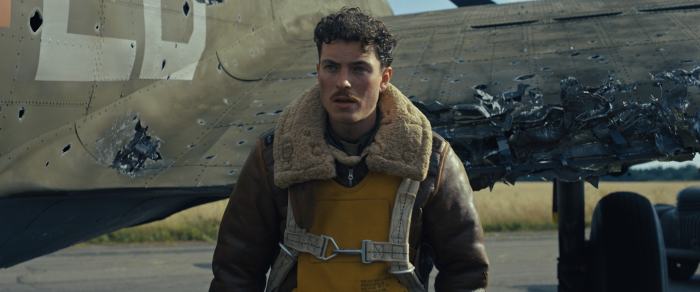
Nate Mann in Masters of the Air, episode five. (Source: AppleTV+)
As the bombers take off, we learn that the 100th Bomb Group can only muster 17 B-17s for this raid, many of which are loaned to them by other groups. As the groups formed, we quickly learned that the 100th Bomb Group was too far behind the rest of the 14th Bombardment Wing. Making matters worse, four B-17s had to turn back due to aircraft malfunctions, leaving the strike force with only 13 B-17s. They are too far back from the other groups and short on aircraft. Egan notes that they are a perfect target for the Luftwaffe. As the bombers approached the target, German fighters attacked in massive head-on passes. One can understand why viewers might think this scene is an embellishment of the actual air battle, but it was not. Approximately 200 German fighters attacked the 14th Bombardment Wing, singling out the 100th Bomb Group in the rear of the formation. In a matter of minutes, veterans that we had come to love are shot down. Egan and Brady bail out, Cruikshanks falls out of formation, and his crew bail out, and finally, we see the B-17 with Bubbles on it take a direct hit and collide with another B-17, killing him in the explosion. The perspective has switched to Rosenthal’s aircraft and crew by this point. The combat is so fast and intense that Rosenthal and the viewers experience the same shock when they realize his ship is the last in the formation, still in the air. The music is great here to create a sense of both eeriness and fear as the aircrew comes to grips with the fact that an entire bomb group has been blasted out of the sky for the first time in the air war. During the historical raid, German fighters eliminated the 100th Bomb Group during the first 10 minutes of a 45-minute air battle.[1] The show does a great job of showing how fast and sudden these losses are.
Back at Thorpe Abbotts, everyone waits for the return of the bombers. The first sign that something is wrong occurs when a bomber from the 390th Bomb Group arrives at the airfield. Colonel Neil “Chic” Harding calls the bomber to ask what happened to his bombers and soon finds out that they are all gone. As this occurs, Rosenthal’s plane returns, giving some hope that more might have made it back. That hope is soon dashed as Rosenthal’s crew relates the mission’s events in interrogation. The mood is sombre. The episode ends with Crosby packing up his good friend Bubbles’ foot locker to send home to his family. This is where Crosby finally breaks down and cries. For many of the airmen and ground personnel in the 100th Bomb Group they have reached the end of the line for this campaign physically and emotionally. This is how the 1943 campaign ended for many other groups. This is where we leave the 100th Bomb Group in the next episode. Episodes four and five are the best of the series by far. We have seen the morality of the air war brought into question, and the Americans lost the air war in 1943. Those who worked on this project went on a limb in the last two episodes by depicting sides of the air war that scholars are familiar with but rarely make their way to the big screen. They have created two great episodes that audiences can absorb, and scholars can use to teach about the air war.
Dr Luke Truxal is an adjunct at Columbia State Community College in Tennessee. He completed his PhD in 2018 from the University of North Texas with his dissertation ‘Command Unity and the Air War Against Germany.’ His previous publications include ‘Bombing the Romanian Rail Network’ in the Spring 2018 issue of Air Power History. He also wrote ‘The Politics of Operational Planning: Ira Eaker and the Combined Bomber Offensive in 1943’ in the Journal of Military Aviation History. In addition, Truxal is researching the effectiveness of joint air operations between the Allied air forces in the Second World War. He can be reached on Twitter at @Luke_Truxal.
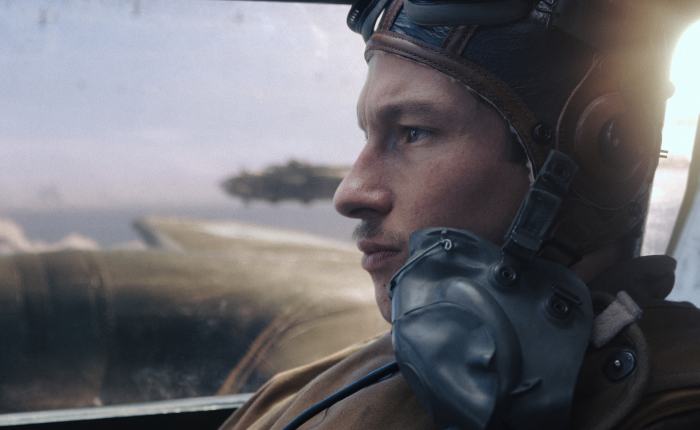
Header image: Callum Turner in Masters of the Air. (Source: Apple TV+)
[1] Donald Caldwell and Richard Muller, The Luftwaffe Over Germany: Defense of the Reich (Barnsley: Frontline Books, 2014), pp. 132-4.
Editorial note: On 26 January 2024, Apple TV+ launched the much-anticipated series Masters of the Air. This series follows the actions of the US 100th Bomb Group during the Combined Bomber Offensive in the Second World War. As the series is being aired, our Book Reviews Editor, Dr Luke Truxal, the author of Uniting against the Reich (2023), will critically review each episode.
The fourth episode of Masters of the Air was about those left behind. This is meant literally in the sense that we do not go up in the air with the planes after they take off, but we also see many of the characters on the show struggle with loss during the war. The result is that we get a good episode that portrays the struggles of airmen, ground crews, resistance fighters, and civilians left on the ground. This review will examine the episode’s analysis and responses to grief thematically rather than tackle the episode chronologically, as in past reviews.
The episode begins with a party after Lieutenant Glenn Dye’s crew completes their 25th mission. This will be the first and only crew of the original 100th Bomb Group to complete their tour of duty and go home. At the party, we are introduced to two new characters, Lieutenant Herbert Nash and Lieutenant Robert ‘Rosie’ Rosenthal. Both are green but capable and eager pilots. During the episode, Nash dances and flirts with Helen, who works for the Red Cross at Thorpe Abbotts. There are sparks between these two characters. At the same time, Rosenthal tries to understand better what he is flying into by talking to Major Gale Clevan. Nash is more successful in flirtations than Rosenthal in feeling out the veteran pilots about the nature of air combat. As the aircrews depart for their first mission the following day, Nash makes a last pass at Helen with a line that foreshadows his fate, “You might be the last pretty face that I ever see.” Nash’s fate is shown off-screen, and it falls on Rosenthal to deliver the shocking news to the young woman with whom he had developed a budding romance. In the same sequence, the news is broken to the group that Clevan and Crosby had gone down. The news that the group’s best pilot and navigator went down in separate planes stuns the group. Colonel Neil ‘Chick’ Harding and Lieutenant Joseph ‘Bubbles’ Payne express the shock that the group and audience feel when the news is broken. Two of the more critical anchors for the group have now been lost off-screen. The show does an excellent job of showing how the loss of these veteran aircrews impacts morale.
Callum Turner and Joanna Kulig in Masters of the Air. (Source: Apple TV+)
Along with shock, we see sympathy and grief for those living under the bombs. During the episode, Egan walks about a series of bombed homes while on leave in London. He finally can see the results of what bombing does to civilians. As he watches the rescue crews work we hear the scream of a woman who lost what appears to be her daughter. While short, this was a hard scene to watch. Seeing the woman pull the dead child out of the rubble builds sympathy between the viewers and the bombed. It is a great scene to include. It is easy for the audience to get lost in the air-to-air combat, but these bombs have consequences. Even those who play no part in this war, such as children, suffer from the air war. It is a well-written and executed scene.
Another element of processing grief for those in combat is the sense of guilt that those who survived feel. This is an area where Masters of the Air has surpassed both Band of Brothers (2001) and The Pacific (2010), in my opinion. That is not to say that the previous series ever avoided the topic, and The Pacific did lean into the post-war struggles of Eugene Sledge with post-traumatic stress syndrome. However, we never saw it portrayed so personally, with Sergeant William Quinn’s decision to leave Sergeant William Hinton behind, trapped on the B-17 Flying Fortress before it exploded. Throughout his time on the run, Quinn grapples with his guilt over leaving his comrade behind. It eats at him throughout the whole episode more so than the fear of being captured by the Germans as his fellow airmen keep asking him about what happens. This plot ends with another crewman who survived the crash, Sergeant Charles Bailey, comforting Quinn. Bailey tells Quinn that he would have made the same decision as well. Some viewers will find it easy to judge Quinn for his actions in the previous episode, but as the show eloquently shows, many of us would have made the same decision in the same circumstances. To me, this was a powerful sequence of scenes paired with the scenes of Sledge at the end of The Pacific; we get a better sense of the survivor’s guilt and its aftermath.
The last element of grief that the episode deals with is anger. During the episode, Major John Egan goes on leave in London and meets a Polish woman with whom he sleeps. As they are in bed together, they watch German bombers strike London from a distance. Egan admits that this is the first time he has seen this side of the air war. As they continue talking, the Polish woman expresses her anger and desire for revenge against the Germans for the war that they unleashed. This scene sets up viewers perfectly for Egan in this episode and in episode five. After finishing his night with the woman, Egan sees the woman grieving the loss of her daughter. He then sees a newspaper highlighting the heavy losses that the Eighth Air Force suffered on the most recent raid. Egan calls Thorpe Abbotts to learn the fate of the 100th Bomb Group and, more importantly, his best friend Clevan. Egan ends the episode by lobbying to be on the next mission. In the teaser at the end of the episode, we see that Egan desires revenge against not only the Luftwaffe but all Germans for the loss of his friend.
This might go down as one of the series’ more important episodes. It broadened the audience’s perspective of the air war. It showed the ground crews, the bombed, and how they fought the air war in their way. Some struggled to process the shock of loss either in the air or on the ground. Others struggled with survivor’s guilt. Finally, we see many turn their grief into anger and desire for payback for the anguish that they feel for the loss of their loved ones. In an episode where grief took centre stage and, in many forms, this episode handled such a delicate topic as well as you can on screen. I think this is arguably the best episode of the series up to this point.
Dr Luke Truxal is an adjunct at Columbia State Community College in Tennessee. He completed his PhD in 2018 from the University of North Texas with his dissertation ‘Command Unity and the Air War Against Germany.’ His previous publications include ‘Bombing the Romanian Rail Network’ in the Spring 2018 issue of Air Power History. He also wrote ‘The Politics of Operational Planning: Ira Eaker and the Combined Bomber Offensive in 1943’ in the Journal of Military Aviation History. In addition, Truxal is researching the effectiveness of joint air operations between the Allied air forces in the Second World War. He can be reached on Twitter at @Luke_Truxal.
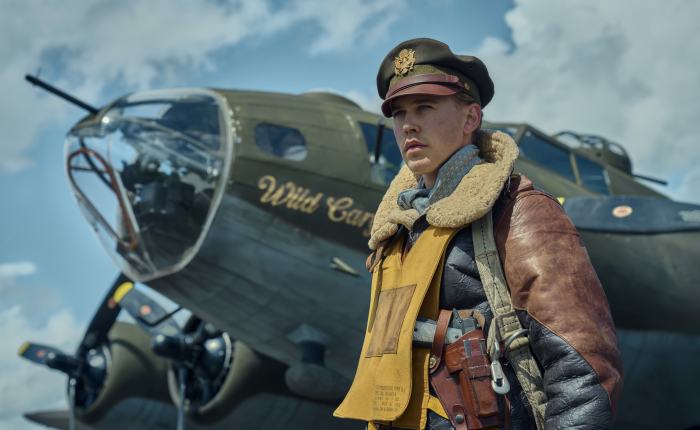
Header image: Edward Ashley and Austin Butler in Masters of the Air. (Source: Apple TV+)
Editorial note: On 26 January 2024, Apple TV+ launched the much-anticipated series Masters of the Air. This series follows the actions of the US 100th Bomb Group during the Combined Bomber Offensive in the Second World War. As the series is being aired, our Book Reviews Editor, Dr Luke Truxal, the author of Uniting against the Reich (2023), will provide a critical review of each episode.
Three episodes in, we now better understand what the series Masters of the Air does well and where the show falls short. Let me begin this review by stating that I enjoy the series and what it deliers. Viewers gain a better perspective of the air war from the airmen who flew the missions than previous depictions. The show does justice to the US 100th Bomb Group and tells its story. This is still a good episode and series despite the criticism you will see at the end of this review. I will still recommend it to others. My problem is that the show fails to reach its full potential in telling this story. I think this is where the shows Band of Brothers (2001) and The Pacific (2010) really soared and why, for me, Masters of the Air feels so close but still not on the same level.
This week’s episode was the fateful Schweinfurt-Regensburg mission on 17 August 1943. The raid was the second unmitigated disaster that the Americans suffered in the air war that month. On 1 August 1943, the US Ninth Air Force attacked the Romanian oil refineries at Ploiești with five B-24 groups, three of which were on loan from the US Eighth Air Force. While the raid succeeded in damaging the refineries, it failed to stop Romanian oil production at the cost of 54 Consolidated B-24 Liberators and 310 airmen.[1] While Ploiești does not appear in the episode, it is crucial to understand the context of the air war in 1943. These were some of the darkest days of the air war for the Americans. The episode begins with a briefing about the Schweinfurt-Regensburg mission. Colonel Neil Harding, portrayed by James Murray, does a great job at explaining the nature of the mission, bad sports metaphors aside. The first strike force, which included the 100th Bomb Group, was to strike at German aircraft factories at Regensburg, thus drawing the bulk of the German fighter force onto their formation. He correctly explains that the bombers behind the 100th Bomb Group will move towards Schweinfurt and strike at German ball-bearing production with less resistance. The audience now has a great understanding of how the mission is supposed to work on paper.
Elliot Warren as Lieutenant James Douglass, a bombardier with the US 100th Bomb Group who flies with Harry Crosby. (Source: Apple TV+)
The thesis of this entire episode was about the choices that soldiers make in war and how they impact the lives of those around them. It all begins with the poor weather delays that affected the execution of the raid. This led the US Eighth Air Force to send out Colonel Curtis LeMay’s Regensburg force five hours ahead of the rest of the force. During the raid, the creators of the show highlight several vital moments when decisions have to be made that affect the lives of the airmen in this episode. The first happens when Roy Claytor’s plane is shot down. As the crew bails out, the ball turret gunner, Sergeant William Hinton, becomes trapped and cannot escape. Sergeant William Quinn, the radio operator, hears his calls and tries to aid him as the rest of the crew bail out. Unfortunately, the plane enters a spin, and the force throws Quinn against the wall. He has to choose between his life and Hinton’s. He chooses his own. Later, we see that same choice posed to Quinn again when he speaks to a member of the Belgian resistance and has to decide if he wants to try to escape or spend the remainder of the war in a prison camp. His choice has not yet been revealed, and the scene ends on a cliffhanger. Lieutenant Curtis Biddick is the second character to face a life-or-death decision. His plane is hit during the raid, and his co-pilot, Lieutenant Richard Snyder, is severely wounded. In an emotionally impactful scene, Biddick decides to try and crash land the plane to save Snyder. The rest of the crew bail out successfully, and for a moment, it appears Biddick has once again pulled off the impossible. Unfortunately, he can’t maintain control of his Boeing B-17 Flying Fortress as it crashes into the ground in a massive explosion. The final major choice we see throughout the raid is Major Gale Clevan’s choice not to bail out and keep pushing his aircraft through the raid. His choice to keep pushing on paid off, with his plane landing just short of the runway at Telergma in the French colony of Algeria. Throughout the entire episode, there are several moments where the show makes it very clear that Clevan’s decision to press on could have had catastrophic consequences for him and his crew. The show did an excellent job at showing the choices that the young airmen of the 100th Bomb Group, many in their late teens and early twenties, had to make in split seconds and their consequences.
For an episode that emphasized the importance of the decisions made in war, the biggest one was left out. On the morning of 17 August 1943, the head of the US VIII Bomber Command, Brigadier General Frederick Anderson, had to decide whether or not to scrap the Schweinfurt-Regensburg mission. Anderson, like the commander of the Eighth Air Force, Major General Ira Eaker, was under immense pressure to execute this mission. General Henry Arnold, the US Army Air Forces commander, had taken a great personal interest in the raid and its success. The raid had been put off before due to poor weather. Additionally, the Regensburg force had to leave with enough time to have light remaining to land when they reached Algeria. Anderson ultimately made the call to send LeMay’s force first through the fog while waiting for the rest of the fog to dissipate before sending the rest of the bombers. This is how the two forces end up five hours apart. [2] This brings me to my biggest criticism of the show. Three episodes in, the show struggles to discuss the air war’s wider context. In the second episode, the writers poorly executed a scene to introduce the doctrine debates between the Americans. In this episode, the decision to not fly the mission as planned does not appear on the screen, which was the raid’s most important decision. This was a big missed opportunity for the creators of Masters of the Air. Anderson had to live with the fact that his decision on 17 August 1943 cost the Eighth Air Force sixty B-17s and 559 airmen either killed or missing.[3]
When it comes to telling the story of the 100th Bomb Group and its experience during the raid, this episode did an excellent job. It showed the life-or-death decisions these young men had to make in seconds, and if they were lucky, they would have to live with the consequences of those decisions. Yet, the quality of the television show could be much improved by occasionally widening its perspective. The series has become so zoomed in on the 100th Bomb Group that it struggles to tell the bigger picture of the air war. Adding a short scene here or there to add that big-picture perspective would bring everything together and make this television series genuinely extraordinary. My criticisms aside, this is still the best series on the air war I have seen, and it deserves to be in the same conversation as the 1949 film Twelve O’clock High.
Dr Luke Truxal is an adjunct at Columbia State Community College in Tennessee. He completed his PhD in 2018 from the University of North Texas with his dissertation ‘Command Unity and the Air War Against Germany.’ His previous publications include ‘Bombing the Romanian Rail Network’ in the Spring 2018 issue of Air Power History. He also wrote ‘The Politics of Operational Planning: Ira Eaker and the Combined Bomber Offensive in 1943’ in the Journal of Military Aviation History. In addition, Truxal is researching the effectiveness of joint air operations between the Allied air forces in the Second World War. He can be reached on Twitter at @Luke_Truxal.
Header image: Edward Ashley, Matt Gavan, Callum Turner and Anthony Boyle in Masters of the Air (Source: Apple TV+)
[1] Jay A. Stout, Fortress Ploesti: The Campaign to Destroy Hitler’s Oil (Havertown, PA: Casemate Publishers, 2011), p. 76.
[2] Luke Truxal, Uniting against the Reich: The American Air War in Europe (Lexington, KT: University Press of Kentucky, 2023), pp. 71-3.
Editorial note: On 26 January 2024, Apple TV+ launched the much-anticipated series Masters of the Air. This series follows the actions of the US 100th Bomb Group during the Combined Bomber Offensive in the Second World War. As the series is being aired, our Book Reviews Editor, Dr Luke Truxal, the author of Uniting against the Reich (2023), will critically review each episode.
The first two episodes of the Apple TV+ television series Masters of the Air are a great introduction to the air war for those less familiar with the subject. Yet, they also treat the subject with the seriousness that scholars of the air war demand from media portrayals. Stylistically, the episodes blend the storytelling style of the famous documentary Target for Today (1944) with the drama of the more famous film Twelve O’clock High (1949). Other films on air power, such as Top Gun (1986), tend to romanticize or glorify air-to-air combat. The episodes do not do that. Instead, viewers better understand the nature of combat in the skies above Europe. This one-two-punch season opener stands strong on its own. This was a very promising start for Masters of the Air.
These were two great episodes for those unfamiliar with the air war in Europe. The first episode centres around the US 100th Bomb Group, which became famous for the high losses that it suffered during the summer and fall of 1943. For those who wish to spoil themselves, read the book the series is based on, Don Miller’s eponymous Masters of the Air, or Harry Crosby’s memoirs A Wing and a Prayer. John Orloff, who created the series, uses the 100th Bomb Group as a vessel to tell the larger story of the American experience in the air war. The opening scenes show young pilots and their aircrews eager to enter combat. By the end of the first episode, they return, having experienced the true horrors of fighting high above the skies in subzero temperatures.
Their first mission to Bremen begins as an introduction to what a typical mission is like for the aircrews. Gale Cleven and the rest of the aircrews are woken up in the pre-dawn hours for all the work that takes place before a mission. As the time gets closer to the start of the mission, viewers can feel the tension building slowly until the aircraft take off. During the mission, viewers get a taste of the dangers aircrews faced, such as forming up in cloud cover, flak, and German fighters. The combat scenes in this episode are fast-paced and intense. Fighters whiz by the formation in the blink of an eye, and gunners struggle to keep up with the speed of combat. Keep in mind that German pilots approached from the front to limit the ability of the bomber formation to concentrate its guns on the fighters. Doing so significantly increased the closing speed between the fighters and the bombers. Masters of the Air is not the Memphis Belle, where combat is long and prolonged. It is quick, brutal, and deadly. This episode is a great educational tool for what a typical mission could look like.
I thought the second episode did a great job of highlighting the personal relationships between the ground crews and the British civilians living near the base at Thorpe Abbotts. We see the close bonds the children near the airfield had with the ground crew. At one point, a group of children helped the ground crew clean up oil on the runway after the planes took off. For many children, these bonds lasted a lifetime. This provides viewers insight into the American and British cultural interactions during the war.
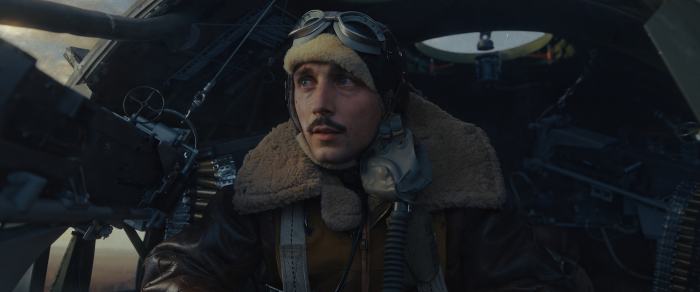
Raff Law and Samuel Jordan in the second episode of Masters of the Air. (Source: Apple TV+)
No depiction of the air war on film is perfect. There are some areas where the second episode struggled, but these are few and far between. Judging by online reactions, the most controversial scene involved the doctrinal debate between American and British airmen in the pub. I believe this scene did a good job of educating the public about the doctrinal differences between the two sides without having to dive into the high-level strategy meetings that occurred on this topic. The episode also demonstrates that the two allies are quite passionate about their beliefs on how best to prosecute the air war. However, the second episode failed to grasp the attitude with which the British expressed their concerns over daylight precision bombing. The British had tried and failed to carry out their own precision bombing campaign at the beginning of the war. Their experience led them to adopt night area bombing. As the more experienced partner in the alliance, the British were concerned that the Americans might be unable to maintain the attrition rate that a daylight campaign demanded. The Americans were, however, more than willing to sustain a much higher attrition rate to execute daylight precision bombing. Instead, the writers wrote a scene that wreaked of animosity between the two groups of airmen. Had the writers changed the tone of the scene, then they might not be facing the blowback that they are today. It was one scene, but even today, the emotions of the air war still run high.
Overall, the first two episodes of Masters of the Air started the series well and educated viewers about the ugly nature of the American strategic bombing campaign from the perspective of the airmen. This episode gave the audiences the basics of what to expect from typical American raids. As a result, they set the stage for the raids that would begin to stand out more in 1943, such as the upcoming 17 August 1943 Schweinfurt-Regensburg mission, a disaster for the Eighth Air Force. Masters of the Air has done an excellent job setting up the rest of the series. Now, viewers will see whether the series can maintain its form going into the darker days of the air war in the following episodes.
Dr Luke Truxal is an adjunct at Columbia State Community College in Tennessee. He completed his PhD in 2018 from the University of North Texas with his dissertation ‘Command Unity and the Air War Against Germany.’ His previous publications include ‘Bombing the Romanian Rail Network’ in the Spring 2018 issue of Air Power History. He also wrote ‘The Politics of Operational Planning: Ira Eaker and the Combined Bomber Offensive in 1943’ in the Journal of Military Aviation History. In addition, Truxal is researching the effectiveness of joint air operations between the Allied air forces in the Second World War. He can be reached on Twitter at @Luke_Truxal.
Header image: Austin Butler as Major Gale ‘Buck’ Cleven in episode one of Masters of the Air. (Source: Apple TV+)
Editorial Note: Led by Editor Dr Mike Hankins, From Balloons to Drones, produces a monthly podcast that provides an outlet for the presentation and evaluation of air power scholarship, the exploration of historical topics and ideas, and provides a way to reach out to both new scholars and the general public. You can find our Soundcloud channel here. You can also find our podcast on Apple Podcasts and Google Podcasts.
From Balloons to Drones is excited to be joined by veteran astronaut Tom Jones to talk about the history of the US Space Shuttle Program. Having flown in space on four shuttle missions, Jones shares not only his own perspective but also reflects on the entirety of the shuttle program based on the interviews and research that informed his new book, Space Shuttle Stories: Firsthand Astronaut Accounts from All 135 Missions (2023), from Smithsonian Books.
Tom Jones is a veteran astronaut, planetary scientist, pilot, author, and speaker who completed four space shuttle missions and three spacewalks in helping build the International Space Station. Jones has authored six books, including Sky Walking: An Astronaut’s Memoir, and has written for aerospace magazines such as Air & Space Smithsonian, Aerospace America, Popular Mechanics, and The Planetary Report. A senior research scientist for IHMC, he appears regularly on television news as an expert commentator for space exploration and science stories.
Header image: Space Shuttle Atlantis takes flight on its STS-27 mission on 2 December 1988, utilising 375,000 pounds of thrust produced by its three main engines. The engines start in 3.9 seconds of ignition and go to static pump speeds of approximately 35,000 revolutions per minute during that time. (Source NASA)
Friday, 26 January, the long-awaited first and second episodes of Masters of the Air, based on the excellent eponymous book by Don Miller, premiered on Apple TV+. When I say long-awaited, rumours and articles have swirled around the series for over a decade, dating back to 2012.
I was lucky to see the first episode early last week as part of pre-screening at the US Air Force Academy. As From Balloons to Drones was created to discuss just such a series in the public realm, I wanted to provide a quick commentary with my thoughts from the first episode.
The oft-watched, oft-quoted, and something of related series that Masters of the Air will be inevitably compared to is 2001’s Band of Brothers. When Band of Brothers released on 09 September 2001 (yes, at its first showing on the evening of the ninth, the world was less than 48 hours away from the events of 11 September), 57 years had passed since the events of the show. Many unit members were still alive in their late seventies or early eighties. As most remember, each episode either began or ended with the veterans telling their stories. This is, sadly, impossible for Masters of the Air. I do ponder how Major Gale ‘Buck’ Cleven, Major John Egan, or Lieutenant Colonel Robert ‘Rosie’ Rosenthal might have reacted to having themselves portrayed in the series. These real-life men never lived to see themselves portrayed in film, another bitter reminder that the Second World War generation is all but gone now.
Bombs being dropped on enemy installations at Wessling, Germany by Boeing B-17 Flying Fortresses of the US 100th Bomb Group, 12 August 1943. (Source: US National Archives and Records Administration)
In my two viewings of episode one so far, two words continually play in my mind: Poignant and terrifying. Masters of the Air has succeeded where other more recent films have failed – at least for me – the actors portraying these real men (I cannot bring myself to refer to them as ‘characters’) do so without entering the realm of parody. The protagonists thus far, Buck and Bucky, seem like mid-twenties officers of the time, and I hope their character development continues in future episodes.
So far, the attention to detail seems well in hand. The men gearing up for the missions, the checklist, and the startup process for the Boeing B-17 Flying Fortresses is something too oft missed in other aerial films where pilots and crews hop in and zoom off to the wild blue yonder with nary a wave at the ground crews. The maintainers and mechanics also have their moments so far, and it is nice to see some recognition for the men who kept the planes in the air.
Obviously, the series uses CGI for the aerial battles but has used existing B-17s where possible. With only one episode down and knowing that the air battles are to increase in size with the number of aircraft and defenders, it has, thus far, demonstrated well the speed of attacking aircraft. Some critics have noted that the air battles are chaotic and difficult to follow. It is hard to tell who is who with the masks up and gear on, and the enemy fighters fly by in a blur with the gunners twisting to get off a few shots, but to my eye, there is realism here: the speed and chaos of air combat amongst the bomber crews is well done.
I cannot tell as of yet if Masters of the Air will live up to the hype, but as a historian, I have already found myself enjoying the series both for its storytelling and its accuracy. I also note that my air power colleagues have talked of little else this week and spent an inordinate amount of time talking to other interested parties, including media outlets (it’s a good time to be an air power historian). Knowing that the Tuskegee Airmen and Stalag Luft prison camps will be seen in future episodes only heightens my eagerness for more.
Thus far, I commend all parties involved in bringing the show to the screen. If this series inspires a younger generation to explore their past, ask questions about history, and look to learn more, it will have done its job.
Meanwhile, those of us already immersed in reading, researching, and publishing should use the series as a moment in time to explain what went on in the skies over Europe – and all over the world – during the Second World War: both the good and the bad, the glory and the horror, the rhetoric and the reality of the Masters of the Air.
Dr Brian Laslie is a US Air Force Historian and Command Historian at the United States Air Force Academy. Formerly he was the Deputy Command Historian at North American Aerospace Defense Command (NORAD) and United States Northern Command (USNORTHCOM). A 2001 graduate of The Citadel and a historian of air power studies, he received his Masters’ from Auburn University Montgomery in 2006 and his PhD from Kansas State University in 2013. He is the author of Air Power’s Lost Cause: The American Air Wars of Vietnam (2021), Architect of Air Power: General Laurence S. Kuter and the Birth of the US Air Force (2017) and The Air Force Way of War (2015). The latter book was selected for the Chief of Staff of the Air Force’s 2016 professional reading list and the 2017 RAF Chief of the Air Staff’s reading list. He can be found on Twitter at @BrianLaslie.
Header image: A formation of Boeing B-17 Flying Fortresses of the 100th Bomb Group flies over a blanket of clouds en route to their target at Warnemunde, Germany, 29 July 1943. The aircraft shown is the B-17 ‘Alice From Dallas’. Source: US National Archive and Records Administration)
Editorial Note: Led by Editor Dr Mike Hankins, From Balloons to Drones, produces a monthly podcast that provides an outlet for the presentation and evaluation of air power scholarship, the exploration of historical topics and ideas, and provides a way to reach out to both new scholars and the general public. You can find our Soundcloud channel here. You can also find our podcast on Apple Podcasts and Google Podcasts.
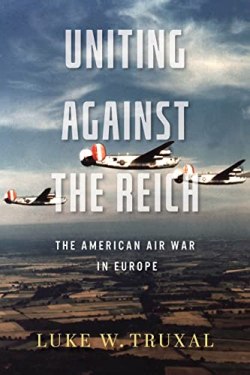
Dr Luke Truxal is the author of the new book Uniting Against the Reich: The American Air War in Europe from the University Press of Kentucky. In it, he traces how the structure of command over air forces in the Second World War created a mess of problems. Only late in 1943 and into 1944 did these command structures change, enabling air power to become more effective. In this interview, Truxal takes us into the dramatic relationships between leaders like Dwight Eisenhower, Carl Spaatz, and more, showing why, in positions of leadership, personality matters.
Dr Luke Truxal is an adjunct at Columbia State Community College in Tennessee. He completed his PhD in 2018 from the University of North Texas with his dissertation ‘Command Unity and the Air War Against Germany.’ His previous publications include ‘Bombing the Romanian Rail Network’ in the Spring 2018 issue of Air Power History. He also wrote ‘The Politics of Operational Planning: Ira Eaker and the Combined Bomber Offensive in 1943’ in the Journal of Military Aviation History. In addition, Truxal is researching the effectiveness of joint air operations between the Allied air forces in the Second World War. He can be reached on Twitter at @Luke_Truxal.
Header image: A formation of Boeing B-17F Flying Fortresses over Schweinfurt, Germany, on 17 August 1943. (Source: National Museum of the United States Air Force)
Editorial Note: Led by Editor Dr Mike Hankins, From Balloons to Drones, produces a monthly podcast that provides an outlet for the presentation and evaluation of air power scholarship, the exploration of historical topics and ideas, and provides a way to reach out to both new scholars and the general public. You can find our Soundcloud channel here. You can also find our podcast on Apple Podcasts and Google Podcasts.
2023 marks the 30th anniversary of the announcement of the first female American combat fighter pilots. How did the US go from women not being allowed in military aeroplanes to having women combat pilots? Eileen Bjorkman (Colonel, USAF, ret’d) joins us to discuss these momentous changes. She is a former flight test engineer who has flown in aircraft like the F-4 Phantom and the F-16 Fighting Falcon, and she is the author of Fly Girls Revolt: The Story of the Women who Kicked Open the Door to Fly in Combat (2023), from Knox Press.
Eileen Bjorkman is a retired US Air Force Colonel. She was a flight test engineer during her USAF career, flying more than 700 hours in twenty-five different types of military aircraft, including fighters such as the F-4 and F-16. She is also a civilian pilot and author of The Propeller Under the Bed (2017) and Unforgotten in the Gulf of Tonkin (2020).
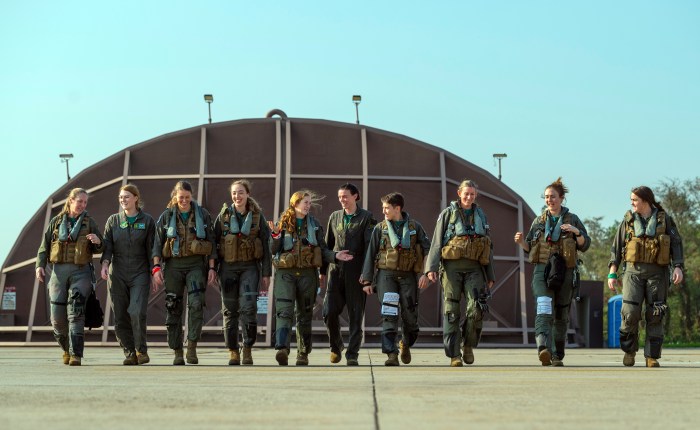
Header image: Female fighter pilots assigned to the 36th and 25th Fighter Squadrons join together before flying a historic all-female flight at Osan Air Base, South Korea, on 25 October 2021. The flight is the first time 10 female Airmen have planned, led and flown in a formation together while assigned to Osan AB. Eight pilots are A-10 Thunderbolt II pilots, and two are F-16 Fighting Falcon pilots. (Source: US Air Force)
In 2024, From Balloons to Drones will run a series of articles that examines the role of air power during the defining year of the Second World War – 1944.
The year 1944 was the defining year of the Second World War. Events such as the fall of Rome, the invasion of France and the destruction of Germany’s Army Group Centre on the Eastern Front defined the war in Europe. In the Pacific and Southeast Asia, events such as the Battles of Imphal and Kohima and the Battle of the Philippine Sea marked important points in the war. In the strategic air war, the Combined Bomber Offensive in Europe peaked. At the same time, the Boeing B-29 Superfortress was introduced in the Far East and Pacific as the US increased its strategic air operations in this theatre of operations.
2024 marks the 80th Anniversary of the critical events of 1944. At all levels of war, air power played an essential role in the various battles and campaigns of 1944. As such, From Balloons to Drones is seeking submissions for articles examining the varied use of air power in 1944. Articles might, for example, explore the strategic air campaigns of 1944, the use of tactical air power, or the use of carrier-based air power. Possible themes to be explored might include, but are not limited to:
Strategy, Theory and Doctrine | Organisation and Policy | Roles Operations – Kinetic and Non-Kinetic | Tactics, Training and Procedures Strategic and Operational Effect | Technological Developments | Ethical and Moral Issues National, International and Transnational Experiences | Personal Experiences Memory and Memorialisation
We are looking for articles of between 500 to 4,000 words, but we will accept larger pieces and reserve the right to publish them in parts. Please visit our submissions page for more information on the types of articles published by From Balloons to Drones.
We plan to begin running the series in March 2024, and it will continue for as long as we receive potential contributions. We welcome and encourage submissions from academics, policymakers, service personnel, and relevant professionals.
Submissions should be submitted in Word format and emailed to the email address below with ‘SUBMISSION – Air Power and 1944 Revisited’ in the subject line. Also, please include a 50-100-word biography with your submission. Footnotes can be used, and please be careful to explain any jargon. If you are unsure if your idea fits our requirements, please email us with ‘POTENTIAL SUBMISSION – Air Power and 1944 Revisited’ in the subject line to discuss.
If you are interested in contributing, please email our Editor-in-Chief, Dr Ross Mahoney, at airpowerstudies@gmail.com or contact us via our contact page here.
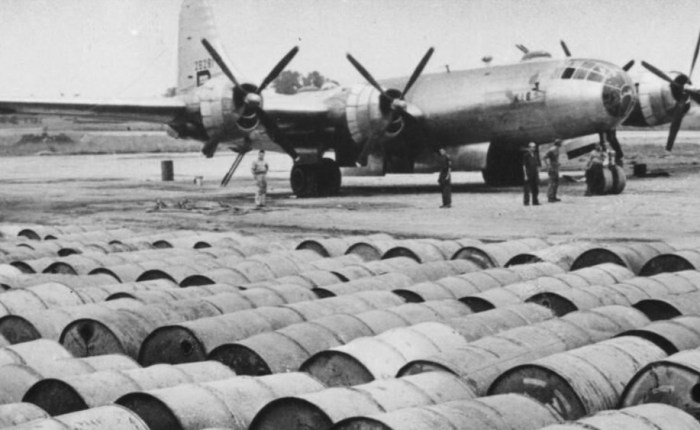
Header image: Rows of fuel tanks in front of a B-29 Superfortress of the 40th Bombardment Group assigned to the US Twentieth Air Force in China, c. 1944. (Source: Wikimedia)







 From Balloons to Drones