Reviewed by Dr Brian Laslie
Rob Zettel, American MiG Pilot: Inside the Top Secret USAF “Red Eagles” MiG Squadron. Oxford: Osprey Publishing, 2026. Appendices. Glossary. Index. Images. Hbk. 366 pp.
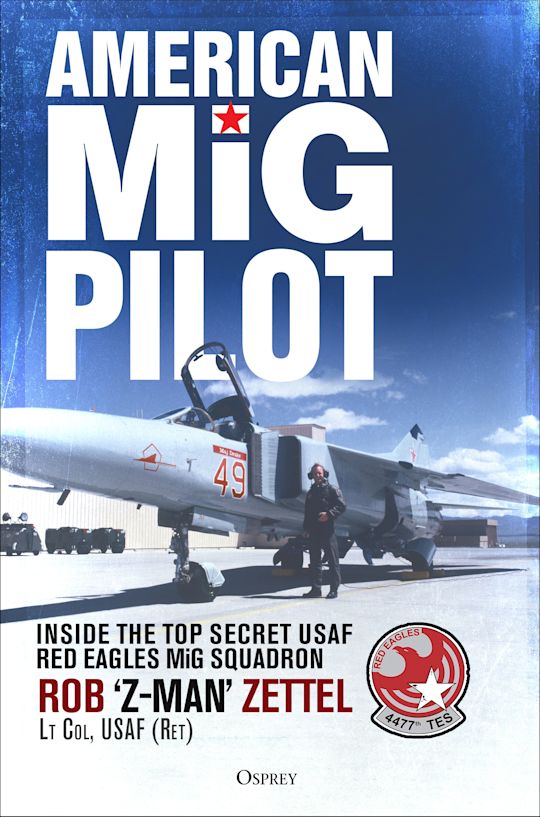
The reviewer approached Osprey Publishing’s new work, American MiG Pilot: Inside the Top Secret USAF “Red Eagles” MiG Squadron, with a bit of trepidation. What else could be said of the now-famous American MiG Squadron? After all, two previously published works in recent years have certainly told the story. Duly humbled after reading it, I answer the question of what remains to be said: quite a lot. This work represents the third book in what Osprey should call their ‘MiG trilogy.’ Beginning with Steve Davies’ Red Eagles: America’s Secret MiGs (2008), the groundbreaking first book detailing the existence and operations of the 4477th Test and Evaluation Squadron and followed by Colonel Gaillard ‘Evil’ Peck’s book America’s Secret MiG Squadron: The Red Eagles of Project CONSTANT PEG (2012) where the author, a former commander of the 4477th, details the genesis and early days of the program. Finally, this new work by Lieutenant Colonel Rob ‘Z-Man’ Zettel provides a line pilot’s view of the tactical flying inside the unit. It is a damn good story, and Zettel tells it with the skill of a seasoned writer, not someone approaching the craft of writing for the first time.
Zettel’s work begins with his desire to become a pilot in the United States Air Force (USAF) and his journey from a high school underachiever to an ROTC graduate headed to pilot training, where he earned an F-4 slot. From there, the book nicely details the post-Vietnam era inside the USAF through the eyes of one of its junior Officers. Despite clearly being an excellent ‘stick and rudder’ pilot, Zettel comes across throughout the book as humble, a fighter pilot just trying to do his best day in and day out, long before the USAF Fighter Weapons School took as its moniker ‘Humble, Credible, and Approachable.’ The same cannot be said of numerous other fighter pilot memoirs, where authors clearly keep the focus on themselves.
The book reiterates what those who study the USAF after Vietnam already recognize: the importance of realistic training in the post-Vietnam era, the creation of Red Flag and the Aggressor squadrons as an impetus for change throughout the organization and how these exercises, events, and training regimens dramatically improved American pilot capability in the years before the aerial conflicts of the 1990s, most notably Operation Desert Storm (Operation El Dorado Canyon garners an interesting position in this work as well). Zettel’s book ‘bridges the gap’ between the Vietnam and Desert Storm generations, which many scholars of aviation and air power history now view as the ‘second inter-war period’ for its technological advancements, doctrinal changes, inter-service agreements, and the melding of these with individual pilot improvement. This latter point was the mission of the 4477th Test and Evaluation Squadron: to expose American fighter pilots to Soviet- and Chinese-made fighter aircraft.
Zettel details his personal career path: how he turned down a chance to attend the weapons school for a chance (with no guarantee) to be selected for an assignment to the Aggressor Squadron at Clark, AFB. This leap of faith set the course for his career from then on. Zettel gained an Aggressor slot and was later interviewed for the 4477th Test and Evaluation Squadron, selected in 1983. Zettel’s humility belies an essential truth: he was one of the best fighter pilots in the USAF.
While his ‘stick and rudder’ skills have been mentioned, it seems evident that Zettel was a quiet professional who took his craft of imparting his knowledge as an aggressor squadron pilot very seriously. His assignment to the 4477th Test and Evaluation Squadron fills the bulk of the pages. American MiG Pilot might be the best of Osprey’s ‘MiG trilogy,’ but it is not for the uninitiated. Comfort with high vs low speed engagements, lift vectors, one vs two-circle fights, and angle of attack, all prerequisites to diving into this work, one finds oneself at a loss to understand where in time and space the aircraft being discussed are and how they are moving relative to each other. The reviewer recommends Robert Shaw’s Fighter Combat: Tactics and Maneuvering (1985) as an excellent primer. While fighter pilots will especially enjoy this work, historians seeking to understand developments in the USAF at the tactical level between 1975 and 1991 will find much to consider here. Zettel nicely bridges the gap between more academic work and the prolific ‘there I was’ popular histories. While this is Zettel’s first foray into the written word, let us hope it is not his last. Any student or scholar of air power and the Cold War is sure to enjoy and find this work useful.
Dr Brian Laslie is a noted air power historian, having authored The Sundowners, Pegasus, and Little Butch: Carrier Air Group Eleven and the War in the Pacific, 1943-1945 (2025), Air Power’s Lost Cause: The American Air Wars of Vietnam (2021), Architect of Air Power: General Laurence S. Kuter and the Birth of the US Air Force (2017) and The Air Force Way of War (2015). The latter book was selected for the Chief of Staff of the Air Force’s 2016 professional reading list and the 2017 RAF Chief of the Air Staff’s reading list. US Air Force Historian and Command Historian at the United States Air Force Academy. Formerly, he was the Deputy Command Historian at the North American Aerospace Defense Command (NORAD) and United States Northern Command (USNORTHCOM). A 2001 graduate of The Citadel and a historian of air power studies, he received his Masters’ from Auburn University Montgomery in 2006 and his PhD from Kansas State University in 2013.
Header image: The ‘Constant Peg: Secret MiGs in the Desert’ exhibit on display in the Cold War Gallery at the National Museum of the US Air Force. (Source: National Museum of the US Air Force)
Discover more from From Balloons to Drones
Subscribe to get the latest posts sent to your email.

 From Balloons to Drones