By Dr Luke Truxal
Editorial note: On 26 January 2024, Apple TV+ launched the much-anticipated series Masters of the Air. This series follows the actions of the US 100th Bomb Group during the Combined Bomber Offensive in the Second World War. As the series is being aired, our Book Reviews Editor, Dr Luke Truxal, the author of Uniting against the Reich (2023), will provide a critical review of each episode.
Three episodes in, we now better understand what the series Masters of the Air does well and where the show falls short. Let me begin this review by stating that I enjoy the series and what it deliers. Viewers gain a better perspective of the air war from the airmen who flew the missions than previous depictions. The show does justice to the US 100th Bomb Group and tells its story. This is still a good episode and series despite the criticism you will see at the end of this review. I will still recommend it to others. My problem is that the show fails to reach its full potential in telling this story. I think this is where the shows Band of Brothers (2001) and The Pacific (2010) really soared and why, for me, Masters of the Air feels so close but still not on the same level.
This week’s episode was the fateful Schweinfurt-Regensburg mission on 17 August 1943. The raid was the second unmitigated disaster that the Americans suffered in the air war that month. On 1 August 1943, the US Ninth Air Force attacked the Romanian oil refineries at Ploiești with five B-24 groups, three of which were on loan from the US Eighth Air Force. While the raid succeeded in damaging the refineries, it failed to stop Romanian oil production at the cost of 54 Consolidated B-24 Liberators and 310 airmen.[1] While Ploiești does not appear in the episode, it is crucial to understand the context of the air war in 1943. These were some of the darkest days of the air war for the Americans. The episode begins with a briefing about the Schweinfurt-Regensburg mission. Colonel Neil Harding, portrayed by James Murray, does a great job at explaining the nature of the mission, bad sports metaphors aside. The first strike force, which included the 100th Bomb Group, was to strike at German aircraft factories at Regensburg, thus drawing the bulk of the German fighter force onto their formation. He correctly explains that the bombers behind the 100th Bomb Group will move towards Schweinfurt and strike at German ball-bearing production with less resistance. The audience now has a great understanding of how the mission is supposed to work on paper.
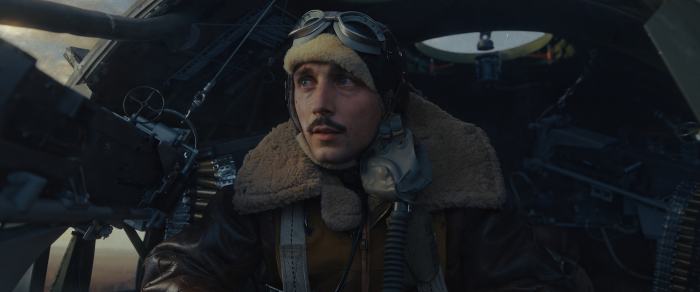
The thesis of this entire episode was about the choices that soldiers make in war and how they impact the lives of those around them. It all begins with the poor weather delays that affected the execution of the raid. This led the US Eighth Air Force to send out Colonel Curtis LeMay’s Regensburg force five hours ahead of the rest of the force. During the raid, the creators of the show highlight several vital moments when decisions have to be made that affect the lives of the airmen in this episode. The first happens when Roy Claytor’s plane is shot down. As the crew bails out, the ball turret gunner, Sergeant William Hinton, becomes trapped and cannot escape. Sergeant William Quinn, the radio operator, hears his calls and tries to aid him as the rest of the crew bail out. Unfortunately, the plane enters a spin, and the force throws Quinn against the wall. He has to choose between his life and Hinton’s. He chooses his own. Later, we see that same choice posed to Quinn again when he speaks to a member of the Belgian resistance and has to decide if he wants to try to escape or spend the remainder of the war in a prison camp. His choice has not yet been revealed, and the scene ends on a cliffhanger. Lieutenant Curtis Biddick is the second character to face a life-or-death decision. His plane is hit during the raid, and his co-pilot, Lieutenant Richard Snyder, is severely wounded. In an emotionally impactful scene, Biddick decides to try and crash land the plane to save Snyder. The rest of the crew bail out successfully, and for a moment, it appears Biddick has once again pulled off the impossible. Unfortunately, he can’t maintain control of his Boeing B-17 Flying Fortress as it crashes into the ground in a massive explosion. The final major choice we see throughout the raid is Major Gale Clevan’s choice not to bail out and keep pushing his aircraft through the raid. His choice to keep pushing on paid off, with his plane landing just short of the runway at Telergma in the French colony of Algeria. Throughout the entire episode, there are several moments where the show makes it very clear that Clevan’s decision to press on could have had catastrophic consequences for him and his crew. The show did an excellent job at showing the choices that the young airmen of the 100th Bomb Group, many in their late teens and early twenties, had to make in split seconds and their consequences.
For an episode that emphasized the importance of the decisions made in war, the biggest one was left out. On the morning of 17 August 1943, the head of the US VIII Bomber Command, Brigadier General Frederick Anderson, had to decide whether or not to scrap the Schweinfurt-Regensburg mission. Anderson, like the commander of the Eighth Air Force, Major General Ira Eaker, was under immense pressure to execute this mission. General Henry Arnold, the US Army Air Forces commander, had taken a great personal interest in the raid and its success. The raid had been put off before due to poor weather. Additionally, the Regensburg force had to leave with enough time to have light remaining to land when they reached Algeria. Anderson ultimately made the call to send LeMay’s force first through the fog while waiting for the rest of the fog to dissipate before sending the rest of the bombers. This is how the two forces end up five hours apart. [2] This brings me to my biggest criticism of the show. Three episodes in, the show struggles to discuss the air war’s wider context. In the second episode, the writers poorly executed a scene to introduce the doctrine debates between the Americans. In this episode, the decision to not fly the mission as planned does not appear on the screen, which was the raid’s most important decision. This was a big missed opportunity for the creators of Masters of the Air. Anderson had to live with the fact that his decision on 17 August 1943 cost the Eighth Air Force sixty B-17s and 559 airmen either killed or missing.[3]
When it comes to telling the story of the 100th Bomb Group and its experience during the raid, this episode did an excellent job. It showed the life-or-death decisions these young men had to make in seconds, and if they were lucky, they would have to live with the consequences of those decisions. Yet, the quality of the television show could be much improved by occasionally widening its perspective. The series has become so zoomed in on the 100th Bomb Group that it struggles to tell the bigger picture of the air war. Adding a short scene here or there to add that big-picture perspective would bring everything together and make this television series genuinely extraordinary. My criticisms aside, this is still the best series on the air war I have seen, and it deserves to be in the same conversation as the 1949 film Twelve O’clock High.
Dr Luke Truxal is an adjunct at Columbia State Community College in Tennessee. He completed his PhD in 2018 from the University of North Texas with his dissertation ‘Command Unity and the Air War Against Germany.’ His previous publications include ‘Bombing the Romanian Rail Network’ in the Spring 2018 issue of Air Power History. He also wrote ‘The Politics of Operational Planning: Ira Eaker and the Combined Bomber Offensive in 1943’ in the Journal of Military Aviation History. In addition, Truxal is researching the effectiveness of joint air operations between the Allied air forces in the Second World War. He can be reached on Twitter at @Luke_Truxal.
Header image: Edward Ashley, Matt Gavan, Callum Turner and Anthony Boyle in Masters of the Air (Source: Apple TV+)
[1] Jay A. Stout, Fortress Ploesti: The Campaign to Destroy Hitler’s Oil (Havertown, PA: Casemate Publishers, 2011), p. 76.
[2] Luke Truxal, Uniting against the Reich: The American Air War in Europe (Lexington, KT: University Press of Kentucky, 2023), pp. 71-3.
[3] Truxal, Uniting Against the Reich, pp. 76-7.
Discover more from From Balloons to Drones
Subscribe to get the latest posts sent to your email.

 From Balloons to Drones