Editorial note: On 26 January 2024, Apple TV+ launched the much-anticipated series Masters of the Air. This series follows the actions of the US 100th Bomb Group during the Combined Bomber Offensive in the Second World War. As the series is being aired, our Book Reviews Editor, Dr Luke Truxal, the author of Uniting against the Reich (2023), will critically review each episode.
For the first time in the Masters of the Air television series, I was genuinely disappointed in an episode. There were two significant issues with this episode. The first major problem has now become a glaring problem for the show, which is the inability to tell a story outside the US 100th Bomb Group with the quality that it deserves. This is either because the show relies so heavily on veteran accounts that it cannot tell the larger story or because the show only half-heartedly covers the topic, like checking a box on an essay due at the end of class. The second major issue is that this episode wasted priceless minutes of television time covering stories and plots that, in the grand scheme of things, are not as important as other aspects of the air war. In many respects, this is likely a major reason why the show will do some more box-checking in the coming episodes. The series spends too much screen time on less critical plots and must condense more essential stories into the final two episodes.
For this review, I will not give an overview of the episode and jump straight into the problems because there is much to criticise. The first major issue that this episode, and the show more generally, struggle with is its treatment of those not members of the 100th Bomb Group. First, generals are written as blundering fools who do not care about their men. In the third episode, Colonel Curtis LeMay’s aggressiveness is blamed for the disaster of the Schweinfurt-Regensburg raid, even though he flew in the lead plane for the mission. Also, it left out the debates that US VIII Bomber Command struggled with in determining whether to send out the raid. This theme continued in this episode. While the episode did a good job of covering the aftermath of the 6 March 1944 Berlin raid well, during the planning and briefing of the 8 March raid, the writers decided to portray the commander of the US Eighth Air Force, Lieutenant General James Doolittle, and the commander of the United States Strategic Air Forces in Europe, Lieutenant General Carl Spaatz, as blundering fools who are using the same navigational route for back to back raids. As an audience member, it is hard to decide whether the showrunners want us to believe these men are unintelligent, lazy, or do not care. Most likely all the above. For perspective, the navigational route was chosen because it avoided flak concentrations and limited combat losses.[1]
Kai Alexander and Bailey Brook in Masters of the Air. (Source: Apple TV+)
The show did not stop there. At the end of this episode, the new commander of the 100th Bomb Group, Lieutenant Colonel John Bennett, lays out the latest air strategy for gaining air superiority at the end of the episode to Captain Robert Rosenthal. He states that the new strategy going into March and April 1944 will be to win the air war by using the bombers as bait for the fighters so that the newly arrived long-range escort fighters, the North American P-51 Mustangs, can shoot down the German fighters. There are so many ways in which that scene does an injustice to the strategic, operational, and tactical changes Spaatz and Doolittle implemented at the beginning of 1944. Starting with the strategic picture. Spaatz rightfully argued that Operation OVERLORD could not go forward if the air superiority had not been gained before troops began landing in Normandy. This was a huge point of contention between Spaatz and the commander of the Allied Expeditionary Air Forces, Air Chief Marshal Leigh-Mallory.[2] Spaatz went into 1944 to grind down the Luftwaffe through a large series of air battles carried out through the skilful concentration of all American air forces in the European and Mediterranean Theaters of Operations. Spaatz deserves much credit for bringing maximum pressure to bear on the Luftwaffe and degrading their combat effectiveness, starting with Big Week from 20 to 25 February 1944 and continuing through March and April 1944. Furthermore, the tactical changes implemented by the Eighth Air Force came from Doolittle. Doolittle changed the fighter tactics when he took over the Eighth Air Force from Lieutenant General Ira Eaker in January 1944. This came in two parts. First, American fighter pilots were no longer merely escorts as they were in 1943. Once engaged, American fighter pilots were to pursue German fighters even if it meant leaving the bomber stream. This was a more effective means to gain air superiority by prioritising shooting down German fighters. Additionally, Doolittle adopted the idea of using a bouncing fighter group, whose job was to roam the edges of the bomber formation in search of German fighters preparing to attack the bombers. These are well-known changes to scholars of the air war and can be easily told on screen to an audience. However, by stating that the generals wanted to use the bombers as bait, the show has given the impression to the audience that the American generals do not care about their losses and that this is simply a numbers game for the brass.
Another problem with this show is the anti-British bias that shows up. By this point, I wonder whether the showrunners think the British military can do anything well. While the criticisms of the British night bombing strategy in the second episode of the series were warranted, the scene did not convey the message well. I initially thought this was merely a poorly written-scene. At this point in the series, I think it is safe to say that whoever is writing the scenes regarding the British military holds them in contempt. It comes up again and again throughout the episodes. Sometimes in tiny doses. At other times, quite openly, as we saw in episodes two and six. In this episode, we get two more doses of British failures. While listening to the radio at Stalag Luft III, the Americans hear about the British failure to take Monte Casino in Italy. Later in the episode, there is the failure of the Great Escape, in which 76 British and Commonwealth prisoners escape the camp. Only three can evade captivity and get back home. Of the 73 that were captured, 50 were executed in retaliation. This is a significant moment for those living at Stalag Luft III and is a sign of British and Commonwealth prisoners continuing to wage war against the Germans using whatever means are at their disposal, including escape. Instead, it is portrayed as another British failure, and the consequences make life at the camp harder for the Americans of the 100th Bomb Group interred there. These are just two examples of the shortcomings of this show to tell the bigger picture. Where Band of Brothers (2001) and The Pacific (2010) did a much better job providing context, Masters of the Air has fallen dreadfully short by putting so much emphasis on the perspective of the airmen. There is no sugarcoating it: this show is bad at telling stories outside the 100th Bomb Group.
These problems pale in comparison to the poor use of screen time in this episode. Much of this episode was dedicated to two plots that did not serve a significant purpose and took away screen time to lay the groundwork for more critical plots. First, much of the plot at Stalag Luft III centred on maintaining some news of the outside world using a handmade radio that the airmen kept hidden. While this did indeed happen, the radio plot took away time that could have be en better spent. While at Stalag Luft III, Major John Egan handled security, and Major Buck Clevan oversaw education at the South Compound.[3] Telling these stories provides more insight into camp life than focusing on losing and rebuilding a radio. Furthermore, the show ended teasing that the Tuskegee airmen would first appear in the eighth or nine episodes. It would have been nice to use some of the time in this episode to show the challenges black airmen faced in their fight to serve their country as fighter pilots and help orchestrate significant civil rights changes in the military through their service. Instead, like with the film Red Tails, Masters of the Air has chosen to skip the crucial challenges faced during training in the United States. This was a big missed opportunity. This is why this episode is so bad. The US 332nd Fighter Group’s story deserves more than a token appearance in the television series. Either tell the story well or save that story for a different television series. Simply throwing this story in without telling the back story does not do the history or airmen justice. For a better portrayal of black fighter pilots’ challenges, see the film The Tuskegee Airmen (1995).
This episode was a disappointment. This review cannot do a proper recap and review that covers every issue with this episode. Instead, I highlighted major flaws and trends in the episode and series. The treatment of other nationalities fighting against the Axis and the treatment of high-ranking officers do this series and subject a disservice. These are symptoms of long-growing problems with this show. This specific episode wasted valuable screen time on less essential plots like Captain Harry Crosby’s fictional infidelity and the time spent fixing a radio. By spending valuable minutes on these storylines, the show missed great opportunities to tell important narratives. This will have grave consequences as the show tries to introduce new storylines and wrap up the show in the final two episodes. Unfortunately, this is where the show is headed. Masters of the Air seems determined to give token coverage to serious issues while wasting valuable time on less important topics. This is an unfortunate development for a show I have come to enjoy.
Dr Luke Truxal is an adjunct at Columbia State Community College in Tennessee. He completed his PhD in 2018 from the University of North Texas with his dissertation ‘Command Unity and the Air War Against Germany.’ His previous publications include ‘Bombing the Romanian Rail Network’ in the Spring 2018 issue of Air Power History. He also wrote ‘The Politics of Operational Planning: Ira Eaker and the Combined Bomber Offensive in 1943’ in the Journal of Military Aviation History. In addition, Truxal is researching the effectiveness of joint air operations between the Allied air forces in the Second World War. He can be reached on Twitter at @Luke_Truxal.
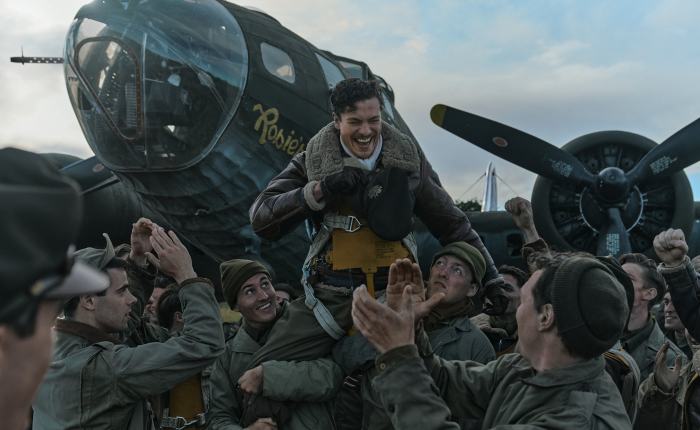
Header image: Nate Mann in Masters of the Air. (Source: Apple TV+)
[1] Donald Caldwell and Richard Muller, The Luftwaffe Over Germany: Defense of the Reich (Barnsley: Frontline Books, 2014), p. 168.
[2] Luke Truxal, Uniting Against the Reich: The American Air War in Europe, (Lexington: University Press of Kentucky, 2023), p. 115-7.
[3] Donald Miller, Masters of the Air: America’s Bomber Boys Who Fought the Air War Against Nazi Germany (New York: Simon and Schuster, 2006), p. 389.
The popular perception of the prisoner of war is that, once captured, he was out of the battle. Rather than compliantly accepting a status of hors de combat, however, many captive allied airmen in Europe during the Second World War continued to be potent military operatives in a new theatre of conflict—the barbed wire battleground. Indeed, the airmen adopted a stance as prison camp combatants. To facilitate this, they actively managed their lives to demonstrate individual and collective agency. They strenuously mitigated the ill-effects of their circumstances by embarking on a program of active disruption. Importantly, they did not give in to, what at least one man termed, ‘the futility of existence’.[2]
Drawing on personal records in private and public collections, as well as official reports, this article provides a brief overview of some of the ways in which Australians and their fellow prisoners in Stalag Luft III, a Luftwaffe prisoner of war camp, established, maintained and promoted themselves as active airmen, on duty, in the barbed wire battleground.
‘Vacation at Stalag’, Cyril Borsht’s wartime log book, courtesy of the late Cyril Borsht (Source: Private Collection)
Many downed airmen spoke of the ‘shock’ of captivity and the shame they felt on capture.[3] These feelings were a common response to being taken from battle.[4] The airmen’s sense of disgrace was exacerbated when they heard the ‘usual taunt’, ‘fürsie der Krieg is beendet’—‘for you the war is over’.[5] The realisation after their unwilling departure from the aerial arena that they had become prisoners of war was a serious blow to self-esteem and service pride.[6] However, rather than accept a situation defined by passivity and docility, they rejected it.[7] The war was not over for them. Moreover, so, they remained on active service as prison camp combatants.
‘I wanted wings’, Ronald Baines’ wartime log book, courtesy of the Baines family (Source: Private Collection)
However, before they re-attained operational readiness, they had to regain their fighting spirit. Humour was a significant means to that end as well as an almost universal morale booster.[8] Many, for instance, depicted their new accommodation as a holiday camp or sanatorium,[9] and tongues were firmly in cheek when they poked fun of the ignominious exits that landed them there.[10] Many illustrated themselves as Donald Duck behind bars.[11] ‘Winglessness’, like that of ‘Downed Donald’, was a shared state and the men gained strength through ridiculing their common plight.[12]
The armed forces have a long tradition of using language to distance themselves from the emotions associated with military action and death in service.[13] The men of Stalag Luft III were no different, and so, they too gained strength through language. While they were initially bemused at being called Terrorflieger, Luftgangster, and Terrorbomber, many filled their wartime logbooks with clippings from German newspapers that promoted Allied airmen as the Second World War version of terrorists.[14] In doing so, the downed airmen recognised that the propagandised terms highlighted their success. Consequently, they ignored the intended insults and willingly accepted—as tributes to their military prowess—their new designations.[15]
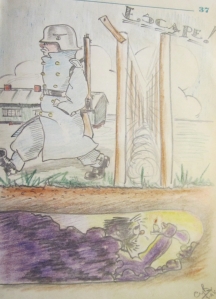
‘Escape’, Cyril Borsht’s wartime log book, courtesy of the late Cyril Borsht. (Source: Private Collection)
The airmen were not, however, so keen to be known as Kriegsgefangener—war prisoner—because of the negative and shameful connotations surrounding the word ‘prisoner’ and its associated trappings, such as POW number, fingerprinting, and identification discs.[16] Accordingly, they spurned ‘prisoner of war’. In a canny example of linguistic reframing, they adopted the easier-to-pronounce and linguistically distancing abbreviation of ‘kriegie’—even those who were captured in the later months of the war.[17] Derived from the first syllable—the German word for ‘war’—it subconsciously indicated that they were still men of war with a fine fighting spirit and distanced them from the stigma of captivity. ‘Kriegie’ removed the sense of derogation surrounding captivity and turned an affront—and assault to their dignity—into a linguistic badge of inclusiveness and pride. ‘Kriegie’ declared that they were still men of war on operational service. It also became ‘a fun word’ to describe them.[18] Ultimately, their prison camp patois—terrorflieger, Luftgangster, kriegie and so on—became a language of agency and defiance.
‘Cutting from a Reich paper of a ‘typical’ ‘terrorflieger’ or ‘luftgangster”, Cyril Borsht’s wartime log book, courtesy of the late Cyril Borsht. (Source: Private Collection).
With self-esteem restored, confidence reasserted, and fighting spirit reinvigorated, the airmen turned to discipline and their strong sense of service duty to help negotiate captivity. Demonstrating collective agency, the kriegies institutionalised air force discipline in the camp.[19] They acknowledged that running Stalag Luft III along RAF station lines was best for the community—for the camp commonweal—and it was generally agreed that the senior officers ‘did an excellent job’.[20] As well as maintaining ‘a high degree of morale and discipline’,[21] there was much security in adhering to the familiar aspects of their former service lives.[22] Moreover, it afforded the airmen the support they needed to wage war as prison camp combatants.
One aspect of that war was the duty of active resistance. All new arrivals were interviewed by the Senior British Officer or, in the NCO compound, the Man of Confidence, who reminded the kriegie new boys of their continuing obligations as servicemen.[23] Importantly, they warned them not to comply with any German order ‘beyond what was necessary’.[24] The airmen welcomed their new responsibility of active resistance and defiance. Exemplifying personal and group agency they were deliberately disruptive.[25] They misbehaved during roll call.[26] They purloined German supplies.[27] They bribed guards.[28] Their favourite sport became goon-baiting.[29] Many embarked on covert operations. Some became code writers and sent secret messages to MI-9.[30] A major aspect of active resistance was escape, and the airmen embraced their moral right[31] and duty[32] to break out of the prison camp. If they were not on the exit list for a particular attempt, or not personally eager—or even physically or psychologically capable—they supported those who were by participating in the communal effort.
Active resistance, disruption, defiance, and escape work epitomised individual and collective agency. Significantly, they reinforced the airmen’s continuing identity as combatants. For many, such concerted agency ameliorated the mortification of becoming prisoners of war. Moreover, so, the escape or ‘X’ organisation became the overriding feature of life in Stalag Luft III.[33]
Each compound had its version of the ‘X’ organisation and Australians participated in almost every aspect of its work. ‘X’ rosters were drawn up disguised as participant lists for sports days, and sporty types created diversions.[34] The carpentry department commandeered bed boards to shore up the tunnels and other purposes and built cabinets and hidey holes to stow secret equipment.[35] Some men did metal work, made dummy rifles, and meticulously constructed compasses.[36] Scroungers obtained ink, radio parts and essential supplies.[37] Photographers took passport photographs.[38] Forgers replicated passes and identification papers.[39] Tunnellers dug, others carted dirt away, and gardeners disposed of it. Meanwhile, the majority joined the army of ‘watchers’ known as ‘stooges’, who kept a lookout for any sign of the Germans. So industrious were the tunnellers that, in East Compound alone, between 60 and 70 tunnels were started during the first six months.[40]
Despite such diligent ‘X’ work and prolific excavation, East Compound’s only successful getaway was that of October 1943—dubbed ‘the Wooden Horse’—where three men made a ‘home run’. The culmination of North Compound’s ‘X’ work was the mass breakout of March 1944. While seventy-six succeeded in fleeing the camp, only three made it home. Seventy-three were recaptured. Fifty were executed, five of whom were Australian.
The men regretted the tragic outcome, but not their part in it. Nor their determined demonstration of collective agency as prison camp combatants. They believed their large-scale resistance work had been worthwhile, not just because of the sustaining effect on morale, but because of the cost to the Germans in tying up resources during the ensuing Großfahndung which they considered ‘biggest manhunt of the war’.[41]
After the war, Paul Brickhill, an Australian journalist and former Stalag Luft III kriegie, was invited to write a book about the March 1944 escape.[42] That book proved influential in how captivity in Stalag Luft III has been portrayed. The mass breakout, for example, was not known as the ‘Great Escape’ until the publication of Brickhill’s The Great Escape in 1951.[43] From that time, the book’s title entered the lexicon as participants, bystanders and the public all appropriated it to describe an event that still resonates. So powerful is the book’s theme of triumph over the enemy through a communal agency, so exciting is the narrative, that most commercially published accounts of life in Second World War German POW camps—and Stalag Luft III in particular—feature the exciting high adventure and derring-do of major escapes.
While many of the former airmen were impressed with Brickhill’s book, many were not overly pleased with John Sturges’ 1963 film. They begrudge it the Americans, the motorbike, a truly appalling Australian accent, and other factual inaccuracies inserted in the interests of ‘good cinema’.[44] Despite their distaste, the film, along with Brickhill’s book, has left a substantial legacy which they, their descendants and popular culture have embraced.
They frame captivity in Stalag Luft III as an action-packed success story. They reinforce the kriegies’ personal and collective agency as active airmen, on operational service, in the barbed wire battleground. They deny any perception of passive, docile, humiliated prisoners of war. Just as the airmen themselves had done when they refused to accept that the war, for them, was over.
Kristen Alexander is a PhD candidate at the University of New South Wales, Canberra, researching the responses to captivity of Australian airmen prisoners of Stalag Luft III and their families. Specialising in Australian aviation history, she is published in Australia, Great Britain and Japan. She won the non-fiction category of the 2015 ACT Writing and Publishing Award and was highly commended in the 2014 and 2017 awards. Her books were included on the RAAF Chief of Air Force’s 2010 and 2015 reading lists. Her military essays won the Military Historical Society of Australia’s 2012 and 2013 Sabretache Writers Prizes. Her website can be found here and she is on Twitter as @kristenauthor.
Header Image: Australians of North Compound, 25 April 1943, courtesy of Ian Fraser. (Source: Private Collection)
[1] This article is based on a paper presented at the Don’t Drown Post Graduate Conference, UNSW Canberra, 4 October 2017, which was a shorter version of that given at Aviation Cultures Mark III Conference, University of Sydney, 27–29 April 2017.
[2] Shrine of Remembrance, James Catanach Collection, 2013. CAT050: Catanach, letter to William Alan Catanach, 28 March 1943.
[3] Private collection: Bruce Lumsden, letter, 24 June 1986, ‘The Complete Tour: Letters of Jaime Bradbeer and Bruce Lumsden, April 1985–October 1990’, unpublished manuscript; Calton Younger, No Flight From the Cage: The Compelling Memoir of a Bomber Command Prisoner of War during the Second World War ([No place]: Fighting High, 2013), p. 40; Rex Austin, Australians at War Film Archive (AAWFA) interview No. 0382, 5 June 2003; Alec Arnel, author’s interview, 29 October 2015.
[4] Aaron Pegram, ‘Bold Bids for Freedom: Escape and Australian Prisoners of Germany, 1916–18’ in Joan Beaumont, Lachlan Grant, and Aaron Pegram (eds.), Beyond Surrender: Australian Prisoners of War in the Twentieth Century (Carlton: Melbourne University Press, 2015), p. 25; Kate Ariotti, ‘Coping with Captivity: Australian POWs of the Turks and the Impact of Imprisonment during the First World War’ (PhD Thesis, The University of Queensland, 2014), pp. 55–57; Karl James, ‘“I hope you are not too ashamed of me”: Prisoners in the siege of Tobruk’, in Beaumont, Grant, and Pegram (eds.), Beyond Surrender, pp. 101–102; Adrian Gilbert, POW:Allied Prisoners in Europe 1939–1945 (London: John Murray, 2007), p. 41.
[5] ‘Usual taunt’, Private collection: Bruce Lumsden, letter, 24 June 1986, ‘The Complete Tour’, unpublished manuscript. Midge Gillies noted that it was a phrase the Germans favoured. Midge Gillies, The Barbed-Wire University: The Real Lives of Allied Prisoners of War in the Second World War (London: Aurum Press, 2011), p. 13. Examples of those who heard the phrase: Private collection: Ronald Baines, wartime log book, p. 8; Younger, No Flight From the Cage, p. 37; Geoffrey Cornish, AAWFA interview No. 1388, 2 July 2004; Kenneth Gaulton, AAWFA interview No. 1276, 3 February 2004; Private collection: Bruce Lumsden, letter, 24 June 1986, ‘The Complete Tour’ unpublished manuscript; Cyril Borsht, ‘A Life Well Lived. A Memoir’, unpublished manuscript, p. 18; Irwin John Dack, So you Wanted Wings, Hey!: An Autobiography – Part One (Moorabbin: the author, 1993), p. 74; ‘Tom Wood Diary’, unpublished manuscript, p. 26; Les Harvey, ‘Over, Down and Out: Recollections of an Airman Captured by the Germans in 1942’, unpublished manuscript, p. 6; Charles R. Lark, A Lark on the Wing: Memoirs World War II and 460 Squadron [No publication details], p. 64. Non-Australians also recorded the phrase. For example, B.A. (Jimmy) James, Moonless Night: The World War Two Escape Epic (Barnsley: Pen & Sword Military), 2008, p. 17; Jack Rae, Kiwi Spitfire Ace: A Gripping World War II Story of Action, Captivity and Freedom (London: Grub Street, 2001), p. 116; Ken Rees, (with Arrandale, Karen), Lie in the Dark and Listen: The Remarkable Exploits of a WWII Bomber Pilot and Great Escaper (London: Grub Street, 2006), p. 111. Rees entitled the chapter dealing with his earliest captivity experiences, ‘“For you the war is over”’.
[6] Private collection: Bruce Lumsden, letter, 24 June 1986, ‘The Complete Tour’, unpublished manuscript.
[7] Stephen Garton, The Cost of War: Australians Return (Oxford: Oxford University Press, 1996), p. 211.
[8] Eric Stephenson, ‘Experiences of a Prisoner of a War: World War 2 in Germany’, Journal of Military and Veterans’ Health, 18:2 (2010), p. 34 (reprinted from Australian Military Medicine, 9:1 (2000), pp. 42–50); Karen Horn, ‘“Stalag Happy”: South African Prisoners of War during World War Two (1939–1945) and their Experiences and Use of Humour’, South African Historical Journal, 63:4 (2011), p. 537.
[9] Australian War Memorial (AWM) PR03211: Peter Kingsford-Smith, wartime log book, pp. 37, 54–55; Andrew R.B. Simpson research collection: Arthur Schrock, wartime log book, p. 1; private collection, Horace ‘Bill’ Fordyce, wartime log book, unpaginated section; private collection: Cyril Borsht, wartime log book, p. 5
[10] AWM PR03211: Peter Kingsford-Smith, wartime logbook, pp. 43 and 37; AWM PR88/160: James McCleery, wartime logbook, unpaginated particulars page (name/POW number/camp/compound) and p. 1.
[12] Alexander Watson, Enduring the Great War. Combat, Morale and Collapse in the German and British Armies, 1914–1918 (Cambridge: Cambridge University Press, 2009), p. 90.
[13] Eric Partridge, A Dictionary of RAF Slang (London: Michael Joseph, 1945), pp. 25, 10, 25, and 52; Joanna Bourke, An Intimate History of Killing: Face-to-face Killing in Twentieth Century Warfare (London: Granta Books, 1999), pp. 231–232.
[14] AWM PR90/035: Torres Ferres, wartime log book, p. 41; AWM PR03211: Peter Kingsford-Smith, wartime log book, pp. 46–47; private collection: Cyril Borsht, wartime log book, pp. 55 and 68; Cyril Borsht, author’s interview, 28 January 2016; private collection: Horace ‘Bill’ Fordyce, wartime log book, pp. 100–101; private collection: William Kenneth Todd, wartime log book, unpaginated section; Richard Winn, AAWFA interview No. 1508, 4 March 2004.
[15] Cyril Borsht, author’s interview, 28 January 2016.
[16] Kate Ariotti, ‘Coping with Captivity’, p. 56; Annette Becker, ‘Art, Material Life, and Disaster: Civilian and Military Prisoners of War,’ in Nicholas J. Saunders (ed.), Matters of Conflict: Material Culture, Memory, and the First World War (Abingdon: Routledge, 2004), p. 28, 88; Joan Beaumont, Gull Force: Survival and Leadership in Captivity, 1941–1945 (Sydney: Allen & Unwin, 1988), p. 2.
[17] AWM PR05675: Guy Grey-Smith, diary, 26 January 1942; H.R. Train, ‘A Barbed-Wire World. The Diary of a Prisoner of War in Germany 1942–1945’, unpublished manuscript, 17 June 1942, pp. 9, 12; Colin Burgess research collection: Robert Mills, wartime log book, p. 31; H. Homer Ashmann, ‘Kriegie Talk’, American Speech, 23:3/4 (1948), pp. 218–219; Paul Brickhill and Conrad Norton, Escape to Danger (London: Faber and Faber, 1954).
[18] Alec Arnel, author’s interview, 29 January 2015.
[19] Ronald Baines, AWM 54, 779/3/129 Parts 1–30: [Prisoners of War and Internees—Examinations and Interrogations:] Statements by repatriated or released Prisoners of War (RAAF) taken at No 11 PDRC, Brighton, England, 1945; Robert Nightingale, AWM 54, 779/3/129; Alan Righetti, AAWFA interview No. 0984, 16 September 2003.
[22] Walter A. Lunden, ‘Captivity Psychoses Among Prisoners of War’, Journal of Criminal Law and Criminology, 39:6 (1949), p. 722.
[23] Private collection: William Kenneth Todd, wartime log book, p.11; AWM PR90/035, Ferres, ‘A POW in Germany’: Beecroft Probus talk, 3 February 1989; Private collection: Bruce Lumsden, letter, 8 April 1988, ‘The Complete Tour’, unpublished manuscript; Andrew R.B. Simpson, ‘OPS’ Victory at all Costs: On Operations over Hitler’s Reich with the Crews of Bomber Command. Their War – Their Words (Pulborough: Tattered Flag Press, 2012), p. 342.
[24] Private collection: Bruce Lumsden, letter, 8 April 1988, ‘The Complete Tour’, unpublished manuscript.
[25] Alec Arnel, author’s interview, 9 October 2014.
[26] Calton ‘Cal’ Younger, Imperial War Museum Sound Archive (IWMSA) interview, No. 23329, [no day] November 2002.
[27] Richard Winn, AAWFA interview No. 1508, 4 March 2004; Younger, IWMSA interview, No. 23329, [no day] November 2002; National Library of Australia (NLA) Justin O’Byrne, John Meredith folklore collection, 31 October 1986.
[28] Justin O’Byrne, ‘Mercury Radio Roundsman’ segment, Radio 7LA, Launceston, undated, [c. July 1947]; Horace ‘Bill’ Fordyce, AAWFA interview No. 0523, 19 June 2003; Geoffrey Cornish, AAWFA No. 1388, 2 July 2004; Royle, IWMSA interview, No. 26605, 2 December 2012.
[29] NLA Justin O’Byrne, John Meredith folklore collection, 31 October 1986.
[30] The National Archives (TNA) (UK), WO 208/3283: Camp History of Stalag Luft III (Sagan) Air Force Personnel, April 1942–January 1945, Part I East (Officers) Compound, pp. 67, 69.
[31] John Herington, Australia in the War of 1939–1945. Series Three. Air. Volume IV: Air Power Over Europe, 1944–1945 (Canberra: Australian War Memorial, 1963), p. 485.
[32]Air Publication 1548, Instructions and Guide to All Officers and Airmen of the Royal Air Force regarding Precautions to be Taken in the Event of Falling into the Hands of an Enemy, ([no publication details], 2nd Edition, June 1941). The duty was rescinded after the Great Escape but was still implied. Air Publication 1548,The Responsibilities of a Prisoner of War, (3rd Edition, April 1944), <http://www.ibiblio.org/hyperwar/UN/UK/RAF/POW-RAF/> (accessed 14 December 2017). British and Australian soldiers had a similar, formal, obligation to escape. James, ‘“I hope you are not too ashamed of me” in Beaumont, Grant, and Pegram (eds.), Beyond Surrender, p. 110.
[33] NLA Justin O’Byrne, John Meredith folklore collection, 31 October 1986.
[34] Justin O’Byrne, ‘Mercury Radio Roundsman’, [c. July 1947]; Robert J. Laplander, The True Story of the Wooden Horse (Barnsley: Pen & Sword, 2014).
[35] Private collection: Horace ‘Bill’ Fordyce, wartime log book, p. 140; TNA, WO 208/3283: Camp History of Stalag Luft III (Sagan) Air Force Personnel, March 1943–January 1945, Part III North (Officers) Compound, pp. 9, 25, 31; AWM ART34781.019: Albert Comber, drawing, ‘Flight Lieutenants (Mac) Jones and (Rusty) Kierath, RAAF at work, Stalag Luft III, Germany’; Justin O’Byrne, ‘Mercury Radio Roundsman’, [c. July 1947]; H.P. Clark, Wirebound World: Stalag Luft III (London: Alfred H. Cooper & Sons Ltd, 1946), p. 8; private collection: Bruce Lumsden, letter, 10 June 1988, ‘The Complete Tour’, unpublished manuscript.
[37] TNA, WO 208/3283: Camp History of Stalag Luft III (Sagan) Air Force Personnel, March 1943–January 1945, Part III North (Officers) Compound, pp. 23–24, 36; Geoffrey Cornish, AAWFA interview No. 1388, 2 July 2004.
[38] Geoffrey Cornish, AAWFA interview No. 1388, 2 July 2004.
[39]Ibid; Justin O’Byrne, ‘Mercury Radio Roundsman’, [c. July 1947].
[40] TNA, WO 208/3283: Camp History of Stalag Luft III (Sagan) Air Force Personnel, April 1942–January 1945, Part 1 East (Officers) Compound, p. 36; private collection: George Archer, 1942 Diary, 5, 21 and 24 August 1942.
[41] Justin O’Byrne, ‘Mercury Radio Roundsman’, [c. July 1947].
[42] Paul Brickhill, The Great Escape (London: Faber and Faber, 1951). A section on the mass escape was included in the earlier publication, Brickhill and Norton, Escape to Danger.
[43] Stephen Dando-Collins, The Hero Maker: A Biography of Paul Brickhill (North Sydney: Penguin Random House Australia, 2016), p. 198.
[44] Cath McNamara, author’s interview, 18 July 2016; NLA ‘Reminiscential conversations between the Hon. Justin O’Byrne and the Hon. Clyde Cameron’, 29 August 1983–28 July 1984; Alan Righetti, AAWFA No. 0984, 16 September 2003.




 From Balloons to Drones