By Dr Michael W. Hankins
I am fascinated by aircraft designs that ‘could have been.’ Maybe it’s just my nostalgia for childhood drawings of imaginary aeroplanes, but I love looking at the concept for the out-of-the-box ideas that never made it off the drawing board. Recently, I was researching at the beautiful Huntington Library archives, combing through the papers of Ben Rich, who ran Lockheed’s Advanced Development Projects division, ‘Skunk Works,’ between 1975 and 1990. ‘Skunk Works’ handled Lockheed’s top-secret programs, such as the U-2. I came across his files on the CL-400, also known as Project Suntan.[1] This had nothing to do with the project I was working on, but I found the files fascinating and wanted to share some of what I found here on From Balloons to Drones.
In 1955, most people dancing to Bill Haley’s new hit song ‘Rock Around the Clock’ had little idea that the Central Intelligence Agency and US Air Force had partnered with Lockheed to design a secret spy plane to fly 70,000 feet above the Soviet Union, the U-2. However, even as the U-2 began flying, Clarence ‘Kelly’ Johnson, then chief engineer at Lockheed’s Burbank, California plant, suspected that the U-2 would not last long – it was an effective aeroplane but vulnerable. Johnson wanted a follow-on to the U-2 that could fly even higher, further, and faster.
Lockheed turned to the advantages of high-energy fuels, specifically liquid hydrogen (LH). With a much greater energy density, hydrogen was more powerful (and hazardous). On paper, it seemed like an LH-powered aircraft could have everything Johnson needed: very long range, very high altitude, and supersonic speed. Rich led the project, working under Johnson at the ‘Skunk Works.’
Rich recalled, ‘between 1955-1958, [Lockheed] developed and built all the components and systems necessary for a liquid hydrogen-fueled airplane.’ Designing aircraft to use this unique fuel source presented major challenges. As Rich noted: ‘The hydrogen fueled airplane has very little flexibility in design configuration […] since fuel requirements dictate a long fuselage with attendant balancing and C.G. [center of gravity] travel limitations.’
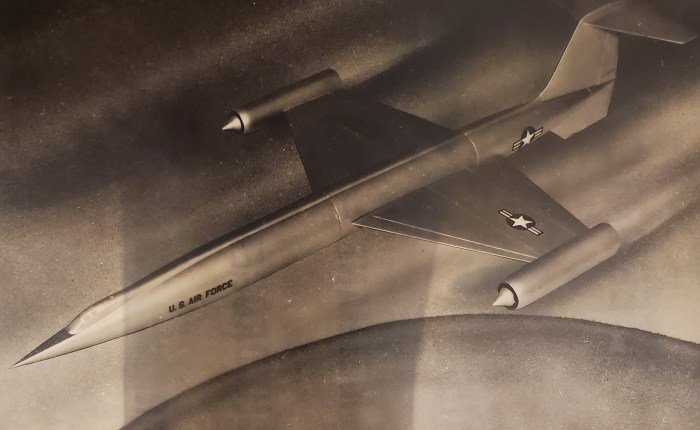
Nevertheless, the concept went through a series of iterations. The original CL-400 was a two-seat reconnaissance plane, 160 feet long with a 10-foot diameter. The wings resembled Lockheed’s F-104 Starfighter, and the plane’s vertical fin was retractable. It was designed to cruise at 99,500 feet, going Mach 2.5, for a maximum range of 2,200 nautical miles.

That was just the beginning. Variant designs on the CL-400, Rich says, ‘were studied from the standpoint of achieving maximum range rather than maximum altitude.’ As evident from the accompanying series of plan drawings, the original CL-400 was near the size of the massive Boeing B-52 Stratofortress bomber, but increasing its range meant increasing the fuel capacity. So, the designs got bigger. Much, much bigger.
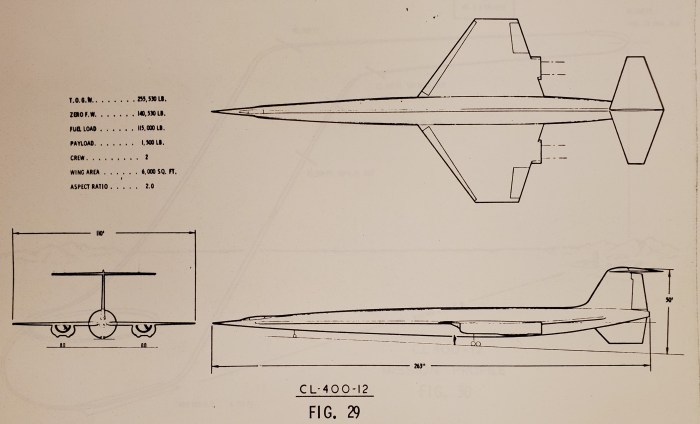
The CL-400-12 was more than double the size of a B-52 and designed for a 4,720 nautical mile range with four engines blasting it to Mach 2.5. Rich’s notes simply stated that ‘the aircraft size is quite large.’
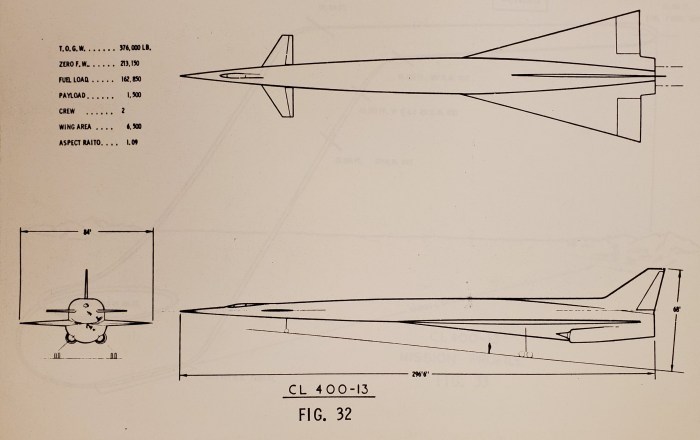
The CL-400-13 took the idea even further with a cone-delta design and forward canards. The aeroplane was almost the length of one football field, with a gross take-off weight of 376,000 pounds. Nevertheless, it could cruise at Mach 4 for a total range of 9,000 nautical miles. The CL-400-14 was similar in size to the -13 but used four smaller engines instead of two big ones.

Hydrogen, as readers familiar with the Hindenburg disaster will attest, is also very dangerous. Lockheed had an approach to address the danger: try to cause a series of hydrogen explosions. Rich’s notes explained that ‘Numerous hydrogen ignition tests were made so as to get a feel for the damage potential in such an explosion, and it was found that the danger was not nearly as great as expected. Explosions were generally mild, and hydrogen fireball radiation was much less than that from a comparable kerosene fire.’ They tried to create an explosion 61 times, and only twice (when purposefully mixed with oxygen and ignited) did it cause ‘a bona fide explosion.’ Lockheed engineers were convinced LH could be handled safely – even more critically since the top-secret nature of the program meant that if there were an uncontrollable fire, they would not be able to call the fire department.[2]
Lockheed built a massive facility to test methods to produce, store, and transport the large quantities of liquid hydrogen necessary to operate a fleet of huge, LH-guzzling aeroplanes a few hundred yards away from the Burbank Municipal Airport. Dr Russell Scott, a leading expert on liquid hydrogen from the U.S. Bureau of Standards, visited the facility and said, ‘My God in heaven, you’re gonna to blow up Burbank.’[3] Ultimately, the logistical challenges of operating a fleet of LH aircraft proved insurmountable at the time. After examining the international basing requirements for the necessary fuel, Johnson gave up on the project. He called the Secretary of the Air Force, James Douglas, and said, ‘I’m afraid I’m building you a dog. My recommendation is that we cancel Suntan.’[4] Today, U-2s are still flying, and the Burbank site, which was once the home for testing and production of classic Lockheed aircraft, has been turned into a giant shopping complex featuring a Best Buy and Wal-Mart. In a way, maybe Burbank did blow up.
It is tempting to write off this story as a historical footnote, but the story of Suntan has three important takeaways: First, failure is important. Just because the project never went to production does not mean it was insignificant. With the aerospace industry currently looking into the potential use of hydrogen fuel, projects like this are still relevant. Second, failed designs still have a strong influence on those that succeed. Going through the process of designing these aircraft and thinking through potential solutions taught these engineers a lot. Many of the design elements first experimented with on the CL-400 went on to have a strong influence on the design of later aircraft – especially the A-12, the forerunner of the SR-71 Blackbird.
Finally, the CL-400 shows the importance and power of imagination. These planes might seem wild, but the effort shows that engineers could push themselves to think outside the box. This reveals the mindset underneath American Cold War aviation design – that it often gravitated to the massive or even outlandish, but it is also inspiring. I am not an aircraft designer, but I hope that in my own life and work, I am pushing myself to think beyond the boundaries of what I think might be possible, explore new ideas and see where they lead.
Dr Michael Hankins is the Curator for US Air Force, Navy, and Marine Corps post-World War II Aviation at the Smithsonian National Air and Space Museum and the author of Flying Camelot: The F-15, the F-16, and the Weaponization of Fighter Pilot Nostalgia (2021). In addition, he is a former Professor of Strategy at the USAF Air Command and Staff College eSchool, and a former Instructor of Military History at the US Air Force Academy. He earned his PhD in history from Kansas State University in 2018, and his master’s in history from the University of North Texas in 2013.
Header image: An artist’s impression of the CL-400 in flight. (Source: The Huntington Library, California, Ben Rich Papers, Box 3, Folder 1, Projects – Engineering – CL-400)
[1] Unless otherwise noted, all information, quotations, and images in this article are taken from: The Huntington Library, California, Ben Rich Papers, Box 3, Folder 1, Projects – Engineering – CL-400.
[2] John L. Sloop, Liquid Hydrogen as a Propulsion Fuel, 1945-1959 (Washington, DC: National Aeronautics and Space Administration, 1978), p. 149.
[3] Ben Rich and Leo Janos, Skunk Works: A Personal Memoir of My Years at Lockheed (New York: Little, Brown and Company, 1994), p. 173.
[4] Rich and Janos, Skunk Works, 177.
 From Balloons to Drones


