
By Dr Brian D. Laslie
Ten years after its first flight and nine years after Detective John McClane brought one down in Live Free or Die Hard, it seems the Lockheed Martin F-35 Lightning II is finally here. Well, at least the U.S. Air Force and Marine Corps versions. Love it or hate it, it is here to stay. I do not want to get off into the discussion of what the F-35 can or cannot do, and we all know it is being asked to do a lot. Per Lockheed Martin’s website the F-35 is supposed to provide: ‘electronic attack, Air-to-Surface, Air-to-Air, Intelligence, Surveillance, and Reconnaissance (ISR), Stealth, Interoperability, and Full Mission Systems Coverage’ (whatever that last one is). That is many missions to cram into one airframe. We are all familiar with the Close Air Support (CAS) debates on the F-35 versus the A-10, and we have all followed the slow, arduous, and downright sloth-like advancement of the F-35 until this point. I have been known to walk both sides of the argument with the F-35.
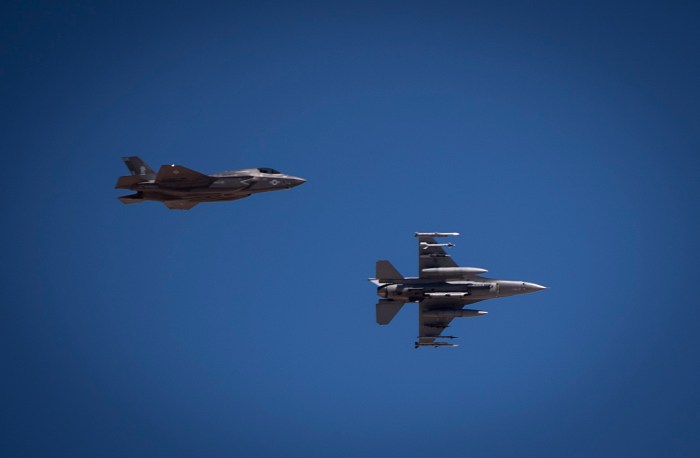
I get it, it is behind schedule, and it is over budget, but so are all of my home improvement projects. I am not sold that it can effectively do everything it is billed to do, but I am also willing to give it a fighting chance in the coming years. For those that have followed the military aircraft industry for a few decades, you will know that every airframe has had its initial struggles: the F-22, F-16, F-15, each and every one of them were plagued by issues. The F-35 is no different with perhaps the one exception that we can all take to Twitter to complain about it. I would rather focus on something entirely different.
All, the F-35 is conducting missions. No, it is not dropping bombs on IS (yet), nor is it providing CAS sorties in Afghanistan. No, it is not even deployed overseas in-theater, but that will come with time as well. However, it is creeping ever closer. Last week, USMC F-35s of VMFA-121 participated in the USAF’s Red Flag exercise. This is a big deal. If you have followed me for more than a hot minute, you know that Red Flag is near and dear to my heart. I have written extensively about, most notably here.
Participating at Red Flag is a major step forward for the entire F-35 program. You can think of Red Flag in some different ways. First, it helps to ‘season’ inexperienced pilots. USAF created Red Flag in 1975 to give its fighter pilots exposure to their first ten ‘combat’ missions. The entire purpose of the exercise was to simulate combat in a realistic training environment. Reports after Vietnam, most notably the Red Baron Reports, indicated that a pilot’s chance for survival increased exponentially after the first ten missions. Second, it exposes units and aircrew to other units and aircrews. Across the spectrum of aerial operations units have to integrate and work together to accomplish the mission. An F-22 pilot of the 1st Fighter Wing at Langley Air Force Base, VA., does not have the opportunity to fly against US Navy, USMC, and other USAF fighters on a daily basis; Red Flag provides that opportunity. The participation of VMFA-121 is as important for the F-35 and its flyers as it is for every other participant in the exercise. This is the first chance for many of these aircrews to see what the F-35 is capable of during mission parameters. This particular Red Flag exercise will see the F-35 integrate with F-22s, F-16s, F-18s and other support aircraft. Finally, Red Flag has traditionally been an exercise used to integrate new aircraft and capabilities with existing missions and platforms. This was true of the F-15 in the 1970s and the F-22 in the 2000s, and it remains true for the F-35 in 2016.
Weapons schools will continue to push the bounds of what the F-35 can do, and we can continue to argue over that, but exercising the F-35 at Red Flag allows other members of the armed forces to see what the F-35 does do.
Dr Brian Laslie is an Air Force Historian and currently the Deputy Command Historian at North American Aerospace Defense Command (NORAD) and United States Northern Command (USNORTHCOM). A 2001 graduate of The Citadel and a historian of air power studies, he received his Masters’ from Auburn University Montgomery in 2006 and his PhD from Kansas State University in 2013. His first book The Air Force Way of War (2015) was selected for the Chief of Staff of the Air Force’s 2016 professional reading list. He lives in Colorado Springs. He can be found on Twitter at @BrianLaslie.
Header Image: F-35Bs, assigned to the 3rd Marine Aircraft Wing, Marine Corps Air Station Yuma, Az., sit on the flight line during Red Flag 16-3 at Nellis Air Force Base, Nev on July 12, 2016. (Source: US Air Force Photo)
 From Balloons to Drones