By Dr Ross Mahoney
Editorial note: This article first appeared on the author’s website. It has been reproduced here with permission.
On 26 July 1950, No. 1 Squadron of the Royal Australian Air Force (RAAF) conducted its first operations in support of Operation FIREDOG, the British Commonwealth’s air operations against insurgents during the Malayan Emergency. The operation consisted of two missions. The first operation involved two GAF Lincolns (A73-36 and A73-31), which dropped 20 1,000-pound bombs from an altitude of 5,000 feet in the Kota Tinggi area. The attack was commanded by the commanding officer of No. 1 Squadron, Squadron Leader Len Williamson. The second mission saw another two Lincolns (A73-39 and A73-31) attack targets in the Yong Peng area. This time, the attack was a combination of dropping bombs (20 x 1000lb bombs) from 5,000 feet and strafing. The Operations Record Book for 26 July noted that the British Army reported the attack on Yong Pend had been successful, while the success of the raid on Kota Tinggi was yet to be reported.[1] These operations took place just 10 days after No. 1 Squadron arrived at RAF Tengah in Singapore on 17 July 1950.[2]
After several years of peaceful protest, on 16 June 1948, three European estate managers and two Asians were murdered in Malaya. This led to a declaration of emergency in Malaya, which resulted in a counterinsurgency against the Malayan Communist Party (MCP) and its military arm, the Malayan National Liberation Army (MNLA). The counterinsurgency officially ended in 1960; however, a second communist insurgency took place in Malaysia from the late 1960s to 1989. In 1950, the British launched the so-called Briggs Plan to deal with the insurgency. Named after the Director of Operations, General Sir Harold Briggs, the plan aimed to cut the MCP and MNLA from the populace by combining civil and military actions. In cutting the MCP and MNLA off from its primary source of supply, it was hoped to destroy ‘the terrorists and preventing a recurrence of their activities.’[3]
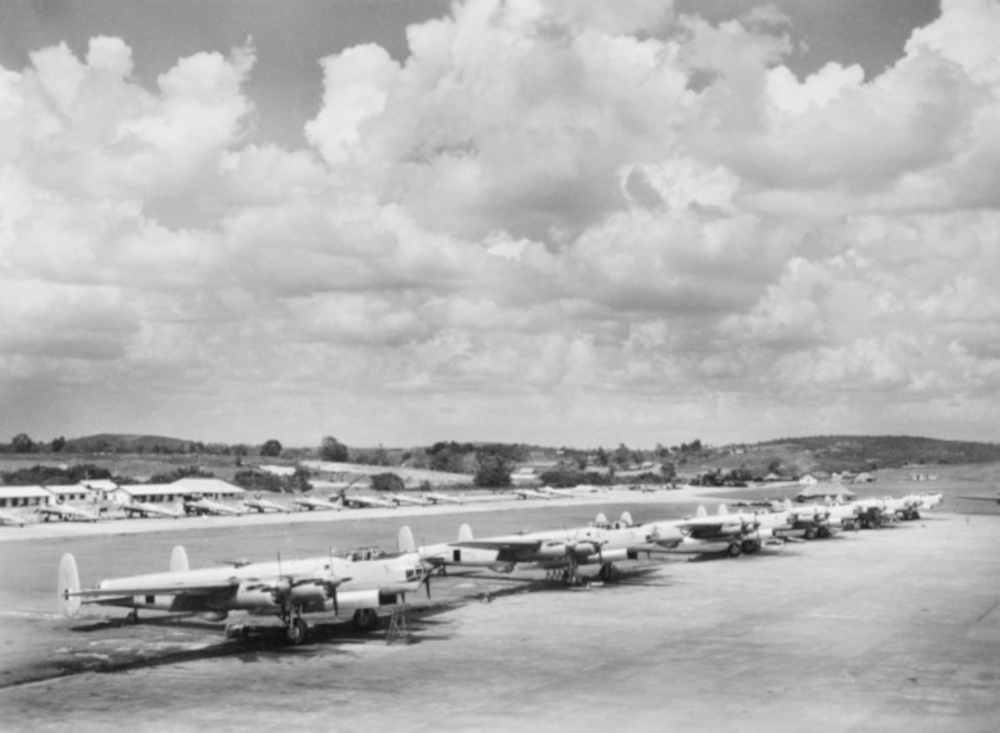
The use of air power in support of counterinsurgency operations during the Malayan Emergency came to be known as FIREDOG. It utilised both kinetic and non-kinetic forms of air power.[4] Primarily, air power was used to provide offensive air support, a variety of air transport roles and air reconnaissance. By 1954, offensive air support had been codified to include air strikes, harassing attacks, close support, air alert, and psychological warfare.[5] It was in the former role of offensive air support that No. 1 Squadron with the RAF Air Historical Branch narrative on FIREDOG noted that in this role, an ‘Australian medium bomber squadron bore the brunt of offensive operations from 1950 to 1958.’[6]
In June 1950, the RAAF’s first deployment to Malaya came in the form of No. 38 Squadron equipped with the Douglas C-47 Dakota. This came about because on 21 April 1950, the British Government requested Australian support in Malaya in the form of ‘air reinforcements.’ Specifically, the British sought a transport squadron, a ‘squadron or flight’ of Lincoln bombers and support for servicing aeroplanes either in Singapore ‘and/or’ Australia.[7] This led to a meeting of the Defence Committee on 27 April, which agreed with the idea that Australia might contribute a transport squadron and ‘small squadron’ of four Avro Lincolns to the air effort over Malaya.[8] The Chief of the Air Staff (CAS), Air Marshal George Jones, noted that the contribution of Lincolns could be increased to six at a later date. On 19 May, the Australian Government agreed to the dispatch of No. 38 Squadron but not the Lincolns.[9] At the end of May, the Prime Minister, Robert Menzies, announced the dispatch of No. 38 Squadron in Parliament and noted that ‘the winning of the “cold” war in Malaya is of vital importance to the security of Australia.’[10] In part, however, the reticence to dispatch Lincolns was due to Menzies’s scepticism about the efficacy of air power in this type of conflict.[11] The outbreak of the Korean War at the end of June 1950 shifted this perception.
On 27 June, the Australian Government finally resolved to deploy No. 1 Squadron to Malaya. As the Official Historian of Australia’s contribution to the Korean War, Robert O’Neill has written:
It is significant that Australia’s first military response to the outbreak of the Korean war was to undertake at once a commitment elsewhere [Malaya] of a kind which, until the outbreak of hostilities in Korea, it had been reluctant to accept.[12]
More recently, in 2017, Andrea Benvenuti wrote that the outbreak of the Korean War dispelled the Australian Government’s ‘last reservations’ over the deployment.[13] Further announcements by the Australian Government made the links between Korea and Malaya clear. They were seen as part of the same problem: communist aggression against the West. The British High Commission in Canberra recorded that the news of the deployment of No. 1 Squadron had been received with ‘great pleasure in London.’[14]
No. 1 Squadron received its orders on 28 June and began preparing for deployment by the start of July.[15] This included, for example, Williamson interviewing the ‘Immigration Department and Taxation Department officials’ about the clearances needed for personnel deploying to Malaya.[16] The squadron departed RAAF Station Amberley on 15 July, stopping at Darwin en route to RAF Tengah in Singapore, where it arrived on 16 July. [17] By October 1950, No. 1 Squadron was stationed alongside 60 Squadron RAF, equipped with the Supermarine Spitfire FMk18 and 45 and 84 Squadrons RAF equipped with the Bristol Brigand B1.
No. 1 Squadron increased in strength to eight Lincolns in 1951 and would stay in Malaya until 1958. As David Lee, in his history of the RAF in the Far East, wrote, the squadron had made ‘a great contribution to FIREDOG operations for almost eight years, and its departure from Tengah was viewed with much regret.’[18] During this time, in 1955, it would be assigned the newly established British Commonwealth Far East Strategic Reserve to which Australia would contribute one bomber and two fighter squadrons.[19] Also, during this time, as a mark of the growing importance of the RAAF’s contribution to the campaign in Malaya and Australia’s growing ‘strategic interests’ in the region, Air Vice-Marshal Frederick Scherger would be appointed Air Officer Commanding Air Headquarters Malaya for two years between 1953 and 1955.[20] Air Vice-Marshal Valston Hancock would also serve as AOC for several months in 1957 before AHQ Malaya was reduced to No. 224 Group. Hancock would continue to command No. 224 Group until mid-1959. Both Scherger and Hancock would go on to become CAS. The RAAF would also take over Butterworth air base from the RAF and operate permanent squadrons from there until 1988.[21] The RAAF continues to maintain a presence at Butterworth, underscoring the region’s importance to Australian security.
Dr Ross Mahoney is an independent scholar specialising in the history of war, with a particular focus on the use of air power and the history of air warfare. He is the Editor-in-Chief of From Balloons to Drones and currently the Senior Historian within the Heritage Policy team at Brisbane City Council in Australia. He has nearly 20 years of experience in the education, museum and heritage sectors in Australia and the United Kingdom, including serving as the inaugural Historian at the Royal Air Force Museum between 2013 and 2017. His other research interests are military leadership and command, military culture, and the history and development of professional military education. He also maintains an interest in transport history. He has published numerous articles, chapters and encyclopedia entries, edited two books, and delivered papers on three continents. His website is here.
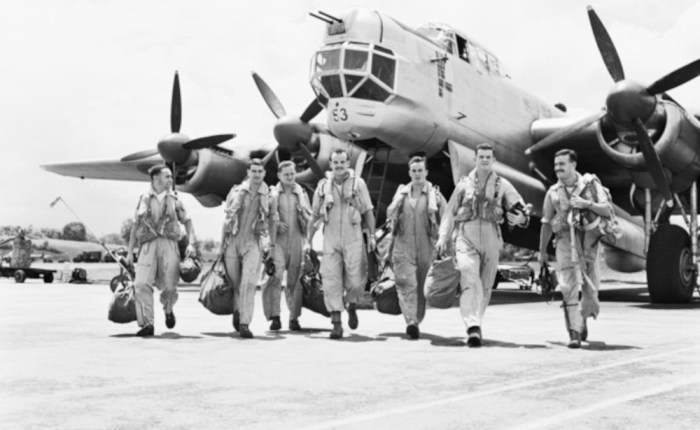
Header image: A No. 1 Squadron RAAF crew in front of their GAF Lincoln after returning from a mission over Malaya, c. 1950. (Source: Australian War Memorial)
[1] National Archives of Australia (NAA), A9186, 2, No. 1 Squadron, Operations Record Book, 26 July 1950; ‘First Malayan Strike by RAAF,’ Daily Mirror, 27 July 1950, p. 6.
[2] ‘Planes Land at Singapore for Use in Malaya,’ Daily Mirror, 17 July 1950, p. 1.
[3] AP3410, The Malayan Emergency, 1948–1960 (London: Ministry of Defence, 1970), p. 16.
[4] The starting point for any analysis of the use of air power during the Malayan Emergency should be the RAF’s Air Historical Branch narrative: AP3410, The Malayan Emergency. This was later published as Malcolm R. Postgate, Operation Firedog: Air Support in the Malayan Emergency 1948–1960 (London: HMSO, 1992). Also see: Malcolm Postgate, ‘Operation Firedog: Air Support in the Malayan Emergency’ in Roger Miller (ed.), Seeing off the Bear: Anglo-American Cooperation during the Cold War (Washinton DC: United States Air Force History and Museums Program, 1995), pp. 181-90; David Jordan, ‘Countering Insurgency from the Air: The Postwar Lessons,’ Contemporary Security Policy 28, no. 1 (2007), pp. 96-111; Andrew Mumford, ‘Unnecessary or unsung? The utilisation of airpower in Britain’s colonial counterinsurgencies,’ Small Wars & Insurgencies 20, no. 3-4 (2009), pp. 638-44; Sebastian Ritche, The RAF, Small War and Insurgencies: Later Colonial Operations, 1945-1975 (London: Air Historical Branch, 2011), pp. 15-35; Roger Arditti, ‘The view from above: how the Royal Air Force provided a strategic vision for operational intelligence during the Malayan Emergency,’ Small Wars & Insurgencies 26, no. 5, (2015), pp. 764–789. For a view of Australian air power and the Malayan Emergency, see: Alan Stephens, Going Solo: The Royal Australian Air Force, 1946-1971 (Canberra, ACT: Australian Government Publishing Service, 1995), pp. 224-44; Mark Lax, Malayan Emergency and Indonesian Confrontation, 1950 to 1966 (Newport, NSW: Big Sky Publishing, 2021); Peter Hunter, ‘Australian air power strategy, technologies, and counter-insurgency in Malaya during the Cold War’ in Nicole Townsend, Kus Pandey, Jarrod Pendlebury (eds.), Australian Perspectives on Global Air and Space Power: Past, Present, Future (Abingdon: Routledge, 2023), pp. 46-60.
[5] Lax, Malayan Emergency and Indonesian Confrontation, p. 108.
[6] AP3410, The Malayan Emergency, p. 56.
[7] NAA, A1209, 1957/4513, Office of the British High Commissioner to the Prime Minister, 21 April 1950.
[8] NAA, A2031, 59/1950, Minutes of a Meeting by the Defence Committee, 27 April 1950; Lax, Malayan Emergency and Indonesian Confrontation, p. 74.
[9] NAA, A4638, SET 2, Minutes of the Meeting of Cabinet, p. 3.
[10] NAA, A1209, 1957/4513, Statement by the Prime Minister in the House of Representatives, 31 May 1950, p. 2.
[11] Lax, Malayan Emergency and Indonesian Confrontation, p. 74.
[12] Robert O’Neill, Australia in the Korean War, 1950-53 – Volume 1: Strategy and Diplomacy (Canberra, ACT: The Australian War Memorial and the Australian Government Publishing Service, 1981), p. 48.
[13] Andrea Benvenuti, Cold War and Decolonisation: Australia’s Policy Towards Britain’s End of Empire in Southeast Asia (Singapore: NUS Press, 2017), p. 20.
[14] NAA, A1209, 1957/4513, Office of the British High Commissioner to the Prime Minister, 1 July 1950.
[15] Lax, Malayan Emergency and Indonesian Confrontation, p. 111.
[16] NAA, A9186, 2, No. 1 Squadron, Operations Record Book, 4 July 1950.
[17] NAA, A9186, 2, No. 1 Squadron, Operations Record Book, 15/16 July 1950.
[18] David Lee, Eastwood: A History of the Royal Air Force in the Far East, 1945-1972 (London: Her Majesty’s Stationery Office, 1984), pp. 150-1.
[19] Tristan Moss, ‘Planning for war in Southeast Asia: The Far East Strategic Reserve, 1955–66’ in Peter Dean and Tristan Moss (eds), Fighting Australia’s Cold War: The Nexus of Strategy and Operations in a Multipolar Asia, 1945–1965 (Canberra, ACT: ANU Press, 2021), p. 99.
[20] NAA, A5954, 2293/1, Office of the High Commissioner to the Prime Minister’s Department, 10 May 1952.
[21] On life at RAAF Butterworth, see: Matthew Radcliffe, Kampong Australia: The RAAF at Butterworth (Sydney, NSW: NewSouth Publishing, 2017).
 From Balloons to Drones