Reviewed by Dr Brian Laslie
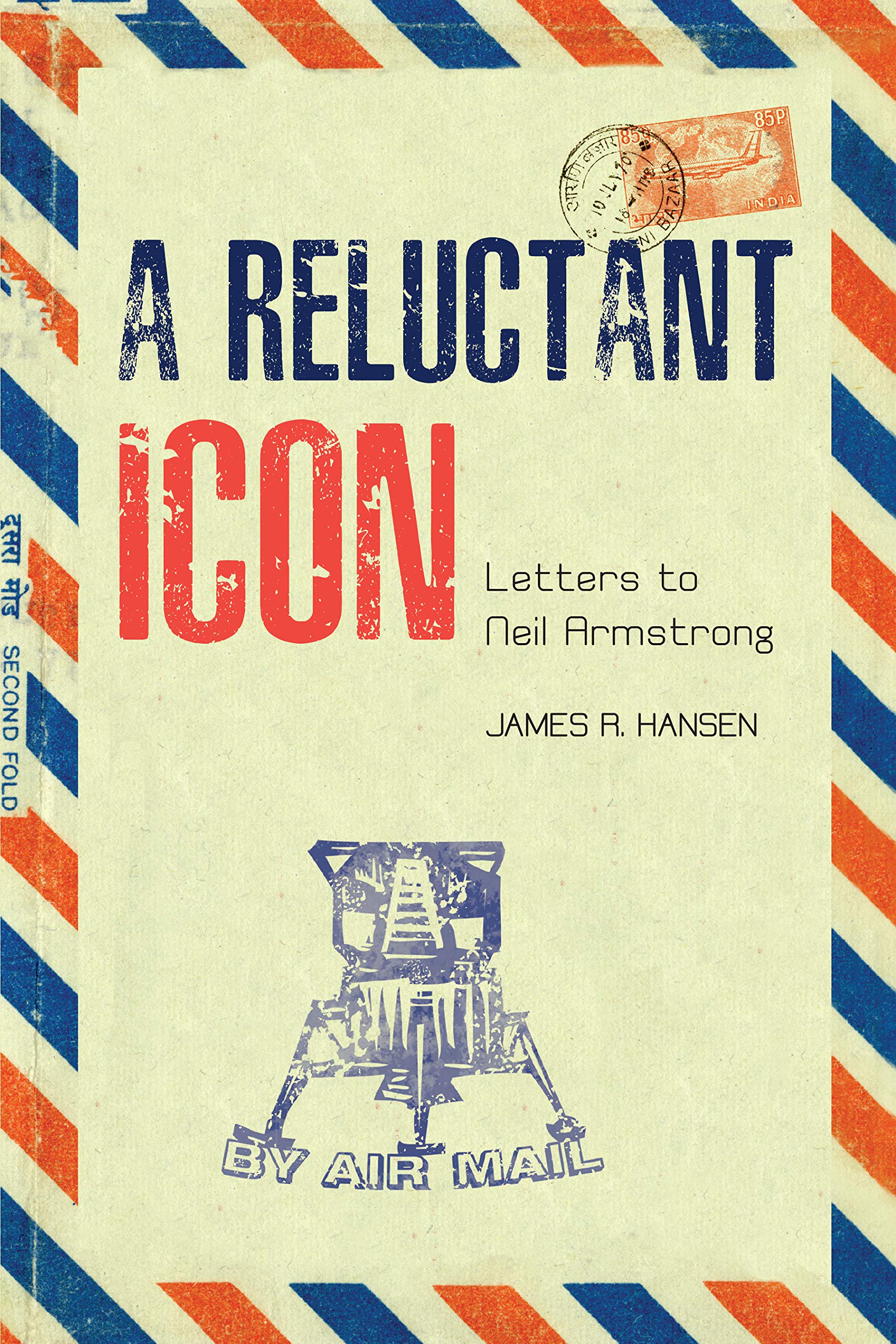
James R. Hansen, A Reluctant Icon: Letters to Neil Armstrong. West Lafayette, IN: Purdue University Press, 2020. Notes. Hbk. 384 pp.
There are new air power scholarship releases all the time. One need look no further than the academic press catalogues for the University Press of Kentucky, University of North Texas Press, and Naval Institute Press (to name a few) to see what is up and coming. As the book reviews editor for From Balloons to Drones, I often receive books or ask for them in advance with promises of a ‘review forthcoming,’ it is all too easy to fall behind. Thus, this book review comes several years in arrears. So, please note that the book covered below was published in the year following the 50th anniversary of Apollo 11.
Now that the hype for #Apollo11, #Apollo50, and all things Apollo program has died following the 50-year celebrations from 2018-2023 (coinciding with Apollo 7-17), there is time for reflection on the Golden Age of Spaceflight. Even as the Space Shuttle moves into distant memory, there continues to be a deep draw towards America’s space pioneers, and no one individual better encapsulates that draw than Neil Armstrong, the enigmatic first man on the moon, and no one better understands Armstrong than his biographer Dr James R. Hansen. Hansen spent hundreds of hours with Armstrong in writing the biography First Man: The Life of Neil A. Armstrong. His second book (from Purdue University Press) on Armstrong was Dear Neil Armstrong: Letters to the First Man from All Mankind, reviewed here. This is Hansen’s third book about Armstrong, and he has not ruled out writing more. This most recent volume, A Reluctant Icon: Letters to Neil Armstrong, is part of the Purdue University Press series: Purdue Studies in Aeronautics and Astronautics.
Since he published First Man in 2005, there has been an explosion of books, podcasts, magazines, toys, and other ephemera available to purchase as a memory or remembrance of the end of the golden age of spaceflight. Books include Jay Barbree’s 2014 Neil Armstrong: A Life of Flight. The Lego Brick Company produced a hugely successful series of building sets, including the Saturn V, Lunar Rover, and Lunar Lander. All this falls under what Hansen calls the ‘Iconography and myth’ of Armstrong and what I have labelled as ‘The Cottage Industry of Neil Armstrong’ culminating in one of the most sought-after signatures in history for collectors, running from $2,000 to $10,000 depending on the medium.
In writing his two ‘Letters to…’ works, Hansen had, for the first time, complete access to Armstrong’s papers now housed in the archives at Purdue University (p. xi). This second book is broken down into six chapters. It contains letters, and sometimes responses, concerning first, religion and belief; second, anger, disappointment and disillusionment; third, quacks, conspiracy theories, and Ufologists; fourth, fellow astronauts and the world of flight; fifth, the corporate world; sixth, celebrities, stars, and notables, and finally, letters from a grieving world.
In ‘Religion and Belief,’ most of the letters projects onto Neil being a devout Christian – Armstrong was a Deist. Neil responded by ‘ignoring their questions or sidestepping the issue of religion altogether’ (p. 5). While most of the letters in this chapter are benign, Armstrong did receive some bizarre and ‘kooky’ letters over many years.
Chapters two and three, ‘Anger, disappointment and disillusionment’ and ‘Quacks, conspiracy theories, and, Ufologists’ complement each other in that the letters Armstrong received (Hanson notes these represented less than one per cent of all letters he received) read like online comment sections: sometimes interesting, rarely thought-provoking, often ad hominem. Hansen includes a selection here: ‘Without taking such letters into account, the iconography involving Neil Armstrong, sadly, is incomplete.’
Of most interest to the readers of this website are the many letters found in the chapter ‘Fellow Astronauts and the World of Flight.’ Armstrong received numerous letters from his fellow astronauts, but he remained close, with very few of them, Jim Lovell and Gene Cernan being the notable exceptions. Hansen shows Jim Irwin’s request for a gathering of moonwalkers that never came to fruition, Al Bean passing along pieces of the Apollo Saturn V, which fell to Earth, and correspondence with Al Shepard and Jim Lovell attempting to enlist Armstrong’s involvement in ventures including the Astronaut Scholarship fund. Even amongst friends and colleagues, Armstrong remained an intensely private person.
The rest of the work, including the corporate world, celebrities, stars, and notables, and letters from a grieving world, all help to put into perspective who Armstrong was and not just the man who made the one giant leap. In many of the above, people wanted something from Armstrong: an autograph, a response, or some enigmatic comfort. Studying Armstrong is something akin to the study of Jefferson; one biography is not enough, and proper understanding can only come through diligent study of correspondence and letters, so Hansen is to be commended for providing a glimpse here and providing access to that which is otherwise available only in archives and special collections. The two volumes of Armstrong’s letters will surely appeal to those interested in Armstrong, the Apollo program, and those looking for something beyond the regular biography, a taste of source documentation in book form. Hansen is not only the best source to begin and end with if one is interested in studying the life of Neil Armstrong, but he is also one of the most outstanding living scholars of aeronautics and astronautics.
Dr Brian Laslie is a US Air Force Historian and Command Historian at the United States Air Force Academy. Formerly, he was the Deputy Command Historian at the North American Aerospace Defense Command (NORAD) and United States Northern Command (USNORTHCOM). A 2001 graduate of The Citadel and a historian of air power studies, he received his Masters’ from Auburn University Montgomery in 2006 and his PhD from Kansas State University in 2013. He is the author of Air Power’s Lost Cause: The American Air Wars of Vietnam (2021), Architect of Air Power: General Laurence S. Kuter and the Birth of the US Air Force (2017) and The Air Force Way of War (2015). The latter book was selected for the Chief of Staff of the Air Force’s 2016 professional reading list and the 2017 RAF Chief of the Air Staff’s reading list.
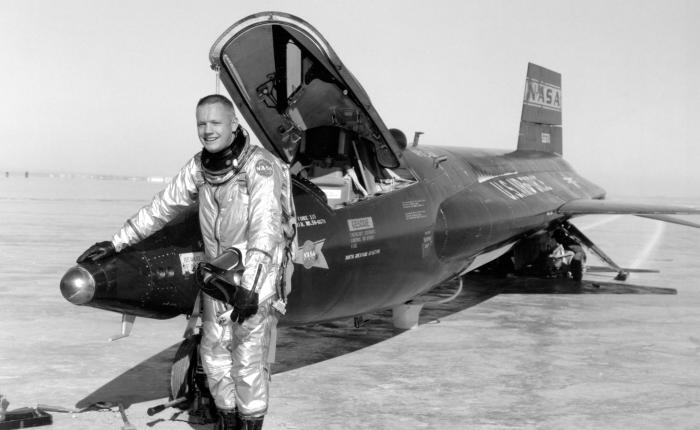
Header Image: Neil Armstrong is seen here next to the X-15 ship #1 after a research flight. Armstrong made his first X-15 flight on November 30, 1960, in the #1 X-15. He made his second flight on December 9, 1960, in the same aircraft. This was the first X-15 flight to use the ball nose, accurately measuring airspeed and flow angle at supersonic and hypersonic speeds. The servo-actuated ball nose can be seen in this photo in front of Armstrong’s right hand. The X-15 employed a non-standard landing gear. It had a nose gear with a wheel and tyre, but the main landing consisted of skids mounted at the vehicle’s rear. The left skid is visible in the photo, as are marks on the lakebed from both skids. Because of the skids, the rocket-powered aircraft could only land on a dry lakebed, not on a concrete runway. (Source: NASA)

 From Balloons to Drones