#ResearchNote – No. 1 Squadron RAAF Goes to War in Malaya

#ResearchNote – No. 1 Squadron RAAF Goes to War in Malaya

By Dr Ross Mahoney

Editorial note: This article first appeared on the author’s website. It has been reproduced here with permission.

On 26 July 1950, No. 1 Squadron of the Royal Australian Air Force (RAAF) conducted its first operations in support of Operation FIREDOG, the British Commonwealth’s air operations against insurgents during the Malayan Emergency. The operation consisted of two missions. The first operation involved two GAF Lincolns (A73-36 and A73-31), which dropped 20 1,000-pound bombs from an altitude of 5,000 feet in the Kota Tinggi area. The attack was commanded by the commanding officer of No. 1 Squadron, Squadron Leader Len Williamson. The second mission saw another two Lincolns (A73-39 and A73-31) attack targets in the Yong Peng area. This time, the attack was a combination of dropping bombs (20 x 1000lb bombs) from 5,000 feet and strafing. The Operations Record Book for 26 July noted that the British Army reported the attack on Yong Pend had been successful, while the success of the raid on Kota Tinggi was yet to be reported.[1] These operations took place just 10 days after No. 1 Squadron arrived at RAF Tengah in Singapore on 17 July 1950.[2]

After several years of peaceful protest, on 16 June 1948, three European estate managers and two Asians were murdered in Malaya. This led to a declaration of emergency in Malaya, which resulted in a counterinsurgency against the Malayan Communist Party (MCP) and its military arm, the Malayan National Liberation Army (MNLA). The counterinsurgency officially ended in 1960; however, a second communist insurgency took place in Malaysia from the late 1960s to 1989. In 1950, the British launched the so-called Briggs Plan to deal with the insurgency. Named after the Director of Operations, General Sir Harold Briggs, the plan aimed to cut the MCP and MNLA from the populace by combining civil and military actions. In cutting the MCP and MNLA off from its primary source of supply, it was hoped to destroy ‘the terrorists and preventing a recurrence of their activities.’[3]
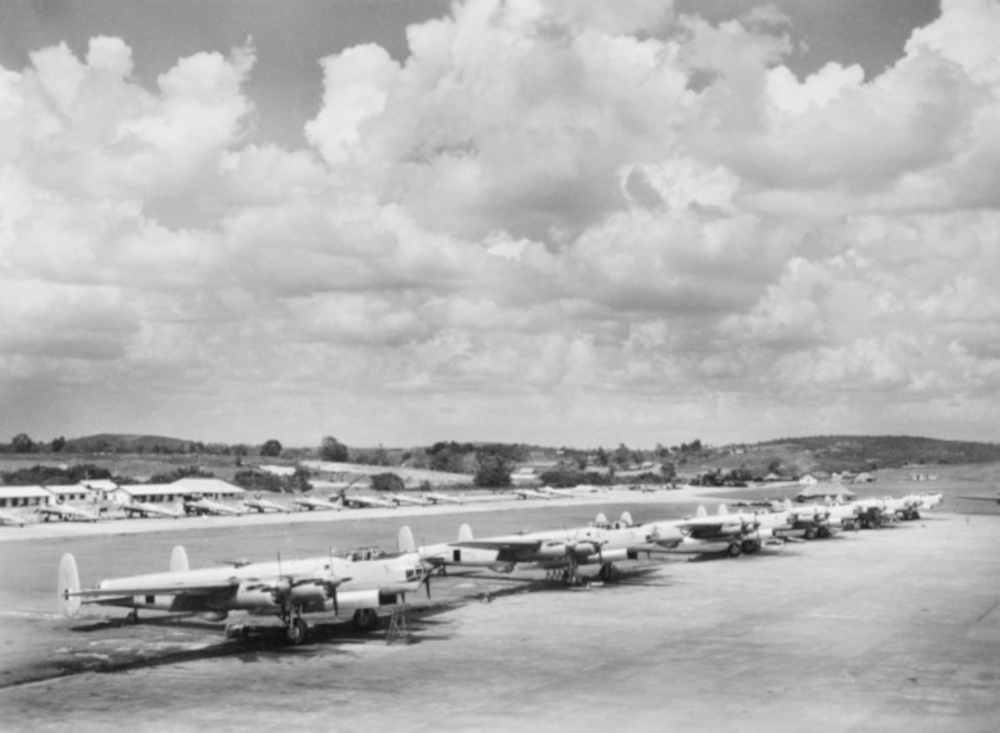
GAF Lincolns of No. 1 Squadron RAAF on the tarmac at RAF Tengah, c. November 1954 (Source: Australian War Memorial)

The use of air power in support of counterinsurgency operations during the Malayan Emergency came to be known as FIREDOG. It utilised both kinetic and non-kinetic forms of air power.[4] Primarily, air power was used to provide offensive air support, a variety of air transport roles and air reconnaissance. By 1954, offensive air support had been codified to include air strikes, harassing attacks, close support, air alert, and psychological warfare.[5] It was in the former role of offensive air support that No. 1 Squadron with the RAF Air Historical Branch narrative on FIREDOG noted that in this role, an ‘Australian medium bomber squadron bore the brunt of offensive operations from 1950 to 1958.’[6]

In June 1950, the RAAF’s first deployment to Malaya came in the form of No. 38 Squadron equipped with the Douglas C-47 Dakota. This came about because on 21 April 1950, the British Government requested Australian support in Malaya in the form of ‘air reinforcements.’ Specifically, the British sought a transport squadron, a ‘squadron or flight’ of Lincoln bombers and support for servicing aeroplanes either in Singapore ‘and/or’ Australia.[7] This led to a meeting of the Defence Committee on 27 April, which agreed with the idea that Australia might contribute a transport squadron and ‘small squadron’ of four Avro Lincolns to the air effort over Malaya.[8]  The Chief of the Air Staff (CAS), Air Marshal George Jones, noted that the contribution of Lincolns could be increased to six at a later date. On 19 May, the Australian Government agreed to the dispatch of No. 38 Squadron but not the Lincolns.[9] At the end of May, the Prime Minister, Robert Menzies, announced the dispatch of No. 38 Squadron in Parliament and noted that ‘the winning of the “cold” war in Malaya is of vital importance to the security of Australia.’[10] In part, however, the reticence to dispatch Lincolns was due to Menzies’s scepticism about the efficacy of air power in this type of conflict.[11] The outbreak of the Korean War at the end of June 1950 shifted this perception.

On 27 June, the Australian Government finally resolved to deploy No. 1 Squadron to Malaya. As the Official Historian of Australia’s contribution to the Korean War, Robert O’Neill has written:

It is significant that Australia’s first military response to the outbreak of the Korean war was to undertake at once a commitment elsewhere [Malaya] of a kind which, until the outbreak of hostilities in Korea, it had been reluctant to accept.[12]

More recently, in 2017, Andrea Benvenuti wrote that the outbreak of the Korean War dispelled the Australian Government’s ‘last reservations’ over the deployment.[13] Further announcements by the Australian Government made the links between Korea and Malaya clear. They were seen as part of the same problem: communist aggression against the West. The British High Commission in Canberra recorded that the news of the deployment of No. 1 Squadron had been received with ‘great pleasure in London.’[14]

No. 1 Squadron received its orders on 28 June and began preparing for deployment by the start of July.[15] This included, for example, Williamson interviewing the ‘Immigration Department and Taxation Department officials’ about the clearances needed for personnel deploying to Malaya.[16] The squadron departed RAAF Station Amberley on 15 July, stopping at Darwin en route to RAF Tengah in Singapore, where it arrived on 16 July. [17] By October 1950, No. 1 Squadron was stationed alongside 60 Squadron RAF, equipped with the Supermarine Spitfire FMk18 and 45 and 84 Squadrons RAF equipped with the Bristol Brigand B1.

No. 1 Squadron increased in strength to eight Lincolns in 1951 and would stay in Malaya until 1958. As David Lee, in his history of the RAF in the Far East, wrote, the squadron had made ‘a great contribution to FIREDOG operations for almost eight years, and its departure from Tengah was viewed with much regret.’[18] During this time, in 1955, it would be assigned the newly established British Commonwealth Far East Strategic Reserve to which Australia would contribute one bomber and two fighter squadrons.[19] Also, during this time, as a mark of the growing importance of the RAAF’s contribution to the campaign in Malaya and Australia’s growing ‘strategic interests’ in the region, Air Vice-Marshal Frederick Scherger would be appointed Air Officer Commanding Air Headquarters Malaya for two years between 1953 and 1955.[20] Air Vice-Marshal Valston Hancock would also serve as AOC for several months in 1957 before AHQ Malaya was reduced to No. 224 Group. Hancock would continue to command No. 224 Group until mid-1959. Both Scherger and Hancock would go on to become CAS. The RAAF would also take over Butterworth air base from the RAF and operate permanent squadrons from there until 1988.[21] The RAAF continues to maintain a presence at Butterworth, underscoring the region’s importance to Australian security.

Dr Ross Mahoney is an independent scholar specialising in the history of war, with a particular focus on the use of air power and the history of air warfare. He is the Editor-in-Chief of From Balloons to Drones and currently the Senior Historian within the Heritage Policy team at Brisbane City Council in Australia. He has nearly 20 years of experience in the education, museum and heritage sectors in Australia and the United Kingdom, including serving as the inaugural Historian at the Royal Air Force Museum between 2013 and 2017. His other research interests are military leadership and command, military culture, and the history and development of professional military education. He also maintains an interest in transport history. He has published numerous articles, chapters and encyclopedia entries, edited two books, and delivered papers on three continents. His website is here.

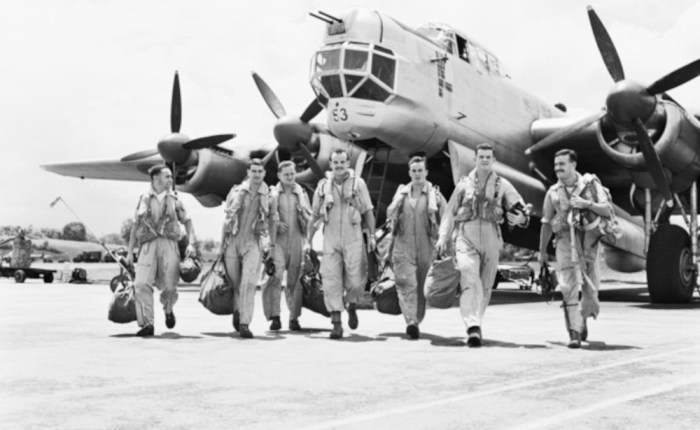
Header image: A No. 1 Squadron RAAF crew in front of their GAF Lincoln after returning from a mission over Malaya, c. 1950. (Source: Australian War Memorial)

[1] National Archives of Australia (NAA), A9186, 2, No. 1 Squadron, Operations Record Book, 26 July 1950; ‘First Malayan Strike by RAAF,’ Daily Mirror, 27 July 1950, p. 6.

[2] ‘Planes Land at Singapore for Use in Malaya,’ Daily Mirror, 17 July 1950, p. 1.

[3] AP3410, The Malayan Emergency, 1948–1960 (London: Ministry of Defence, 1970), p. 16.

[4] The starting point for any analysis of the use of air power during the Malayan Emergency should be the RAF’s Air Historical Branch narrative: AP3410, The Malayan Emergency. This was later published as Malcolm R. Postgate, Operation Firedog: Air Support in the Malayan Emergency 1948–1960 (London: HMSO, 1992). Also see: Malcolm Postgate, ‘Operation Firedog: Air Support in the Malayan Emergency’ in Roger Miller (ed.), Seeing off the Bear: Anglo-American Cooperation during the Cold War (Washinton DC: United States Air Force History and Museums Program, 1995), pp. 181-90; David Jordan, ‘Countering Insurgency from the Air: The Postwar Lessons,’ Contemporary Security Policy 28, no. 1 (2007), pp. 96-111; Andrew Mumford, ‘Unnecessary or unsung? The utilisation of airpower in Britain’s colonial counterinsurgencies,’ Small Wars & Insurgencies 20, no. 3-4 (2009), pp. 638-44; Sebastian Ritche, The RAF, Small War and Insurgencies: Later Colonial Operations, 1945-1975 (London: Air Historical Branch, 2011), pp. 15-35; Roger Arditti, ‘The view from above: how the Royal Air Force provided a strategic vision for operational intelligence during the Malayan Emergency,’ Small Wars & Insurgencies 26, no. 5, (2015), pp. 764–789. For a view of Australian air power and the Malayan Emergency, see: Alan Stephens, Going Solo: The Royal Australian Air Force, 1946-1971 (Canberra, ACT: Australian Government Publishing Service, 1995), pp. 224-44; Mark Lax, Malayan Emergency and Indonesian Confrontation, 1950 to 1966 (Newport, NSW: Big Sky Publishing, 2021); Peter Hunter, ‘Australian air power strategy, technologies, and counter-insurgency in Malaya during the Cold War’ in Nicole Townsend, Kus Pandey, Jarrod Pendlebury (eds.), Australian Perspectives on Global Air and Space Power: Past, Present, Future (Abingdon: Routledge, 2023), pp. 46-60.

[5] Lax, Malayan Emergency and Indonesian Confrontation, p. 108.

[6] AP3410, The Malayan Emergency, p. 56.

[7] NAA, A1209, 1957/4513, Office of the British High Commissioner to the Prime Minister, 21 April 1950.

[8] NAA, A2031, 59/1950, Minutes of a Meeting by the Defence Committee, 27 April 1950; Lax, Malayan Emergency and Indonesian Confrontation, p. 74.

[9] NAA, A4638, SET 2, Minutes of the Meeting of Cabinet, p. 3.

[10] NAA, A1209, 1957/4513, Statement by the Prime Minister in the House of Representatives, 31 May 1950, p. 2.

[11] Lax, Malayan Emergency and Indonesian Confrontation, p. 74.

[12] Robert O’Neill, Australia in the Korean War, 1950-53 – Volume 1: Strategy and Diplomacy (Canberra, ACT: The Australian War Memorial and the Australian Government Publishing Service, 1981), p. 48.

[13] Andrea Benvenuti, Cold War and Decolonisation: Australia’s Policy Towards Britain’s End of Empire in Southeast Asia (Singapore: NUS Press, 2017), p. 20.

[14] NAA, A1209, 1957/4513, Office of the British High Commissioner to the Prime Minister, 1 July 1950.

[15] Lax, Malayan Emergency and Indonesian Confrontation, p. 111.

[16] NAA, A9186, 2, No. 1 Squadron, Operations Record Book, 4 July 1950.

[17] NAA, A9186, 2, No. 1 Squadron, Operations Record Book, 15/16 July 1950.

[18] David Lee, Eastwood: A History of the Royal Air Force in the Far East, 1945-1972 (London: Her Majesty’s Stationery Office, 1984), pp. 150-1.

[19] Tristan Moss, ‘Planning for war in Southeast Asia: The Far East Strategic Reserve, 1955–66’ in Peter Dean and Tristan Moss (eds), Fighting Australia’s Cold War: The Nexus of Strategy and Operations in a Multipolar Asia, 1945–1965 (Canberra, ACT: ANU Press, 2021), p. 99.

[20] NAA, A5954, 2293/1, Office of the High Commissioner to the Prime Minister’s Department, 10 May 1952.

[21] On life at RAAF Butterworth, see: Matthew Radcliffe, Kampong Australia: The RAAF at Butterworth (Sydney, NSW: NewSouth Publishing, 2017).

#ResearchResources – Recent Articles and Books (October 2021)

#ResearchResources – Recent Articles and Books (October 2021)

Editorial note: In this series, From Balloons to Drones highlights research resources available to researchers. Contributions range from discussions of research at various archival repositories to highlighting new publications. As part of this series, we are bringing you a monthly precis of recent articles and books published in air power history. This precis will not be exhaustive but will highlight new works published in the preceding month. Publication dates may vary around the globe and are based on those provided on the publisher’s websites. If you would like to contribute to the series, please contact our Editor-in-Chief, Dr Ross Mahoney, at airpowerstudies@gmail.com or via our contact page here.

Articles

Mateusz Piątkowski, ‘War in the Air from Spain to Yemen: The Challenges in Examining the Conduct of Air Bombardment,’ Journal of Conflict and Security Law, 2021; https://doi.org/10.1093/jcsl/krab017 

Air power is a dominant factor in both past and modern battlespace. Yet, despite its undisputed importance in warfare, its legal framework did not correspond with the significance of the air military operations, especially before the adoption of the Additional Protocol I to the Geneva Conventions of 1977. Even after this date, not all the particulars of air warfare are regulated by the positive rules, as the law is scattered in norms of customary character. Even more challenging process than reconstruction of the legal architecture of the air warfare is the evaluation of the specific incidents containing the elements of military aviation activity. The aim of the article is to present possible challenges arising from very complex normative and operational background of the air warfare and air bombardments in particular. The pivotal point in considerations is the forgotten inquiry conducted by the military experts operating within the established by the League of Nations commission reviewing the conduct of air bombardment during the Civil War in Spain. The adopted methodology of the commission could be considered as a reasonable and balanced approach of analyzing the cases including the involvement of the air power and a relevant reference in contemporary investigations.

Jasmine Wood (2021) ‘Lashings of Grog and Girls’: Masculinity and Sexuality in the Rehabilitation of Facially Disfigured Servicemen in the Second World War, War & Society, DOI: 10.1080/07292473.2021.1969172 

This article explores the importance of masculinity in the rehabilitation experience of members of the Royal Air Force who were facially disfigured during the Second World War. Other historical work has highlighted the significance of masculinity in the rehabilitation of other groups of disabled veterans, but the experience of the facially disfigured is somewhat neglected. This article investigates the methods employed at Rooksdown House and East Grinstead Hospital where men suffering from burns injuries and disfigurements were both physically and psychologically rehabilitated. It explores the key themes of hospital environment, occupational therapy and relationships. In using oral histories and memoirs this article argues that masculinity and sexuality were key aspects of servicemen’s identity that had to be restored through rehabilitation to ensure their successful reintegration into society.

Books

Thomas McKelvey Cleaver, The Tonkin Gulf Yacht Club: Naval Aviation in the Vietnam War (Oxford: Osprey Publishing, 2021).

On August 2, 1964, the USS Maddox became embroiled in the infamous Gulf of Tonkin incident that led directly to America’s increased involvement in the Vietnam War. Supporting the Maddox that day were four F-8E Crusaders from the USS Ticonderoga, and this was the very start of the US Navy’s commitment to the air war over Vietnam.

The Tonkin Gulf Yacht Club is titled after the nickname for the US Navy’s Seventh Fleet which was stationed off the coast of Vietnam, and it tells the full story of the US Navy’s war in the air. It details all the operations from the USS Maddox onwards through to the eventual withdrawal of the fleet following the collapse of South Vietnam in 1975.

The Seventh Fleet’s Task Force 77, which at points during the war had as many as six carriers on station at any one time with 70-100 aircraft on each, provided vital air support for combat troops on the ground, while at the same time taking part in the major operations against North Vietnam itself such as Rolling Thunder, Linebacker I and II. All of these operations took place in a hostile environment of flak, missiles and MiGs.

The story is told through the dramatic first-hand accounts of those that took part in the fighting, with many of the interviews carried out by the author himself. The Vietnamese perspective is also given, with the author having had access to the official Vietnamese account of the war in the air. The author also has a personal interest in the story, as at the age of 20 he served with the US Seventh Fleet off the coast of Vietnam and was personally involved in the dramatic history of The Tonkin Gulf Yacht Club.

Kenneth Jack, Eyes of the Fleet Over Vietnam: RF-8 Crusader Combat Photo-Reconnaissance Missions (Havertown, PA: Casemate Publishers, 2021). 

Photo reconnaissance played a significant role during the Cold War, however, it remained unknown to the public for many years because its product and methods remained classified for security purposes. While the U-2 gets most of the credit, low-level photo reconnaissance played an equally important role and was essential to target selection and bomb damage assessment during the Vietnam War. Moreover, the contribution of naval aviation photo-reconnaissance to the bombing effort in Vietnam is largely an untold story. This book highlights the role of the unarmed supersonic RF-8A/G photo-Crusader throughout the war, and also the part played by its F-8 and F-4 escort fighters.

Veteran and historian Kenneth Jack pieces together the chronological history of photo recon in the Vietnam War between 1964 and 1972, describing all types of missions undertaken, including several Crusader vs. MiG dogfights and multiple RF-8 shootdowns with their associated, dramatic rescues. The narrative focuses on Navy Photo Squadron VFP-63, but also dedicates chapters to VFP-62 and Marine VMCJ-1. Clandestine missions conducted over Laos began in 1964, becoming a congressionally authorized war after the Tonkin Gulf incident in August 1964. VFP-63 played a role in that incident and thereafter sent detachments to Navy carriers for the remainder of the war. By the war’s end, they had lost 30 aircraft with 10 pilots killed, six POWs, and 14 rescued. The historical narrative is brought to life through vivid first-hand details of missions over intensely defended targets in Laos and North Vietnam. While most books on the Vietnam air war focus on fighter and bombing action, this book provides fresh insight into the air war through its focus on photo-reconnaissance and coverage of both versions of the Crusader.

Mark Lax, Malayan Emergency and Indonesian Confrontation, 1950-1966 (Newport, NSW: Big Sky Publishing, 2021).

Australia’s involvement in the Malayan Emergency from 1950 to 1960 and later in a Confrontation with Indonesia in the 1960s is little remembered today. Yet the deployment of over a third of the RAAF to support the British and Malayan governments in what became a long war of attrition against communist insurgents in the former case, and against Indonesian regulars and militia in the latter, kept the RAAF engaged for over 15 years. Wars by another name, these two events led to the birth of Malaysia and the establishment of an ongoing RAAF presence in South East Asia. Until recent operations in Afghanistan, the Malaya Emergency was Australia’s longest conflict. Malayan Emergency and Indonesian Confrontation recounts the story of the politics, strategies and operations that brought these two conflicts to a close.

Ian Pearson, Cold War Warriors: Royal Australian Air Force P-3 Orion Operations 1968-1991 (Newport, NSW: Big Sky Publishing, 2021).

Cold War Warriors tells the little-known story of the operations by the Royal Australian Air Force’s P-3 Orions during the latter years of the Cold War. The aircraft’s largely low-profile missions, usually flown far from their base, were often shrouded by confidentiality. Now, access to declassified documents has allowed this story to be told. From the lead-up to their delivery in 1968, to the end of the Cold War in 1991; from the intrigues associated with the procurement of the aircraft and subsequent upgrades, to perilous moments experienced by the aircraft and their crews while conducting operations; and from triumphs to tragedies; Cold War Warriors documents the P-3’s service in the RAAF in the context of the unfolding domestic and international events that shaped the aircraft’s evolving missions. As well as being a story of the RAAF Orions and their growing capabilities, Cold War Warriors is also the story of the crews who flew the aircraft. Using their words, Cold War Warriors faithfully describes a number of incidents, both on the ground, and in the air, to provide a sense of the enormous breadth of service the P-3 Orion has provided to the Royal Australian Air Force, to Australia and to our allies.

John Shields, Air Power in the Falklands Conflict: An Operational Level Insight into Air Warfare in the South Atlantic (Barnsley: Air World, 2021).

From the television footage shown in all its stark reality and the daily coverage and subsequent memoirs, the impression delivered from the air battles in the Falklands Conflict was that of heroic Argentine pilots who relentlessly pressed home their attacks against the British. While, by contrast, there is a counter-narrative that portrayed the Sea Harrier force as being utterly dominant over its Argentine enemies. But what was the reality of the air war over the Falkland Islands?

While books on the air operations have published since that time, they have, in the main, been personal accounts, re-told by those who were there, fighting at a tactical level, or back in their nation’s capital running the strategic implications of the outcome. But a detailed analysis of the operational level of the air war has not been undertaken – until now. At the same time, some analysts have inferred that this Cold War sideshow offers little insight into lessons for the operating environment of future conflicts. As the author demonstrates in this book, there are lessons from 1982 that do have important and continued relevance today.

Using recently released primary source material, the author, a serving RAF officer who spent two-and-a-half years in the Falklands as an air defence navigator, has taken an impartial look at the air campaign at the operational level. This has enabled him to develop a considered view of what should have occurred, comparing it with what actually happened. In so doing, John Shields has produced a comprehensive account of the air campaign that has demolished many of the enduring myths.

This is the story of not why, but how the air war was fought over the skies of the South Atlantic.

Mark Stille, Pacific Carrier War: Carrier Combat from Pearl Harbour to Okinawa (Oxford: Osprey Publishing, 2021).

The defining feature of the Pacific Theatre of World War II was the clash of carriers that ultimately decided the fate of nations. The names of these battles have become legendary as some of the most epic encounters in the history of naval warfare. Pre-war assumptions about the impact and effectiveness of carriers were comprehensively tested in early war battles such as Coral Sea, while US victories at Midway and in the waters around Guadalcanal established the supremacy of its carriers. The US Navy’s ability to adapt and evolve to the changing conditions of war maintained and furthered their advantage, culminating in their comprehensive victory at the battle of the Philippine Sea, history’s largest carrier battle, which destroyed almost the entire Japanese carrier force.

Examining the ships, aircraft and doctrines of both the Japanese and US navies and how they changed during the war, Mark E. Stille shows how the domination of American carriers paved the way towards the Allied victory in the Pacific.

Richard Worrall, The Ruhr 1943: The RAF’s Brutal Fight for Germany’s Industrial Heartland (Oxford: Osprey Publishing, 2021).

Between March and July 1943, RAF Bomber Command undertook its first concentrated bombing campaign, the Battle of the Ruhr, whose aim was nothing less than the complete destruction of the industry that powered the German war machine. Often overshadowed by the famous ‘Dambusters’ single-raid attack on the Ruhr dams, the Battle of the Ruhr proved much larger and much more complex. The mighty, industrial Ruhr region contained not only some of the most famous and important arms makers, such as the gunmakers Krupp of Essen, but also many other industries that the German war economy relied on, from steelmakers to synthetic oil plants. Being such a valuable target, the Ruhr was one of the most heavily defended regions in Europe.

This book examines how the brutal Ruhr campaign was conceived and fought, and how Bomber Command’s relentless pursuit of its objective drew it into raids on targets well beyond the Ruhr, from the nearby city of Cologne to the Skoda works in Czechoslovakia. Drawing on a wide-range of primary and secondary sources, this is the story of the first titanic struggle in the skies over Germany between RAF Bomber Command and the Luftwaffe.