#FilmReview – Masters of the Air, Episode Seven

#FilmReview – Masters of the Air, Episode Seven

By Dr Luke Truxal

Editorial note: On 26 January 2024, Apple TV+ launched the much-anticipated series Masters of the Air. This series follows the actions of the US 100th Bomb Group during the Combined Bomber Offensive in the Second World War. As the series is being aired, our Book Reviews Editor, Dr Luke Truxal, the author of Uniting against the Reich (2023), will critically review each episode.  

For the first time in the Masters of the Air television series, I was genuinely disappointed in an episode. There were two significant issues with this episode. The first major problem has now become a glaring problem for the show, which is the inability to tell a story outside the US 100th Bomb Group with the quality that it deserves. This is either because the show relies so heavily on veteran accounts that it cannot tell the larger story or because the show only half-heartedly covers the topic, like checking a box on an essay due at the end of class. The second major issue is that this episode wasted priceless minutes of television time covering stories and plots that, in the grand scheme of things, are not as important as other aspects of the air war. In many respects, this is likely a major reason why the show will do some more box-checking in the coming episodes. The series spends too much screen time on less critical plots and must condense more essential stories into the final two episodes.

For this review, I will not give an overview of the episode and jump straight into the problems because there is much to criticise. The first major issue that this episode, and the show more generally, struggle with is its treatment of those not members of the 100th Bomb Group. First, generals are written as blundering fools who do not care about their men. In the third episode, Colonel Curtis LeMay’s aggressiveness is blamed for the disaster of the Schweinfurt-Regensburg raid, even though he flew in the lead plane for the mission. Also, it left out the debates that US VIII Bomber Command struggled with in determining whether to send out the raid. This theme continued in this episode. While the episode did a good job of covering the aftermath of the 6 March 1944 Berlin raid well, during the planning and briefing of the 8 March raid, the writers decided to portray the commander of the US Eighth Air Force, Lieutenant General James Doolittle, and the commander of the United States Strategic Air Forces in Europe, Lieutenant General Carl Spaatz, as blundering fools who are using the same navigational route for back to back raids. As an audience member, it is hard to decide whether the showrunners want us to believe these men are unintelligent, lazy, or do not care. Most likely all the above. For perspective, the navigational route was chosen because it avoided flak concentrations and limited combat losses.[1]

Masters_Of_The_Air_Photo_010707
Kai Alexander and Bailey Brook in Masters of the Air. (Source: Apple TV+)

The show did not stop there. At the end of this episode, the new commander of the 100th Bomb Group, Lieutenant Colonel John Bennett, lays out the latest air strategy for gaining air superiority at the end of the episode to Captain Robert Rosenthal. He states that the new strategy going into March and April 1944 will be to win the air war by using the bombers as bait for the fighters so that the newly arrived long-range escort fighters, the North American P-51 Mustangs, can shoot down the German fighters. There are so many ways in which that scene does an injustice to the strategic, operational, and tactical changes Spaatz and Doolittle implemented at the beginning of 1944. Starting with the strategic picture. Spaatz rightfully argued that Operation OVERLORD could not go forward if the air superiority had not been gained before troops began landing in Normandy. This was a huge point of contention between Spaatz and the commander of the Allied Expeditionary Air Forces, Air Chief Marshal Leigh-Mallory.[2] Spaatz went into 1944 to grind down the Luftwaffe through a large series of air battles carried out through the skilful concentration of all American air forces in the European and Mediterranean Theaters of Operations. Spaatz deserves much credit for bringing maximum pressure to bear on the Luftwaffe and degrading their combat effectiveness, starting with Big Week from 20 to 25 February 1944 and continuing through March and April 1944. Furthermore, the tactical changes implemented by the Eighth Air Force came from Doolittle. Doolittle changed the fighter tactics when he took over the Eighth Air Force from Lieutenant General Ira Eaker in January 1944. This came in two parts. First, American fighter pilots were no longer merely escorts as they were in 1943. Once engaged, American fighter pilots were to pursue German fighters even if it meant leaving the bomber stream. This was a more effective means to gain air superiority by prioritising shooting down German fighters. Additionally, Doolittle adopted the idea of using a bouncing fighter group, whose job was to roam the edges of the bomber formation in search of German fighters preparing to attack the bombers. These are well-known changes to scholars of the air war and can be easily told on screen to an audience. However, by stating that the generals wanted to use the bombers as bait, the show has given the impression to the audience that the American generals do not care about their losses and that this is simply a numbers game for the brass.

Another problem with this show is the anti-British bias that shows up. By this point, I wonder whether the showrunners think the British military can do anything well. While the criticisms of the British night bombing strategy in the second episode of the series were warranted, the scene did not convey the message well. I initially thought this was merely a poorly written-scene. At this point in the series, I think it is safe to say that whoever is writing the scenes regarding the British military holds them in contempt. It comes up again and again throughout the episodes. Sometimes in tiny doses. At other times, quite openly, as we saw in episodes two and six. In this episode, we get two more doses of British failures. While listening to the radio at Stalag Luft III, the Americans hear about the British failure to take Monte Casino in Italy. Later in the episode, there is the failure of the Great Escape, in which 76 British and Commonwealth prisoners escape the camp. Only three can evade captivity and get back home. Of the 73 that were captured, 50 were executed in retaliation. This is a significant moment for those living at Stalag Luft III and is a sign of British and Commonwealth prisoners continuing to wage war against the Germans using whatever means are at their disposal, including escape. Instead, it is portrayed as another British failure, and the consequences make life at the camp harder for the Americans of the 100th Bomb Group interred there. These are just two examples of the shortcomings of this show to tell the bigger picture. Where Band of Brothers (2001) and The Pacific (2010) did a much better job providing context, Masters of the Air has fallen dreadfully short by putting so much emphasis on the perspective of the airmen. There is no sugarcoating it: this show is bad at telling stories outside the 100th Bomb Group.

These problems pale in comparison to the poor use of screen time in this episode. Much of this episode was dedicated to two plots that did not serve a significant purpose and took away screen time to lay the groundwork for more critical plots. First, much of the plot at Stalag Luft III centred on maintaining some news of the outside world using a handmade radio that the airmen kept hidden. While this did indeed happen, the radio plot took away time that could have be en better spent. While at Stalag Luft III, Major John Egan handled security, and Major Buck Clevan oversaw education at the South Compound.[3] Telling these stories provides more insight into camp life than focusing on losing and rebuilding a radio. Furthermore, the show ended teasing that the Tuskegee airmen would first appear in the eighth or nine episodes. It would have been nice to use some of the time in this episode to show the challenges black airmen faced in their fight to serve their country as fighter pilots and help orchestrate significant civil rights changes in the military through their service. Instead, like with the film Red Tails, Masters of the Air has chosen to skip the crucial challenges faced during training in the United States. This was a big missed opportunity. This is why this episode is so bad. The US 332nd Fighter Group’s story deserves more than a token appearance in the television series. Either tell the story well or save that story for a different television series. Simply throwing this story in without telling the back story does not do the history or airmen justice. For a better portrayal of black fighter pilots’ challenges, see the film The Tuskegee Airmen (1995).

This episode was a disappointment. This review cannot do a proper recap and review that covers every issue with this episode. Instead, I highlighted major flaws and trends in the episode and series. The treatment of other nationalities fighting against the Axis and the treatment of high-ranking officers do this series and subject a disservice. These are symptoms of long-growing problems with this show. This specific episode wasted valuable screen time on less essential plots like Captain Harry Crosby’s fictional infidelity and the time spent fixing a radio. By spending valuable minutes on these storylines, the show missed great opportunities to tell important narratives. This will have grave consequences as the show tries to introduce new storylines and wrap up the show in the final two episodes. Unfortunately, this is where the show is headed. Masters of the Air seems determined to give token coverage to serious issues while wasting valuable time on less important topics. This is an unfortunate development for a show I have come to enjoy.

Dr Luke Truxal is an adjunct at Columbia State Community College in Tennessee. He completed his PhD in 2018 from the University of North Texas with his dissertation ‘Command Unity and the Air War Against Germany.’ His previous publications include ‘Bombing the Romanian Rail Network’ in the Spring 2018 issue of Air Power History. He also wrote ‘The Politics of Operational Planning: Ira Eaker and the Combined Bomber Offensive in 1943’ in the Journal of Military Aviation History. In addition, Truxal is researching the effectiveness of joint air operations between the Allied air forces in the Second World War. He can be reached on Twitter at @Luke_Truxal.

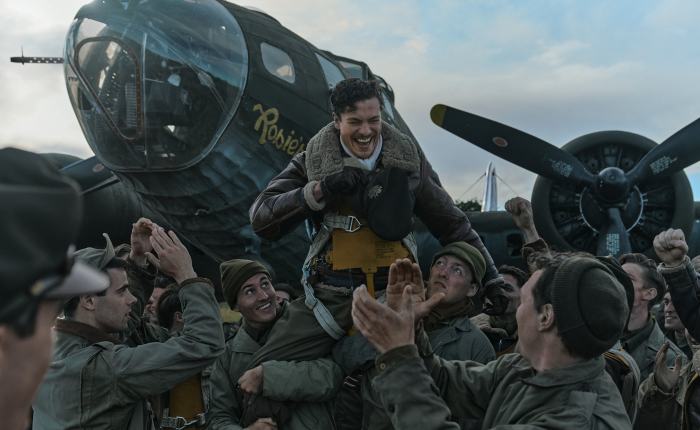
Header image: Nate Mann in Masters of the Air. (Source: Apple TV+)

[1]  Donald Caldwell and Richard Muller, The Luftwaffe Over Germany: Defense of the Reich (Barnsley: Frontline Books, 2014), p. 168.

[2] Luke Truxal, Uniting Against the Reich: The American Air War in Europe, (Lexington: University Press of Kentucky, 2023), p. 115-7.

[3] Donald Miller, Masters of the Air: America’s Bomber Boys Who Fought the Air War Against Nazi Germany (New York: Simon and Schuster, 2006), p. 389.

#Podcast – “The Americans were clearly defeated in 1943…”: An Interview with Dr Luke Truxal

#Podcast – “The Americans were clearly defeated in 1943…”: An Interview with Dr Luke Truxal

Editorial Note: Led by Editor Dr Mike Hankins, From Balloons to Drones, produces a monthly podcast that provides an outlet for the presentation and evaluation of air power scholarship, the exploration of historical topics and ideas, and provides a way to reach out to both new scholars and the general public. You can find our Soundcloud channel here. You can also find our podcast on Apple Podcasts and Google Podcasts.

Dr Luke Truxal is the author of the new book Uniting Against the Reich: The American Air War in Europe from the University Press of Kentucky. In it, he traces how the structure of command over air forces in the Second World War created a mess of problems. Only late in 1943 and into 1944 did these command structures change, enabling air power to become more effective. In this interview, Truxal takes us into the dramatic relationships between leaders like Dwight Eisenhower, Carl Spaatz, and more, showing why, in positions of leadership, personality matters.

41KKUqJT9LL._SL500_

Dr Luke Truxal is an adjunct at Columbia State Community College in Tennessee. He completed his PhD in 2018 from the University of North Texas with his dissertation ‘Command Unity and the Air War Against Germany.’ His previous publications include ‘Bombing the Romanian Rail Network’ in the Spring 2018 issue of Air Power History. He also wrote ‘The Politics of Operational Planning: Ira Eaker and the Combined Bomber Offensive in 1943’ in the Journal of Military Aviation History. In addition, Truxal is researching the effectiveness of joint air operations between the Allied air forces in the Second World War. He can be reached on Twitter at @Luke_Truxal.

Header image: A formation of Boeing B-17F Flying Fortresses over Schweinfurt, Germany, on 17 August 1943. (Source: National Museum of the United States Air Force)

Clearing the Skies for the Red Army – Part One: Learning from Failure

Clearing the Skies for the Red Army – Part One: Learning from Failure

By Dr Luke Truxal

Editorial note: On 20 August 1944, the Soviet Union launched two army group sized formations, the Second and Third Ukrainian Fronts, against Axis Army Group South Ukraine. Army Group South Ukraine had been tasked with defending Romania. During this offensive, known as the Second Iași-Chișinău Offensive, the Soviets routed the Third and Fourth Romanian Armies and destroyed the German Sixth Army. By the end of the offensive on 29 August, the Romanian fascist government under Prime Minister Ion Antonescu was overthrown, and Romania defected to the Allies. In the first of a two-part series on the contribution of US air power to the conduct of the Second Iași-Chișinău Offensive, Dr Luke Truxal examines some of the lessons and issues that emerged from the First Iași-Chișinău Offensive between April and June 1944.

Few historians have delved deeply into the history of the Second Iași-Chișinău Offensive. Those who have written about the campaign typically only analyse the ground war. The foremost authority on the ground war on the Eastern Front, David Glantz, has covered the fighting in Romania in two of his books. In Red Storm Over the Balkans, Glantz analyses the First Iași-Chișinău Offensive. He also writes about the Second Iași-Chișinău Offensive in his overview of the fighting on the Eastern Front. Neither work referred to the air war that influenced the outcome of the fighting on the ground. Rob Citino, in his analysis of the fighting in Romania, excludes the air war.[1] Likewise, much of the historiography of the air war has overlooked the role of American air support provided to the Soviets during the invasion of Romania and focused more on the attacks against the Romanian oil industry. James Lea Cate and Wesley Frank Craven, in the official history of the United States Army Air Forces in the Second World War, focus strictly on the bombing of Romanian oil at the exclusion of the interdiction and air superiority campaigns. As a result, their narrative remained unchallenged for years.[2] In the 1990s, historians began to examine other aspects of the air war over Romania, including attacks against Romanian civilians and an air interdiction campaign.[3]

FRE_000860
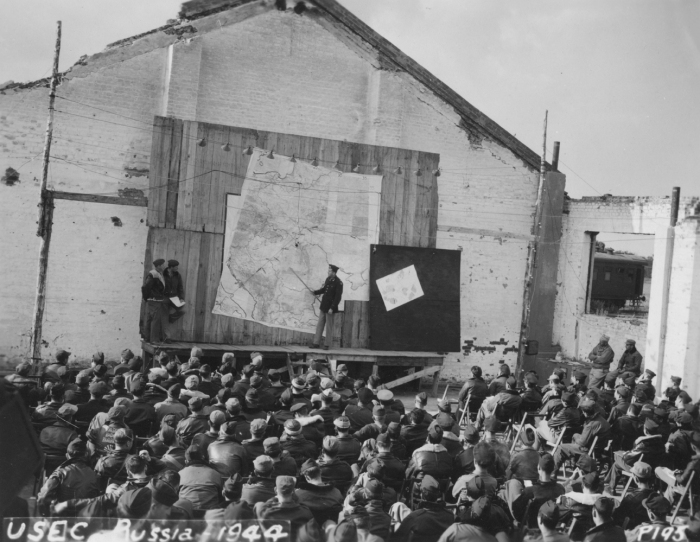
Personnel of the 96th Bomb Group and the 452nd Bomb Group receive briefing against the wall of a bombed-out railway building in Poltava, Russia during Operation FRANTIC in summer 1944. (Source: IWM (FRE 860))

This first article examines the lessons learned from the First Iași-Chișinău Offensive and the Soviet-American planning that led to an aggressive air suppression campaign against Axis air forces in Romania.  As a result of this work, the US Fifteenth Air Force, under the command of Major General Nathan Twining, was able to execute a successful air superiority campaign that aided the Soviet advance into Romania in August 1944 during the Second Iași-Chișinău Offensive from 20 to 29 August 1944. The success of this air campaign was due to the considerable level of coordination between the Fifteenth Air Force and the Red Army before launching the offensive against the Luftwaffe. The architect of this coordination was none other than the commander of the United States Strategic Air Forces in Europe (USSTAF), Lieutenant General Carl Spaatz. In establishing air superiority over Romania, the Fifteenth Air Force ground down German and Romanian air assets from as high as 255 aircraft deployed in the Bucharest area in April 1944 to as low as 40 aircraft in that same area by August 1944.[4]

The unsuccessful first attempt to seize Romania came during the First Iași-Chișinău Offensive between 8 April to 6 June 1944. The Second and Third Ukrainian Fronts aggressively pressed forward after their success in Ukraine. Despite initial breakthroughs, the German and Romanian forces counter-attacked and held the frontier, then known as Bessarabia. Soviet forces suffered setbacks both on land and in the air.

Perhaps the only positive to come from the First Iași-Chișinău Offensive for the Allies was the establishment of a system to coordinate the operations of the Fifteenth Air Force with Soviet ground forces. The system, established over the course of March and April 1944, coordinated Fifteenth Air Force air operations through the Red Army General Staff in Moscow. This laid the groundwork for future coordination when the Soviets resumed their invasion of Romania. United States Army representative in Moscow, Major General John R. Deane, worked tirelessly during March and April to establish a system to coordinate Fifteenth Air Force operations with the Red Army. Ultimately, the Soviets only agreed to an indirect communication system through Moscow to the Second and Third Ukrainian Fronts. On 20 April, General Aleksei Antonov, Deputy Chief of Staff of the Soviet Armed Forces, made it clear to Deane that any such coordination had to be done through Moscow. Antonov went on to say that his superior, Field Marshal Aleksandr Vasilievsky, Chief of Staff of the Soviet Armed Forces, did not believe that the Soviet forces advancing into Romania needed an air liaison officer.[5] This created a slow process when it came to coordinating air attacks with Soviet forces. According to Deane, without the liaison officers, coordination passed from Spaatz to Deane. Afterwards, Deane scheduled a meeting with his counterpart, Major General N. V. Slavin, who then sought approval of the air attacks from his superior Antonov. Antoniv communicated with Soviet field commanders to determine if the American missions interfered with their operations. Antonov then relayed everything back through the same chain. This was not the ideal means of coordinating air missions with the Red Army.[6] Nevertheless, while deeply flawed, the system did allow for the Soviets and Americans to coordinate a bombing campaign in Romania.

Starting in June 1944, the Fifteenth Air Force began to carry out air support operations once again for the Red Army in Romania at the direction of Spaatz. The first area of focus was the Luftwaffe in Romania. One of the critical factors for German success in the First Iași-Chișinău Offensive was that German air power had checked the Red Air Force.  From May to June 1944, the Luftwaffe regained a level of air superiority in the skies over northern Romania. A series of intense air battles took place over the town of Iași between German and Soviet airmen for control of the skies. In Red Phoenix Rising, Von Hardesty and Ilya Grinberg state that the air battles over Iași were some of the most intense of the air war on the Eastern Front. Due to the strategic importance of the Romanian oil refineries, the Luftwaffe transferred some of their most experienced air units to aid in defence of Iași. On 28 April alone the Luftwaffe flew 807 sorties over Iași. The following day the Germans flew another 1,181 sorties against the Soviets. During the entire week, the Germans launched 4,000 sorties against Soviet troops located in the Iași sector. By comparison, the Soviets only carried out 1,970 sorties of their own during that same period. [7]

The Soviet Fifth Air Army tried to enlarge its own air operations to counter the Germans throughout May. Starting on 28 May, forward units of the Soviet Fifth Air Army attempted to reverse the gains made by the Luftwaffe. They attacked German and Romanian airfields located at Roman and Khushi. The goal was to destroy 200 Axis aircraft located at these two locations. Romanian and German forces located the attacking force. The raid only destroyed 35 German and Romanian aircraft. The Germans responded on 30 May. The Luftwaffe flew 2,082 sorties against the Second Ukrainian Front, countered by only 703 sorties flown by the Soviet Fifth Air Army. Throughout the fighting over Iasi, German fighters continued not only to carry out close air support missions of their own but also disrupted those of the Soviet Fifth Air Army.[8]

Operation Frantic
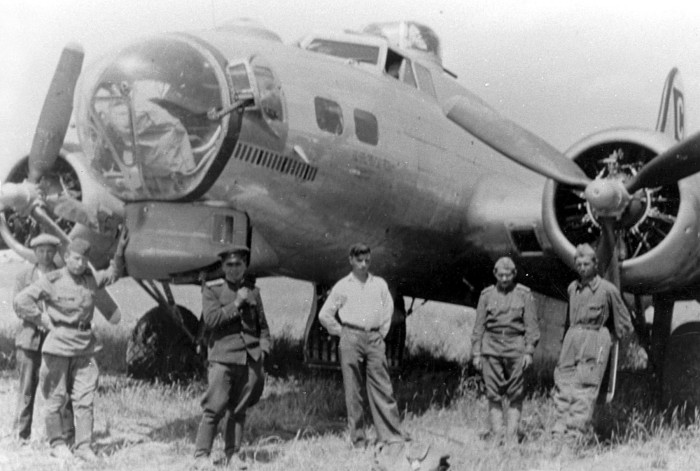
A Badly damaged US B-17 bomber and Russian soldiers in Poltava, Russia, on 22 June 1944 during Operation FRANTIC. (Source: National Museum of the USAF)

As this was happening, the Soviets relayed their struggles against Luftflotte IV to the Americans. On 13 May, the head of USSTAF intelligence, Colonel L.P. Weicker, and Red Air Force General D.D. Grendal met as a part of a conference between the USSTAF air staff and the Red Army to discuss the air war on the Eastern Front. The Soviets provided the Americans with their analysis of the deployment of the Luftwaffe on the Eastern Front. According to Soviet air intelligence, the Germans had concentrated 500 of their 900 bombers on the Eastern Front in the south-facing the Second and Third Ukrainian Front. Additionally, the Luftwaffe deployed 240 of its 650 fighters on the Eastern Front in the south. At the same time, approximately half of the German aerial reconnaissance aircraft were also deployed on the Soviet Southwest Front. In total, 970 of the 2,090 aircraft deployed on the Eastern Front were arrayed against the Soviet Second and Third Ukrainian Front. [9]  During the same meeting, Grendal informed the Americans that many German aircraft began operating from Romania after they retreated from the Ukraine. Those at the meeting recalled: ‘The Soviets estimate that at present the Germans have in excess of 1,000 aircraft on the Roumanian territory.’[10] With this information, the Soviets and Americans were now able to eliminate the threat that Luftflotte IV presented to ground operations.

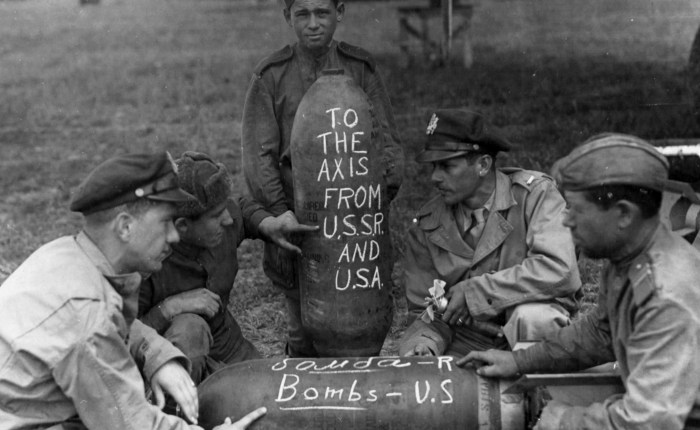
One means of providing more direct aid to the Soviet advance was through shuttle bombing missions, codenamed Operation FRANTIC. During these missions, American bombers from bases either in the United Kingdom or Italy would fly attack a German target on the Eastern Front, then continue east and land at Soviet airfields. FRANTIC I’s planning and execution was designed to aid the Soviet air power in the Iasi-Chișinău sector. In the 22 May draft of FRANTIC I, the Americans contemplated ‘an operation from Foggia against airfields in the Galatz area, followed by 3 operations from Russian bases against targets selected by the Russians.’[11] The Americans believed that attacking Axis airfields in Romania could alleviate the pressure on the Second and Third Ukrainian Fronts. On 27 May, the commander of the Mediterranean Allied Air Force (MAAF), Lieutenant General Ira Eaker, laid out the proposed plan to Twining. He wrote: ‘Fifteenth Air Force will conduct its first FRANTIC bombing operation on the first day weather permits after June first. Force will consist of 130 B-17s and 70 P-51s.’ Eaker then briefed Twining on the preferred targets that the USSTAF wanted to strike, which included the Galatz airfields, an aircraft factory at Mieléc, and an aircraft factory at Riga.[12] While the factories at Mieléc and Riga were on the list, the Galatz airfields had a more immediate effect on air operations in Romania. According to a briefing memo dated 28 May 1944 for the Fifteenth Air Force: ‘The German Air Force in the Southeast, Luftflotte IV, has been forced to withdraw its aircraft to a small number of fields in the Foscani-Galatz area. While recent coverage of this area is not complete, latest photography indicates over 550 aircraft (principally fighters, ground support and bombers) on five fields in the area, of which 450 are on the two Foscani landing grounds and Zilistea.’[13] The primary objective of FRANTIC I was the destruction of these airfields.

On 2 June 1944, the Fifteenth Air Force carried out FRANTIC I. The 2nd, 97th, 99th, and 483rd Bomb Groups, struck the Debreczen marshalling yards before continuing to the Russian airfields located at Poltava in modern-day Ukraine. This had been a last-minute request by the Soviets. Therefore, the Americans added to their first mission as a part of FRANTIC I.[14] With the first leg complete, the Fifteenth Air Force then prepared to strike at the target that American and Soviet planners wanted to get in Romania, Axis air power.

Operation Frantic
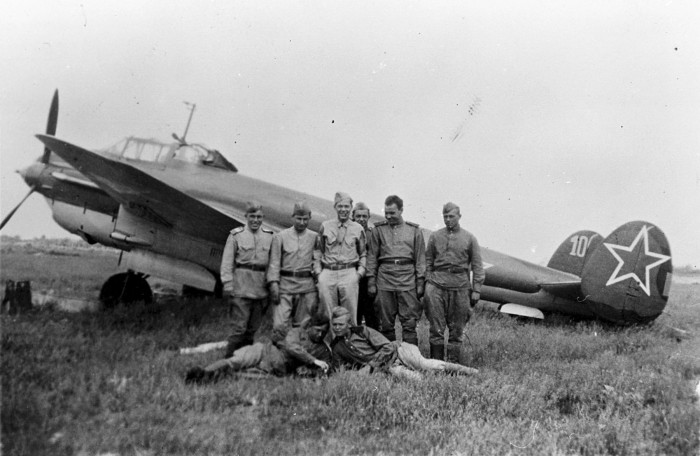
Russian pilots and ground crew stand in front of a Petlyakov Pe-2 at Poltava, Russia, during Operation FRANTIC in June 1944. The American is Technical Sergeant Bernard J. McGuire of the 348th Bomb Squadron, 99th Bomb Group. (Source: National Museum of the USAF)

We can take two lessons away from the failures of the First Iași-Chișinău and the period afterwards. First, the Allies recognised the reasons for the shortcomings of the offensive in the air and on the ground. Remarkably, they were able to figure out what went wrong with the offensive in a matter of days and weeks. As a result, the Allies spent the following month, May 1944, working to fix the problem. That problem, the threat posed by Luftflotte IV, became the main topic of discussion when planning the FRANTIC shuttle missions between the Americans and the Soviets. At the end of these planning sessions, both sides agreed that the Fifteenth Air Force needed to pour more resources into defeating Luftflotte IV before the next major ground offensive. This set the stage for the air superiority campaign that would begin on 2 June 1944.

Dr Luke Truxal is an adjunct at Columbia State Community College in Tennessee. He completed his PhD in 2018 from the University of North Texas with his dissertation ‘Command Unity and the Air War Against Germany.’ His previous publications include ‘Bombing the Romanian Rail Network,’ in the Spring 2018 issue of Air Power History. He has also written ‘The Politics of Operational Planning: Ira Eaker and the Combined Bomber Offensive in 1943’ in the Journal of Military Aviation History. Truxal is currently researching the effectiveness of joint air operations between the Allied air forces in the Second World War. He can be reached on Twitter at: @Luke_Truxal.

Header Image: American and Russian soldiers in 1944 during Operation FRANTIC. In the background is a B-17 Flying Fortress bomber and a C-47 Dakota transport aircraft. (Source: Wikimedia)

[1] For a comprehensive history of the First Iasi-Chișinău Offensive, see David Glantz, Red Storm Over the Balkans: The Failed Soviet Invasion Spring 1944 (Lawrence, KS: University Press of Kansas, 2006), pp. 60-70, 76-100. Glantz is the first historian provide a detailed analysis of the Red Army’s failed first attempt to take Romania. He argues that the history of the campaign was forgotten because of its shortcomings. Glantz also covers the Second Iasi-Chișinău Offensive in David Glantz and Jonathan House, When Titans Clashed: How the Red Army Stopped Hitler (Lawrence, KS: University Press of Kansas, 1995), pp. 218-21. See also Rob Citino, The Wehrmacht’s Last Stand: The German Campaigns of 1944-1945 (Lawrence, KS: University Press of Kansas, 2017), pp. 307-12.

[2] Wesley F. Craven and James L. Cate (eds.), The Army Air Forces in World War II, Volume 6: Europe, Argument to VE Day, January 1944 to May 1945 (Chicago, IL: The University Press of Chicago, 1951), pp. 280-7. Examples of other historians who have also focused only on the oil bombing in Romania include Donald Miller, Masters of the Air: America’s Bomber Boys Who Fought the Air War Against Nazi Germany (New York: Simon and Schuster, 2006), pp. 312-21. While Miller is a popular historian, the influence of his book on the public at large has influenced how many outside the academic community view the air war against Romania. Tami Davis Biddle, Rhetoric and Reality in Air Warfare: The Evolution of British and American Ideas About Strategic Bombing, 1914-1945 (Princeton, NJ: Princeton University Press, 2002), pp. 236-43.

[3] For more scholarship that covers the bombing of Romania outside the spectrum of oil see Mark Conversino, Fighting with the Soviets: The Failure of Operation FRANTIC, 1944-1945 (Lawrence, KS: University Press of Kansas, 1997). For an analysis of the Mediterranean Allied Air Forces’ attacks against Romanian rail targets and the mining of the Danube see Robert S. Ehlers Jr., The Mediterranean Air War: Air Power and Allied Victory in World War II (Lawrence, KS: University Press of Kansas, 2009), p. 364 and pp. 373-7; Conrad Crane, Bombs, Cities, and Civilians: American Air Power Strategy in World War II (Lawrence, KS: University Press of Kansas, 1993), pp. 95-8. To date, the best analysis of the attacks against Romanian civilians is Richard Overy, Bombers and the Bombed: Allied Air War Over Europe, 1940-1945 (New York: Penguin Books, 2004), p. 8, 404, and 413. For further analysis of attacks against the Romanian infrastructure see Luke Truxal, ‘Bombing the Romanian Rail Network,’ Air Power History 65, no. 1 (2018). For a short summary of American and Soviet coordination during the Second Jassy-Chișinău Offensive see Luke Truxal, ‘Forgotten Fights: The Second Jassy-Chișinău Offensive and the Destruction of German Sixth Army,’ National World War II Museum, 14 September 2020.

[4] Ike Skelton Combined Arms Research Library Digital Library, US Army Command and General Staff College, Army Air Force Evaluation Board, ‘Army Air Force Evaluation Board Report VI: Ploesti,’ n.d., , p. 21.

[5] US Library of Congress, Personal Papers of General Carl Spaatz, 30 Mission Moscow to AFHQ, Combined Chiefs of Staff, and British Chiefs of Staff, 20 April 1944. See also Truxal, ‘Bombing the Romanian Rail Network,’ pp. 17-8.

[6] John R. Deane, The Strange Alliance (London: John Murray, 1947), pp. 127-8. See also Truxal, ‘Bombing the Romanian Rail Network,’ p. 18.

[7] Von Hardesty and Ilya Grinberg, Red Phoenix Rising: The Soviet Air Force in World War II (Lawrence, KS: University of Kansas Press, 2012), pp. 286-7.

[8] Hardesty and Grinberg, Red Phoenix Rising, pp. 287-9.

[9] United States Air Force Historical Research Agency (USAFHRA), Call 622.430-6, Fred Anderson to Carl Spaatz, ‘Report on visit to Russia by Mission of USSTAF Officers,’ Exhibit D. Williamson Murray places Luftflotte IV’s numbers at 390 ground attack aircraft, 160 single-engine fighters, and 45 twin-engine fighters. William Murray, Strategy for Defeat: The Luftwaffe, 1933-1945, (Montgomery, AL: Air University Press, 1983), p. 285.

[10] USAFHRA, Anderson to Spaatz, ‘Report on visit to Russia by Mission of USSTAF Officers,’ Exhibit B.

[11] USAFHRA, Call 622.430-6, To Spaatz, ‘Plan for Operation “Frantic,”’ 22 May 1944.

[12] USAFHRA, Call 622.430-6, Ira Eaker to Nathan Twining, 27 May 1944.

[13] USAFHRA, Call 622.430-6, 1. Headquarters Fifteenth Air Force, ‘Annex No. I Combat Operation Enroute Fifteenth Air Force Plan for Operation ‘Frantic Joe’ Part One,’ 28 May 1944.

[14] USAFHRA, Call 622.430-6, ‘Debreczen-Damage Assessment’; USAFHRA, Call 622.430-6, Headquarters Eastern Air Command, ‘Eastern Command Narrative of Operations: 1st Italy-Russia Shuttle Operation-2 June 1944.’