#BookReview – Eyes All Over the Sky: Aerial Reconnaissance in the First World War

#BookReview – Eyes All Over the Sky: Aerial Reconnaissance in the First World War

By Dr Tyler Morton

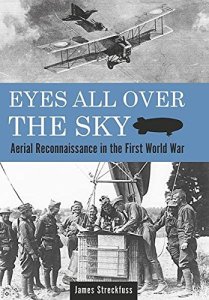
James Streckfuss, Eyes All Over the Sky: Aerial Reconnaissance in the First World War. Oxford, UK: Casemate Publishers, 2016. Maps. Bibliography. Notes. Index. Hbk. 239 pp.

51jjn6edowl

Aviation historian after aviation historian has fallen into the trap of overlooking the important role played by airborne intelligence collection platforms during the First World War. Mystified with the glamorous images of Baron von Richthofen and Eddie Rickenbacker, the historical narrative has primarily focused on the exploits of the fighter pilot. This narrative has been fueled by a general lack of scholarly writing about the important role played by airborne-derived intelligence. In Eyes All Over the Sky: Aerial Reconnaissance in the First World War, James Streckfuss seeks to remedy the oversight.

From the dawn of war, military commanders have sought enhanced intelligence to assist decision making. For much of history, the quest for better information was limited to the use of spies or, at best, the ability to obtain improved vantage points from high terrain or even trees. Almost immediately after man achieved flight, military thinkers put the air platform to intelligence use and in June 1794 the French conducted the world’s first military airborne reconnaissance sortie when they used balloons to reconnoitre Austrian forces near the town of Maubeuge on the border with Belgium. Military use of the air asset proliferated and by the start of World War I, the balloon and the aeroplane were firmly entrenched in militaries around the world. In every case, the air assets were reconnaissance platforms. This point, more than any other, drives Streckfuss’ subsequent analysis of the importance of airborne reconnaissance in the war.

large_0000001
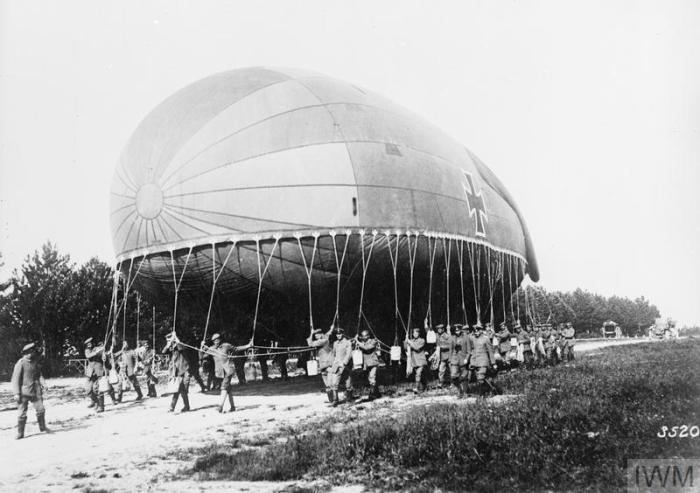
A German balloon section mooring an observation balloon to a new position. (Source: © IWM (Q 54462))

After briefly outlining the early days of the balloon – and aeroplane – based reconnaissance, Streckfuss dives right into the tactical fight of the First War. Choosing first to highlight the little-known importance of balloon reconnaissance, Streckfuss thoroughly examines all the major combatants’ use of balloons comparing the challenges faced by each as they tried to maximise the impact of this still unfamiliar capability. Of note in this section is the advanced progress which the Germans had made as compared to that of the Allies. Count Ferdinand von Zeppelin’s determination to make Germany the air power envy of the world had resulted in considerable pride and dedication to balloons. When the war began, they were significantly ahead of the Allies. Unfortunately for the Germans, their commanders on the Western Front had not been convinced of the veracity of the intelligence their airborne reconnaissance platforms provided.[1] Thus, German commanders ignored the information provided by their airmen and instead made disastrous moves that eventually resulted in the famous German retreat to the Aisne River and the subsequent stalemate that characterised much of the war.

Over the next several chapters, Streckfuss lays out a well-told story of aviation’s wartime missions of artillery spotting, infantry liaison, and photographic interpretation. These chapters magnificently describe the primary missions conducted by the various air forces during the war. As the war was, by any estimation, a war of the ‘big guns,’ the importance of aviation to the artillery mission cannot be overstated. Due to air power, the artillery could now hit targets all over the battlefield – even deep behind enemy lines – with previously unheard of accuracy. As Streckfuss writes, airborne intelligence ‘held the key to making the artillery more deadly than it had been in any previous war’ (p.84).

large_0000003
Air Mechanic Cecil Haliday of the Royal Flying Corps demonstrates a ‘C’ type aerial reconnaissance camera fixed to the fuselage of a BE2c aircraft. (Source: © IWM (Q 33850))

The book’s final chapter examines the reasons why the success of airborne reconnaissance was downplayed after the war. Thoroughly convinced that air power would be the dominant force in all future wars, airmen of the major victorious powers sought to free – or in the case of the British, keep free – their air arms from the control of the British Army and the Royal Navy. According to Streckfuss, this dogged drive for independence caused airmen to highlight the ‘power’ part of air power and to minimise the primarily ‘service’ role air power had played in the war. The ability to singlehandedly win a war was a far more compelling argument than the contributions the air forces had made in their support of the Army and Navy.

Streckfuss’ argument is compelling. Airborne reconnaissance was the primary purpose of air forces going into the First World War and, contrary to some beliefs, it contributed significantly to both victory and defeat. This new book is a welcome addition and helps fill a historiographical gap in the literature about the war and our general understanding of the importance of airborne reconnaissance. I highly recommend it for the air power expert and novice alike.

Dr Tyler Morton is a Lieutenant Colonel in the United States Air Force (USAF) and holds a PhD in Military Strategy from Air University. A graduate of the USAF’s School of Advanced Air and Space Studies (SAASS), he is currently converting his dissertation on the evolution of manned airborne intelligence collection into a book which he hopes to publish in 2017. His research interests include the history of airborne reconnaissance with a focus on airborne linguists, the role of intelligence in the formulation of grand strategy, and the importance of innovation to the next era of military capability.

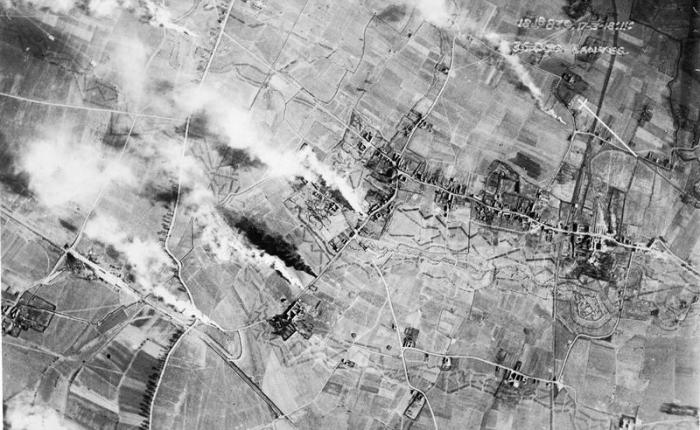
Header Image: An RAF aerial photograph showing how the enemy attempted to conceal gun positions by artificial smoke screens, which were defeated by the use of the camera. (Source: © IWM (Q 12224))

[1] Eric Dorn Brose, The Kaiser’s Army: The Politics of Military Technology in Germany During the Machine Age, 1870-1918 (New York, NY: Oxford University Press, 2001), p. 191.

#BookReview – A Thunder Bird in Bomber Command

#BookReview – A Thunder Bird in Bomber Command

By Dr Ross Mahoney

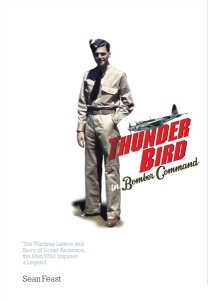
Sean Feast, A Thunder Bird in Bomber Command: The Wartime Letters and Story of Lionel Anderson, the Man who Inspired a Legend. London: Fighting High Publishing, 2015. Foreword. Appendices. Sources. Index. Hbk. xiii + 169 pp.

lionel-book

Thunderbirds are go! It is not often that you get to write those immortal words at the start of a review to do with a book on Bomber Command; however, this is no ordinary book. Indeed, it is a book that will be of interest to two distinct groups of people. First, there are those with an interest in the experience of Bomber Command operations during the Second World War. Second, there are those with a passion for the 1960s TV show Thunderbirds and other production that came from Gerry Anderson’s fertile imagination. This, of course, begs the question of how these two seemingly disparate interests are linked. Well, as Shane Rimmer, who provided the voice to Scott Tracey, recollected in the foreword to the book, the inspiration was ‘direct and personal – from his elder brother Lionel who had given up his life as a pilot during the Second World War’ (p.ix).

This biography, therefore, tells the story of Lionel Anderson, Gerry Anderson’s older brother through the letters that he sent home while also considering the impact of his death on his younger brother. The book details Lionel Anderson’s early interest in flying and his decision to volunteer as aircrew in the RAF (p.3). The book then follows a chronological order following Lionel Anderson’s experience of flying training to through to undertaking operations as part of No. 515 Squadron, which formed part of Bomber Command’s No. 100 (Bomber Support) Group. The unit had been established in October 1942 from the so-called Defiant Flight at RAF Northolt and at that time formed part of Fighter Command. The unit was then equipped with the Bristol Beaufighter and then the de Havilland Mosquito. Lionel Anderson joined No. 515 Squadron in early 1943 (p.77). The squadron was involved in operating Moonshine, Mandrel, and Serrate electronic warfare systems that had emerged as part of the pantheon of homing and jamming systems that developed during the Second World War. These were designed to provide support in an ongoing battle to defeat German equipment, such as the Freya radar net as well as defeat German night fighters. In this, Sean Feast provides a good overview of No. 515 Squadron’s role in this area.

large_0000001
Hawker Hurricane Mark X, AG111 ‘HK-G’, of No. 59 Operational Training Unit, on the ground at Milfield, Northumberland. Although bearing the unit codes of the Fighter Leaders School (based at Charmy Down, Wiltshire), AG111 does not appear to have been officially transferred to them. It was passed later to No. 57 OTU at Eshott, Northumberland, and crashed after colliding with a Supermarine Spitfire over Wooler on 5 May 1943. (Source: © IWM (CH 9222))

The section dealing with Lionel Anderson’s time with No. 59 Operational Training Unit is, however, problematic. Feast suggests that in late 1942, Anderson’s course transferred to Brunton, which was No. 59 OTU’s satellite airfield and that while there they became known as No. 559 Squadron.  Additionally, Feast suggests that, as No. 559 Squadron, the unit could be called on to intercept incoming aircraft as part of ‘Saracen scheme’ (p.76). This is where it becomes murky as there does not appear to be a No. 559 Squadron. There is no Operations Record Book for No. 559 Squadron and C.G. Jefford’s work on RAF squadrons does not list the unit.[1] However, No. 559 Squadron was a numberplate reserved for No. 59 OTU if activated as part of Plan BANQUET. Additionally, Ray Sturtivant’s work on flying training units does suggest that, in March 1943, the squadron number above was used.[2] So what is to be made of this? First, Plan BANQUET, which originated in 1940, had been revised in May 1942. Part A of the Fighter Command element of the revised plan – BANQUET FIGHTER – called for aircraft and crews from OTUs to form squadrons as reinforcements, as such; they would have received a numberplate. This process was activated by a codeword ‘APPLE’.[3] Nevertheless, as Jefford noted, the squadron numberplates allocated to fighter OTUs were not used as the units were not mobilised.[4] Second, it is reasonable that crews at OTU’s were aware of this plan, and their designation if activated. It is probably this that is being recollected rather than an official designation. This of course raises the question of whether matters, which is clearly subjective. I would suggest that the pilots being trained by No. 59 OTU were aware of their reserve role and the details of the unit’s designation. It highlights the tension between the operational record and memory and how it can be distorted.

The earlier sections of the book that detail Lionel Anderson’s decision to volunteer, his training in America and time at an Advanced Flying Unit are, for me, the real gem of this book as it is here where the letters home find their place. Indeed, the reason for this appears to be that the last letter kept by Lionel Anderson’s mother, Deborah comes from this period. As Feast explains, Deborah Anderson had reproduced the letters into a pair of hard-backed exercise books, and this is all that was left of Lionel Anderson’s correspondence (pp.69-70). This helps explain why the book’s subtitle is ‘The Wartime Letters and Story’ as the latter period has been reconstructed from other sources. Nevertheless, the use of letters in the earlier part of the book help us explore what it was like to serve in the RAF during the war and the experience of training in America. In one letter, Lionel Anderson described the planned graduation dance they held at the end of his training in America. ‘We invite our instructors and friends we have made during our stay here and, of course, we have plenty of girls.’ This recollection (p.55) both highlights the friendly relations between American and Britain but also one recurring theme in the letters, girls.

Overall, as with many books of this type, this is a fascinating insight into life in the RAF. It is made all the more interesting given the links between Lionel Anderson and his younger brother’s later work.

This book review originally appeared at Thoughts on Military History.

Dr Ross Mahoney is an independent historian and defence specialist based in Australia. Between 2013 and 2017, he was the resident Historian at the Royal Air Force Museum, and he is a graduate of the University of Birmingham (MPhil and PhD) and the University of Wolverhampton (PGCE and BA). His research interests include the history of war in the twentieth and twenty-first centuries, air power and the history of air warfare, and the social and cultural history of armed forces. To date, he has published several chapters and articles, edited two books, and delivered papers on three continents. He is a member of the Royal Historical Society and is an Assistant Director of the Second World War Research Group. He is a member of the Royal Historical Society and an Assistant Director of the Second World War Research Group. He blogs at Thoughts on Military History, and can be found on Twitter at @airpowerhistory.

Header Image: The prototype Boulton Paul Defiant fighter, which first flew in August 1937. This aircraft type equipped the so-called Defiant Flight at RAF Northolt, which eventually became No. 515 Squadron. (Source: © IWM (MH 5507))

[1] Wing Commander C.G. Jefford, RAF Squadrons: A Comprehensive Record of the Movement and Equipment of all RAF Squadrons and their Antecedents since 1912, 2nd Edition, (Shrewsbury: Airlife, 2001).

[2] Ray Sturtivant, Flying Training and Support Units since 1912 (Staplefield: Air-Britain, 2007), p.242.

[3] Anon, The Air Defence of Great Britain – Volume V: The Struggle for Air Supremacy, January 1942-May 1945, (Air Historical Branch Narrative), pp.10-1.

[4] Jefford, RAF Squadrons, p.188.

#BookReview – How the War Was Won: Air-Sea Power and Allied Victory in World War II

#BookReview – How the War Was Won: Air-Sea Power and Allied Victory in World War II

By Alexander Fitzgerald-Black

Phillips Payson O’Brien, How the War Was Won: Air-Sea Power and Allied Victory in World War II. Cambridge: Cambridge University Press, 2015. Figures. Maps. Tables. Illustrations. Notes. Bibliography. Hbk. xix + 626 pp.

how-the-war-was-won-by-phillips-payson-obrien

The Second World War is known for its decisive battles. The Battle of Britain, the Battle of Stalingrad, the Battle of Midway, and the Battle of Normandy are among the most popular. However, what if there was no such thing as a decisive battle in the greatest conflict in human history? This is what Dr. Phillips Payson O’Brien of the University of Glasgow argues in How the War Was Won: Air-Sea Power and Allied Victory in World War II, a monograph in the making for at least a decade and a half.

O’Brien seeks to contest the now standard argument that the Soviet Union bore the brunt of the German onslaught. The Red Army broke the back of German power while the Western Allies played a relatively modest role according to this view. This is one of the main themes in Richard Overy’s Why the Allies Won, a well-reputed study of the war from the mid-1990s. Western access to Russian archives emerged as the Cold War ended. Overy and other scholars took the opportunity to learn more about the war from Russia’s perspective. What emerged was a significant criticism of Western scholarship for downplaying the USSR’s role in the victory over Nazi Germany.

O’Brien’s analysis turns this thinking on its head. Those who laud the Soviet contribution do so within a paradigm that understands the contribution to victory through manpower. O’Brien cannot deny that the USSR engaged a larger percentage of the Wehrmacht than the Western Allies. His argument is that the Second World War was primarily a mechanized war. The production and destruction of equipment are what decided the war in spite of the human cost of 70 million dead (civilians included).

The production of air and sea weaponry far outstripped that of land weaponry. As such, O’Brien argues that the air-sea war was more significant than the fight on the ground. For instance, the German Army received only between 30-35% of production when it was lucky. A plurality of production effort was generally aimed at air weaponry. For instance, in May 1943 40% of German production efforts were spent on aircraft. American, British, and Japanese production efforts were similar, with the UK spending approximately one-half of its production efforts on aircraft from 1940 onwards. Naval production for each of these four nations also typically outstripped that of armoured fighting vehicles (AFVs) associated with the great land battles.

Air and sea power allowed for the most efficient destruction of Axis equipment. This destruction could be achieved in three phases. ‘Pre-production’ destruction prevented the Germans and Japanese from producing weaponry in the first place by damaging factories and destroying or preventing the arrival of raw materials. ‘Production’ destruction meant destroying equipment as it was being assembled in the factories. ‘Deployment’ destruction refers to equipment lost as it was in transit from assembly plants to the front lines. The Western Allies – mainly Great Britain and the United States – were primarily responsible for these equipment losses. The Russians did not maintain a very large navy, nor did they invest in many large, four-engined bombers to strike at the German economy.

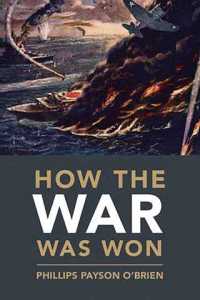
The great land battles were not decisive. The incredible attrition sustained by the German and Japanese war machines on a daily basis was decisive. O’Brien’s argument is that this super-battlefield of air and sea weaponry mattered most. Few battles were decisive regarding equipment destroyed. German AFV losses at the Battle of Kursk, commonly lauded as the greatest tank battle of the war, were a meagre 0.2 percent of German armaments production in 1943; German AFV losses at the great British victory at El Alamein were a paltry 0.1 percent of 1942 armaments production. O’Brien does note an exception to this: the Battle of Midway. At that near-decisive naval engagement, the Imperial Japanese Navy lost four aircraft carriers, vessels that could not be replaced for some years. Consequently, it is little surprise that an image of Japanese carriers under attack at Midway graces the cover of the book.

O’Brien does leave some unanswered questions. He does not discuss the role – real or imagined – of initiative in the conflict. Battles are often considered decisive, not only for the casualties or equipment losses they incurred but for their role in shifting perceptions of how the war was going. His assessments of certain Eighth Air Force raids over Germany in 1943 may also be open to some criticism. He notes the efficiency of the air-sea war, but the losses sustained on these raids were anything but efficient. More salient to my research is his mixed treatment of the Mediterranean Theatre of Operations. O’Brien acknowledges the significant attrition imposed on Axis air forces there but laments that this was not a more integral part of the Allied strategy. He opposes the Allied decision to focus on the Mediterranean in 1943 instead of mounting the invasion of France.

How the War Was Won is an excellent read for those interested in how the interaction between production, logistics, and combat decided the war against Germany and Japan. This is its greatest contribution to the Second World War’s expansive historiography.

This post first appeared at Fighter-Bombers Blog.

Alexander Fitzgerald-Black completed his MA thesis, ‘Eagles over Husky: The Allied Air Forces and the Sicilian Campaign, 14 May to 17 August 1943,’ with The Gregg Centre for the Study of War and Society, University of New Brunswick in 2014. He is in the process of turning this work into a manuscript for publication with Helion & Company. Alex lives with his wife in Moncton, Canada. He operates his own blog at alexfitzblack.wordpress.com and can be reached on Twitter @AlexFitzBlack.

Header Image: A low-level oblique photograph showing incendiary bombs dropped by Lockheed Venturas of No. 2 Group, RAF Bomber Command, during Operation OYSTER, the daylight attack on the Philips radio and valve works at Emmasingel, Holland, 6 December 1942. (Source: © IWM (C 3268))

#BookReview – The Mediterranean Air War: Airpower and Allied Victory in World War II

#BookReview – The Mediterranean Air War: Airpower and Allied Victory in World War II

By Alexander Fitzgerald-Black

Robert S. Ehlers Jr., The Mediterranean Air War: Airpower and Allied Victory in World War II. Lawrence, KS: University Press of Kansas, 2015. Notes. Bibliography. Index. Hbk. 536 pp.

9780700620753

The Second World War’s Mediterranean Theatre of Operations was a sideshow, right? The road to defeating Nazi Germany where the Western Allies were concerned lay through Normandy, not North Africa. The Allies launched their great Combined Bomber Offensive from the United Kingdom as this incredible animation from the American Air Museum shows. Other efforts were relatively unimportant and sapped resources from where the real air battle took place. Alternatively, were they?

Robert S. Ehlers Jr.’s The Mediterranean Air War: Airpower and Allied Victory in World War II offers a valuable counter-narrative. The Mediterranean was not a sideshow. In fact, it was a critical theatre for Allied victory. Adolf Hitler committed the Wehrmacht to the Mediterranean in 1941 to support Benito Mussolini’s faltering armies in Greece and North Africa. Four years later the consequence of this simple plan was 400,000 Italian and 730,000 German casualties. However, human casualties only tell part of the tale. The European Axis lost 42 percent of its merchant shipping in the Mediterranean. The Allies all but destroyed the Regia Aeronautica by mid-1943 while the Luftwaffe lost 17,750 aircraft in the Mediterranean throughout the war. By comparison, the Germans lost 20,419 aircraft on the Western Front while losing only 11,000 on the Eastern Front.

This is just the strategic picture. Ehlers’s work also talks logistics. Historians have often highlighted the importance of tank strength in the Western Desert. The side that could field the most tanks had the advantage. Since both sides had to maintain their forces across long supply chains the ability to retrieve and repair damaged battlefield equipment was crucial. The same was true for aircraft. The Royal Air Force created an efficient system for repair and salvage early in the campaign. Air Vice-Marshal Graham Dawson, the RAF’s Chief Maintenance Officer in the Mediterranean, organized the effort. Dawson was a Battle of Britain veteran who received a Mention in Dispatches for superb engine repair efforts in 1940. He coordinated his crews’ efforts with local Egyptian shops that could repair and manufacturer parts. Dawson’s command was innovative. It created modifications that allowed Hurricane fighters to engage high-flying Junkers Ju 86P photo reconnaissance aircraft. The aircraft’s service ceiling was 36,000 feet, yet the modified version achieved its first victory over the Nile at 49,000 feet.

large2
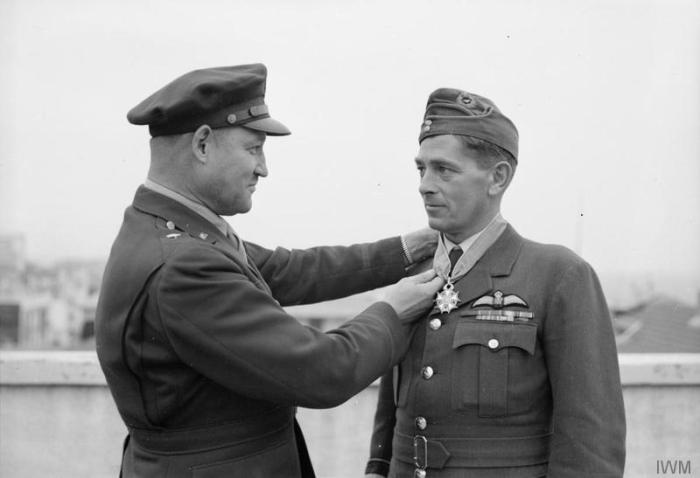
Air Vice-Marshal Graham Dawson, Director of Maintenance and Supply, Mediterranean Allied Air Forces, is presented with the American Legion of Merit in the degree of Commander, by Brigadier-General Harold A. Barton, Commanding General of the USAAF Service Command, Mediterranean Theatre of Operations, during a parade at Algiers. (Source: © IWM (CNA 2721))

The Mediterranean was ultimately a battle for sea lines of communication or SLOCs. Air superiority was essential to winning this and other battles. With the war in North Africa won, Ehlers argues that the Western Allies were right to take the war to Sicily and then on to mainland Italy. After securing air superiority, the Allied air forces were free to expand their cooperation with Allied armies. The Allies produced great results when the services coordinated their efforts. In the first half of 1944, Operations STRANGLE and DIADEM sought to defeat German forces barring the way to Rome. STRANGLE was an air campaign aimed at depriving the Germans of supplies while DIADEM was a large-scale ground offensive with air support. On its own, air power’s effectiveness was limited. The Germans lost 20 trucks per day during STRANGLE, but that number rose to 100 per day during DIADEM. Pressure from the army kept enemy transports on the road in large numbers, making them easier prey for prowling fighter-bombers. Together these operations cost the Germans Rome and 80,000 casualties.

Ehlers convincingly argues that the final air campaigns flown from bases in Italy shortened the war and saved lives. Targets included the Luftwaffe, the German oil industry, and German lines of communication to the Eastern Front. Instructors who seek to offer their students a fresh perspective on the Mediterranean Theatre of Operations will do well to include this book on their reading lists.

This post first appeared at Fighter-Bomber’s Blog.

Alexander Fitzgerald-Black completed his MA thesis, ‘Eagles over Husky: The Allied Air Forces and the Sicilian Campaign, 14 May to 17 August 1943,’ with The Gregg Centre for the Study of War and Society, University of New Brunswick in 2014. He is in the process of turning this work into a manuscript for publication with Helion & Company. Alex lives with his wife in Moncton, Canada. He operates his own blog at alexfitzblack.wordpress.com and can be reached on Twitter @AlexFitzBlack.

Header Image: A formation of five Blenheim Mark IVs of No. 14 Squadron RAF in flight over the Western Desert. A Curtiss Kittyhawk, one of the escorting fighters, can be seen on the far right (Source: © IWM (CM 3108))