By Lieutenant Colonel Michael H. Taint, United States Air Force (ret’d)
Editorial note: In this two-part article, Michael Taint re-evaluates the conduct of Colonel Edward Deeds in the management of the US Army’s First World War aircraft production program and the overall aeroplane production program itself. In this first part, he sets the scene to be explored in the second part.
The US Army was the first military in the world to procure an aeroplane. However, when the United States entered the First World War in the spring of 1917, its military aviation program lagged pitifully behind other belligerents. The expectation of the US government, the American public and its new allies was that American industrial might would quickly create an air force so enormous as to ‘permanently cloud Germany’s place in the sun’ according to Major General George Owen Squier, Chief Signal Officer (the Signal Corps included all military aviation unit at that time).[1] In July 1917 – after a mere 40-minute debate – Congress appropriated an unprecedented $640 million for this purpose, with a production goal of 22,635 aeroplanes and 45,250 engines. However, at the end of the First World War, despite the benefit of having a build-to-print design for an existing aeroplane, a mere 196 aeroplanes were delivered for combat action at the front, an embarrassing failure.[2]
The ensuing political fallout caused President Woodrow Wilson to request an informal inquiry by aviation enthusiast and artist Gutzon Borglum (better known as the sculptor of Mount Rushmore and Stone Mountain). Borglum’s accusations of impropriety, particularly against Edward Deeds, a Dayton industrialist directly commissioned Colonel in the US Army Air Service, spurred further Congressional scrutiny. Eventually, Wilson directed a formal investigation led by Charles Evans Hughes, his opponent in the 1916 presidential campaign and future Chief Justice of the Supreme Court. Hughes recommended Deeds’ court-martial; a court martial that never occurred. This paper re-evaluates Deeds’ conduct in the First World War aircraft production program and the overall aeroplane production program. Though often characterised as a failure, American aeroplane production in 1917-18 was more a victim of unrealistic expectations than a lack of competence.
The Pre-Bellum State of American Aviation: The Bolling Commission
Mimicking the experience of the US Army, American military aviation in April 1917 was underdeveloped due to a lack of investment. Although a few officers, such as Squier, had been advocating the potential revolutionary capabilities of military aviation for nearly a decade (Squier himself wrote the technical specification for the US Army’s first purchase of the Wright Flyer), the rest of the US Army and Congress remained sceptical, and funding reflected that scepticism. On active duty, the Aviation Section of the US Army’s Signal Corps consisted of only 52 officers (26 of whom were fully qualified pilots), 1,100 civilian and enlisted personnel, and the air fleet that consisted of 165 aeroplanes – none of which could undertake the type of aerial combat that was occurring over the Western Front – stationed at two flying fields.[3]
Unlike America’s entry into the next world war, which had issues, at the declaration of hostilities, the USA in 1917 was no great ‘Arsenal of Democracy.’ The US aircraft industry employed only about 10,000 workers, total, at a half dozen firms, and the two largest firms, Curtiss and Wright-Martin, despite bearing the names of America’s foremost aviation pioneers, were controlled by the automotive industry, most notably Howard Coffin of Hudson and Packard’s Sydney Waldon.[4] With limited military interest (except for an order of 800 training planes the Allies placed in 1916), no airline industry, and no airmail, there was insufficient demand to motivate manufacturers. Intellectual property issues were another significant deterrent to the aviation industry’s growth. The Wright Brothers’ invention of ‘wing warping,’ which allowed an aeroplane to roll (turn) left or right, was ruled in 1914 to apply to all flight controls on all aircraft types – in other words, to anyone who built an aeroplane that did anything but fly in a straight line. The Wrights demanded a heavy licensing fee for this technology, adding significant costs and further discouraging start-up efforts.[5] The remedy was an industry steering group and forum that could wrest control of aircraft design and manufacturing from these proprietary interests. So Coffin and Waldon, among others, founded the Aircraft Manufacturers Association (AMA), modelled after the highly successful Society for Automotive Engineers (where Coffin and Waldon were also leaders). The AMA was designed to address issues plaguing early aeroplane manufacturing: intellectual property deterrents and custom parts and interfaces, to make mass production possible, just as they had for automobiles.
The creation of the AMA was timely, as once America declared war on Germany, Europeans besieged the US Government’s official steering body, the Aircraft Production Board, for more aeroplanes. Benedict Crowell, Assistant Secretary of War and Director of Munitions, wrote in the US Army’s official history:
France and Italy had both adopted the policy of depending upon the private development of designs for their supplies of airplanes […] the United States would have to pay considerable royalties for the use of any of these European devices. As to the relative merits of types and designs, it was soon apparent that no intelligent decision could be reached in Washington or anywhere but Europe.[6] (emphasis added)
To make recommendations for this decision, Major Raynal Bolling, a corporate (US Steel) lawyer, National Guard officer, and pilot, was tasked to lead a fact-finding team that became known as the ‘Bolling Commission.’ The Bolling Commission included 12 military and aeroplane experts, plus 93 production specialists from various American factories – the cadre of the future American aviation industry.[7] The Bolling Commission arrived in Britain on 17 June 1917 and visited French, Italian and British aeroplane factories during an intensive 5-week trip and determined in its 30 July report that a handful of specific Allied aircraft, including the De Havilland DH-4, were the best candidates for American domestic production. For the coming year, however, the Bolling Commission recommended US materiel and funding be prioritised to French factories already in production while America ramped up its infant aviation industrial base. They planned for American factories to produce 22,000 tactical aircraft plus training aeroplanes.[8] Consequently, the US Army Air Service awarded a contract for delivery by 1 July 1918 of 5,875 planes manufactured in France but with mostly American materials. Almost all-American airmen flew aircraft produced by this contract.
On 18 October 1917, the DH-4, a 2-seat reconnaissance and day bombing aircraft initially designed by Geoffrey de Havilland in the UK and introduced into service the year before, was selected for American production.[9] The most recent version of this light bomber, the DH-9, was chosen. However, when production started a few months later only the older DH-4 was available to be shipped to America and a production sample – so it was used instead.
Not everyone, however, such as Colonel (later Brigadier General) Billy Mitchell, agreed with the selection of this aircraft. Bolling chose a light bomber rather than a pursuit plane because the latter needed design updates every six months to remain combat-ready; at any one time, 60 per cent of the Allied combat aircraft at the Front were considered obsolete. To all American manufacturers, the DH-4 certainly had another advantage. Unlike the French and Italian aircraft designed by private firms with heavy licensing (intellectual property) fees, the DH-4 was provided by the British government license-free.[10] However, not everyone agreed that aircraft production in America was a good idea, either. Mitchell, then commander of all American aviation forces stationed in France, had toured French factories extensively and was convinced of their superiority in capability and product. Mitchell viewed sending American materials and men to expand existing French manufacturers as the quickest way to victory. As Mitchell recalled with his characteristic bluntness:
It was the beginning of a series of blunders by those directing aviation in Washington, which culminated later in that department being virtually removed from the authority of the War Department and put into the hands of businessmen […- I am referring to the De Havilland airplane and the Liberty engine […] this one decision held up delivery of equipment to American air forces for an entire year, and constituted one of the most serious blunders.[11]
However, those businessmen in charge of aviation in the summer of 1917 had a hugely different view.
The Businessman becomes a Colonel – Edward Deeds of Drayton
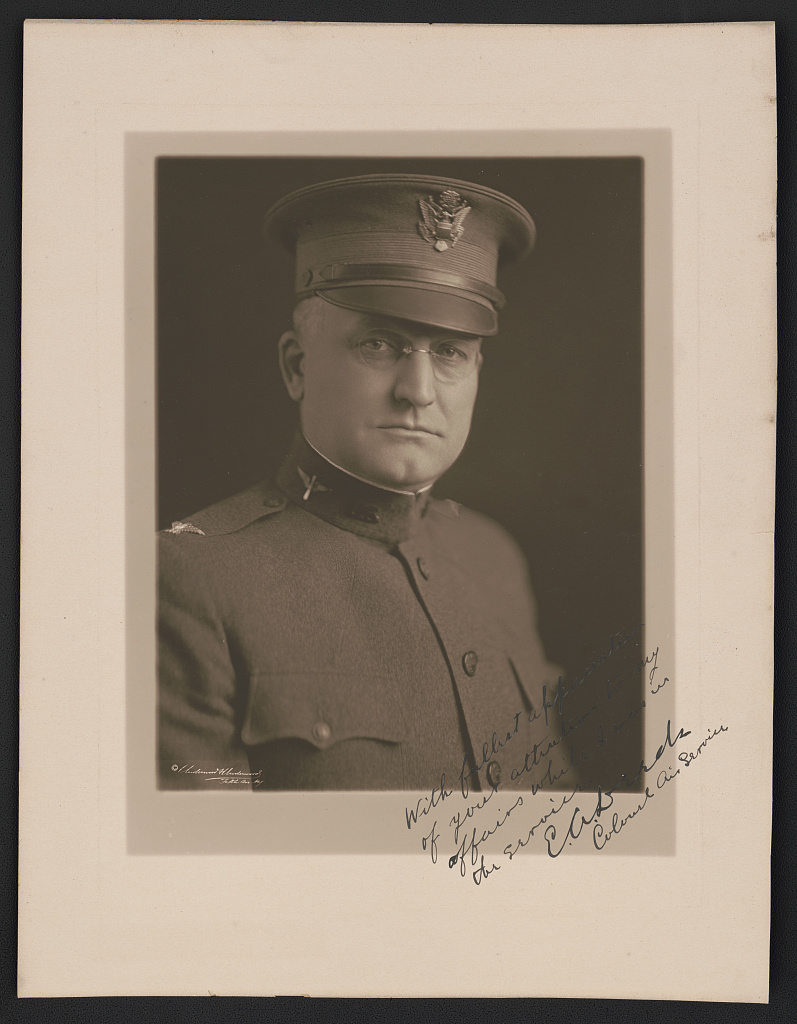
When the United States declared war, Edward Deeds was a wealthy 43-year-old industrialist and prominent citizen of Dayton, Ohio. Starting as an electrical engineer designing motors for cash registers with the National Cash Register (NCR) company in Dayton, Ohio, Deeds eventually rose to vice president and general manager. His pleasant personality and charm were undoubtedly key to his business success. His most famous hire was another engineer, Charles Kettering. The two became lifelong friends and business partners, often tinkering in Deeds’ barn, where Kettering invented the first automotive electronic ignition system. The enormous success of this invention led Deeds and Kettering to form another company, the Dayton Electronics Company (DELCO), in 1908, a powerhouse in the rapidly expanding automotive industry; Kettering served as chief technical officer, and Deeds focused primarily on business affairs.[12]
Deeds was well into this second successful business venture when his first one caught up with him in a shocking way. NCR had cornered over 95% of the cash register market, but not always through ethical or legal business practices. In February 1913, along with John Patterson and future IBM chief executive Thomas J Watson, Deeds was convicted in the Federal district court in Cincinnati of the first criminal violation of the Sherman Antitrust Act in US history. Along with a $5,000 fine, each man was sentenced to a year in prison. Their careers appeared ruined, but fate intervened. Waiting on appeal, the NCR executives were redeemed in the public’s eye by their extraordinary response to the Great Dayton Flood that nearly destroyed the city a few months later.[13] By marshalling all their company’s resources, Patterson and Deeds provided food and shelter, as well as a small flotilla of rescue boats that saved hundreds of lives. Two years later, on 13 March 1915, an Appeals court overturned all the convictions and ordered a retrial. However, by then, the retrial of these local heroes was politically impossible, and all charges were dropped.
By 1917, just days after the US declaration of war, Deeds and Kettering saw yet another business opportunity, yet another chance to ‘get in on the ground floor’ as they had with electronic ignition in automobiles. They met with Dayton financier H.E. Talbot and his son in the senior Talbot’s suburban Dayton home. Also present were a few original Wright Airplane Company employees, including pilot and aeroplane designer Grover Loening. Deeds and Kettering, with additional financial backing from the Talbots, proposed creating a new aeroplane company called the Dayton Wright Airplane Company, specifically to compete for the substantial number of aeroplane orders that would undoubtedly be coming from the War Department. Orville Wright would be included as a ‘non-working’ director, allowing the new company to capitalise on the prestige and credibility the Wright name would bring (Wright only rarely participated in the actual business, usually as a technical consultant). Deeds proposed that engines from the booming American automotive industry (using the electronic ignition system built by his DELCO Company) would be mated with build-to-print designs from proven European tactical aircraft (since everyone knew America had no design expertise). The solution to the aeroplane production problem would be at hand, with handsome profits. The company’s incorporators needed but $500,000 to begin operations; within a few months, large aircraft contracts would be a massive payback on their investment.[14] The one true aeronautical expert there, Grover Loening, confessed to being ‘astonished’ at these bold plans, which he considered ’shady.’[15] After the First World War, in a section of his memoirs entitled ‘The Detroit Conspiracy’ Loening noted:
the way step after step led the automobile crowd in Detroit to the ownership, control, direction and parceling out of all aircraft and aircraft-motor business, by the time we entered the war in 1917, is a pattern that much too beautifully fit together to be accidental […] Our able and efficient automobile manufacturers in Detroit, foreseeing a war production era, apparently picked on aviation as a likely field to fill their plants […] They absolutely butted into the aircraft business. Not a single one of them had any previous experience along this line […] all of this work was done at cost plus 10% or more; so one can be sure none of the automobile group lost much.[16]
Subsequent events show that Deeds’ vision from that evening in April 1917 happened largely as planned.
Deeds’ plans progressed rapidly, starting with his appointments to several critical Government advisory and procurement boards. Through his connection with Howard Coffin, a fellow automobile executive (Vice President of the Hudson Motor Car Company), Deeds was offered a position on the Munitions Standards Board dealing with ‘matters relating to the procurement of munitions and supplies’; when that Board was disbanded shortly afterwards, Coffin persuaded him to join a new steering committee to oversee military aircraft, the Aircraft Production Board, chaired by Coffin himself.[17] Deeds considered and eventually accepted.[18] Also on the board was the US Army’s Chief Signal Officer and its foremost aviation proponent, Major General George Owen Squier. Though it had no direct procurement authority, the Aircraft Production Board was the preeminent body in making critical policies that determined which engineering specifications and standards were adopted, how and where pilot training was conducted, and even which supply depots for logistics support and flying fields were to be established. It was tasked with the creation of an American aviation industry. Far from being merely another committee, it became ‘foremost in the war program of the country.’[19] Deeds, the founder of the Dayton Wright Airplane Company in April, was, by July, on the executive steering committee for creating the new industry. And he was not done yet.
On 15 August, scarcely a month later, Edward Deeds – with no military training or experience of any kind – became Colonel Edward Deeds, chief of the US Army’s Signal Corps Aviation Equipment Division, responsible for the procurement of all Army aviation hardware, including aeroplanes, aircraft armament, spare parts and engines. Supervising between 4,000 and 5,000 personnel, Deeds’ new division was expected to obligate over $500,000,000 in government funds over the next 9 months.[20] Though direct commissions of civilian executives were not unknown during the war, Deeds’ situation was unusual; he was commissioned in the high grade of full colonel, and even more so, he received a Regular Army, not a Reserve (‘temporary’) commission. This was all accomplished through the intervention of Squier, chief of the Army aviation section and soon to be Chief Signal Officer of the entire Army. In the latter position, Squier had the enormous responsibility of providing all transatlantic communications and in-theatre military communications in France, plus the US Army’s whole air effort. Though highly trained as an engineer (the first army officer to earn a PhD in the field), he did not have the time to translate the $640,000,000 Congressional aeroplane appropriation into actual hardware. That enormous task was Deeds’.
Deeds later made it clear to government service that he had divested himself entirely from his recently established business interest in the Dayton Wright Airplane Company. However, this divestiture consisted only of resigning from the company, as Deeds was the only incorporator of Dayton Wright, who did not take any of the new company’s 5,000 shares of stock, an oddity for which remains unexplained.[21] Of course, it is possible Deeds had no interest in stock because he planned to obtain an influential position in the Government all along to facilitate Dayton Wright Airplane’s growth, which would benefit him greatly when he re-joined the company after the war. Deeds flatly denied he had been promised any such quid pro quo.
Lieutenant Colonel Michael Taint, United States Air Force (ret’d) is an independent historian. He retired after a 21-year military career in the US Air Force, which included tours of duty in missile and space operations, acquisition management and headquarters staff. He also spent 15 years in the defence industry as a project manager. He received a BA in History with a specialisation in Military History from Norwich University, an MA in Political Science from Wichita State University, and an MS in Computer Science from the University of Dayton.
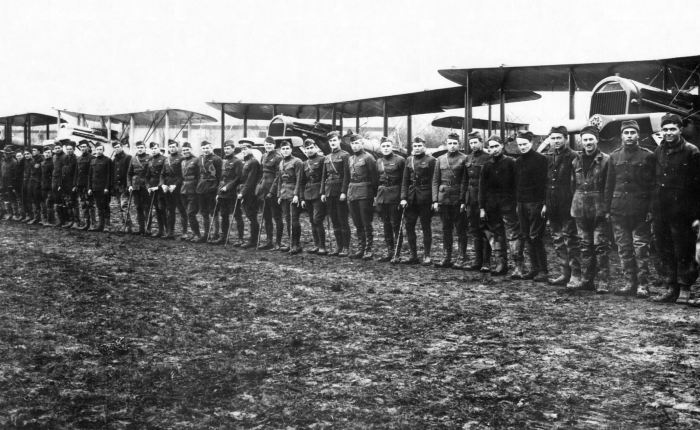
Header image: US Army 166th Aero Squadron personnel standing in front of licence-produced Airco DH4s, November 1918. (Source: Wikimedia)
[1] John H. Morrow, The Great War in the Air: Military Aviation from 1909 to 1921 (Tuscaloosa: Univerity of Alabama Press, 2009), p. 266.
[2] Colonel Edgar S. Gorrell, The Measure of America’s World War Aeronautical Effort (Northfield, VT: Norwich University, 1940), pp. 7-9. A build-to-print design is one where (theoretically at least) detailed blueprints and specifications allow another organization to manufacture the item.
[3] Ibid, p. 2. Other authors have slightly higher numbers, but Gorrell’s data comes from reviewing 60 volumes of raw data – he was also an active-duty Air Service staff officer at the time of the events.
[4] Morrow, The Great War in the Air, pp. 265-66.
[5] Ibid.
[6] Benedict Crowell, America’s Munitions 1917-1918: Report of Benedict Crowell, Director of Munitions (Washington, DC: US Government Printing Office, 1919), pp. 240-41.
[7] Gorrell, The Measure of America’s World War Aeronautical Effort, p. 3. Gorrell himself, then a captain, was a member of the Commission.
[8] Ibid, p. 5.
[9] Ibid, p. 3-4.
[10] Judy Rummerman, https://www.centennialofflight.net/essay/Aerospace/WWi/Aero5.htm.
[11] Major Michael A.Macwilliam, The Development and Emergence of the American De Havilland Aeroplane (Air Command and Staff College Thesis, Maxwell AFB, AL: Air Command and Staff College, 1997), p. 11, citing Mitchell Memoirs.
[12] Isaac F. Marcosson, Colonel Deeds Industrial Builder (New York: Dodd, Mead and Company, 1947).
[13] Lisa Rickey, ‘The court decision in John H. Patterson’s case was announced…..
[14] United States House of Representatives, Hearings Before Subcommittee 1 (Aviation), Select Committee on Expenditures in the War Department, Vol 3 (Washington: United States Government Printing Office, 1920), p. 3883.
[15] Lieutenant Colonel W. R. Laidlaw, MSS from Lt Colonel Laidlaw to Mr Charles Kettering Dec 7, 1957, (Unpublished).
[16] Grover Loening, Our Wings Grow Faster (Garden City, NY: Doubleday, Doran and Co., 1935), pp 69-84. ‘Cost plus’ refers to the type of contract used – the aeroplane contractors were reimbursed for all their costs, plus given an additional 10% or more as profit – so in actuality a business loss was impossible.
[17] Marcosson, Colonel Deeds Industrial Builder, p. 267.
[18] Ibid, pp 216-218. Deeds’ biographer claims that Deeds initially refused to join the Aircraft Production Board, then reconsidered because of the ‘opportunity to stimulate the air program.’
[19] ‘US Aircraft Production Board: Body Which is Entrusted with Making America Supreme in the Air,’ Motor Age, 12 July 1917, p. 20.
[20] ‘E.A. Deeds Now Colonel in Regular army of the US,’ Dayton Daily News, 29 August 29 1917, p. 1.
[21] United States House of Representatives, Hearings Before Subcommittee 1 (Aviation), Select Committee on Expenditures in the War Department, Vol 3 (Washington: United States Government Printing Office, 1920), p. 3882.
 From Balloons to Drones