#ResearchNote – Top 10 Air Power History Books of this Generation

#ResearchNote – Top 10 Air Power History Books of this Generation

By Dr Ross Mahoney

Editorial note: This post was originally posted on my website and has been cross-posted here to generate further discussion. Minor editorial changes have been made to the post.

Ok, this post stems from a question I asked on BlueSky: ‘Who is the most significant air power historian of our generation? Discuss #airpowerhistory.’ The question stemmed from the call for contributors I posted last week and is related to my ongoing research into writing about air power. For the purpose here, ‘generation’ is to be considered to have been in the past 20-30 years. As such, the books listed here have been published since 1990.

In response, one poster asked me to list the top ten books I consider the most significant. I did a similar exercise for From Balloons to Drones back in 2017. The difference between the two lists is that the list produced in 2017 reflected those books that influenced and shaped my writing as an air power historian. In contrast, this list is more focused on those that I consider significant for their impact, though the list is still biased as I selected books from my library, and as such, they reflect my own research interests to some extent. I have also excluded edited books except for John Andreas Olsen and Philip Meilinger’s work for reasons I hope will be apparent. Other works, such as Tami Davis Biddle’s Rhetoric and Reality in Air Warfare (2002), would have made an expanded list. For an Air Power Reading list, visit the one from From Balloons to Drones.

Here is the list…

Tony Mason, Air Power: A Centennial Appraisal (London: Brassey’s, 1994). As I wrote here, Mason was one of the doyens of air power studies and undoubtedly crucial in developing the field in the UK. This work represented the culmination of his thinking, even though he would continue to write after its publication. He used history as a tool to explore the development of air power, and it is a significant volume and still requires reading to this day.

Philip Meilinger (ed.), The Paths of Heaven: The Evolution of Airpower Theory (Maxwell AFB, AL: Air University Press, 1997). One of the two edited works in this list. Written as a primer by the United States Air Force’s School of Advanced Airpower Studies faculty, this charts the evolution of air power theory and doctrine and is a necessary starting point for anyone researching the subject.

John Buckley, Air Power in the Age of Total War (London: UCL Press, 1999). Despite its age, this remains an excellent examination of the rise of air power in the first half of the 20th Century, and it is vital reading for anyone wanting an introduction to the subject.

Richard Hallion, Taking Flight: Inventing the Aerial Age from Antiquity through the First World War (Oxford: Oxford University Press, 2003). I could have selected any of Hallion’s work, for he is probably the United States’ preeminent air power historian. However, this book offers an excellent history of air power before the First World War.

John Andreas Olsen (ed.), A History of Air Warfare (Washington DC: Potomac Books, 2010). This edited book is listed for two reasons. One, Olsen is adept at bringing together leading air power scholars and any of his edited or single-authored books should be on your bookshelf. Second, the book is an excellent introduction to the use of air power in the major conflicts of the 20th and early 21st Centuries, written by leading experts such as Tony Mason, Richard Hallion, Richard Overy, John Morrow Jr, Alan Stephens, Benjamin Lambeth and Williamson Murray.

Richard Overy, The Bombing War: Europe, 1939-1945 (London: Allen Lane, 2013). The result of Overy’s voluminous research, this volume is required reading for anyone looking to understand the strategic bombing campaigns of the Second World War.

Thomas Hippler, Bombing the People: Giulio Douhet and the Foundations of Air-Power Strategy, 1884-1939 (Cambridge: Cambridge University Press, 2013). If one name is associated with the early development of air power thinking, it is the Italian Giulio Douhet. In this volume, Hippler does a thorough job of examining the evolution of Dohet’s strategic thought. It is necessary reading for anyone looking at the evolution of air power theory.

Peter Dye, The Bridge to Airpower: Logistics Support for the Royal Flying Corps on the Western Front, 1914-18 (Annapolis, MD: Naval Institute Press, 2015). This excellent work shows that air power history is not just about aeroplanes. Dye does a superb job of showing how logistics shaped the character of the air war over the Western Front and how the RFC/RAF’s system helped it prevail in 1918.

Phillips Payson O’Brien, How the War Was Won: Air-Sea Power and Allied Victory in World War II (Cambridge: Cambridge University Press, 2015). While not solely focused on air power, O’Brien’s work is essential in examining the role played by air power in conjunction with sea power in the Allied victory of the Second World War. The work challenges many preconceptions and should be required reading for anyone interested in the Second World War.

Peter Gray, Air Warfare: History, Theory and Practice (London: Bloomsbury, 2016). This book was the outgrowth of the old MA in Air Power run by Gray at the University of Birmingham. Gray gives an excellent overview of critical issues related to air power and is a necessary reading for those just getting into the subject.

What would you include? What would you remove?

Dr Ross Mahoney is an independent scholar specialising in the history of war with particular reference to the use of air power and the history of air warfare. He is currently the Senior Historian within the Heritage Policy team at Brisbane City Council in Australia. He has nearly 20 years of experience in the education, museum and heritage sectors in Australia and the United Kingdom. Between 2013 and 2017, he was the inaugural Historian at the Royal Air Force Museum in the UK. In Australia, he has worked as a Historian for the Department of Veterans’ Affairs and taught at the Strategic and Defence Studies Centre at The Australian National University based at the Australian War College. His research interests are focused on the history of war, specifically on the history of air power and air warfare, military leadership and command, military culture, and the history and development of professional military education. He also maintains an interest in transport history. He has published numerous articles, chapters and encyclopedia entries, edited two books, and delivered papers on three continents. His website is here, and he can be found on Twitter at @airpowerhistory.

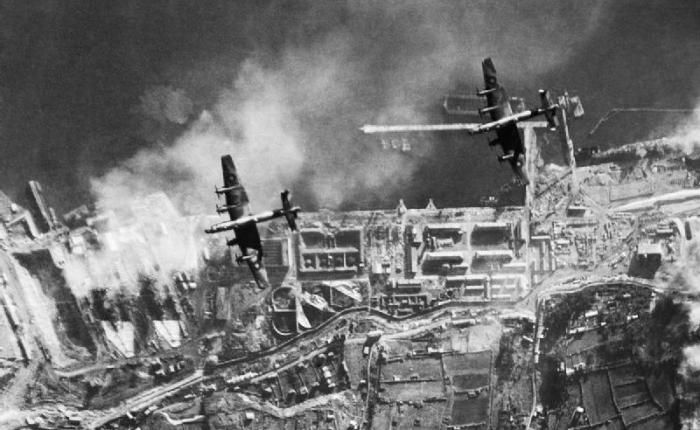
Header image: Vertical aerial photograph taken during a daylight attack on German warships docked at Brest, France. Two Handley Page Halifaxes of No. 35 Squadron RAF fly towards the dry docks in which the battlecruisers Scharnhorst and Gneisenau are berthed (right), and over which a smoke screen is rapidly spreading. (Source: Imperial War Museum)

Space: A Reading List

Space: A Reading List

By Dr Brian Laslie

As the combatant command of the ‘newly re-established’ United States Space Command inches closer to being stood up (or reincarnated we are really not sure), we at From Balloons to Drones thought now would be an opportune time to publish articles, book reviews, and reading lists on the very best of space scholarship.[1] The simple fact is that here at the site we have focused almost exclusively on air power. We just have not gone high enough. Therefore, to make a mid-course correction, we are looking to expand into air and space power. The first step is this reading list. Hopefully to be followed by book reviews and original articles like this one here that we have previously published.

Our Assistant Editor, Brian Laslie, has chosen to divide this reading list up: Primer texts, NASA and civilian histories, and finally a list of biographies, memoirs and autobiographies.

Much of what you will find below was done in coordination with historians at the United States Air Force Academy, Air Command and Staff College, and the School of Advanced Air and Space Studies. We reached out to some of their senior scholars for their list of ‘must reads’ plus what they assign to students. We also reached out to several academic presses who specialise in space scholarship. Here you will find some of the usual suspects (University Press of Kentucky, MIT, Johns Hopkins), but also some really impressive works out of the University Press of Florida, look for book reviews of some of these titles below coming shortly. This is by no means a comprehensive list, but we believe that if you are interested in expanding your space knowledge, professionally or for fun, this list is a great place to start.

Primer Texts:

31ln1jkisbl._sx355_bo1,204,203,200_

  • Ted Spitzmiller, The History of Human Space Flight (Gainesville, FL: University Press of Florida, 2017);
  • Michael J. Neufeld, Spaceflight: A Concise History (Cambridge, MA: The MIT Press, 2018);
  • Walter A. McDougall, The Heavens and the Earth: A Political History of the Space Age (New York, NY: Basic Books, 1985);
  • William F. Burrows, This New Ocean: The Story of the First Space Age (New York, NY: Random House, 1998);
  • A. Heppenheimer, Countdown: A History of Spaceflight (New York, NY: Wiley, 1997);
  • Everett C. Dolman, Astropolitik: Classical Geopolitics in the Space Age (London: Frank Cass, 2002);
  • Joan Johnson-Freese, Space as a Strategic Asset (New York, NY: Columbia University Press, 2007);
  • Matthew Brezezinski, Red Moon Rising: Sputnik and the Hidden Rivalries that Ignited the Space Age (New York, NY: Times Books, 2007);
  • John Klein, Space Warfare: Strategy, Principles and Policy (Abingdon: Routledge, 2006);
  • David Spires, Beyond Horizons: A Half Century of Air Force Space Leadership, Revised Edition (Maxwell, AL: Air Force Space Command in association with Air University Press, 1998);
  • Bruce DeBlois (ed.), Beyond the Paths of Heaven: The Emergence of Space Power Thought (Maxwell, AL: Air University Press, 1999).

NASA History Series (@NASAhistory)

The NASA History Office runs arguably the single best history program in the entirety of the United States Government. With dozens of publications (and most available to download for free here, this is the first place you should stop for the history of space flight in the United States. More recently some of their titles have been re-published with the University of Florida Press.

61yt-kkiaxl

So much of the literature of the space race focused exclusively on the American perspective. Even the Soviet ‘firsts’ are often viewed through the lens of how other Americans reacted. If you are interested in the development of the Soviet space programs there is Challenge to Apollo: The Soviet Union and the Space Race (2000) by Asif A. Siddiqi and the four-volume set by Boris Chertok Rockets and People (2005 to 2012) which provides ‘direct first-hand accounts of the men and women who were behind the many Russian accomplishments in exploring space.’

If the early American experience in spaceflight interests you then download: Where no Man has Gone Before: A History of the Apollo Lunar Exploration Missions (1989) by William David Compton, Project Apollo: The Tough Decisions (2007) by Robert C. Seamans, Jr., On the Shoulders of Titans: A History of Project Gemini (2010) by Barton C. Hacker and James M. Grimwood, and “Before this Decade is Out” Personal Reflections of the Apollo Program (1999) edited by Glen. E. Swanson

Under the UPF bin there is Pat Duggins, The Final Countdown: NASA and the End of the Space Shuttle Program (2008) which seems a bit dated in 2019 (there is a reference to a pre-iPad that might perplex readers) but provides an excellent treatment of the history of the Shuttle Program as well as NASA’s uncertain future.

The Final Mission: Preserving NASA’s Apollo Sites (2018) by Lisa Westwood, Beth O’Leary, and Milford W. Donaldson details the importance preserving sites related to the Project Apollo and moon missions both here on Earth and the lunar surface.

Other works by NASA or UPF that are well worth your time include: Safely to Earth: The Men and Women who Brought the Astronauts Home (2018) by Jack Clemons, and Spies and Shuttles: NASA’s Secret Relationships with the DOD and CIA (2015) by James David. If you are an engineer by trade or just interested in highly technical work, there is Stages to Saturn: A Technological History of the Apollo/Saturn Launch Vehicles (1999) by Roger Bilstein

Memoirs and Biographies:

There are dozens of books in this genre from the ‘Golden Age of Manned Spaceflight.’ Many of the Mercury, Gemini, and particularly the Apollo astronauts either wrote a memoir or have had a biography published. We cannot list them all here, but we agree the following rate among the very best: First Man: The Life of Neil Armstrong (2018) by James R. Hansen, Carrying the Fire: An Astronauts Journey (2001) by Michael Collins, The Last Man on the Moon: Astronaut Eugene Cernan and America’s Race in Space (1999) by Eugene Cernan, Apollo Pilot: The Memoir of Astronaut Donn Eisele (2017) by Don Eisele, and Calculated Risk The Supersonic Life and Times of Gus Grissom (2016) by George Leopold.

97816103983051

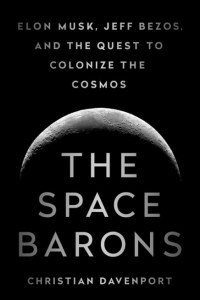
More recent works by the space shuttle and ISS astronauts include Scott Kelly’s Endurance about his year in space. As space flight becomes increasingly commercialised, the recently published The Space Barons: Elon Musk, Jeff Bezos, and the Quest to Colonize the Cosmos (2018) by Christian Davenport were also showing up from many of the academic institutions with whom we spoke.

Finally, in a departure from the readings above, we recommend the YouTube channel of Amy Shira Teitel. Amy is a ‘spaceflight historian, author, YouTuber, and popular space personality,’ who does a great job in her web series Vintage Space.

Again, this is not a comprehensive list, but rather a starting point. As interest increases and we enter what may very well be a second golden age of space exploration, these are the titles that provide the background and history of working with, in, and through the space domain. If you have suggestions, leave them in the comments.

Dr Brian Laslie is an Air Force Historian and currently the Deputy Command Historian at North American Aerospace Defense Command (NORAD) and United States Northern Command (USNORTHCOM). A 2001 graduate of The Citadel and a historian of air power studies, he received his PhD from Kansas State University in 2013. His first book The Air Force Way of War (2015) was selected for the Chief of Staff of the Air Force’s and the Royal Air Force’s Chief of the Air Staff professional reading lists. His recently published Architect of Air Power: General Laurence S. Kuter and the Birth of the US Air Force. He lives in Colorado Springs. He can be found on Twitter at @BrianLaslie.

Header Image: The US Air Force launches the ninth Boeing-built Wideband Global SATCOM satellite at Cape Canaveral Air Force Station, Florida., 18 March 2017. Such satellites play an integral part in the strategic and tactical coordination of military operations. (Source: US Department of Defense)

[1] There continues to be debate about whether the U.S. Space Command is being re-established from its predecessor or if this truly a new combatant command