Editorial note: In 1976, Joseph Frantz, the pilot of the aeroplane credited with the first aerial victory in history, was interviewed by the Service Historique de l’Armėe de l’Air (French Air Force Historical Service) about his experience. This article was published in Vortex 8, the professional journal of the French Air and Space Force. It has been reproduced here by permission. From Balloons to Drones would like to thank Jean-Christophe Noel, the Editor-in-Chief of Vortex, for permission to make this interview available to a wider audience. We are also grateful to the Service Historique de Défense (Defence Historical Service) for their agreement to make this interview available. The article has been reproduced verbatim from the original.
On 14th December 1976, Joseph Frantz, then aged 86, was invited to testify about his aeronautical career at the Air Force Historical Service (SHAA). This aviation pioneer, who, with his mechanic Louis Quenault, achieved the first officially recognised aerial victory in history aboard the Voisin V 82,[1] spoke for 2 hours and 50 minutes. He successively recounted his aviation calling, the early days of aviation, his piloting career at Robert Savary’s aviation school in Chartres, his military service, his participation in the First World War as a combat pilot and a test pilot, and his role in the Les Vieilles Tiges association.
Naturally, his narration of the famous aerial combat on 5th October 1914 was the highlight of this testimony. For this issue of Vortex, the initial intention was to transcribe only J. Frantz’s remarks concerning this combat, which ushered nascent aviation into a new, simultaneously glorious and tragic, era. After all, on that autumn day in 1914, J. Frantz became the first fighter pilot in history and undoubtedly deserved the honours of an issue dedicated to air defence.
However, as J. Frantz described the adventures in which he had participated and evoked the atmosphere prevalent in aeronautical circles at the beginning of the 20th century, something became clear. J. Frantz deserved far more than simply being “reduced” once again to what he had accomplished on the morning of 5th October 1914. His aeronautical experience also needed to be recounted. This humble, modest man had set aeronautical records in the 1910s. Yet, he had also witnessed many of his friends and fellow pilots die brutally, victims of a still poorly understood science of flight, unreliable aircraft, or German bullets. As if to apologise for not having perished cruelly like all his friends, he simply stated that he “had been lucky.”
For this reason, the account of this combat is enhanced by the evocation of J. Frantz’s military career. Through the interviewee’s eyes, the reader will better grasp the fragility of military aviation’s developments, the initial initiatives to prepare for combat against German aircraft, the emergence of the now common choreography of dogfights, and the first attempts at night-time hunting.
To conclude this introduction, it is important to specify that the text presented here is not an exact transcription of J. Frantz’s testimony. To enhance readability, fluidity, and enjoyment, the editor chose to rephrase questions and, at times, slightly rewrite the form of the answers. Naturally, all reported events, facts, and details are rigorously respected. Furthermore, the testimony gathered in December 1976 at the SHAA is somewhat complemented by another that Frantz recorded several years prior, on 22nd May 1945,[2] which provides some additional details. These contributions have been underlined within the main text to indicate their origin.
Sincere thanks are extended to the Oral Testimonies Department of the Defence Historical Service, which kindly provided this document and authorised its publication. Particular gratitude is expressed to Messrs. B. Fonck, F. Beauperin, O. Valat, and Captain J. Sencert. Without their assistance and goodwill, this project could not have been realised.
Excerpt from interview no. 57 of Mr. Joseph Frantz, conducted on 14th December 1976 in Paris by Mrs. Destouches and Mr. Wallon
Mr. Frantz, you obtained your military pilot’s licence in 1912. Can you tell us what that examination involved?
When I took my military examination, I was still a civilian. I hadn’t yet started my military service, as I had obtained a one-year deferment. It was my employer, Robert Savary, who asked me to take it, precisely so I could participate in the military competition. I hadn’t really focused on it myself.
I was fortunate to have reliable equipment because the test required completing a one-hundred-kilometre course three times, on three different days but within a period of less than a month.
I recall flying from Chartres to Orléans and back. A controller was present at a designated point in Orléans. It was simply a matter of flying past it and making sure they saw you clearly, without flying too high. We would fly over the location at 100 or 150 metres. I was lucky to have good weather and, more importantly, a Labor engine that worked well. Finally, the fixed tail surfaces allowed me to use the ailerons without the tail turning. I was also fortunate to complete these three courses on three consecutive days, thanks to an engine that ran perfectly throughout, which was quite rare at that time.
Was the civil examination easier?
Yes, the Aero-Club civil licence exam was indeed easier to complete because you could choose your day, and it only lasted one day. Furthermore, the tests were completed in less than fifteen minutes. Later on, things got more complicated.
Did you think much about war at that time?
No, we didn’t think much about it. I did ponder it a little during my training in Verdun. The barracks were modern at the time; they had been built, I don’t know, three or four years earlier. And there were showers, which was rare. A chief warrant officer in the company ran everything. He always stayed beside me during the test marches. We would cover 25 kilometres in a day with our backpacks. He would tell me, “Ah, you’re not used to walking; you’re in the air, it’s hard for you!” We would chat like that, and it made the time pass. I stayed for four weeks while the classes were going on.
Were you the only aviator?
There were three of us who had our military licences before joining the regiment. There was Michel Mahieu, who was killed almost at the end of the war in a Voisin by a shell, probably during a night flight at that moment.[3] And then Jean Benoist, whom I replaced as a test pilot at Voisin after he was killed.
You were transferred to the engineering corps and distinguished yourself during the large-scale manoeuvres in the southwest, at Toulouse, on a Breguet aircraft.
Indeed, I had a dual satisfaction. Firstly, without intending to, I accumulated the most reconnaissance flight hours in the squadron. We had five or six aircraft, and I believe I accrued about 8 hours and 50 minutes of flight time – something like that. This seems laughable now, but at the time, flights lasted half an hour, an hour maximum.
Secondly, I was the only one to bring my aircraft back intact. Following these reconnaissance missions, Captain Le Goÿs, who later became the famous general,[4] promoted me to corporal on the manoeuvre field in front of the troops.
You were then assigned to Bourges to test the launching of pyrotechnic devices. Did an acquaintance of yours join you there?
Yes, I always managed, easily I must say, to have my mechanic join me within a fortnight of my arrival at a new posting. I would make the request, and the officers I was leaving handled the procedures very well.
Louis Quenault, to whom I refer, was two years my junior. He had been hired by Savary to develop the Labor engines from Labor-Aviation. The company hoped to receive many orders, but that didn’t really happen.
Nevertheless, we were good clients at Savary. I had come to appreciate Quenault at that time, and I didn’t lose sight of him when he went to the regiment. After completing his training, he became my full-time mechanic. These mechanics were, for the vast majority, extremely dedicated and conscientious individuals. It was their aeroplane; it wasn’t the pilot’s aeroplane, it was theirs.
How did the tests proceed?
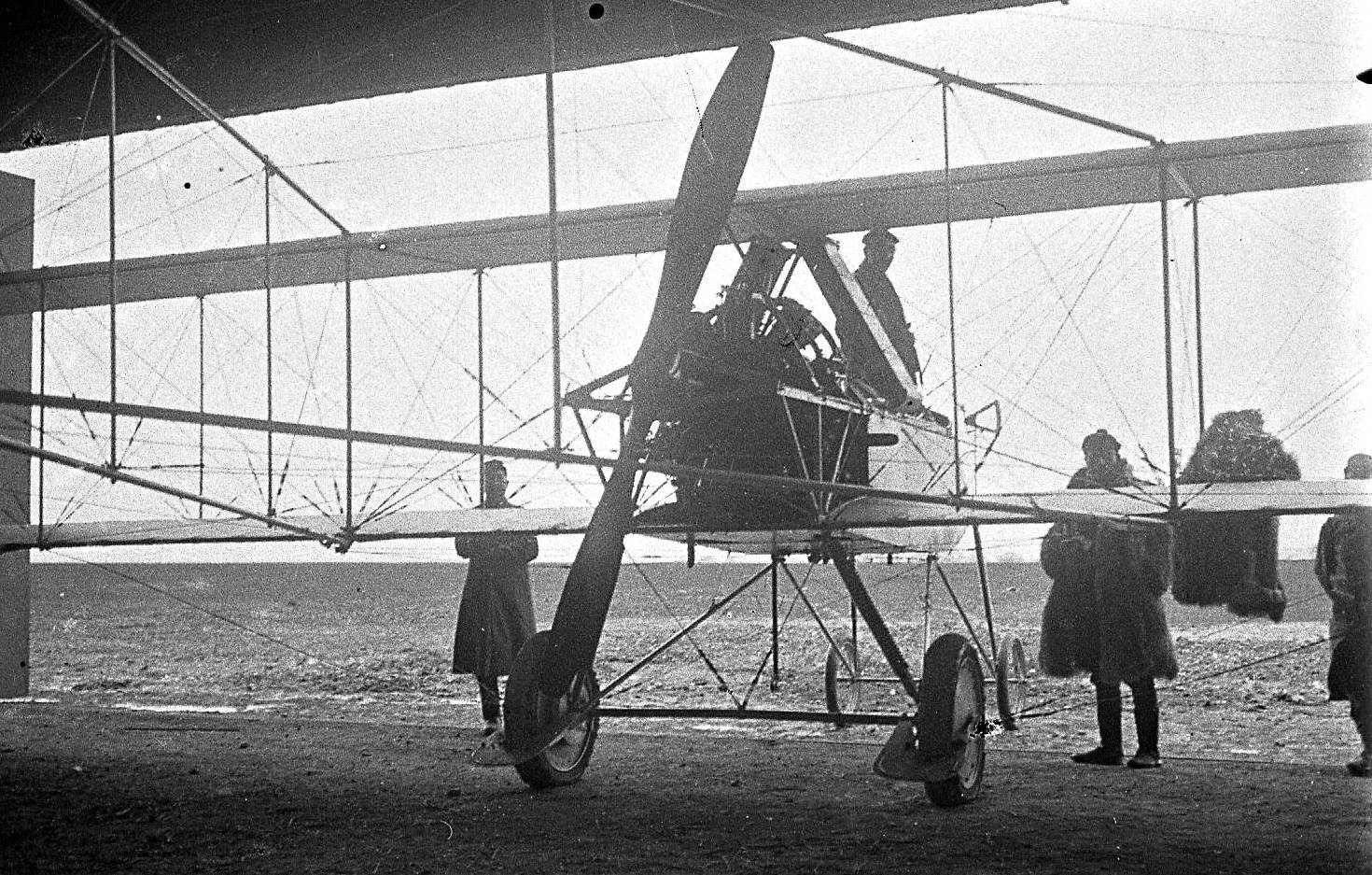
I had some bad days and some good ones; one remembers the good ones. I was therefore seconded to the Central Pyrotechnics School in Bourges. This was a strip of land located next to the explosives and bomb factory, which produced incendiary bombs before the war, in particular. I was very fortunate one day. I was flying with my mechanic, and we were launching incendiary shells overboard, one after another. Quenault would pull a rough cord that ignited the shell, and it would explode a few seconds later. However, there were many cables in the Savary aircraft I was piloting, especially in the landing gear, which was quite sturdy. This was true of all biplanes of that era. That day, one of the shells got caught on one of the landing gear cables, and despite my efforts – I was scared because I jostled the aircraft trying to dislodge it – it didn’t fall. Fortunately, at that time, at least two or three out of ten shells would not ignite and therefore did not function. The shell belonged to this category. Fortunately for us, as it was near the landing gear and other phosphorus shells!
Following this event, the colonel nominated me for the Military Medal.
You also mentioned less good days?
Towards the end, there were two pilots conducting the tests. Lieutenant Delvert arrived with a Henri Farman aircraft. Even though I was a corporal, we shared a rapport as pilots, and rank distinctions were secondary.
He would always depart with a captain from the pyrotechnics unit, a friend of his, to launch the shells. Powered by a 50-horsepower Gnome engine, he would fly straight and level and then playfully perform a small “chandelle,” pulling back on the stick when he had some speed, ascending to 10 metres – 15 metres maximum. At the time, there wasn’t the power of current jet aircraft that can ascend vertically to 2,000 metres in a few seconds.
I had told him, “You know, Lieutenant, that’s dangerous because if you experience an engine cut, you risk losing speed, and that’s very serious.” He replied that it was not. He seemed very confident; he was very polite and even thanked me for my advice, but it was to no avail.
One day, he was eagerly awaiting his captain. He said to me, “Frantz, I’ve never taken you up, I’ll take you with me if you like.” I replied, “Of course, Lieutenant,” out of politeness, but I wasn’t particularly keen.
In the Bessonneau hangar, I was putting on my fur-lined flight suit. We were exposed to the open air during flight, especially in the Farman. It was worse than in the Savary, where the engine was at the rear, and this suit was essential.
I remember, I can still visualise the hangar. I put my right leg into the suit. The captain arrived: “Oh, excuse me, I’m late. If you don’t mind, may I take your place?” I said “Yes.” I don’t know why, but I had a premonition, and deep down, I was very relieved by this turn of events. I took off my suit, well, I took my right leg out, they departed… and they died. They performed a chandelle, and what I had anticipated occurred; they lost speed and both perished.[5]
The colonel commanding the Central Pyrotechnics School told me, “I am going to abandon pyrotechnics, aircraft are too dangerous, and we will conduct our tests with a captive balloon for projectile launches.” He was profoundly affected by this accident.
After these tests ceased, you were transferred to Mourmelon. Was that when you learned about the outbreak of war?
I was a corporal and was promoted to sergeant at the beginning of the war. I was mobilised on a Caudron G.3. I already knew the G.3; I had spent time in Reims flying one of them. It was a very good aircraft, but it was not a warplane. As André Luguet, a very good friend and one of our vice-presidents at Les Vieilles Tiges, told me, you had to try hard to kill yourself in a G.3. It was a very safe aircraft, but it was not a warplane.
However, at Mourmelon, there was a squadron of military Voisin aircraft, Squadron 24, and its commander, Captain Faure, told me that there were only six pilots, including himself, and that one of them was going to Voisin to receive aircraft. He asked, “I’m short a pilot; would you be interested?” I replied, “Oh yes, Captain, a Voisin—now that’s an aeroplane.” He said, “Agreed, I’ll take you.” That is how I ended up with Voisin. It was a squadron whose aircraft were destined for Russia; they were models with a long range for the time. We carried out reconnaissance missions of 300 to 400 kilometres. It was the only aircraft that could do that, with its framework made of metal tubes that could remain in the rain without deforming and usually did not require the use of a hangar. It was, without question, the best military aeroplane of the era.
Do you remember your first wartime missions?
Initially, we went to Belgium. I conducted a reconnaissance mission with a staff officer. We took mechanics for transfers, but for these missions, staff officers often came along. He was a junior officer, and it was his first flight. The reconnaissance was near the Luxembourg border.
We then observed many troops and convoys, and also trains, heading towards Belgium. However, there were conventions in place. Belgium was, in principle, neutral. After landing back at Mézières, where our first military airfield was located, the captain asked me, “Would you like to come with me while I make my verbal report?” As we had taken notes together, my presence could support what he said. Looking at the ground, I had also noticed many movements towards Belgium.
When we reported this to the commandant to whom we were to make the report, he told us, “That’s impossible; it’s forbidden.” One shouldn’t be too harsh, but it demonstrated our good faith (laughs).
Did you have special equipment for these reconnaissance missions?
We would send two homing pigeons for the initial reconnaissance. We also carried a Model 72 pistol—or perhaps it was a 76, a large, very heavy revolver—and a box of “Tisons” brand matches. The pistol was for puncturing the fuel tank in the event of a forced landing, which occurred quite often due to engine failure or similar issues behind enemy lines. The matches ignited and burned very fiercely for a few seconds. We were supposed to throw them into the punctured and holed fuel tank to set the aircraft ablaze and prevent it from falling into enemy hands.
Had you thought about the best way to shoot down an enemy plane?
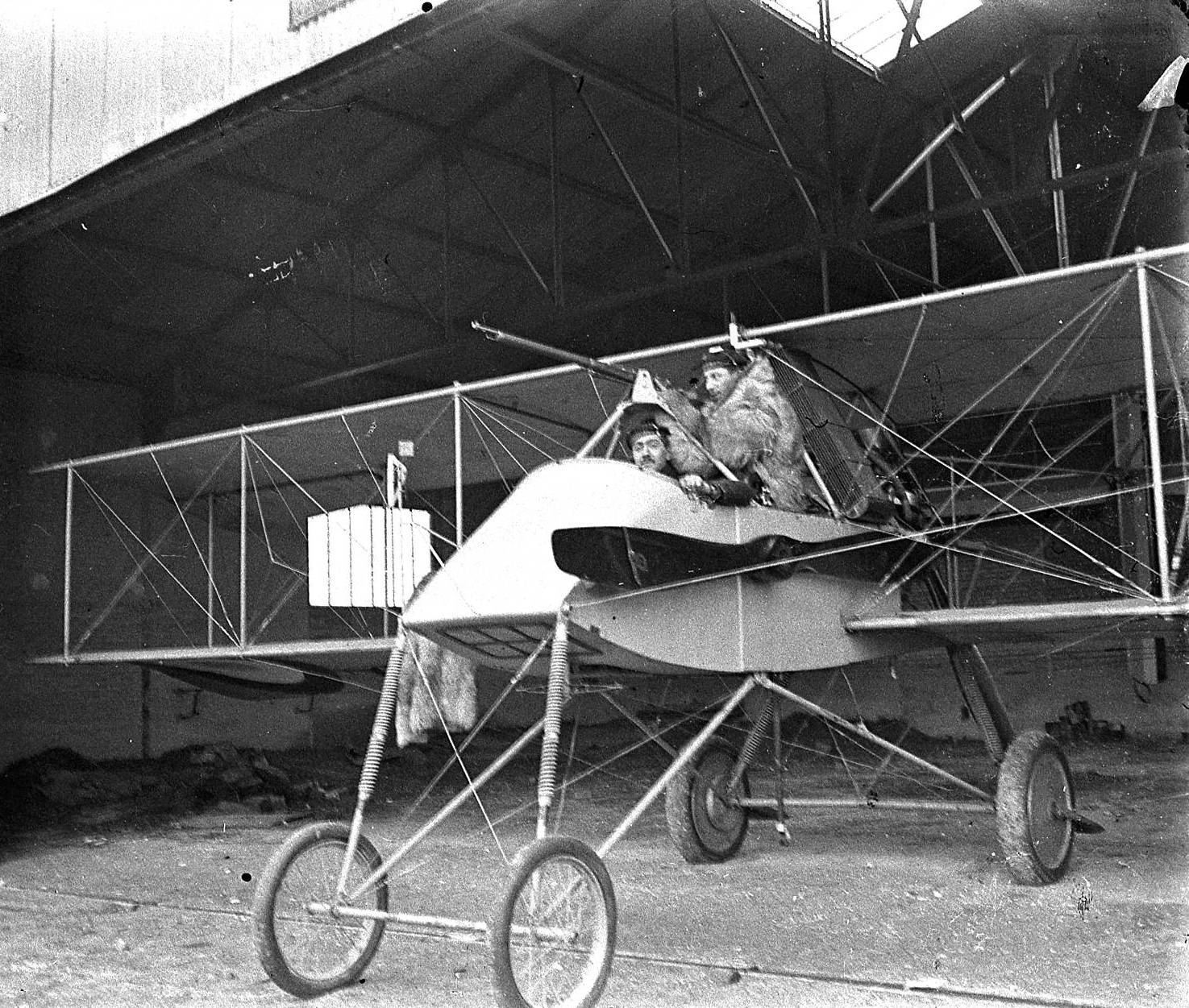
We didn’t know how to do it. We had discussed it with friends in the squadron. I had discussed it with Quenault because he was the one doing the shooting. In fact, we were shooting too far. It’s difficult in the air to gauge distance. We would fire across the target and take a few shots. We couldn’t fire in automatic mode because the mechanism of the Hotchkiss machine gun jammed very quickly, especially at altitudes above 1,000 metres. It had even jammed on the first shot for me; that’s why we fired shot by shot.
We would press the trigger each time and then release it. In automatic mode, I believe the problem came from the ejection of the Hotchkiss casings, which is still a light infantry machine gun. The ejection was automatic, triggered by the explosion of the bullet itself, but the air pressure was slightly less strong than on the ground. This expulsion also caused us problems, as the propeller was behind us, and a semi-rigid bag was needed to catch the casing.
At what speed were you flying?
At 90-95 km/h in regular flight. When diving, we probably reached 115-120 km/h. We didn’t have a speed indicator, but during my acceptance tests, I was doing 90-95 km/h. So, if we fired while crossing paths, we had little chance of hitting each other.
How did you evaluate German aircraft?
In my opinion, the Taube was a very slow aircraft, an Austrian aircraft incidentally, but it was used in the German army. It was not a dangerous aircraft at all. But the other aircraft were more modern with a powerful engine at the front – a six-cylinder Mercedes-Benz engine. They were a little faster than our Voisin, a little more modern too, but did not have our range.
How did aerial combat begin?
The Germans initiated it, under the following circumstances. Lieutenant Levassor d’Yerville was a chasseur d’Afrique, a very bold and excellent individual. He had a slightly tilted head from a saber blow to the neck. He was remarkable and, incidentally, had a very distinguished career.
He had departed from Mézières on a solo reconnaissance mission to Aachen in his Voisin. Levassor then encountered a German aircraft. At that time, aviators considered themselves more as sportsmen than as belligerents or enemies. He expected to salute the German pilot, but as they passed, the passenger in the German aircraft fired three bullets that lodged in Levassor’s aeroplane.
I always found it extraordinary, incidentally, to encounter an aircraft and manage to shoot at it. That represents a closing speed of 200 km/h from each side. It’s not like being at a shooting range; there’s wind.
For the Germans, it was even more difficult than for us on the Voisin. On the Aviatik, the engine is at the front of the aircraft, whereas it’s at the rear for the French aeroplane. The passenger was positioned between the engine and the pilot for a very simple reason: the passenger’s weight was placed close to the centre of gravity, if you will. If the passenger climbs on board, the aircraft’s balance or trim was not altered. Trim was important at the time; it’s less true now, where one sees passengers moving about in the aisles of transport aircraft.
To return to Levassor, three bullets struck his aeroplane, one of which passed through the cushion he was sitting on. It was a small cushion, yet not thick.
How did you decide to react?
When he returned and showed the impact, the squadron leader telephoned Gabriel Voisin in Issy-les-Moulineaux, telling him, “This is what happened; we must find a solution.” Voisin replied that he would mount machine guns and prepare everything with all the necessary templates.
Three or four days later, Voisin arrived in Mézières with six machine guns to install on our six aircraft, along with one or two mechanics to assist. The plan was to install a tripod above the pilot’s head, with the machine gun for the passenger in the rear to operate.
That’s how the idea came to us. But it wasn’t easy to implement, because the colonel commanding the 5th Army’s aviation – we were, I believe, already the 5th Army – learned about it. He telephoned Captain Faure and said, “What is this? You’ve mounted machine guns? Don’t you know we’ll never fight in the air? It doesn’t exist. It’s Jules Verne, honestly!”
Captain Faure then responded, “My squadron is for reconnaissance. If these reconnaissance missions aren’t carried out, you can object, but I will make the modifications I see fit.”
The colonel placed him under close arrest!
Eventually, a general managed to reconcile the two opposing viewpoints. He agreed that if it did not interfere with reconnaissance missions, the weapons could remain on the aircraft.
Fortunately, on the German side, it was the same situation. They did not believe in aerial warfare; they thought we would never shoot each other down in the air. A few days before my victorious combat, a command note for aviation had been circulated among German squadrons asserting that such combats would never occur. We had heard that some French pilots enjoyed shooting at German aviators, but that it was of little importance. They would not hit them, and consequently, they were forbidden to engage us in combat.
On our side, we had arrived at the simplest conclusion: one must shoot at a target that is, at least for a while, immobile. And for it to be immobile, one must get behind it. The entire difficulty lay in getting behind it. The Aviatik was four or five km/h faster than the Voisin, but there are ways to work with the sky, so to speak! The key was to spot them early enough.
Could you describe your experience of achieving this first aerial victory?
Quenault and I had set out, carrying six 90mm shells to drop on enemy troop concentrations. These were difficult to spot at 1,200, 1,500, or 2,000 metres, especially as we had no binoculars.
I was gaining altitude, following the lines between Reims and Craonne, when at approximately 1,800 metres, I saw an aircraft inside French lines heading north. I had, and still do have, despite being 86, quite good eyesight. It was to my left. Focusing intently, I realised it was a German aircraft. It was returning from its reconnaissance mission. At that moment, I was perpendicular to it, slightly ahead and at the same altitude. I alerted Quenault. The first thing I did then was to try and cut off its path by turning sharply to the right. This is where a significant element of luck came into play, as one shouldn’t initiate too early. I was slightly above it, which also helped; it allowed me to dive more or less to catch up before it gained too much distance. This was something I hadn’t managed to do until then. This time, however, I tried to get into a position where I could slow down if needed. It’s always easier to slow down. I arrived precisely where I wanted by diving slightly towards it. I then only had to turn right, position myself in its wake, and it was perfect; everything was in place.
At that point, I was very close. This is the approach that was also used by Fonck, by Navarre, all the great Aces who returned with very few bullets in their aircraft, or none at all if one considers Fonck. As for the sun’s position, I think I might have been well-placed. It was 8:00/8:30 AM; yes, I didn’t realise it. In any case, it was very clear, a cloudless sky. I’m not certain they saw me.
I shouted to my machine gunner to fire. We were so close then that I could clearly distinguish the pilot and the observer. They saw me at the first shot; I saw them turn their heads; I was close. I saw the pilot turn his head back with a surprised look. He was behind. He dipped slightly to gain speed. I followed him like a shadow.
The passenger pulled out a carbine and fired. He had a shoulder-fired carbine, whereas we could aim more easily thanks to the tripod. The German aircraft tried to make right and left turns to break free. The passenger found it difficult to shoot because, as I told you, he was positioned between the pilot and the engine. The pilot, the tail assembly, and the rest formed obstacles, provided I positioned myself exactly in line. We had 25 rounds in the rigid part that held the cartridges. On the 25th, Quenault changed the Hotchkiss belt. The combat was quite long. We fired shot by shot. Quenault fired 47 rounds, which took 10-12 minutes, and by chance, we only jammed on the 47th round. I thought to myself, “We’re screwed again.” Maybe the staff officer is right; we’ll never shoot each other down in the air.
The German pilot was still turning from right to left. He was trying to regain his lines by descending. He descended because we eventually found ourselves at 1,200 metres. And all of a sudden, it pitched up. And, like an aircraft about to perform acrobatics, it remained suspended in the air. Quenault then tapped me on the shoulder and said, “Careful, we’re going to hit it.” We were very close, but when I saw it pitch up, it was slightly to the left. I gave a kick and had already initiated the right turn to avoid colliding with it. It’s true that it would have been too foolish, but in the heat of the moment, one doesn’t think about the danger one might be in.
At that moment, I saw it like an aircraft losing speed. It flipped onto its back, in straight flight, leaving a trail of smoke. It probably had a punctured fuel tank and fuel streaming into the engine. I immediately thought, “I hope they’re both dead… especially the passenger.”
I eventually landed 300 metres from the aircraft wreckage. It had fallen into wooded marshes. I set down in a field a few hundred metres from where our victims were still burning. The marshes were indeed surrounded by suitable landing grounds, fields where there had probably been wheat, and where there was no danger of damage, especially for the Voisin, which had four wheels and wheel brakes. Once again, the aircraft was very advanced for its time.
We went to see. Some farmers were already there. It was at Jonchery-sur-Vesle, 20 km from the trenches. Some women also came and gave me a bouquet of wild flowers they had picked. It was very touching. Then officers from a nearby staff arrived. Among them was a general, General Franchet d’Espèrey; but I did not know him, I do not know if it was him. In short, it was a general with his staff who then said to me: “Are you the pilot?” I replied: “Yes, General.” He continued: “You will receive the Military Medal.” I told him verbatim: “I already have it, General” (laughs). Surprised, he then said: “Oh, well, you will receive the Legion of Honour, and your mechanic-gunner will receive the Military Medal.”
A pheasant was brought to me; it ended up in the kitchen. Back at the unit, they were starting to get worried. When I returned, they had already begun eating. In that squadron, our pay differed according to rank, and the captain had instituted that at the mess, one paid their share pro rata to what they earned. Jean Benoist and I were sergeants. We were the only two sergeants, having been promoted shortly after our arrival.
Captain Faure drove us back in the afternoon. There, we saw the bodies of our victims, whose legs were charred, having been removed from the aircraft. I will not hide from you today that Quenault and I were very moved at the sight of the two victims we had brought down.
A letter was found on the body of one of the victims. One of the deceased addressed it to his mother, stating that he had escaped a French aircraft in September by entering a large cloud. A strange coincidence: a few weeks earlier, we had pursued an aircraft that had escaped us in precisely that manner…
Just thinking about that combat, I think of the men who were in it. After all, it was war… But I never speak of that engagement without great emotion.
The Legion of Honour seemed like a lot for an “exploit” that was, all things considered, normal. If one had a rifle on board, it was surely to use it. It seemed improbable, far too significant, to be awarded such a commendation.
Did you quickly participate in other aerial combats?
Two or three days later, we were slightly southwest of Reims. The Germans still held the north of the city. I saw an aircraft on the other side of the lines. I climbed, and it climbed too. At about 1,500 metres altitude, we headed towards each other. Confident from my recent exploits, I thought success was assured, but then, with the first shot, the machine gun jammed.
Facing us was the same type of Aviatik. The tactic of getting behind the hunted aircraft was known to him as well as to me. To do this, one had to turn as tightly as possible. What I had to do was turn, since Quenault was already trying to clear the jammed machine gun. For once, it wasn’t working, and the adversary fired at us each time we crossed paths. It was very difficult, and he fired two or three bullets per pass. As soon as he had passed, I would turn to get behind him, and he would do the same, and ultimately, neither of us succeeded.
He gave up, or perhaps his gun was also jammed. He descended and headed back towards his lines. This occurred over French lines, just near the trenches.
The most amusing part is that the squadron commander received a phone call from an army colonel or general. He said, “We witnessed the combat. Congratulate the pilot who didn’t stop firing.” On the ground, they heard the gunshots; they believed it was our crew firing. In fact, it was not at all. I told the captain I hadn’t mentioned it because I was playing the fool.
I almost could have received a citation!
Were citations numerous?
Some were occasionally questionable. Once, I incidentally read in a newspaper at the front that the passenger, a captain I had taken up, had received a citation of the type: “successfully brought back to his lines an aircraft damaged by enemy shells.”
That corresponded somewhat to the reconnaissance we had carried out. I had returned with difficulty with a broken propeller. The rear engine was quite reliable, but large pushrods extended from it. One of these rods had gone into the propeller. I immediately reduced the throttle to try to regain the French lines, which I managed to do.
The captain then told me that the damage was due to a shell. I replied no. Besides, we would see immediately. A pushrod was missing, which had broken the wooden propeller, and that was that. He had made his report nonetheless. I did not find that very elegant, but I said nothing. You know, I was young; I attached no importance to it.
Is your subsequent operational career notably associated with the cannon-armed aircraft?
Yes, the idea was to place a small cannon on the aircraft to fire at and bring down the Drachen[6] observation balloons. The problem was that when we hit them, they didn’t catch fire. Incendiary shells of 37mm didn’t exist; they hadn’t been invented yet.
To ignite the balloon, a flame is required. However, this flame must not be inside the balloon, as hydrogen does not burn internally. An incendiary shell is needed that maintains a flame trace long enough to ignite the mixture.
Initially, the Germans would pull the balloon down to prevent it from being shot down. Later, when they saw that we were only making small holes, the bolder observers no longer requested to descend.
Later, when I was in Nancy, the Germans feared these cannon-armed aircraft despite everything. These cannons extended from the fuselage by at least 60 or 80 cm. This is why some pilots bought fake stovepipes from hardware stores, hoping to deter attacks from the Germans who feared them.
Did you have a mishap at night in this type of aircraft?
First, allow me to provide an example of aircraft development at that time, which was very empirical.
The cannon was heavy; it was a long 37mm cannon. I don’t recall its exact weight, but it was 100 kilograms or more.
I found that the aircraft was unbalanced, too nose-heavy despite its very effective, very large control surfaces.
I mentioned this to Voisin. I telephoned him, and as he was down in Issy-les-Moulineaux, he immediately came up to Villacoublay. He made swift decisions and decided to move forward and offset the upper wing. After using his slide rule, he said, “I believe 10 cm should be sufficient. It needs to be done tonight so you can conduct a test flight tomorrow morning.” I was more than willing.
He brought a team with him, known as the “Aces of the Workshop,” about ten mechanics and carpenters, and by three in the morning, it was done! I tested the aircraft; it was just a matter of cutting piano wires, lengthening them on one side and shortening them on the other. As the ribs were threaded onto spars, the frame was supported by 30mm drawn steel tubes, as I recall. It didn’t pose significant difficulties.
So, to return to that night flight, I went to the entrenched camp at Le Bourget, where I received my first military punishment. One evening, a Zeppelin was reported near Compiègne. Always confident and proud of my previous exploit, I decided to investigate: “A Zeppelin, let’s go!” I told my mechanic, “We’ll give it some cannon shots in the gondola.” And off we went. We made a wide circuit, and there was no Zeppelin to be found, “no more than butter on a spit,” as the expression goes. In fact, at the beginning of the war, everyone saw aircraft and Zeppelins everywhere, especially those who weren’t in aviation! When I returned to the airfield, landing was impossible due to fog. So we landed at Villacoublay. However, I was expected for duty at six in the morning at Le Bourget…
The punishment came down. It was four days of confinement for having “departed without waiting for orders”! Never mind!
Header image: A Voisin II on display at the Musée de l’Air et de l’Espace, Le Bourget, France. (Source: Wikimedia)
[1] This first aerial victory was not the first duel between airmen. There had been many exchanges of fire since the beginning of the war. Air war historians list several dates in August and September 1914 when original feats were accomplished. On 10 August 1914, near Cernay (Haut-Rhin), Corporal Thoret of BL 10 (Bleriot XI-2) fired a revolver at an Aviatik B. On 25 August 1914, Second Lieutenant Harvey-Kelly and Lieutenant Mansfield of No. 2 Squadron RAF threatened a Taube in the air with their Royal Aircraft Factory B.E.2. The German aircraft eventually landed. It was destroyed on the ground by the British crew who had landed nearby. On 1 September 1914, Lieutenant Moris of the MF8 destroyed a Drachen. Finally, on 7 September, Chtabs-Kapitan Nesterov, of the 11th detachment of the Russian Corps, used his Morane-Saulnier Type G to board an Austrian Albatros B.II. Both aircraft crashed and the Russian pilot died the next day as a result of his injuries. See in particular C. Cuny, “1914: la France invente le combat aérien”, Avions, n°200, July-August 2014, pp. 6-25.
[2] R. Saladin, “L’histoire des temps héroïques de l’aviation”, Archives INA, 22 May 1945
[3] Commander of the VP 114 squadron since 26 February 1917, he and his gunner, Lieutenant Rivalleau, were shot down in the German lines to the north-west of Ham (80) during the night of 2 to 3 May 1918 in their Voisin no. 5597
[4] General Louis de Goÿs de Mézeyrac was the precursor of bombing aviation in France. A battalion commander in 1914, he was tasked by General Joffre with organising bombing aviation. Hit during a raid over the Palatinate in May 1915, he was taken prisoner but escaped at the end of 1917. He returned to combat and commanded the first bombing brigade in 1918. He distinguished himself in the 1920s by opening air routes.
[5] The two victims were Lieutenant Jean Louis Delvert of the 21st Artillery and Captain Gaston Niquet of the 1st Artillery, both temporarily seconded to the Aéronautique Militaire. Lieutenant Delvert had replaced Lieutenant Jean Kreyder in May 1913, after the latter’s death during a flight.
[6] German observation balloons.
Discover more from From Balloons to Drones
Subscribe to get the latest posts sent to your email.

 From Balloons to Drones