Reviewed by Dr Dan Ellin
Marcus Gibson, The Greatest Force: How RAF Bomber Command became the No.1 factor in Britain’s total, destructive defeat of Nazi Germany. York: Marcus Gibson, 2025. Illustrations. Bibliographic Notes. xv + 537 pp.
Daniel Knowles, Reaping the Whirlwind: The Changing Perceptions of the Wartime Role of RAF Bomber Command. York: Barnthorn, 2025. Illustrations. Appendices. Bibliographic Notes. Index. 281 pp.
The history of RAF Bomber Command is a difficult heritage. Since the war itself, questions about area bombing have divided opinion, and today the bombing war is frequently remembered through the divisive, binary lenses of the ‘Dams or Dresden’.[1] Both books consider the public perception of the actions of RAF Bomber Command. However, while Reaping the Whirlwind examines the subject critically and objectively, The Greatest Force passionately argues for further recognition for Bomber Command. On his website, Gibson claims that the book aims to ‘fundamentally change our view, once and for all, of the immensity of their contribution.’[2]
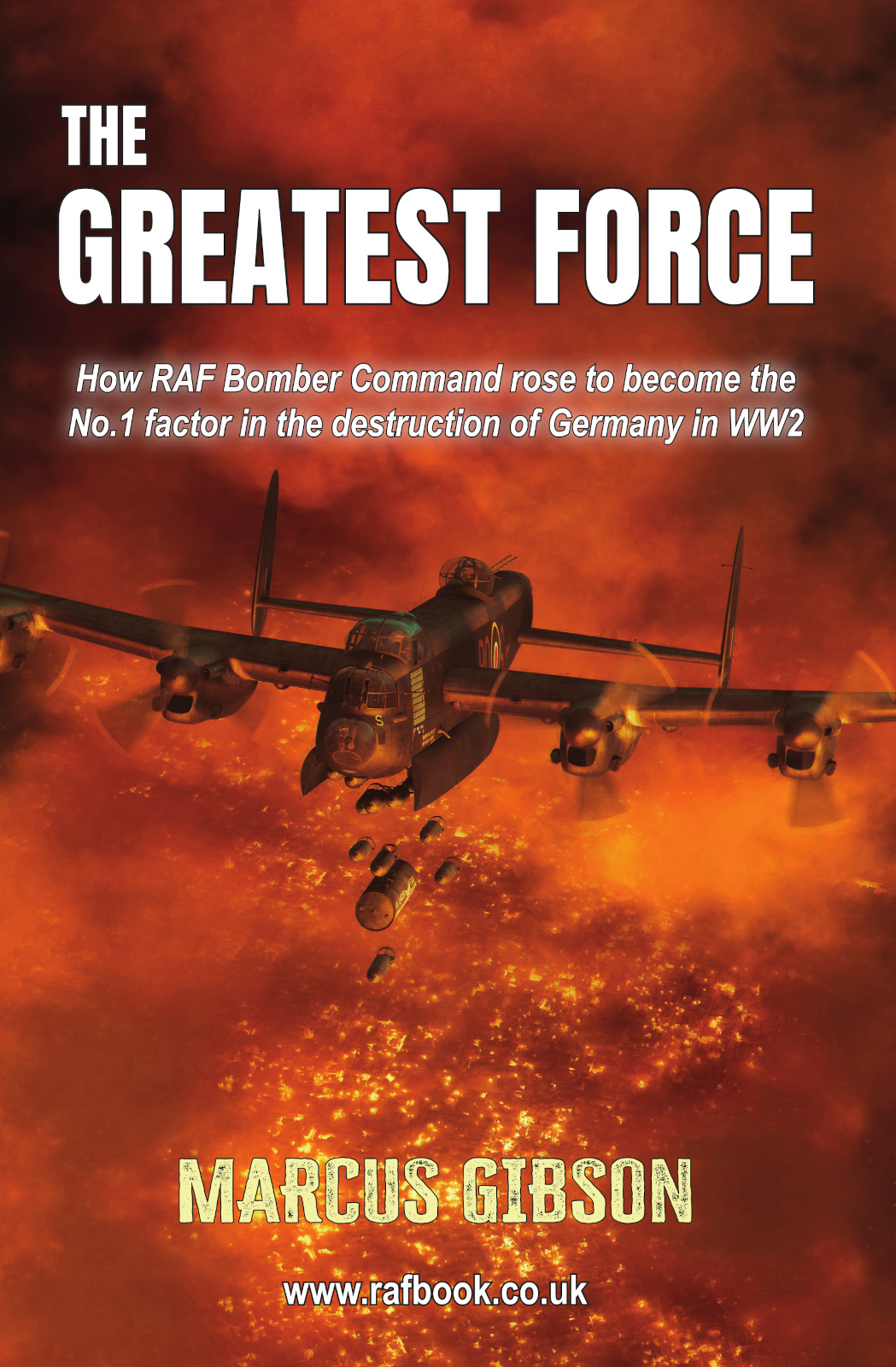
In The Greatest Force, Gibson claims to answer the ‘outstanding questions’ (Rear cover) he has identified about RAF Bomber Command’s war, including why ‘Harris was right to bomb city centres’, how ‘Bomber Command became the No.1 factor in Britain’s total, destructive defeat of Nazi Germany’, and how the force ‘gave little-known but vital support to the Royal Navy against the U-boats and to Allied armies.’ He also maintains that the ‘book is the first-ever full analysis of the impact of RAF Bomber Command on Nazi Germany’. He claims that his research finally ‘dispels the many myths about Bomber Command’s true effectiveness,’ and proves that ‘it was the foremost military force in securing victory.’[3] The Greatest Force massively overpromises and underdelivers.
The book makes a couple of legitimate points, notably the importance of small industrial production to the Nazi war effort. However, it lacks proper evidence to support these ideas, and Gibson’s claims are largely unsubstantiated. The book fails to live up to the promise of the title, the blurb on the back cover, and its marketing. In the introduction, he back-pedals from the title’s claim, concluding ‘that the RAF’s bombing was the principal reason for Germany’s early military defeat in the West – a destructive force equalled in effectiveness only by the victories of the Red Army on the Eastern Front’. (p. xiv) More importantly, the questions he asks are not ‘outstanding’. For example, we already know that materiel was diverted from elsewhere to defend against Allied air power (p. 163).
He resolutely buys into the big man of history concept, citing Harris, Churchill, and his namesake with the dog, while making his disdain for Atlee very clear. (p. 470) His political stance and agenda are also revealed by phrases like ‘group think’ (p. 461) and ‘betrayal’ (p. 465, 469), as well as his wish for a column for Harris to rival that of Nelson. (p. 465) He tries so hard to clear the name of Bomber Command that he avoids the complexity of the subject and includes so much that is irrelevant. Rather than debunking certain myths about the role of Bomber Command, the book reinforces those on one side of the debate over the difficult heritage of the bombing war. His wish for a monumental column taller than that of Nelson firmly positions him in this. Gibson is a journalist with an axe to grind; he is not a historian.
The book is poorly referenced, many claims are unsupported, and the sources used are often cherry-picked without analysis. Most references are to the secondary literature, such as Adam Tooze’s Wages of Destruction (2006), rather than to the primary sources he claims to have used. The book overlooks the cultural context of the historiography he cites, as well as the nuances of working with veteran testimony 80 years after the events. One moment, he’s talking about Allied air power; the next, he is attributing all success solely to RAF Bomber Command (p. 159, 163).[4] Reading it made me realise that ‘yes and’ can be a negative comment.
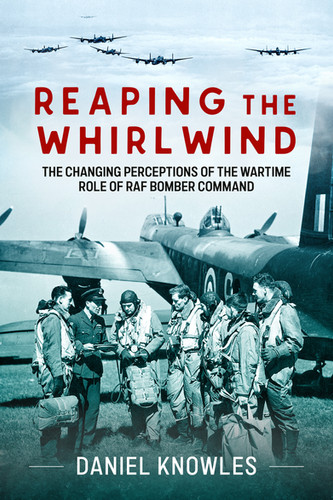
Conversely, in Reaping the Whirlwind, Daniel Knowles acknowledges that the bomber has been in ‘the shadow of Fighter Command’ since Churchill’s speech about ‘the few’ in 1940, and like Gibson, argues that since the end of the war, Bomber Command has occasionally been regarded ‘with great distaste’ (p. 100). However, unlike Gibson, he traces how the ‘perceptions of, and attitudes to the role played by Bomber Command’ have fluctuated between 1945 and today, and he advances explanations for their changing favour (p. 5).[5]
Unlike Gibson, Knowles is historically minded, having a degree in History and Politics. The difference is highlighted in their approach to their subject. He critically examines the historiography, and how literature, film and TV, novels and comics, political discourse and contemporary events, the popular press, and even representations in school textbooks, have played their part in the construction of the popular memory of Bomber Command. He goes into some detail describing the capabilities of different bombsights, and navigation aids including Gee, H2S and Oboe, before he considers how the tactical differences between RAF and USAAF bombing policies have been remembered as area or precision bombing. In doing so, unlike Gibson, Knowles engages with the complexity and the nuance of evolving attitudes to the bombing war in the context of changing politics and worldwide events over the last eight decades.
Reaping the Whirlwind has a logical structure; it is well-referenced and includes 70 pages of appendices with transcripts of important primary sources, including the Butt Report and Churchill’s speeches and correspondence. I would argue that it is worth buying to have these sources accessible on a bookshelf. The book flounders a little by oversimplifying the discussion around censorship of films and the removal of statues (pp. 130-1), but the reader can forgive this and the occasional typo. Although he perhaps incongruously claims ‘little concern has been given to the aircrews of Bomber Command’, (p. 79) Knowles examines the decorations awarded to veterans, and comments that the issue of the Bomber Command Clasp in 2013 would not have occurred if ‘perceptions and attitudes of Bomber Command’s role within the Second World War had not changed’ (p. 97).
Knowles summarises the historiographical and current perspectives on the bombing war, whereas the thinking behind The Greatest Force remains rooted in the late 1990s or early 2000s. Although his book is half as long, Knowles is more effective than Gibson at arguing that the ‘hostility’ to Bomber Command’s position in public memory has been ‘unfair’. (p. 162) He concludes that while their role still divides opinion, perceptions have altered, and Bomber Command is now recognised by the memorials in London and by the International Bomber Command Centre in Lincoln. (p. 179)
Dr Dan Ellin is the archivist for the International Bomber Command Centre Digital Archive housed at the University of Lincoln. A Social and Cultural historian, his research examines the lives, emotions and medical treatment of the men and women who served with Bomber Command during the Second World War, and how the bombing war is remembered.
Header image: An Avro Lancaster MkIII of No. 103 Squadron at Elsham Wolds, Lincolnshire, early March 1943. As part of the publicity for ‘Wings For Victory Week’ (6-13 March), the station photographer was required to supply photographs of the men and machines of the squadron for inclusion in local newspapers. (Source: IWM (CH 8965))
[1] Mark Connelly Reaching for the Stars: A New History of Bomber Command in World War II (London: I.B. Tauris, 2001), p. 147.
[2] Marcus Gibson, ‘The Greatest Force – New Book by Marcus Gibson’ 2025. Accessed 15/08/2025 https://rafbook.co.uk/
[3] Marcus Gibson, ‘The Greatest Force – New Book by Marcus Gibson’ 2025. Accessed 15/08/2025 https://rafbook.co.uk/
[4] Paul Woodadge and Marcus Gibson, ‘How RAF Bomber Command became the No.1 factor in Britain’s total, destructive defeat of Nazi Germany’, WW2TV (2025). Accessed 15/08/2025
[5] Ashley Barnett and Daniel Knowles, Barnthorn Publishing, ‘Reaping the Whirlwind by Daniel Knowles.’ Accessed 15/08/2025
Discover more from From Balloons to Drones
Subscribe to get the latest posts sent to your email.

 From Balloons to Drones
This review reminds me of something that may be lost when solely reading works of historical analysis, which I love to do. What may be lost is an appreciation for just how hard and determined the British aircrews were.
In the last few years I’ve read Cheshire’s book about flying Whitley’s early in the war, Bennet’s book about the Pathfinders, a book called Typhoon pilot and a novel by an Australian navigator the name of which I forgot. These guys went and kept going. despite what seemed to me in retrospect to be close to hopeless situations. They kept on.
Extraordinary.
LikeLike