#FilmReview – Masters of the Air, Episode Eight

#FilmReview – Masters of the Air, Episode Eight

By Dr Luke Truxal

Editorial note: On 26 January 2024, Apple TV+ launched the much-anticipated series Masters of the Air. This series follows the actions of the US 100th Bomb Group during the Combined Bomber Offensive in the Second World War. As the series is being aired, our Book Reviews Editor, Dr Luke Truxal, the author of Uniting against the Reich (2023), will critically review each episode.  

With only one more episode left, Masters of the Air turned in another disappointing performance in episode eight. The poor pacing of episode seven and, to some degree, episode six has forced the show into a dilemma, namely, what to cover in the final episodes. The showrunners have now decided to cover the significant events of the summer, fall, and early winter of 1944 that shaped the lives of the US 100th Bomb Group, the 332nd Fighter Group, and the prisoners at Stalag Luft III in just 51 minutes. That is too much to ask of any television series. This episode failed largely due to poor pacing and trying to cover too many topics without going into depth on any of them. As a result, the show gave each storyline a token appearance, and, as such, it lacked the substance of the series’ first five episodes. Given this, one must wonder if this series had been written and filmed with the intent of being a much longer television series and how poorly these subjects were covered.

Episode eight covers three main storylines. For the 100th Bomb Group at Thorpe Abbotts, the focus is Major Harry Crosby’s mental and physical breakdown due to the stress of planning missions that force him to be sent on a four-week leave. The second major plot revolves around the prisoners at Stalag Luft III and their preparations to fight back, escape, or be marched to another camp. Finally, the series introduced a new storyline with only one episode remaining, namely that of the famous 332nd Fighter Group – a unit composed of African-American personnel and more commonly known as the ‘Tuskegee Airmen.’ Even though there are some good moments where the show portrays the real struggles of these men, by grazing the surface of each one of these topics, viewers and historians come away asking for more. Masters of the Air tried to do too much, and this episode and the rest of the series paid the price.

Much of the Crosby plot in this episode focuses on his work as a staff officer and his ultimate breakdown. The lead-up to Operation OVERLORD, the landing in Normandy and, ultimately, the liberation of France, has Crosby working for days without sleep. Crosby narrates himself trying to push through and continue planning missions as he feels the weight of each mission on his shoulders. He consumes coffee like water and even resorts to taking medication to keep himself awake. Eventually, he passes out in front of Lieutenant Colonel John ‘Jack’ Kidd from exhaustion. This ultimately leads the new commander of the 100th Bomb Group, Colonel Thomas Jeffrey, to order Crosby to take a four-week vacation to recharge his batteries. This shows the war’s effect on those serving behind the front lines and involved in planning the conduct of the Second World War. This is something that did not get enough coverage in Band of Brothers or The Pacific. With the notable exception of Kenneth More’s portrayal of Captain Jonathan Shepard in Sink the Bismarck in 1960, this is something not often captured well in war films. However, throughout the Second World War, staff officers played a vital role in the success of their units, and it was not uncommon for those leading from the rear to suffer significant health crises because they quite literally worked themselves to death. Notably, for example, Major General Theodore Roosevelt Jr., the eldest son of the US President, died of a heart attack while serving as the Assistant Division Commander of the US 4th Infantry Division during the fighting in Normandy. Dealing with this issue was a nice addition to the series.

Masters of the Air introduced the story of the 332nd Fighter Group, more commonly known as the ‘Tuskegee Airmen,’ in this episode. There are a host of problems with this plot line. First, telling the story of this all-black fighter group is important, but giving the group only minutes of screen time in the second to last episode of the series does not do their story justice. Either increase the number of episodes to tell the story well or save that story for its separate mini-series. The last-minute addition of the 332nd Fighter Group also created additional problems with this plot. For example, we are never really introduced to the group itself and their previous struggles to get into combat. From training and through participation in the North African and Sicilian Campaigns, black fighter pilots faced an uphill struggle to prove their worth. Furthermore, the group became more widely known for their more conservative escort fighter tactics, leading them to snuggle tightly to the bomber formations. This hallmark of the 332nd Fighter Group contributed to their ability to reduce bomber losses while on escort duty and earned them a sterling reputation throughout the US Army Air Forces (USAAF). This moves us into the key individuals. Colonel Benjamin O. Davis Jr. is never really introduced. His story is critical here.

While the episode focuses on Lieutenants Alexander Jefferson and Richard Macon from the 332nd Fighter Group, they do not receive a proper introduction either. They are flung at us. Finally, the only mission we see is the 332nd providing close air support for Operation DRAGOON, the landings in southern France in August 1944. During this episode, Jefferson and Macon are shot down and then captured by the Germans. They go through the same interrogations that Egan also experienced in episode six. The key difference here is that the Germans used the state of racism in the United States to get Jefferson and Macon to turn on their country. While this fails, it is one of the few hints of these men’s challenges in fighting for their country. Instead of putting a face on racism, Masters of the Air decided to keep it faceless and very much in the background. Once again, this was another missed opportunity. In short, by dedicating so little time to this plot in previous episodes or by not expanding the episode count to tell this story well, we get additional problems. The 332nd Fighter Group’s story is glossed over, key individuals get a footnote, and finally, racism hardly appears in the episode.
Masters_of_the_Air_Photo_010812
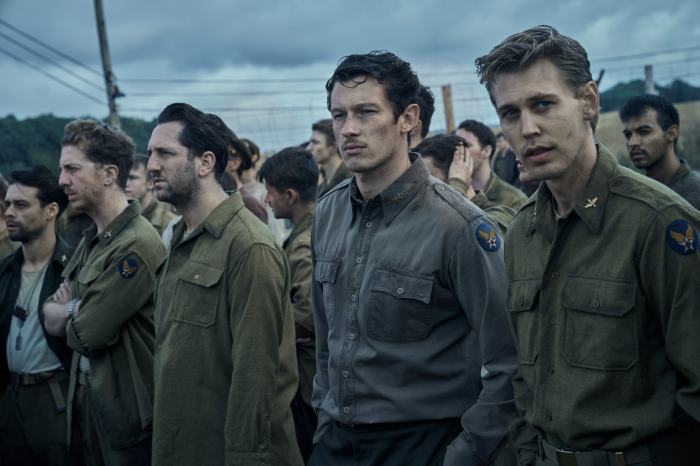
Adam Long, Matt Gavan, Callum Turner and Austin Butler in Masters of the Air. (Source: Apple TV+)

At Stalag Luft III, we see the Americans struggle with being cut off from the events of the world and the daily boring, melancholy life that takes over. It is a real struggle for Major John Egan, who wants to do something. Meanwhile, Major Gale Clevan tries to organise men to build a new water well. This leads to a fight between the two officers. Eventually, we see Jefferson and Macon arrive at the camp. When they arrived, some men regarded them as heroes, referring to them as the ‘Red Tails.’ Few American airmen knew of the 332nd Fighter Group besides their tail markings. Most did not know that they were an all-black fighter unit. So, this scene where they are greeted as heroes does not land well. Some American airmen did know about the 332nd Fighter Group, but they arrived later at the camp. Most of the airmen interred at Stalag Luft III were shocked to find that black fighter pilots were flying in the USAAF. This scene seems flung at the viewers without any context, especially considering that viewers never got to see the 332nd Fighter Group fly an escort mission in this episode. As the episode ends at Stalag Luft III, the airmen realise that they must work together to prepare for liberation, execution, a forced march to another camp, or escape. By the end of the episode, the different plot lines introduced in episodes six, seven, and eight finally start coming together to set up the series finale.

Overall, this episode fails because it tries to do too much. It tried to cover much of the fighting in 1944 in a single episode and juggled too many plots. In attempting to cover so many stories, we see the episode fail to introduce new characters, units, and stories well properly. Context is missing a lot of the time with each of these plots. Viewers are zipping from story to story like the fast-forward button has been hit on 1944 so we can get to the end of the war. This left a lot to be desired. One positive aspect of the episode was the analysis of Crosby’s physical and mental breakdown as a staff officer. However, one bright spot, in an episode that gave token coverage to a wide range of important historical events and topics, did not help this episode. Ultimately, the approach taken did not serve the series or the history well. One must wonder if this series was written with more episodes in mind and had been forced to make dramatic cuts at some point during the production process.

Dr Luke Truxal is an adjunct at Columbia State Community College in Tennessee. He completed his PhD in 2018 from the University of North Texas with his dissertation ‘Command Unity and the Air War Against Germany.’ His previous publications include ‘Bombing the Romanian Rail Network’ in the Spring 2018 issue of Air Power History. He also wrote ‘The Politics of Operational Planning: Ira Eaker and the Combined Bomber Offensive in 1943’ in the Journal of Military Aviation History. In addition, Truxal is researching the effectiveness of joint air operations between the Allied air forces in the Second World War. He can be reached on Twitter at @Luke_Truxal.

Header image: Josiah Cross in Masters of the Air. (Source: Apple TV+)
#FilmReview – Masters of the Air, Episode Seven

#FilmReview – Masters of the Air, Episode Seven

By Dr Luke Truxal

Editorial note: On 26 January 2024, Apple TV+ launched the much-anticipated series Masters of the Air. This series follows the actions of the US 100th Bomb Group during the Combined Bomber Offensive in the Second World War. As the series is being aired, our Book Reviews Editor, Dr Luke Truxal, the author of Uniting against the Reich (2023), will critically review each episode.  

For the first time in the Masters of the Air television series, I was genuinely disappointed in an episode. There were two significant issues with this episode. The first major problem has now become a glaring problem for the show, which is the inability to tell a story outside the US 100th Bomb Group with the quality that it deserves. This is either because the show relies so heavily on veteran accounts that it cannot tell the larger story or because the show only half-heartedly covers the topic, like checking a box on an essay due at the end of class. The second major issue is that this episode wasted priceless minutes of television time covering stories and plots that, in the grand scheme of things, are not as important as other aspects of the air war. In many respects, this is likely a major reason why the show will do some more box-checking in the coming episodes. The series spends too much screen time on less critical plots and must condense more essential stories into the final two episodes.

For this review, I will not give an overview of the episode and jump straight into the problems because there is much to criticise. The first major issue that this episode, and the show more generally, struggle with is its treatment of those not members of the 100th Bomb Group. First, generals are written as blundering fools who do not care about their men. In the third episode, Colonel Curtis LeMay’s aggressiveness is blamed for the disaster of the Schweinfurt-Regensburg raid, even though he flew in the lead plane for the mission. Also, it left out the debates that US VIII Bomber Command struggled with in determining whether to send out the raid. This theme continued in this episode. While the episode did a good job of covering the aftermath of the 6 March 1944 Berlin raid well, during the planning and briefing of the 8 March raid, the writers decided to portray the commander of the US Eighth Air Force, Lieutenant General James Doolittle, and the commander of the United States Strategic Air Forces in Europe, Lieutenant General Carl Spaatz, as blundering fools who are using the same navigational route for back to back raids. As an audience member, it is hard to decide whether the showrunners want us to believe these men are unintelligent, lazy, or do not care. Most likely all the above. For perspective, the navigational route was chosen because it avoided flak concentrations and limited combat losses.[1]

Masters_Of_The_Air_Photo_010707
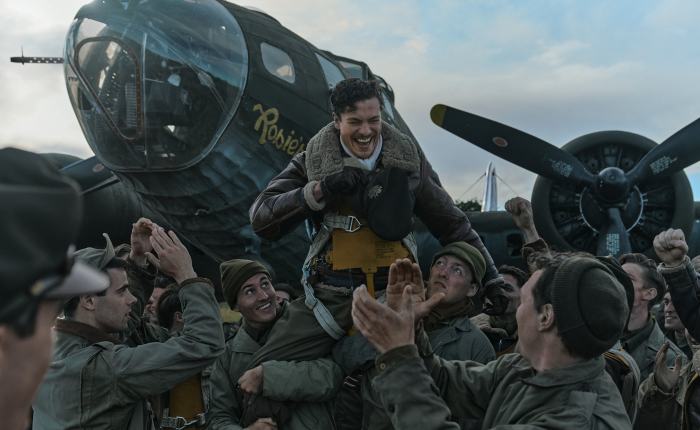
Kai Alexander and Bailey Brook in Masters of the Air. (Source: Apple TV+)

The show did not stop there. At the end of this episode, the new commander of the 100th Bomb Group, Lieutenant Colonel John Bennett, lays out the latest air strategy for gaining air superiority at the end of the episode to Captain Robert Rosenthal. He states that the new strategy going into March and April 1944 will be to win the air war by using the bombers as bait for the fighters so that the newly arrived long-range escort fighters, the North American P-51 Mustangs, can shoot down the German fighters. There are so many ways in which that scene does an injustice to the strategic, operational, and tactical changes Spaatz and Doolittle implemented at the beginning of 1944. Starting with the strategic picture. Spaatz rightfully argued that Operation OVERLORD could not go forward if the air superiority had not been gained before troops began landing in Normandy. This was a huge point of contention between Spaatz and the commander of the Allied Expeditionary Air Forces, Air Chief Marshal Leigh-Mallory.[2] Spaatz went into 1944 to grind down the Luftwaffe through a large series of air battles carried out through the skilful concentration of all American air forces in the European and Mediterranean Theaters of Operations. Spaatz deserves much credit for bringing maximum pressure to bear on the Luftwaffe and degrading their combat effectiveness, starting with Big Week from 20 to 25 February 1944 and continuing through March and April 1944. Furthermore, the tactical changes implemented by the Eighth Air Force came from Doolittle. Doolittle changed the fighter tactics when he took over the Eighth Air Force from Lieutenant General Ira Eaker in January 1944. This came in two parts. First, American fighter pilots were no longer merely escorts as they were in 1943. Once engaged, American fighter pilots were to pursue German fighters even if it meant leaving the bomber stream. This was a more effective means to gain air superiority by prioritising shooting down German fighters. Additionally, Doolittle adopted the idea of using a bouncing fighter group, whose job was to roam the edges of the bomber formation in search of German fighters preparing to attack the bombers. These are well-known changes to scholars of the air war and can be easily told on screen to an audience. However, by stating that the generals wanted to use the bombers as bait, the show has given the impression to the audience that the American generals do not care about their losses and that this is simply a numbers game for the brass.

Another problem with this show is the anti-British bias that shows up. By this point, I wonder whether the showrunners think the British military can do anything well. While the criticisms of the British night bombing strategy in the second episode of the series were warranted, the scene did not convey the message well. I initially thought this was merely a poorly written-scene. At this point in the series, I think it is safe to say that whoever is writing the scenes regarding the British military holds them in contempt. It comes up again and again throughout the episodes. Sometimes in tiny doses. At other times, quite openly, as we saw in episodes two and six. In this episode, we get two more doses of British failures. While listening to the radio at Stalag Luft III, the Americans hear about the British failure to take Monte Casino in Italy. Later in the episode, there is the failure of the Great Escape, in which 76 British and Commonwealth prisoners escape the camp. Only three can evade captivity and get back home. Of the 73 that were captured, 50 were executed in retaliation. This is a significant moment for those living at Stalag Luft III and is a sign of British and Commonwealth prisoners continuing to wage war against the Germans using whatever means are at their disposal, including escape. Instead, it is portrayed as another British failure, and the consequences make life at the camp harder for the Americans of the 100th Bomb Group interred there. These are just two examples of the shortcomings of this show to tell the bigger picture. Where Band of Brothers (2001) and The Pacific (2010) did a much better job providing context, Masters of the Air has fallen dreadfully short by putting so much emphasis on the perspective of the airmen. There is no sugarcoating it: this show is bad at telling stories outside the 100th Bomb Group.

These problems pale in comparison to the poor use of screen time in this episode. Much of this episode was dedicated to two plots that did not serve a significant purpose and took away screen time to lay the groundwork for more critical plots. First, much of the plot at Stalag Luft III centred on maintaining some news of the outside world using a handmade radio that the airmen kept hidden. While this did indeed happen, the radio plot took away time that could have be en better spent. While at Stalag Luft III, Major John Egan handled security, and Major Buck Clevan oversaw education at the South Compound.[3] Telling these stories provides more insight into camp life than focusing on losing and rebuilding a radio. Furthermore, the show ended teasing that the Tuskegee airmen would first appear in the eighth or nine episodes. It would have been nice to use some of the time in this episode to show the challenges black airmen faced in their fight to serve their country as fighter pilots and help orchestrate significant civil rights changes in the military through their service. Instead, like with the film Red Tails, Masters of the Air has chosen to skip the crucial challenges faced during training in the United States. This was a big missed opportunity. This is why this episode is so bad. The US 332nd Fighter Group’s story deserves more than a token appearance in the television series. Either tell the story well or save that story for a different television series. Simply throwing this story in without telling the back story does not do the history or airmen justice. For a better portrayal of black fighter pilots’ challenges, see the film The Tuskegee Airmen (1995).

This episode was a disappointment. This review cannot do a proper recap and review that covers every issue with this episode. Instead, I highlighted major flaws and trends in the episode and series. The treatment of other nationalities fighting against the Axis and the treatment of high-ranking officers do this series and subject a disservice. These are symptoms of long-growing problems with this show. This specific episode wasted valuable screen time on less essential plots like Captain Harry Crosby’s fictional infidelity and the time spent fixing a radio. By spending valuable minutes on these storylines, the show missed great opportunities to tell important narratives. This will have grave consequences as the show tries to introduce new storylines and wrap up the show in the final two episodes. Unfortunately, this is where the show is headed. Masters of the Air seems determined to give token coverage to serious issues while wasting valuable time on less important topics. This is an unfortunate development for a show I have come to enjoy.

Dr Luke Truxal is an adjunct at Columbia State Community College in Tennessee. He completed his PhD in 2018 from the University of North Texas with his dissertation ‘Command Unity and the Air War Against Germany.’ His previous publications include ‘Bombing the Romanian Rail Network’ in the Spring 2018 issue of Air Power History. He also wrote ‘The Politics of Operational Planning: Ira Eaker and the Combined Bomber Offensive in 1943’ in the Journal of Military Aviation History. In addition, Truxal is researching the effectiveness of joint air operations between the Allied air forces in the Second World War. He can be reached on Twitter at @Luke_Truxal.

Header image: Nate Mann in Masters of the Air. (Source: Apple TV+)

[1]  Donald Caldwell and Richard Muller, The Luftwaffe Over Germany: Defense of the Reich (Barnsley: Frontline Books, 2014), p. 168.

[2] Luke Truxal, Uniting Against the Reich: The American Air War in Europe, (Lexington: University Press of Kentucky, 2023), p. 115-7.

[3] Donald Miller, Masters of the Air: America’s Bomber Boys Who Fought the Air War Against Nazi Germany (New York: Simon and Schuster, 2006), p. 389.

#ResearchResources – Recent Articles and Books (February 2023)

#ResearchResources – Recent Articles and Books (February 2023)

Editorial note: In this series, From Balloons to Drones highlights research resources available to researchers. Contributions range from discussions of research at various archival repositories to highlighting new publications. As part of this series, we are bringing you a monthly precis of recent articles and books published in air power history. This precis will not be exhaustive but will highlight new works published in the preceding month. Publication dates may vary around the globe and are based on those provided on the publisher’s websites. If you would like to contribute to the series, please contact our Editor-in-Chief, Dr Ross Mahoney, at airpowerstudies@gmail.com or via our contact page here.

Books

Krzysztof Dabrowski, Defending Rodinu – Volume 2: Build-up and Operational History of the Soviet Air Defence Force, 1960-1989 (Warwick: Helion and Company, 2023).

In the 1950s, the Soviets had managed to grow a major Air Defence Force (PVO) capable of covering the entire airspace of the Union of the Soviet Socialist Republics (USSR). The PVO was able to field interceptors and surface-to-air missiles to intercept even high-flying foreign reconnaissance aircraft. By the early 1960s, the Soviets managed to theoretically, seal their airspace to unwanted visitors. Nevertheless, multiple foreign intelligence agencies and air forces continued seeking to penetrate the airspace of the USSR by means ranging from non-steerable ‘spy blimps’, via strategic bombers, to high-speed tactical reconnaissance aircraft. This activity kept the PVO on constant alert so that time and again it reacted mercilessly, even to entirely innocent passenger airliners, causing several major international incidents.

Defending Rodinu Volume 2 provides the operational history of the Soviet PVO from the early 1960s until the late 1980s – a period of continuously escalating tensions of the Cold War. Using documentation and publications never before released in the English language and richly illustrated, it provides a comprehensive, single-source point of reference for historians and enthusiasts alike.

Mark Galeotti, Afghanistan, 1979–88: Soviet Air Power against the Mujahideen (Oxford: Osprey Publishing, 2023).

The Soviet Union’s invasion of Afghanistan was fought as much in the air as on the ground. From the high-level bombing raids that blasted rebel-held mountain valleys, to the Mi-24 helicopter gunships and Su-25 jets that accompanied every substantial army operation, Soviet control of the air was a crucial battlefield asset. Vital to every aspect of its operations, Mi-8 helicopters ferried supplies to remote mountain-top observation points and took the bodies of fallen soldiers on their last journey home in An12 ‘Black Tulips’.

But this was not a wholly one-sided conflict. Even before the Afghan rebels began to acquire man-portable surface-to-air missiles such as the controversial US ‘Stinger,’ they aggressively and imaginatively adapted. They learnt new techniques of camouflage and deception, set up ambushes against low-level attacks, and even launched daring raids on airbases to destroy aircraft on the ground.

Featuring information previously unknown in the West, such as the Soviets’ combat-testing of Yak-38 ‘Forger’ naval jump jets, Soviet-expert Mark Galeotti examines the rebel, Kabul government and the Soviet operation in Afghanistan, drawing deeply on Western and Russian sources, and including after-action analyses from the Soviet military. Using maps, battlescenes and detailed ‘Bird’s Eye Views’, he paints a comprehensive picture of the air war and describes how, arguably, it was Soviet air power that made the difference between defeat for Moscow and the subsequent stalemate that they decided to disengage from.

Daniel Haulman, Misconceptions about the Tuskegee Airmen: Refuting Myths about America’s First Black Military Pilots (Athens, GA: University of Georgia Press, 2023).

Once an obscure piece of World War II history, the Tuskegee Airmen are now among the most celebrated and documented aviators in military history. With this growth in popularity, however, have come a number of inaccurate stories and assumptions. Misconceptions about the Tuskegee Airmen refutes fifty-five of these myths, correcting the historical record while preserving the Airmen’s rightful reputation as excellent servicemen.

The myths examined include: the Tuskegee Airmen never losing a bomber to an enemy aircraft; that Lee Archer was an ace; that Roscoe Brown was the first American pilot to shoot down a German jet; that Charles McGee has the highest total combat missions flown; and that Daniel “Chappie” James was the leader of the “Freeman Field Mutiny.” Historian Daniel Haulman, an expert on the Airmen with many published books on the subject, conclusively disproves these misconceptions through primary documents like monthly histories, daily narrative mission reports, honor-awarding orders, and reports on missing crews, thereby proving that the Airmen were without equal, even without embellishments to their story.

Jeff Pedrina, Wallaby Airlines: Twelve months flying the Caribou in Vietnam (Newport, NSW: Big Sky Publishing, 2023).

Jeff Pedrina’s book provides a very personal and thoughtful account of his twelve month’s service in Vietnam with No 35 Squadron – ‘Wallaby Airlines’. While the story is primarily about the people, and the personalities, he encountered during his tour of duty in Vietnam, it is also the story of a remarkable aircraft, the de Havilland Canada DHC-4 Caribou – the first mass-produced short take-off and landing (STOL) aircraft of its size. For seven and a half years it was the backbone of the airlift effort in the highlands of Vietnam, and was operated by the Royal Australian Air Force until November 2009, forty-five years after it first entered RAAF service.

First into the theatre in 1964 and last out in 1972, the Caribou aircraft and its air and ground crews were the RAAF’s quiet achievers in Vietnam. In the course of seven and a half years, Wallaby Airlines achieved an excellent operational record and reputation as a tactical transport squadron. This book in its original format was first published in 2006, having been awarded Special Mention in the 2005 RAAF Heritage Awards. This new edition is intended to bring the experiences of Jeff Pedrina, and the exploits of the Wallaby Airlines and its venerable Caribou aircraft to life for a new generation of reader.

Usman Shabbir and Yawar Mazhar, Eagles of Destiny – Volume 1: Growth and Wars of the Pakistan Air Force, 1956-1971 (Warwick: Helion and Company, 2023).

Eagles of Destiny Volume 2 is a detailed account of the transformation of the Pakistan Air Force (PAF) with the help of the first US assistance program, and how its leadership utilised this opportunity to create a modern air force. It provides detailed coverage of the PAF’s participation in the 1965 Indo-Pakistani War, based on official documentation and material from private collections that were previously not available to the public. The story of the Pakistan Air Force during this period is concluded by the coverage of the first build-up with the Chinese support, against the backdrop of US sanctions, highlighting and discussing the challenges and response.

Finally, the book provides detailed coverage of PAF operations during the 1971 War with India, including several first-hand accounts by key officers. Between 1956 and 1971, the PAF inducted a number of new weapon systems, including US-made F-86 Sabres, French-made Mirages, and Chinese-made F-6s. These developments and PAF’s strategy are all discussed in great detail.

Richly illustrated, and almost entirely based on accounts never published before, Eagles of Destiny Volume 2 provides a unique insight from professionals who were either directly involved, or witnessed the affairs in question.