Reviewed by Dr Ross Mahoney
Randall Wakelam, David Varey and Emanuele Sica (eds.), Educating Air Forces: Global Perspectives on Airpower Learning. Lexington, KY: University Press of Kentucky, 2020. Hbk. Notes. Index. vii + 260 pp.
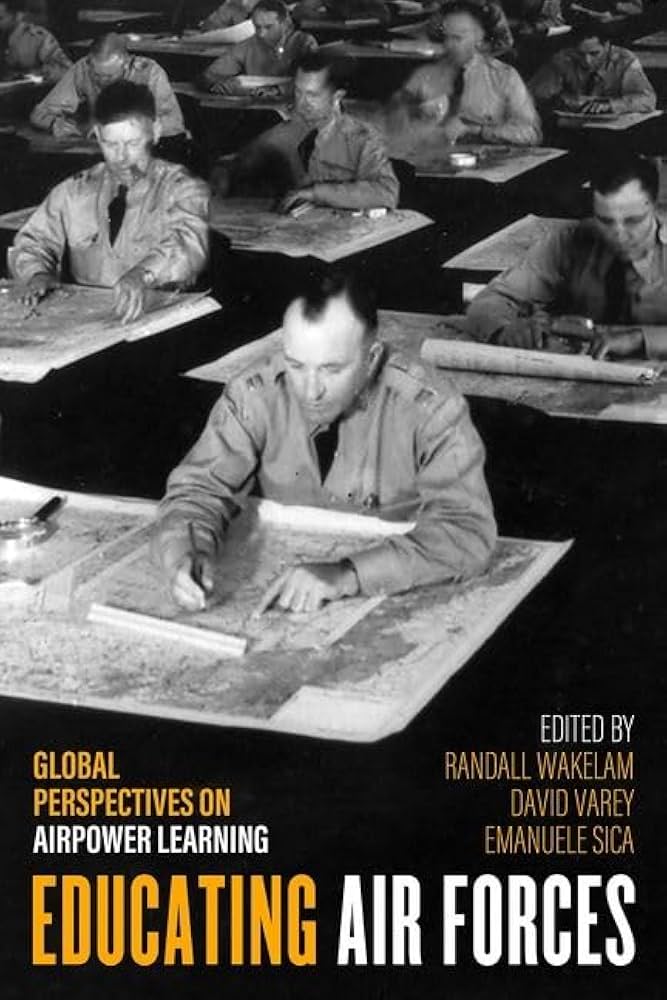
Air power history is dominated by accounts of operations, especially those of the First World War, the Second World War, and the Vietnam War. There is relatively little written about how air forces prepared for war. However, an inherent part of this preparation is how air forces have educated their aviators throughout history. As such, it is refreshing to read a volume dedicated to the subject of learning in air forces. Moreover, as the editors of the volume correctly write (p. 1), [i[f we accept that militaries are professions and that professions need education […] then we could reasonably want to know how militaries are educated and how well they perform this task.’
This edited volume is the outgrowth of a 2016 conference held at the Royal Military Academy of Canada on air power education. The book consists of 13 chapters organised into three chronological eras (the interwar years, the Cold War, and the post-Cold War). Many of the chapters were presented as keynote lectures at the 2016 conference. Several chapters, such as James Beldon and Peter Gray’s reflection on air power education in the modern Royal Air Force (RAF), were added for the publication of the volume (pp. 232-44). The addition of such chapters helps to round out the book and give shape to the subject.
Before examining some of the chapters, it is essential to recognise that, conceptually, this edited volume focuses on learning rather than solely on education. However, the latter is its main focus. This is an important distinction, as some of the chapters deal with educational establishments whose primary focus was training rather than education. As the editors relate, a tiered system of learning exists in military organisations that moves from training through to education (pp. 3-4). Nonetheless, for example, the chapters by Emanuele Sica (pp. 30-50) and John Farquhar (pp. 111-33) address institutions – the Accademia Aeronautica (Italian Air Force Academy) and the United States Air Force (USAF) Academy, respectively – whose primary focus is training. However, such institutions still have a broader educational role to play, and in this, we have a case of ‘Athens in Sparta,’ or a mix of skills-based training (Sparta) with broader education (Athens).
A review of this kind cannot hope to critique each chapter individually. As such, a couple of examples taken from each period will suffice. In the section on the interwar years, Sica examines the role that Giulio Douhet’s writing played in the education of the Regia Aeronautica (Italian Air Force) through the lens of the Accademia Aeronautica. In doing this, Sica presents a well-trodden subject – the writing of Douhet – in a new light. As Sica highlights, the place of Douhet in the development of his own country’s air force remains ‘open to debate’ (p. 43). Moreover, while the appointment of Italo Balbo in 1926 as undersecretary for air in the Italian government has been interpreted as ‘boon for Douhet’s fortune,’ the former’s policies illustrate the difficulty of assessing Douhet’s impact. This is born out in the teaching at the Accademia Aeronautica. As Sica argued, Douhet’s ‘ideas […] did not appear to gain wide acceptance, especially in the first years of the Italian Air Force Academy’ (p. 44).
In the section on the Cold War, the chapter by Richard Goette is of particular interest to this author, given the parallels between the Canadian and Australian experiences in the early years of the Cold War. Canada’s experience with creating its own Staff College is the subject of Goette’s chapter. However, it is worth noting that during the interwar years, both the Royal Canadian Air Force (RCAF) and the Royal Australian Air Force (RAAF) relied on the RAF to provide mid-level officer education through the RAF Staff College at Andover, the latter examined by Gray in his chapter (pp. 15-29). The experience of the Second World War led the RCAF and RAAF to establish their own staff colleges. Goette, however, points out (p. 103) that ‘[a]ir force education at the RCAF Staff College […] involved much more than studying and time spent in the classroom.’ Goette’s point here is important. Attendance at institutions such as staff colleges is about more than just formal learning; it is about the experience as a whole and the opportunity for socialisation, networking and the sharing of ideas amongst peers.
The establishment of the USAF School of Advanced Airpower Studies (now the School of Advanced Air and Space Studies (SAASS)) by the world’s preeminent air force is the subject of Harold Winton’s chapter. In this chapter, Winton compares SAASS with the interwar Air Corps Tactical School and examines five key areas of comparison: origins and purpose, faculty, curriculum, students, and significance (p. 154). In his conclusion, Winton rightly highlights that, in creating an institution for the ‘elite’ education of select officers in the form of SAASS, the USAF must ensure that its officers show ‘intellectual humility’ to prevent them from degenerating (p. 163) into ‘elites of privilege and entitlement.’ Conversely, Martin James discusses the role of education and the establishment of the Air Power Studies Centre (APSC) (now the Air and Space Power Centre) by the RAAF. In this, James highlights the importance of key stakeholders, notably, the Chief of the Air Staff (CAS), Air Marshal Ray Funnell, in supporting the establishment of APSC. Indeed, the role of such ‘champions’ needs to be more fully understood. For example, Marshal of the RAF Lord Cameron was instrumental in establishing the role of Director of Defence Studies for the RAF in 1977. The RAAF was fortunate in having a CAS, Funnell, who recognised that the study and writing of air power, including its doctrine, had been neglected (p. 170).
It is hard to criticise an edited work such as this, as it does not purport to be a comprehensive examination of air power learning. It could never hope to be, but it does offer a valuable insight into a much-underappreciated subject. However, the volume focuses on the experience of Western air forces. It would have been interesting to compare the experience of Western air forces in learning with that of non-Western countries. For example, discussing air power learning in communist countries such as the Soviet Union and China could highlight the role ideology played in officer education.
In conclusion, despite the author’s criticism above, the editors are to be commended for bringing this volume to fruition. The volume offers a starting point for any scholar researching learning in the military, generally, and in air forces specifically. It should be read by both scholars and practitioners who are interested in military learning.
Dr Ross Mahoney is an independent scholar specialising in the history of war, with a particular focus on the use of air power and the history of air warfare. He is the Editor-in-Chief of From Balloons to Drones and currently the Senior Historian within the Heritage Policy team at Brisbane City Council in Australia. He has 20 years of experience in the education, museum, heritage and government sectors in Australia and the United Kingdom, including serving as the inaugural Historian at the Royal Air Force Museum from 2013 to 2017. His other research interests are military leadership and command, military culture, and the history and development of professional military education. He also maintains an interest in transport history. He has published numerous articles, chapters and encyclopedia entries, edited two books, and delivered papers on three continents.
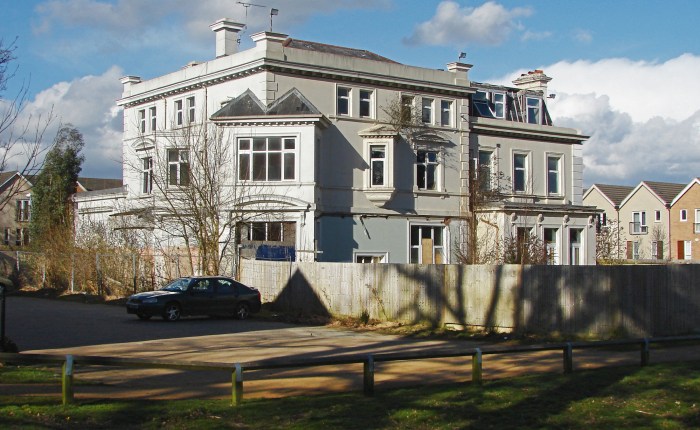
Header image: Ramslade House, the home of the RAF Staff College in Bracknell after the Second World War. (Source: Wikimedia)


 From Balloons to Drones