#BookReview – Rain of Ruin: Tokyo, Hiroshima and the Surrender of Japan

#BookReview – Rain of Ruin: Tokyo, Hiroshima and the Surrender of Japan

Reviewed by Dr Ross Mahoney

Richard Overy, Rain of Ruin: Tokyo, Hiroshima and the Surrender of Japan. London: Allen Lane, 2025. Hbk. Images. Notes. Further readings. Index. xiii + 206 pp.
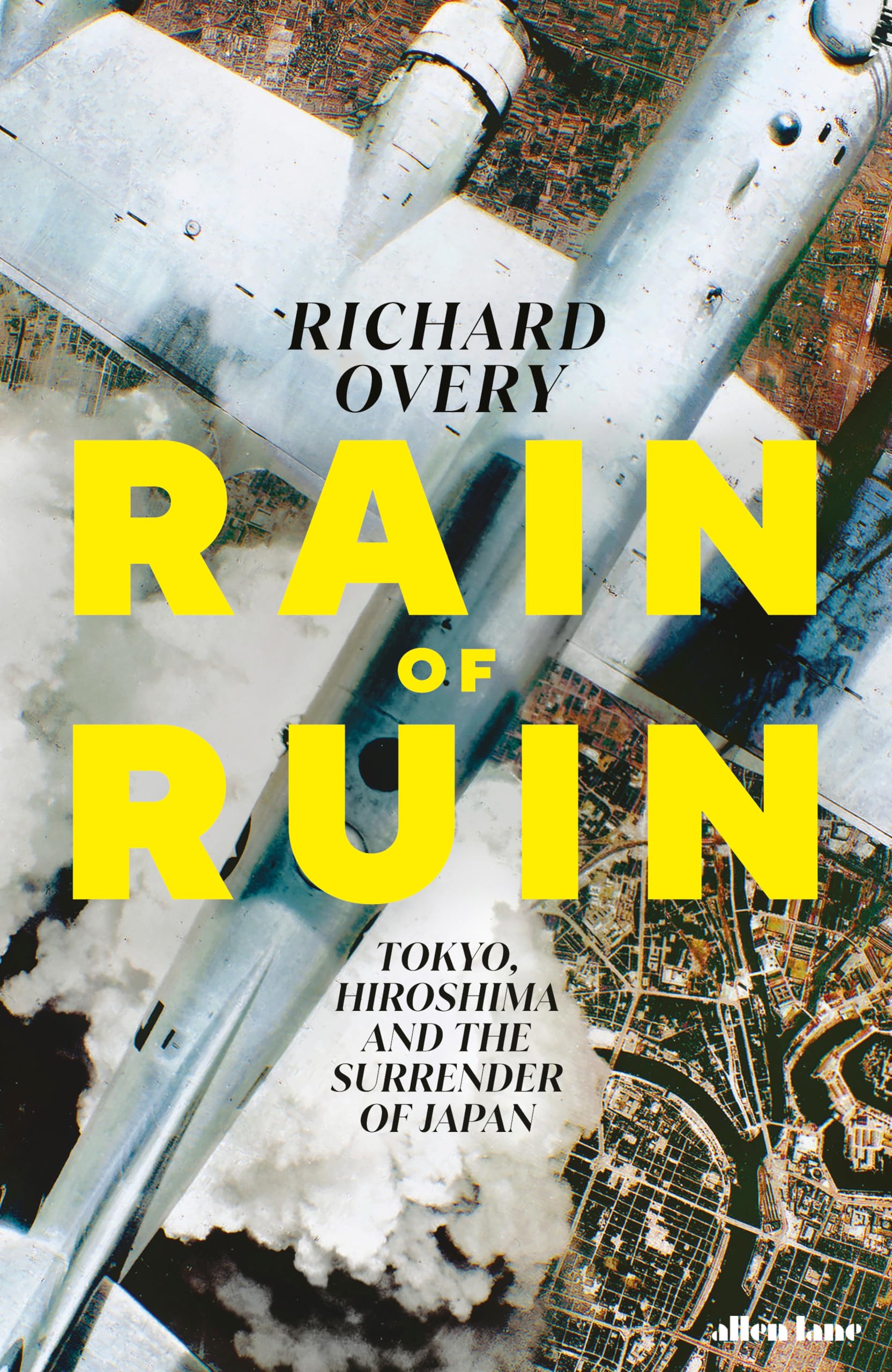
The decision to use the atomic bomb in the Second World War is one of the most written-about episodes in modern military history. As Richard Overy (p. xi) identifies in this work:

[n]o single subject in the history of the United States war effort has prompted so much historical, political, and philosophical writing. No set of surviving records has been subjected to so much close forensic scrutiny.

Broadly speaking, debates over its use range from the argument that they were used to save American lives to the view that they were used to forestall Soviet ambition in the Far East and prevent the division of Japan. As exemplified by the controversy in 1994 surrounding the planned script for what became the ‘Enola Gay’ exhibition at the Smithsonian National Air and Space Museum in 1995, debates over how we interpret the decision to use the atomic bomb have been subject to intense scrutiny and disagreements. Into this milieu comes Overy, one of the world’s leading authorities on the history of the Second World War and an expert on the history of air power.

Overy had previously written the voluminous The Bombing War (2013), which dealt with debates surrounding bombing in the European theatre of war; however, in this volume, he turns his attention to the US strategic bombing campaign against Japan in 1945 and the decision to use the atomic bomb. In Rain of Ruin, Overy deals with three separate but indelibly linked areas, which form the core of the book’s key chapters. Indeed, each chapter provides the necessary context for the next. For example, in Chapter Two, Overy explores the reason why the US shifted from precision targeting to a strategy of indiscriminate firebombing from March 1945 onwards. As Overy notes, the US had abhorred British ‘area bombing’ techniques. However, they were willing to adopt similar methods in the Far East against Japan because of a shift in thinking about the use of incendiary raids influenced by the character of the war in the Far East, ‘the demonisation of the Japanese enemy, and the effort to define area targets as legitimate military-economic ones.’ (p.40). Furthermore, they were supported in this shift in strategy by appointing an officer, General Curtis LeMay, who showed no ‘compunction about bombing and killing civilians if it helped shorten the war’ (p. 22).

Following on from the shift in US air power strategy, Chapter Three deals with the development and decision to use the atomic bomb. Indeed, Overy highlights that in accepting the change in air power strategy, it became easier for the US to normalise the use of the atomic bombs. As he argued, the shift in strategy ‘prepared the way for the apotheosis of indiscriminate destruction in the two atomic attacks’ (p. 18). Moreover, Overy also adeptly illustrates the role that civilian scientists played in the development of the atomic bomb, arguing that ‘[w]ere it not for the maximum effort by a cohort of the world’s most distinguished physicists, the bomb would not have been ready by 1945’ (p.54). As such, it is essential to remember that the use of the atomic bombs was a whole-of-government affair that not only required a shift in US air power strategy but also the willingness of other stakeholders to buy into the project and their eventual use. This also included government officials in key decision-making roles and illustrates that military strategy, such as the decision to use the atomic bomb, does not develop in a vacuum.

Finally, in Chapter Four, Overy examines the reasons for the Japanese surrender in 1945 and the role that the dropping of the atomic bombs played in that decision. In doing so, Overy does an excellent job in comparing the various arguments related to Japan’s decision to surrender, most notably, the role played by the Soviet invasion of Manchuria that started between the dropping of the two atomic bombs. Indeed, as Overy illustrates, drawing on Japanese sources, the Japanese decision to surrender – the so-called ‘Sacred Decision’ – was complex and not readily accepted. For example, towards the end of August, a Japanese Kamikaze unit dropped propaganda leaflets over Tokyo, warning residents not to surrender and stating that the imperial rescript had been a false document (p. 126). Despite this, Overy makes clear that the decision to surrender was complex. Both conventional and atomic attacks on Japan played a role in the decision-making process, though whether they were decisive, as many have argued, remains open to question. Indeed, Japanese leaders viewed the atomic bombings simply as an ‘extension of LeMay’s campaign’ (p. 110).

Overall, Overy has, in the course of just 150 pages, placed the decision to use the atomic bomb in its essential context, the shift in US air power strategy that occurred in the Far East in 1945 and assessed their role in the Japanese decision to surrender. The book is supported by copious referencing to sources not just from the US but also from Britain and Japan. It is necessary reading for anyone interested in the decision to use the atomic bomb, how the Second World War ended, or US air power strategy. However, perhaps the greatest strength of Overy’s analysis is that he does not ‘judge the past’ but allows the evidence to tell its story and allows the reader to ‘understand it better on its own terms’ (p. xiii). In this, Overy has been successful.

Dr Ross Mahoney is an independent scholar specialising in the history of war, with a particular focus on the use of air power and the history of air warfare. He is the Editor-in-Chief of From Balloons to Drones and currently the Senior Historian within the Heritage Policy team at Brisbane City Council in Australia. He has nearly 20 years of experience in the education, museum, and heritage sectors in Australia and the United Kingdom, including serving as the inaugural Historian at the Royal Air Force Museum from 2013 to 2017. His other research interests are military leadership and command, military culture, and the history and development of professional military education. He also maintains an interest in transport history. He has published numerous articles, chapters and encyclopedia entries, edited two books, and delivered papers on three continents.

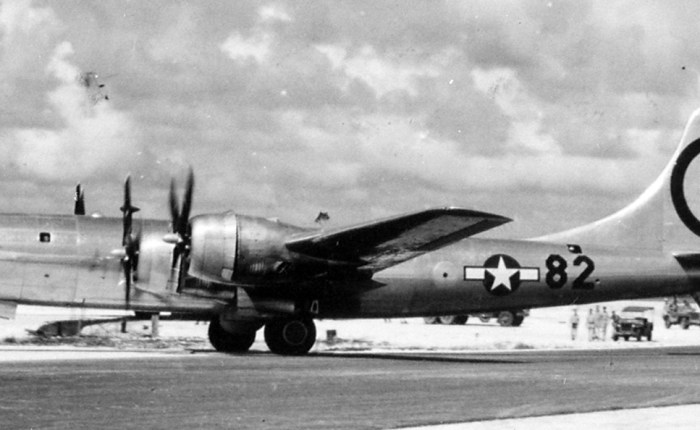
Header image: The Boeing B-29 Superfortress Enola Gay on Tinian just after the attack on Hiroshima on 6 August 1945. (Source: Wikimedia)
#FilmReview – Masters of the Air, Episode Seven

#FilmReview – Masters of the Air, Episode Seven

By Dr Luke Truxal

Editorial note: On 26 January 2024, Apple TV+ launched the much-anticipated series Masters of the Air. This series follows the actions of the US 100th Bomb Group during the Combined Bomber Offensive in the Second World War. As the series is being aired, our Book Reviews Editor, Dr Luke Truxal, the author of Uniting against the Reich (2023), will critically review each episode.  

For the first time in the Masters of the Air television series, I was genuinely disappointed in an episode. There were two significant issues with this episode. The first major problem has now become a glaring problem for the show, which is the inability to tell a story outside the US 100th Bomb Group with the quality that it deserves. This is either because the show relies so heavily on veteran accounts that it cannot tell the larger story or because the show only half-heartedly covers the topic, like checking a box on an essay due at the end of class. The second major issue is that this episode wasted priceless minutes of television time covering stories and plots that, in the grand scheme of things, are not as important as other aspects of the air war. In many respects, this is likely a major reason why the show will do some more box-checking in the coming episodes. The series spends too much screen time on less critical plots and must condense more essential stories into the final two episodes.

For this review, I will not give an overview of the episode and jump straight into the problems because there is much to criticise. The first major issue that this episode, and the show more generally, struggle with is its treatment of those not members of the 100th Bomb Group. First, generals are written as blundering fools who do not care about their men. In the third episode, Colonel Curtis LeMay’s aggressiveness is blamed for the disaster of the Schweinfurt-Regensburg raid, even though he flew in the lead plane for the mission. Also, it left out the debates that US VIII Bomber Command struggled with in determining whether to send out the raid. This theme continued in this episode. While the episode did a good job of covering the aftermath of the 6 March 1944 Berlin raid well, during the planning and briefing of the 8 March raid, the writers decided to portray the commander of the US Eighth Air Force, Lieutenant General James Doolittle, and the commander of the United States Strategic Air Forces in Europe, Lieutenant General Carl Spaatz, as blundering fools who are using the same navigational route for back to back raids. As an audience member, it is hard to decide whether the showrunners want us to believe these men are unintelligent, lazy, or do not care. Most likely all the above. For perspective, the navigational route was chosen because it avoided flak concentrations and limited combat losses.[1]

Masters_Of_The_Air_Photo_010707
Kai Alexander and Bailey Brook in Masters of the Air. (Source: Apple TV+)

The show did not stop there. At the end of this episode, the new commander of the 100th Bomb Group, Lieutenant Colonel John Bennett, lays out the latest air strategy for gaining air superiority at the end of the episode to Captain Robert Rosenthal. He states that the new strategy going into March and April 1944 will be to win the air war by using the bombers as bait for the fighters so that the newly arrived long-range escort fighters, the North American P-51 Mustangs, can shoot down the German fighters. There are so many ways in which that scene does an injustice to the strategic, operational, and tactical changes Spaatz and Doolittle implemented at the beginning of 1944. Starting with the strategic picture. Spaatz rightfully argued that Operation OVERLORD could not go forward if the air superiority had not been gained before troops began landing in Normandy. This was a huge point of contention between Spaatz and the commander of the Allied Expeditionary Air Forces, Air Chief Marshal Leigh-Mallory.[2] Spaatz went into 1944 to grind down the Luftwaffe through a large series of air battles carried out through the skilful concentration of all American air forces in the European and Mediterranean Theaters of Operations. Spaatz deserves much credit for bringing maximum pressure to bear on the Luftwaffe and degrading their combat effectiveness, starting with Big Week from 20 to 25 February 1944 and continuing through March and April 1944. Furthermore, the tactical changes implemented by the Eighth Air Force came from Doolittle. Doolittle changed the fighter tactics when he took over the Eighth Air Force from Lieutenant General Ira Eaker in January 1944. This came in two parts. First, American fighter pilots were no longer merely escorts as they were in 1943. Once engaged, American fighter pilots were to pursue German fighters even if it meant leaving the bomber stream. This was a more effective means to gain air superiority by prioritising shooting down German fighters. Additionally, Doolittle adopted the idea of using a bouncing fighter group, whose job was to roam the edges of the bomber formation in search of German fighters preparing to attack the bombers. These are well-known changes to scholars of the air war and can be easily told on screen to an audience. However, by stating that the generals wanted to use the bombers as bait, the show has given the impression to the audience that the American generals do not care about their losses and that this is simply a numbers game for the brass.

Another problem with this show is the anti-British bias that shows up. By this point, I wonder whether the showrunners think the British military can do anything well. While the criticisms of the British night bombing strategy in the second episode of the series were warranted, the scene did not convey the message well. I initially thought this was merely a poorly written-scene. At this point in the series, I think it is safe to say that whoever is writing the scenes regarding the British military holds them in contempt. It comes up again and again throughout the episodes. Sometimes in tiny doses. At other times, quite openly, as we saw in episodes two and six. In this episode, we get two more doses of British failures. While listening to the radio at Stalag Luft III, the Americans hear about the British failure to take Monte Casino in Italy. Later in the episode, there is the failure of the Great Escape, in which 76 British and Commonwealth prisoners escape the camp. Only three can evade captivity and get back home. Of the 73 that were captured, 50 were executed in retaliation. This is a significant moment for those living at Stalag Luft III and is a sign of British and Commonwealth prisoners continuing to wage war against the Germans using whatever means are at their disposal, including escape. Instead, it is portrayed as another British failure, and the consequences make life at the camp harder for the Americans of the 100th Bomb Group interred there. These are just two examples of the shortcomings of this show to tell the bigger picture. Where Band of Brothers (2001) and The Pacific (2010) did a much better job providing context, Masters of the Air has fallen dreadfully short by putting so much emphasis on the perspective of the airmen. There is no sugarcoating it: this show is bad at telling stories outside the 100th Bomb Group.

These problems pale in comparison to the poor use of screen time in this episode. Much of this episode was dedicated to two plots that did not serve a significant purpose and took away screen time to lay the groundwork for more critical plots. First, much of the plot at Stalag Luft III centred on maintaining some news of the outside world using a handmade radio that the airmen kept hidden. While this did indeed happen, the radio plot took away time that could have be en better spent. While at Stalag Luft III, Major John Egan handled security, and Major Buck Clevan oversaw education at the South Compound.[3] Telling these stories provides more insight into camp life than focusing on losing and rebuilding a radio. Furthermore, the show ended teasing that the Tuskegee airmen would first appear in the eighth or nine episodes. It would have been nice to use some of the time in this episode to show the challenges black airmen faced in their fight to serve their country as fighter pilots and help orchestrate significant civil rights changes in the military through their service. Instead, like with the film Red Tails, Masters of the Air has chosen to skip the crucial challenges faced during training in the United States. This was a big missed opportunity. This is why this episode is so bad. The US 332nd Fighter Group’s story deserves more than a token appearance in the television series. Either tell the story well or save that story for a different television series. Simply throwing this story in without telling the back story does not do the history or airmen justice. For a better portrayal of black fighter pilots’ challenges, see the film The Tuskegee Airmen (1995).

This episode was a disappointment. This review cannot do a proper recap and review that covers every issue with this episode. Instead, I highlighted major flaws and trends in the episode and series. The treatment of other nationalities fighting against the Axis and the treatment of high-ranking officers do this series and subject a disservice. These are symptoms of long-growing problems with this show. This specific episode wasted valuable screen time on less essential plots like Captain Harry Crosby’s fictional infidelity and the time spent fixing a radio. By spending valuable minutes on these storylines, the show missed great opportunities to tell important narratives. This will have grave consequences as the show tries to introduce new storylines and wrap up the show in the final two episodes. Unfortunately, this is where the show is headed. Masters of the Air seems determined to give token coverage to serious issues while wasting valuable time on less important topics. This is an unfortunate development for a show I have come to enjoy.

Dr Luke Truxal is an adjunct at Columbia State Community College in Tennessee. He completed his PhD in 2018 from the University of North Texas with his dissertation ‘Command Unity and the Air War Against Germany.’ His previous publications include ‘Bombing the Romanian Rail Network’ in the Spring 2018 issue of Air Power History. He also wrote ‘The Politics of Operational Planning: Ira Eaker and the Combined Bomber Offensive in 1943’ in the Journal of Military Aviation History. In addition, Truxal is researching the effectiveness of joint air operations between the Allied air forces in the Second World War. He can be reached on Twitter at @Luke_Truxal.

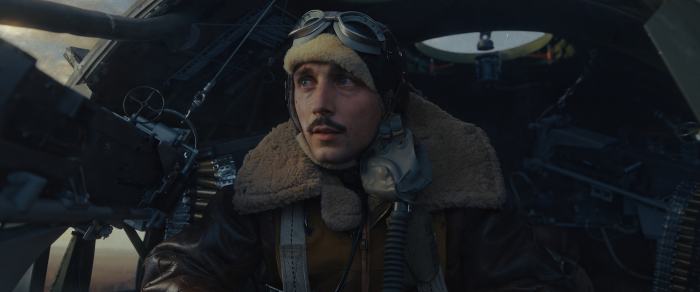
Header image: Nate Mann in Masters of the Air. (Source: Apple TV+)

[1]  Donald Caldwell and Richard Muller, The Luftwaffe Over Germany: Defense of the Reich (Barnsley: Frontline Books, 2014), p. 168.

[2] Luke Truxal, Uniting Against the Reich: The American Air War in Europe, (Lexington: University Press of Kentucky, 2023), p. 115-7.

[3] Donald Miller, Masters of the Air: America’s Bomber Boys Who Fought the Air War Against Nazi Germany (New York: Simon and Schuster, 2006), p. 389.

#FilmReview – Masters of the Air, Episode Three

#FilmReview – Masters of the Air, Episode Three

By Dr Luke Truxal

Editorial note: On 26 January 2024, Apple TV+ launched the much-anticipated series Masters of the Air. This series follows the actions of the US 100th Bomb Group during the Combined Bomber Offensive in the Second World War. As the series is being aired, our Book Reviews Editor, Dr Luke Truxal, the author of Uniting against the Reich (2023), will provide a critical review of each episode.

Three episodes in, we now better understand what the series Masters of the Air does well and where the show falls short. Let me begin this review by stating that I enjoy the series and what it deliers. Viewers gain a better perspective of the air war from the airmen who flew the missions than previous depictions. The show does justice to the US 100th Bomb Group and tells its story. This is still a good episode and series despite the criticism you will see at the end of this review. I will still recommend it to others. My problem is that the show fails to reach its full potential in telling this story. I think this is where the shows Band of Brothers (2001) and The Pacific (2010) really soared and why, for me, Masters of the Air feels so close but still not on the same level.

This week’s episode was the fateful Schweinfurt-Regensburg mission on 17 August 1943. The raid was the second unmitigated disaster that the Americans suffered in the air war that month. On 1 August 1943, the US Ninth Air Force attacked the Romanian oil refineries at Ploiești with five B-24 groups, three of which were on loan from the US Eighth Air Force. While the raid succeeded in damaging the refineries, it failed to stop Romanian oil production at the cost of 54 Consolidated B-24 Liberators and 310 airmen.[1] While Ploiești does not appear in the episode, it is crucial to understand the context of the air war in 1943. These were some of the darkest days of the air war for the Americans. The episode begins with a briefing about the Schweinfurt-Regensburg mission. Colonel Neil Harding, portrayed by James Murray, does a great job at explaining the nature of the mission, bad sports metaphors aside. The first strike force, which included the 100th Bomb Group, was to strike at German aircraft factories at Regensburg, thus drawing the bulk of the German fighter force onto their formation. He correctly explains that the bombers behind the 100th Bomb Group will move towards Schweinfurt and strike at German ball-bearing production with less resistance. The audience now has a great understanding of how the mission is supposed to work on paper.

Masters_Of_The_Air_Photo_010305
Elliot Warren as Lieutenant James Douglass, a bombardier with the US 100th Bomb Group who flies with Harry Crosby. (Source: Apple TV+)

The thesis of this entire episode was about the choices that soldiers make in war and how they impact the lives of those around them. It all begins with the poor weather delays that affected the execution of the raid. This led the US Eighth Air Force to send out Colonel Curtis LeMay’s Regensburg force five hours ahead of the rest of the force. During the raid, the creators of the show highlight several vital moments when decisions have to be made that affect the lives of the airmen in this episode. The first happens when Roy Claytor’s plane is shot down. As the crew bails out, the ball turret gunner, Sergeant William Hinton, becomes trapped and cannot escape. Sergeant William Quinn, the radio operator, hears his calls and tries to aid him as the rest of the crew bail out. Unfortunately, the plane enters a spin, and the force throws Quinn against the wall. He has to choose between his life and Hinton’s. He chooses his own. Later, we see that same choice posed to Quinn again when he speaks to a member of the Belgian resistance and has to decide if he wants to try to escape or spend the remainder of the war in a prison camp. His choice has not yet been revealed, and the scene ends on a cliffhanger. Lieutenant Curtis Biddick is the second character to face a life-or-death decision. His plane is hit during the raid, and his co-pilot, Lieutenant Richard Snyder, is severely wounded. In an emotionally impactful scene, Biddick decides to try and crash land the plane to save Snyder. The rest of the crew bail out successfully, and for a moment, it appears Biddick has once again pulled off the impossible. Unfortunately, he can’t maintain control of his Boeing B-17 Flying Fortress as it crashes into the ground in a massive explosion. The final major choice we see throughout the raid is Major Gale Clevan’s choice not to bail out and keep pushing his aircraft through the raid. His choice to keep pushing on paid off, with his plane landing just short of the runway at Telergma in the French colony of Algeria. Throughout the entire episode, there are several moments where the show makes it very clear that Clevan’s decision to press on could have had catastrophic consequences for him and his crew. The show did an excellent job at showing the choices that the young airmen of the 100th Bomb Group, many in their late teens and early twenties, had to make in split seconds and their consequences.

For an episode that emphasized the importance of the decisions made in war, the biggest one was left out. On the morning of 17 August 1943, the head of the US VIII Bomber Command, Brigadier General Frederick Anderson, had to decide whether or not to scrap the Schweinfurt-Regensburg mission. Anderson, like the commander of the Eighth Air Force, Major General Ira Eaker, was under immense pressure to execute this mission. General Henry Arnold, the US Army Air Forces commander, had taken a great personal interest in the raid and its success. The raid had been put off before due to poor weather. Additionally, the Regensburg force had to leave with enough time to have light remaining to land when they reached Algeria. Anderson ultimately made the call to send LeMay’s force first through the fog while waiting for the rest of the fog to dissipate before sending the rest of the bombers. This is how the two forces end up five hours apart. [2] This brings me to my biggest criticism of the show. Three episodes in, the show struggles to discuss the air war’s wider context. In the second episode, the writers poorly executed a scene to introduce the doctrine debates between the Americans. In this episode, the decision to not fly the mission as planned does not appear on the screen, which was the raid’s most important decision. This was a big missed opportunity for the creators of Masters of the Air. Anderson had to live with the fact that his decision on 17 August 1943 cost the Eighth Air Force sixty B-17s and 559 airmen either killed or missing.[3]

When it comes to telling the story of the 100th Bomb Group and its experience during the raid, this episode did an excellent job. It showed the life-or-death decisions these young men had to make in seconds, and if they were lucky, they would have to live with the consequences of those decisions. Yet, the quality of the television show could be much improved by occasionally widening its perspective. The series has become so zoomed in on the 100th Bomb Group that it struggles to tell the bigger picture of the air war. Adding a short scene here or there to add that big-picture perspective would bring everything together and make this television series genuinely extraordinary. My criticisms aside, this is still the best series on the air war I have seen, and it deserves to be in the same conversation as the 1949 film Twelve O’clock High.

Dr Luke Truxal is an adjunct at Columbia State Community College in Tennessee. He completed his PhD in 2018 from the University of North Texas with his dissertation ‘Command Unity and the Air War Against Germany.’ His previous publications include ‘Bombing the Romanian Rail Network’ in the Spring 2018 issue of Air Power History. He also wrote ‘The Politics of Operational Planning: Ira Eaker and the Combined Bomber Offensive in 1943’ in the Journal of Military Aviation History. In addition, Truxal is researching the effectiveness of joint air operations between the Allied air forces in the Second World War. He can be reached on Twitter at @Luke_Truxal.

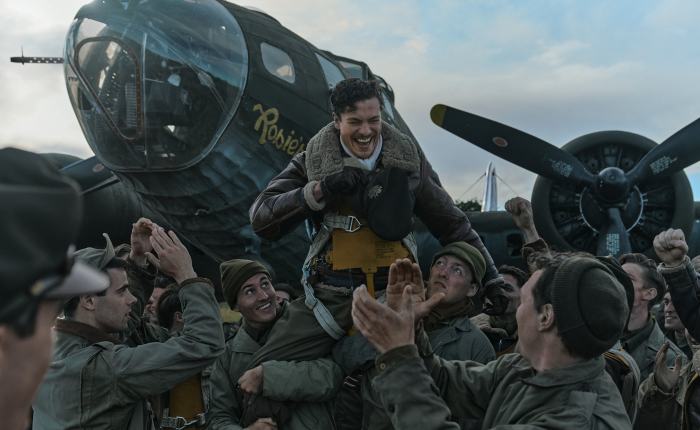
Header image: Edward Ashley, Matt Gavan, Callum Turner and Anthony Boyle in Masters of the Air (Source: Apple TV+)

[1] Jay A. Stout, Fortress Ploesti: The Campaign to Destroy Hitler’s Oil (Havertown, PA: Casemate Publishers, 2011), p. 76.

[2] Luke Truxal, Uniting against the Reich: The American Air War in Europe (Lexington, KT: University Press of Kentucky, 2023), pp. 71-3.

[3] Truxal, Uniting Against the Reich, pp. 76-7.