#ResearchResources – Recent Articles and Books (February 2022)

#ResearchResources – Recent Articles and Books (February 2022)

Editorial note: In this series, From Balloons to Drones highlights research resources available to researchers. Contributions range from discussions of research at various archival repositories to highlighting new publications. As part of this series, we are bringing you a monthly precis of recent articles and books published in air power history. This precis will not be exhaustive but will highlight new works published in the preceding month. Publication dates may vary around the globe and are based on those provided on the publisher’s websites. If you would like to contribute to the series, please contact our Editor-in-Chief, Dr Ross Mahoney, at airpowerstudies@gmail.com or via our contact page here.

Books

Douglas C. Dildy, “Big Week” 1944: Operation ARGUMENT and the Breaking of the Jagdwaffe (Oxford: Osprey Publishing, 2022).

A rigorous new analysis of America’s legendary ‘Big Week’ air campaign which enabled the Allies to gain air superiority before D-Day.

The USAAF’s mighty World War II bomber forces were designed for unescorted, precision daylight bombing, but no-one foresaw the devastation that German radar-directed interceptors would inflict on them. Following the failures of 1943’s Schweinfurt-Regensburg raids, and with D-Day looming, the Allies urgently needed to crush the Luftwaffe’s ability to oppose the landings.

In February 1944, the Allies conceived and fought history’s first-ever successful offensive counter­air (OCA) campaign, Operation Argument or “Big Week.” Attacking German aircraft factories with hundreds of heavy bombers, escorted by the new long-range P-51 Mustang, it aimed both to slash aircraft production and force the Luftwaffe into combat, allowing the new Mustangs to take their toll on the German interceptors. This expertly written, illustration-packed account explains how the Allies finally began to win air superiority over Europe, and how Operation Argument marked the beginning of the Luftwaffe’s fall.

Richard Hallion, Desert Storm 1991: The Most Shattering Air Campaign in History (Oxford: Oxford University Press, 2022).

An expertly written, illustrated new analysis of the Desert Storm air campaign fought against Saddam Hussein’s Iraq, which shattered the world’s fourth-largest army and sixth-largest air force in just 39 days, and revolutionized the world’s ideas about modern air power.

Operation Desert Storm took just over six weeks to destroy Saddam Hussein’s war machine: a 39-day air campaign followed by a four-day ground assault. It shattered what had been the world’s fourth-largest army and sixth-largest air force, and overturned conventional military assumptions about the effectiveness and value of air power.

In this book, Richard P. Hallion, one of the world’s foremost experts on air warfare, explains why Desert Storm was a revolutionary victory, a war won with no single climatic battle. Instead, victory came thanks largely to a rigorously planned air campaign. It began with an opening night that smashed Iraq’s advanced air defense system, and allowed systematic follow-on strikes to savage its military infrastructure and field capabilities. When the Coalition tanks finally rolled into Iraq, it was less an assault than an occupation.

The rapid victory in Desert Storm, which surprised many observers, led to widespread military reform as the world saw the new capabilities of precision air power, and it ushered in today’s era of high-tech air warfare.

David Hobbs, The Fleet Air Arm and the War in Europe, 1939–1945 (Barnsley: Seaforth Publishing, 2022).

For the first time, this book tells the story of how naval air operations evolved into a vital element of the Royal Navy’s ability to fight a three-dimensional war against both the Kriegsmarine and Luftwaffe. An integral part of RN, the Fleet Air Arm was not a large organisation, with only 406 pilots and 232 front-line aircraft available for operations in September 1939. Nevertheless, its impact far outweighed its numbers – it was an RN fighter that shot down the first enemy aircraft of the war, and an RN pilot was the first British fighter ‘ace’ with 5 or more kills. The Fleet Air Arm’s rollcall of achievements in northern waters went on to include the Norwegian Campaign, the crippling of Bismarck, the gallant sortie against Scharnhorst and Gneisenau as they passed through the Channel, air attacks on enemy E-boats in the narrow seas, air cover for the Russian convoys, air attacks that disabled Tirpitz, and strikes and minelaying operations against German shipping in the Norwegian littoral that continued until May 1945. By the end of the war in Europe the FAA had grown to 3243 pilots and 1336 aircraft.

This book sets all these varied actions within their proper naval context and both technical and tactical aspects are explained with ‘thumb-nail’ descriptions of aircraft, their weapons and avionics. Cross reference with the Fleet Air Arm Roll of Honour has been made for the first time to put names to those aircrew killed in action wherever possible as a mark of respect for their determination against enemy forces on, above and below the sea surface which more often than not outnumbered them.

The Fleet Air Arm and the War in Europe completes David Hobbs’ much-praised six-volume series chronicling the operational history of British naval aviation from the earliest days to the present.

Milos Sipos and Tom Cooper, Wings of Iraq: Volume 2 – The Iraqi Air Force, 1970-1980 (Warwick: Helion and Company, 2022).

Officially established on 22 April 1931, around a core of 5 pilots and 32 aircraft mechanics, the Royal Iraqi Air Force was the first military flying service in any Arab country.

Wings of Iraq, Volume 2 tells the story of the Iraqi Air Force between 1970 and 1980. In doing so it examines the air force’s involvement in the October 1973 Arab-Israeli War, and then the showdown with the Iranian-supported Kurdish insurgency in northern Iraq in 1974-1975. These two affairs taught the Iraqis that numbers alone did not make an air force. Correspondingly, during the second half of the 1970s, Baghdad embarked on a project based on full technology transfer from France, which was intended to result in preparing the IrAF for the twenty-first century.

This process hardly began when the new ruler in Baghdad, Saddam Hussein at-Tikriti, led his country into an invasion of neighbouring Iran, embroiling it in a ruinous, eight-year-long war. This volume details the events leading up to the beginning of that war and its opening moves in the air.

Although virtually ‘born in battle’, collecting precious combat experience and playing an important role in so many internal and external conflicts, the Iraqi Air Force remains one of the least known and most misinterpreted military services in the Middle East. Richly illustrated, Wings of Iraq, Volume 2, provides a uniquely compact yet comprehensive guide to its operational history, its crucial officers and aircraft, and its major operations between 1970 and 1980.

#Commentary – Biplanes against Battleships: The Fairey Swordfish Biplane and Lessons for Today’s Air Power

#Commentary – Biplanes against Battleships: The Fairey Swordfish Biplane and Lessons for Today’s Air Power

By Dr Adam Leong Kok Wey

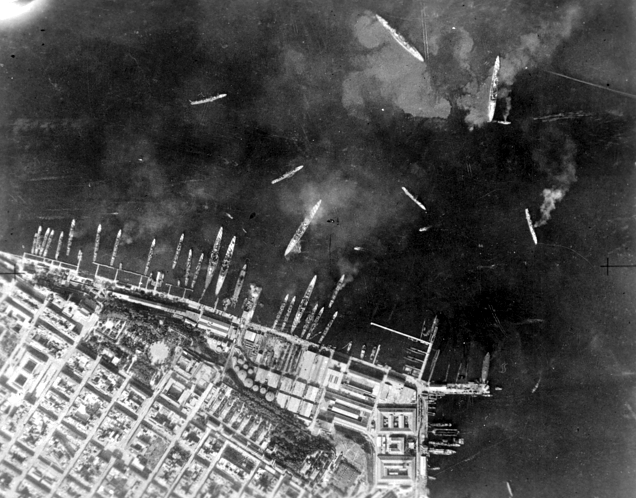
The Fairey Swordfish flew just above the sea waves at about 30 feet while anti-aircraft artillery shells exploded around it, the sea waters splashing high due to the impact. The pilot, Lieutenant M.R. Maund, struggled to keep his plane steady to release his torpedo at an Italian battleship.[1] Maund flew a Swordfish biplane: one of the 20 Swordfish aircraft from HMS Illustrious that took part in the air attack on the Italian Navy’s (Regia Marina) battleship fleet in the harbour of Taranto on the night of 11-12 November 1940. The Italians had six battleships, 14 cruisers and 27 destroyers at Taranto.[2] During this night attack, the Swordfish aircraft dropped torpedoes and bombs and managed to sink a battleship (Conte di Cavour) while severely damaging two more (Caio Duilio and Littorio). Only two Swordfish aircraft were shot down. As a result of the attack, half of the Regia Marina’s capital ship fleet was disabled, giving the Royal Navy (RN) some tactical space and time to conduct its maritime operations in the Mediterranean.[3]

6032069
An aerial view showing the aftermath of the raid on Taranto in November 1940. (Source: Australian War Memorial)

More importantly, the Battle of Taranto signalled a change in naval power and the use of air power.  It demonstrated the value of using aircraft to destroy an enemy’s fleet. The lessons of the Battle of Taranto were not lost on those who observed the effects of the operation. The Japanese Assistant Naval Attaché in Berlin visited Taranto and studied the raid. His findings then fed into the planning process for the massive surprise air raid against the US Navy at Pearl Harbor on 7 December 1941. The use of precision airstrikes against naval targets rendered the fleet-in-being strategy as a highly risky practice, and subsequent Second World War naval battles with air power serve to highlight this point.

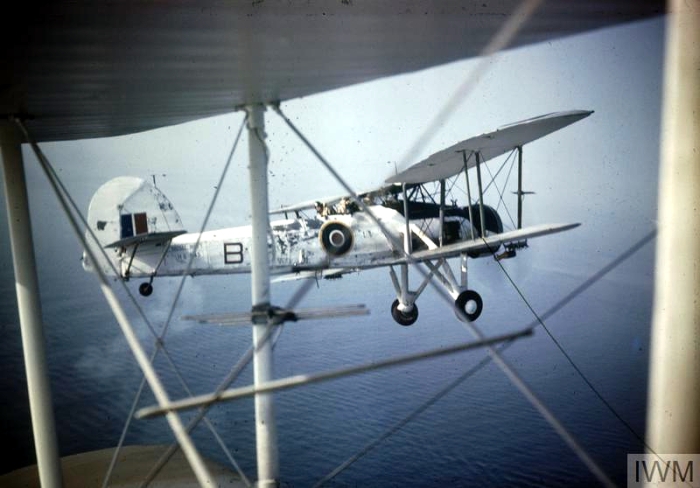
The Swordfish aircraft, which was successfully used in the attack against Taranto, was an obsolete aircraft when the Second World War started. It was a fabric wire biplane first flown in 1934 and became operational in July 1936 with the Fleet Air Arm (FAA) of the Royal Air Force, which was later transferred to the control of the Royal Navy. It had a top speed of just 138 mph; a service ceiling of 10,890 feet; a range of 1,028 miles; and it could carry either a 1,600 lb torpedo or a 1,500 lb load of depth charges, mines or bombs.[4]  For self-defence, it was armed with a .303 Vickers machine gun above its engine and another .303 Vickers machine gun operated by the rear gunner. It had a crew of three – a pilot, a navigator-observer, and a radioman-rear gunner – flying in an open cockpit. Due to its fabric skin-cover holding the aircraft together, it was nicknamed the ‘Stringbag.’

FL 2425
HMS Illustrious in 1940. (Source: © IWM (FL 2425))

By the time of the outbreak of the Second World War, the Swordfish was slow and vulnerable to faster and more agile monoplane fighters. Nevertheless, the FAA used it as its primary torpedo and reconnaissance aircraft on the RN’s aircraft carriers during the war. However, its slow speed and crude design allowed it to fly slow and manoeuvre at low altitude. These qualities were crucial to victory at Taranto, when the Swordfish aircraft flew low, almost at sea wave height, enabling them to avoid Italian anti-aircraft artillery. The slow speed also allowed the Swordfish aircraft to fly around some barrage balloons and unleash their ordnance with accuracy. The fabric skin construction of the Swordfish also saved it from light cannon shells armed with contact fuses as the shells shot through the soft fabric.

The anti-battleship feat of the Swordfish was repeated when they took part in the hunt for the German Navy’s (Kriegsmarine) battleship, Bismarck. Swordfish aircraft from HMS Ark Royal launched a torpedo attack against Bismarck on 26 May 1941 and managed to destroy its port-side rudder. This caused the Bismarck to turn in circles.[5] The RN’s surface fleet eventually caught up with the Bismarck and sank it the next day. Ironically, the HMS Prince of Wales, which took part in the sinking of Bismarck, was sunk by Japanese air power on 10 December 1941 off the coast of eastern Malaya.

TR 1138
Close-up of a Fairey Swordfish MkII in flight as seen through the struts of another aircraft, probably while serving with No. 824 Squadron of the Fleet Air Arm, c. 1943-1944. (Source: © IWM (TR 1138))

The Swordfish continued to be manufactured (2,391 were built) and used by the FAA until the end of the Second World War.[6] Despite its obsolescence at the start of the war, it doggedly flew on and even outlived some of its more modern contemporary aircraft. The Swordfish gained a solid reputation as the most successful British naval aircraft with the highest score of Axis ships sunk during the Second World War.[7] The rugged biplane was finally retired from active service in 1946.

The tactical lessons drawn from the experience of the Swordfish in the Second World War should not be lost on modern observers. Many modern countries are looking to procure the latest technologically superior combat aircraft to equip their air forces, at very expensive prices. For example, there are continued debates today on the viability for some air forces to acquire either the F-35 Lightning II or modernised versions of the F/A-18 Super Hornet or the F-16V Viper. Perhaps it might be prudent to understand that sometimes older platforms if used smartly and asymmetrically to offset their disadvantages, can yield some strategic utility as the humble Fairey Swordfish did during the Second World War. After all, it is not the machines that count, but the tactical effects yielding strategic utility that matter.

Dr Adam Leong Kok Wey is an Associate Professor in Strategic Studies, and the Deputy Director of Research in the Centre for Defence and International Security Studies (CDiSS) at the National Defence University of Malaysia. He has a PhD in Strategic Studies from the University of Reading and is the author of two books on military strategy and history, including Killing the Enemy! Assassination operations during World War II published by I.B. Tauris.

Header Image: A Fairey Swordfish Mk.I from the Torpedo Training Unit at RAF Gosport drops a practice torpedo during training in the late-1930s. (Source: © IWM (MH 23))

[1] See David Wragg, Swordfish: The Story of the Taranto Raid (London: Cassell, 2003).

[2] Richard P. Hallion, ‘Dress Rehersal for Pearl Harbor?’, HistoryNet.com, August 2008.

[3] Bernard Ireland, Naval Airpower (London: HarperCollins, 2003), pp.117-8.

[4] Jim Winchester (ed.), Aircraft of World War II (Kent: Grange, 2007), p. 87.

[5] John Moffat, I Sank the Bismarck: Memoirs of a Second World War Navy Pilot (London: Bantam, 2009), pp. 226-7.

[6] Winchester (ed.), Aircraft, p. 87

[7] Justin D. Murphy and Matthew A. McNiece, Military Aircraft, 1919-1945 (Oxford: ABC Clio, 2009), p. 212.