
By Dr Luke Truxal
Editorial note: On 26 January 2024, Apple TV+ launched the much-anticipated series Masters of the Air. This series follows the actions of the US 100th Bomb Group during the Combined Bomber Offensive in the Second World War. As the series is being aired, our Book Reviews Editor, Dr Luke Truxal, the author of Uniting against the Reich (2023), will critically review each episode.
The fourth episode of Masters of the Air was about those left behind. This is meant literally in the sense that we do not go up in the air with the planes after they take off, but we also see many of the characters on the show struggle with loss during the war. The result is that we get a good episode that portrays the struggles of airmen, ground crews, resistance fighters, and civilians left on the ground. This review will examine the episode’s analysis and responses to grief thematically rather than tackle the episode chronologically, as in past reviews.
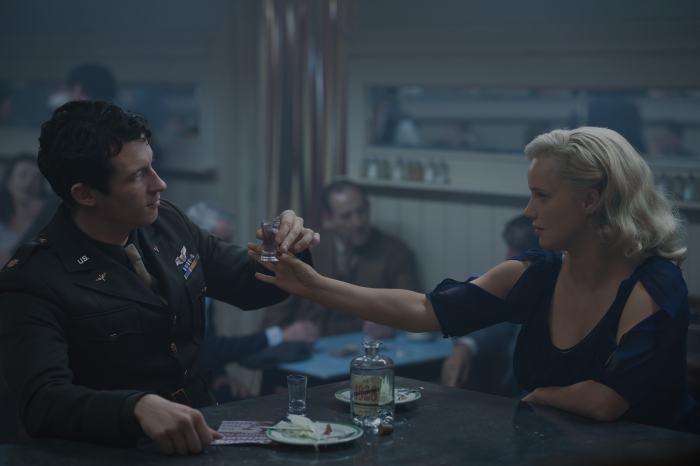
The episode begins with a party after Lieutenant Glenn Dye’s crew completes their 25th mission. This will be the first and only crew of the original 100th Bomb Group to complete their tour of duty and go home. At the party, we are introduced to two new characters, Lieutenant Herbert Nash and Lieutenant Robert ‘Rosie’ Rosenthal. Both are green but capable and eager pilots. During the episode, Nash dances and flirts with Helen, who works for the Red Cross at Thorpe Abbotts. There are sparks between these two characters. At the same time, Rosenthal tries to understand better what he is flying into by talking to Major Gale Clevan. Nash is more successful in flirtations than Rosenthal in feeling out the veteran pilots about the nature of air combat. As the aircrews depart for their first mission the following day, Nash makes a last pass at Helen with a line that foreshadows his fate, “You might be the last pretty face that I ever see.” Nash’s fate is shown off-screen, and it falls on Rosenthal to deliver the shocking news to the young woman with whom he had developed a budding romance. In the same sequence, the news is broken to the group that Clevan and Crosby had gone down. The news that the group’s best pilot and navigator went down in separate planes stuns the group. Colonel Neil ‘Chick’ Harding and Lieutenant Joseph ‘Bubbles’ Payne express the shock that the group and audience feel when the news is broken. Two of the more critical anchors for the group have now been lost off-screen. The show does an excellent job of showing how the loss of these veteran aircrews impacts morale.
Along with shock, we see sympathy and grief for those living under the bombs. During the episode, Egan walks about a series of bombed homes while on leave in London. He finally can see the results of what bombing does to civilians. As he watches the rescue crews work we hear the scream of a woman who lost what appears to be her daughter. While short, this was a hard scene to watch. Seeing the woman pull the dead child out of the rubble builds sympathy between the viewers and the bombed. It is a great scene to include. It is easy for the audience to get lost in the air-to-air combat, but these bombs have consequences. Even those who play no part in this war, such as children, suffer from the air war. It is a well-written and executed scene.
Another element of processing grief for those in combat is the sense of guilt that those who survived feel. This is an area where Masters of the Air has surpassed both Band of Brothers (2001) and The Pacific (2010), in my opinion. That is not to say that the previous series ever avoided the topic, and The Pacific did lean into the post-war struggles of Eugene Sledge with post-traumatic stress syndrome. However, we never saw it portrayed so personally, with Sergeant William Quinn’s decision to leave Sergeant William Hinton behind, trapped on the B-17 Flying Fortress before it exploded. Throughout his time on the run, Quinn grapples with his guilt over leaving his comrade behind. It eats at him throughout the whole episode more so than the fear of being captured by the Germans as his fellow airmen keep asking him about what happens. This plot ends with another crewman who survived the crash, Sergeant Charles Bailey, comforting Quinn. Bailey tells Quinn that he would have made the same decision as well. Some viewers will find it easy to judge Quinn for his actions in the previous episode, but as the show eloquently shows, many of us would have made the same decision in the same circumstances. To me, this was a powerful sequence of scenes paired with the scenes of Sledge at the end of The Pacific; we get a better sense of the survivor’s guilt and its aftermath.
The last element of grief that the episode deals with is anger. During the episode, Major John Egan goes on leave in London and meets a Polish woman with whom he sleeps. As they are in bed together, they watch German bombers strike London from a distance. Egan admits that this is the first time he has seen this side of the air war. As they continue talking, the Polish woman expresses her anger and desire for revenge against the Germans for the war that they unleashed. This scene sets up viewers perfectly for Egan in this episode and in episode five. After finishing his night with the woman, Egan sees the woman grieving the loss of her daughter. He then sees a newspaper highlighting the heavy losses that the Eighth Air Force suffered on the most recent raid. Egan calls Thorpe Abbotts to learn the fate of the 100th Bomb Group and, more importantly, his best friend Clevan. Egan ends the episode by lobbying to be on the next mission. In the teaser at the end of the episode, we see that Egan desires revenge against not only the Luftwaffe but all Germans for the loss of his friend.
This might go down as one of the series’ more important episodes. It broadened the audience’s perspective of the air war. It showed the ground crews, the bombed, and how they fought the air war in their way. Some struggled to process the shock of loss either in the air or on the ground. Others struggled with survivor’s guilt. Finally, we see many turn their grief into anger and desire for payback for the anguish that they feel for the loss of their loved ones. In an episode where grief took centre stage and, in many forms, this episode handled such a delicate topic as well as you can on screen. I think this is arguably the best episode of the series up to this point.
Dr Luke Truxal is an adjunct at Columbia State Community College in Tennessee. He completed his PhD in 2018 from the University of North Texas with his dissertation ‘Command Unity and the Air War Against Germany.’ His previous publications include ‘Bombing the Romanian Rail Network’ in the Spring 2018 issue of Air Power History. He also wrote ‘The Politics of Operational Planning: Ira Eaker and the Combined Bomber Offensive in 1943’ in the Journal of Military Aviation History. In addition, Truxal is researching the effectiveness of joint air operations between the Allied air forces in the Second World War. He can be reached on Twitter at @Luke_Truxal.
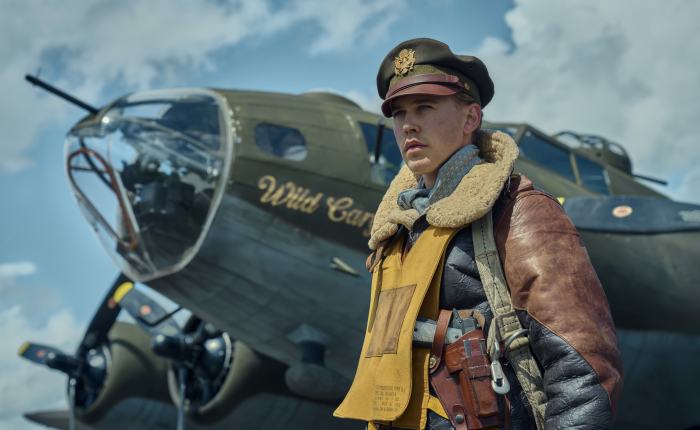
Header image: Edward Ashley and Austin Butler in Masters of the Air. (Source: Apple TV+)

 From Balloons to Drones